NWi

Industry Insights & Research

Market research, practical perspectives and the latest developments in cross-border commerce.

87 articles

Article library

Industry Research

Amazon Brazil 55m imports: direct or local stock?

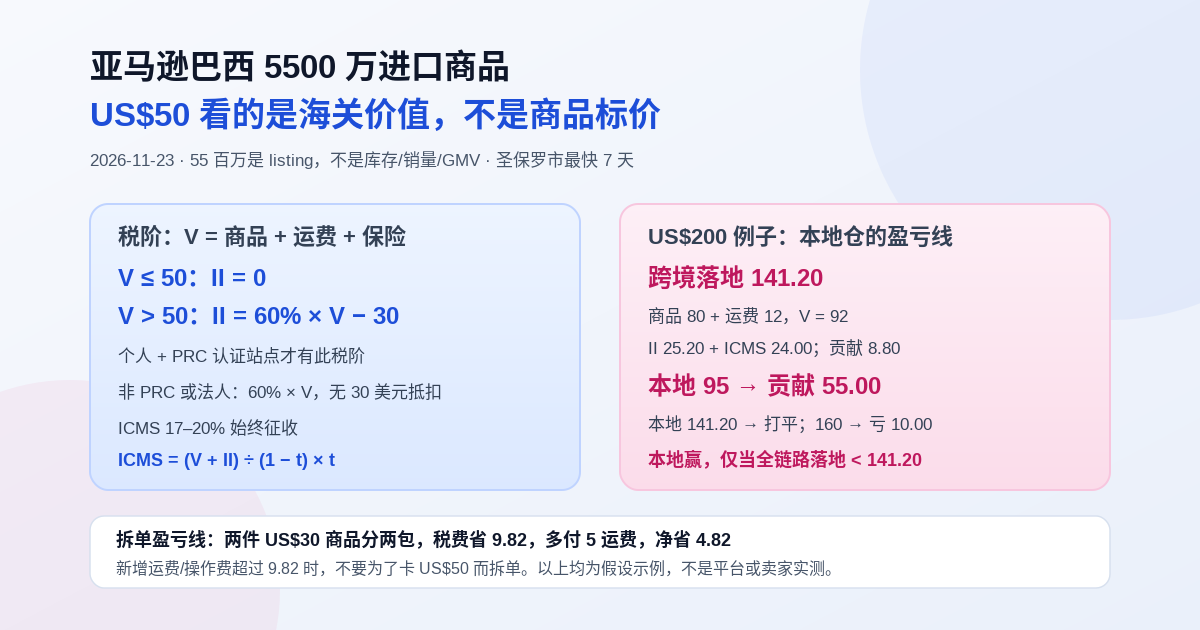
Amazon Brasil said on 23 November 2026 that its international selection passed 55 million items, with sales up more than 50% in 2026 and 4 million items added; São Paulo city orders arrive in up to seven days. The company disclosed no GMV, seller count, category mix or return rate. This article separates the US$50 customs-value line from the sticker price, compares direct mail and local stock under one contribution formula, and gives a US$141.20 break-even landed cost for a US$200 item plus a US$9.82 break-even for splitting a two-unit order.
Amazon Brazil 55m imports: direct or local stock?
Industry Research

Amazon India's $27B Exports: Four Denominators

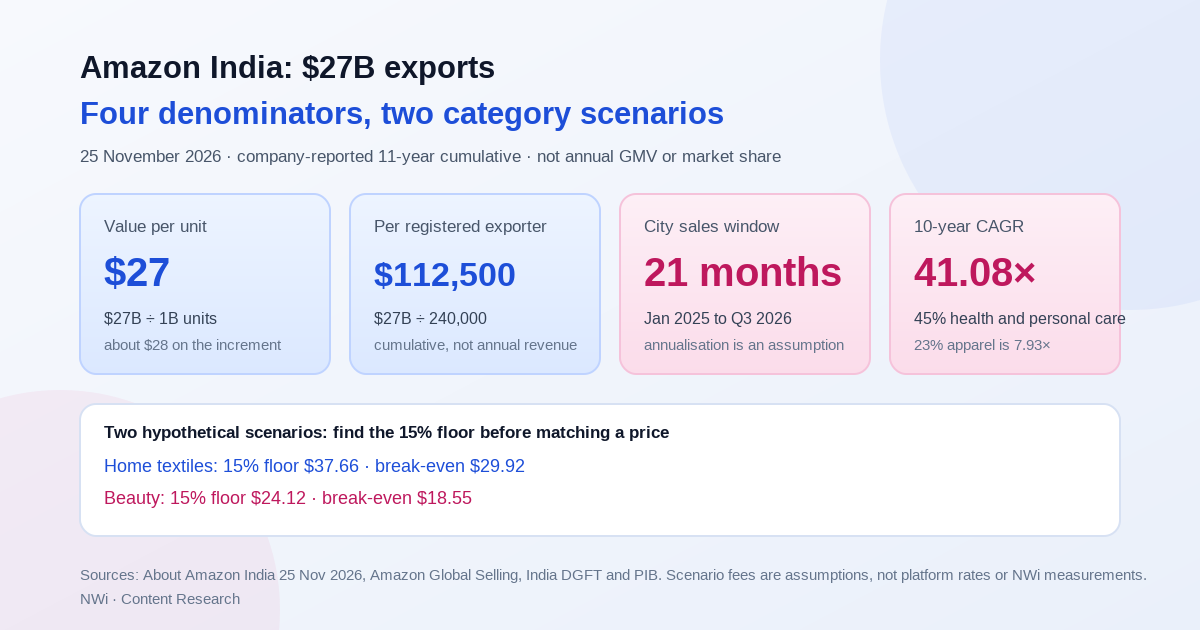
On 25 November 2026 Amazon said its Global Selling India programme had reached $27 billion in cumulative exports, with 240,000+ registered exporters. This article splits the figure into four denominators – value per unit, value per registered exporter, the 21-month city window and the base behind each CAGR – then recomputes price floors for a home-textile SKU and a beauty SKU, with a 60-day test and stop conditions. These are company-reported cumulative figures, not annual GMV or market share.
Amazon India's $27B Exports: Four Denominators
Industry Research

Shopee Indonesia's 4% ad-spend threshold for Free Shipping XTRA: spend more, cut price or leave before 1 December?

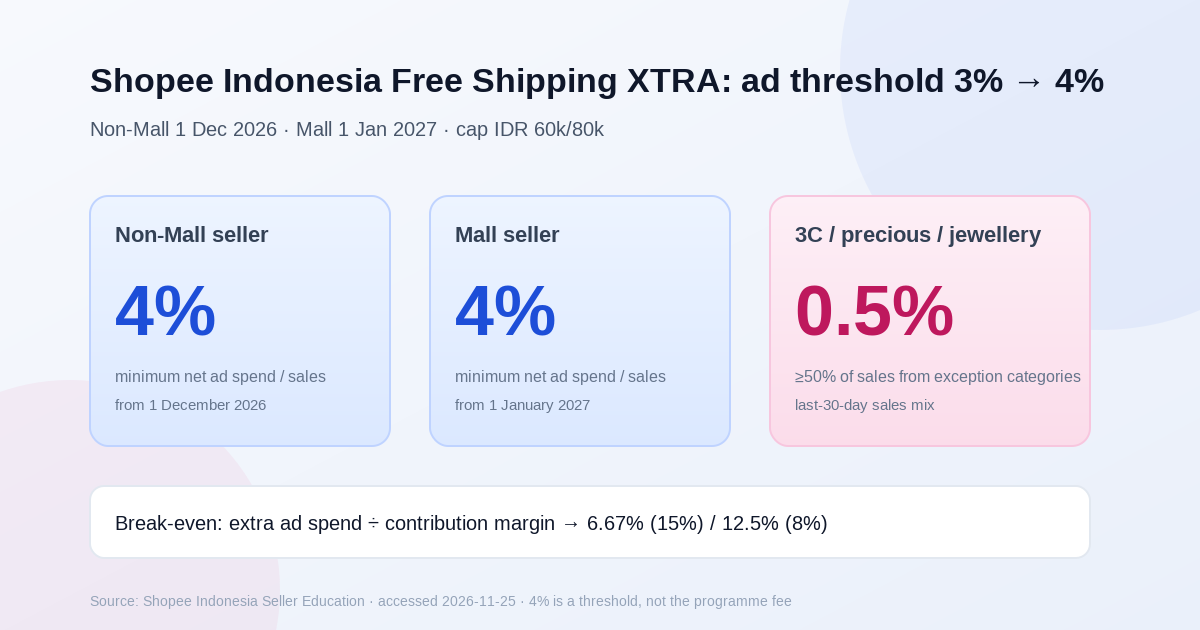
Shopee Indonesia raises the minimum net ad spend for the Free Shipping XTRA ad-user programme from 3% to 4% of sales for non-Mall sellers on 1 December 2026 and Mall sellers on 1 January 2027, while the per-item cap rises from IDR 40,000/60,000 to IDR 60,000/80,000. This analysis separates the 4% threshold from the programme fee, works out the incremental sales needed to break even under three contribution-margin cases, and sets out the data to pull, actions and stop conditions before 1 December.

Shopee Indonesia's 4% ad-spend threshold for Free Shipping XTRA: spend more, cut price or leave before 1 December?
Industry Insights

Amazon A/B test sample size: is the 8% lift real?

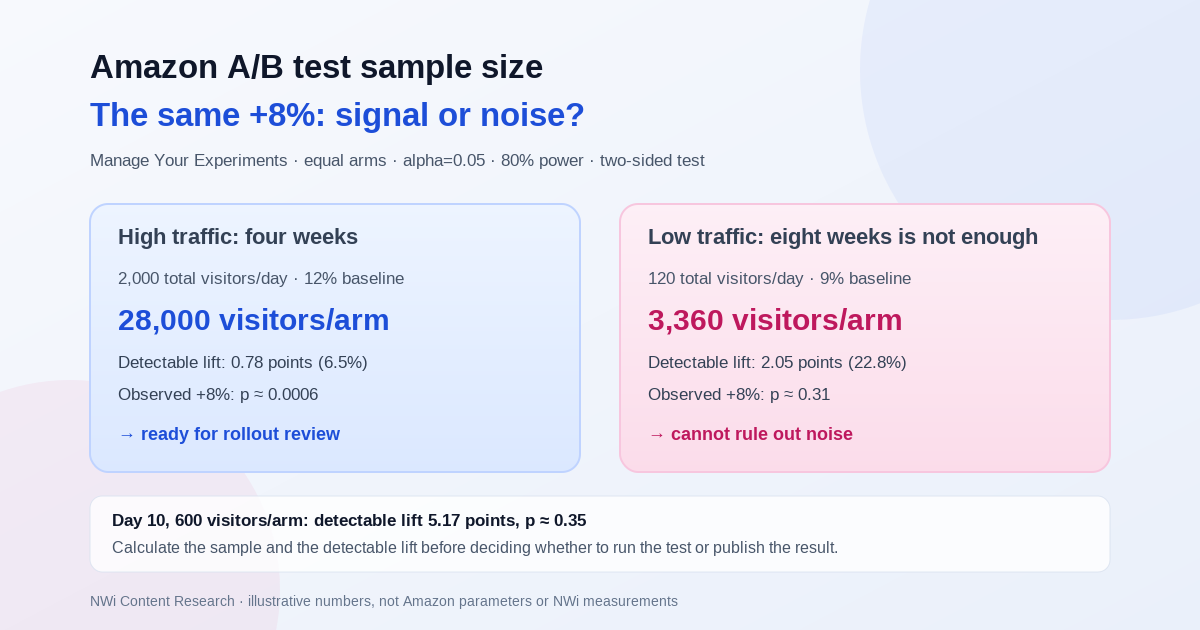
Amazon Manage Your Experiments randomly splits shoppers who view a detail page and reports units sold, sales, conversion rate, units sold per unique visitor and sample size once results are statistically significant. But significance depends on the traffic you actually have: this article uses the two-proportion sample-size formula to convert daily visitors into the smallest detectable lift, works through high-traffic, low-traffic and early-peek scenarios, and sets pre-test, in-test and post-test actions and stop rules.
Amazon A/B test sample size: is the 8% lift real?
Industry Insights

Amazon Review Requests Ads: Rating or Click?

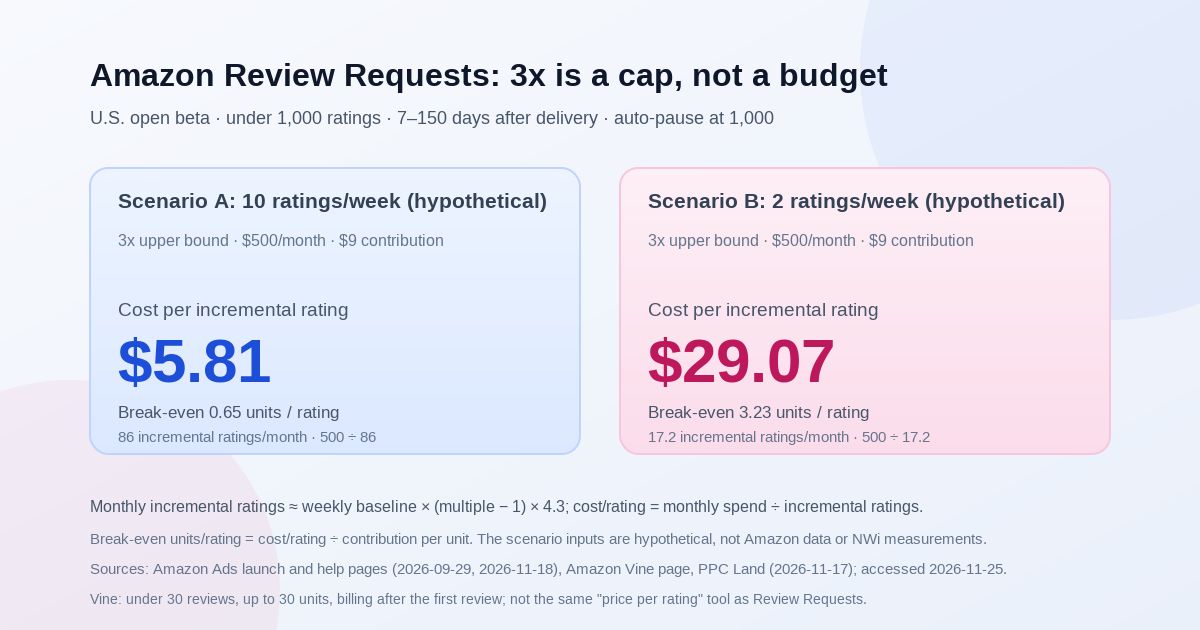
Amazon Review Requests is in a U.S. open beta for products under 1,000 ratings, with automatic targeting from 7 to 150 days after delivery and an automatic pause at 1,000 ratings. Amazon reports 3x weekly ratings and reviews in an internal closed beta, but its public pages do not reconcile per-rating billing with the CPC metric in the console. This article treats 3x as an upper bound, computes cost per incremental rating and break-even units per rating at two baselines, and sets a four-week test, stop rules and the Vine eligibility boundary.
Amazon Review Requests Ads: Rating or Click?
Industry Insights

Shopee Malaysia 11.11 Live Sales 8x: 12.12 Budget?

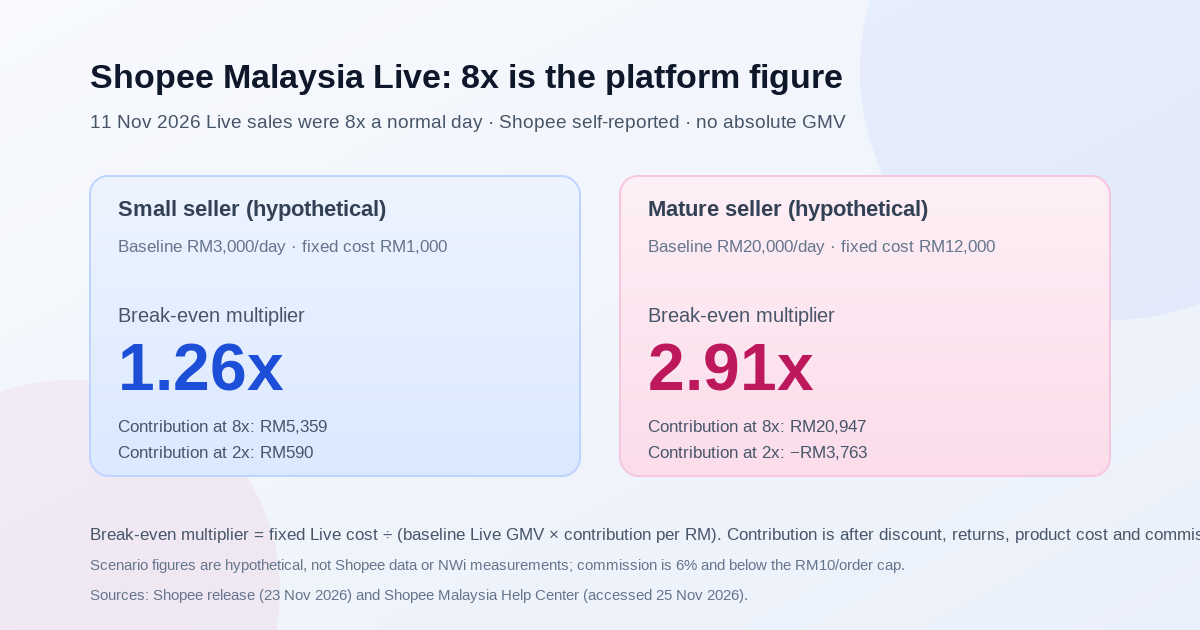
Shopee Malaysia says Live sales on 11 November 2026 were 8x a normal day, sellers above RM1 million in Live sales rose 50% year on year, and new sellers' Live sales rose 14x. The release gives no absolute GMV, conversion, AOV, return rate or seller count. This article turns the headline into an own-baseline break-even test, with two recomputable seller scenarios and the fields and stop conditions to watch before, during and after 12.12.

Shopee Malaysia 11.11 Live Sales 8x: 12.12 Budget?
Industry News

Shopee SG Video Commission Takes Effect 24 Nov: 0%

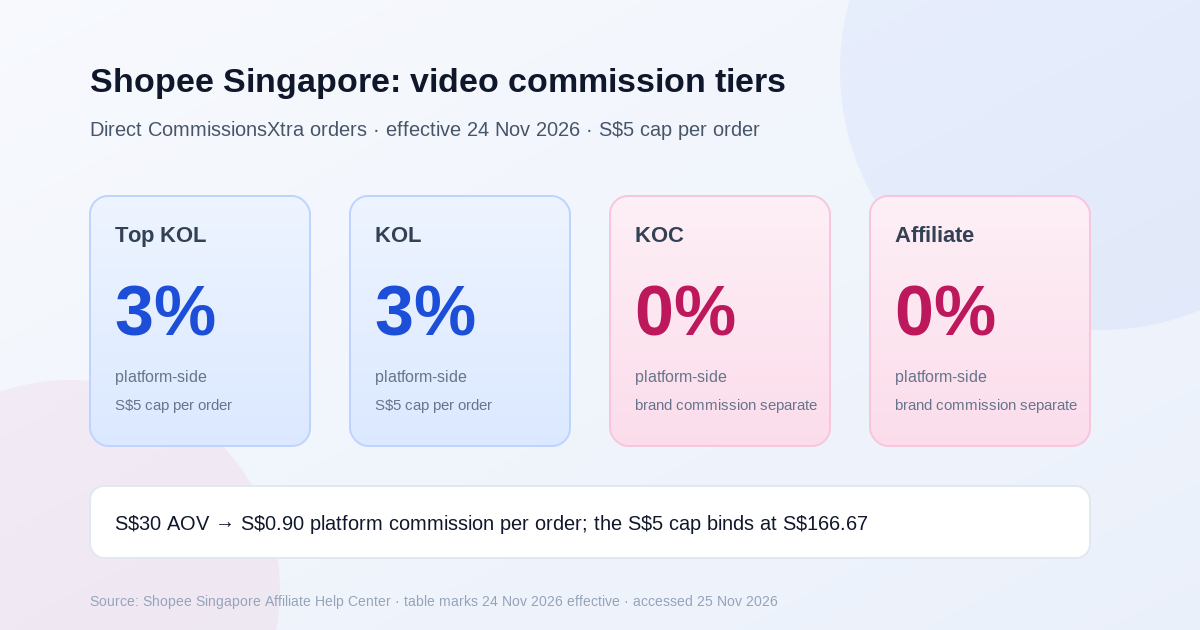
Shopee Singapore's affiliate help centre now marks Shopee Video direct CommissionsXtra orders from 24 November 2026 at 3% for Top KOL/KOL and 0% for KOC/Affiliate, both capped at S$5 per order. Two other official pages still show 5% or split by AMS/non-AMS product. This article separates platform commission from seller-funded brand commission, sets out the three-page inconsistency and the S$5 cap, and gives two recomputable seller scenarios, the fields to watch and stop conditions for a four-week test.
Shopee SG Video Commission Takes Effect 24 Nov: 0%
Industry Research

Agentic checkout on Shopify: a 30-day order test

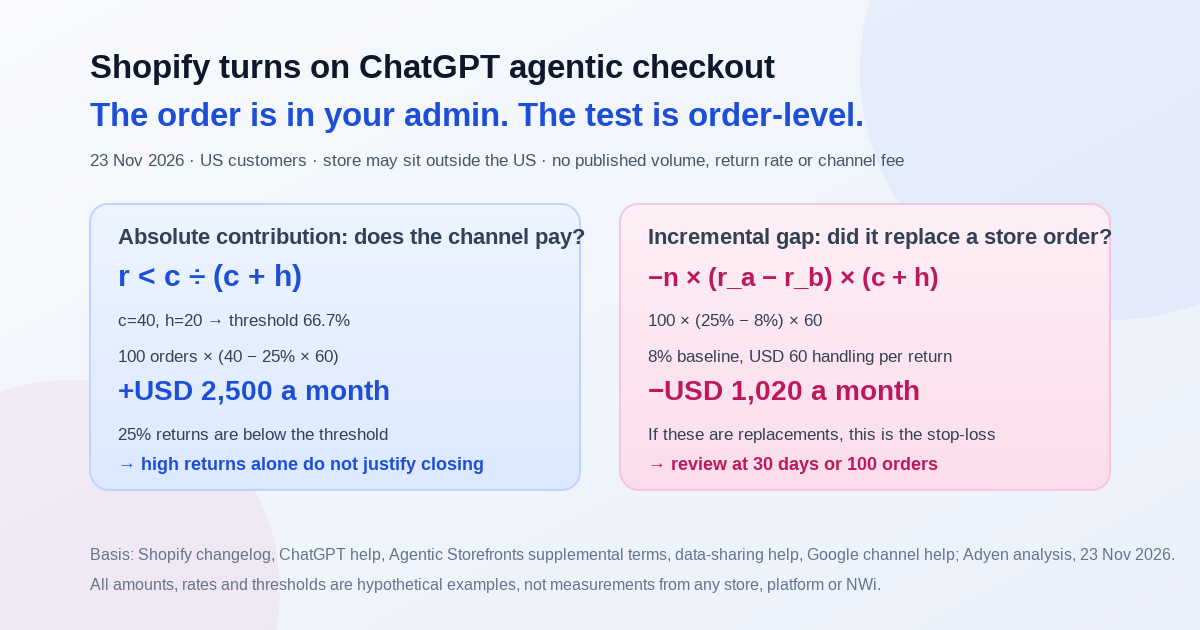
On 23 November 2026 Shopify renamed Direct checkout to agentic checkout and opened it to ChatGPT. Eligible stores have it on by default when Manage for me or Automatically enable new channels is on, and orders land in the Shopify admin with channel or referrer attribution. Shopify's public pages publish no agent order volume, conversion, return rate or channel fee, and its help page saying there are no fees sits alongside clause 6.1 of the supplemental terms, which reserves fees for certain channels. This article separates absolute contribution (r < c ÷ (c+h)) from incremental contribution (the gap to baseline × (c+h)), recomputes three hypothetical scenarios and sets a 30-day or 100-order reconciliation and stop-loss test.

Agentic checkout on Shopify: a 30-day order test
Industry News

TikTok Shop return-shipping new rules: Vietnam and Malaysia from 7 December

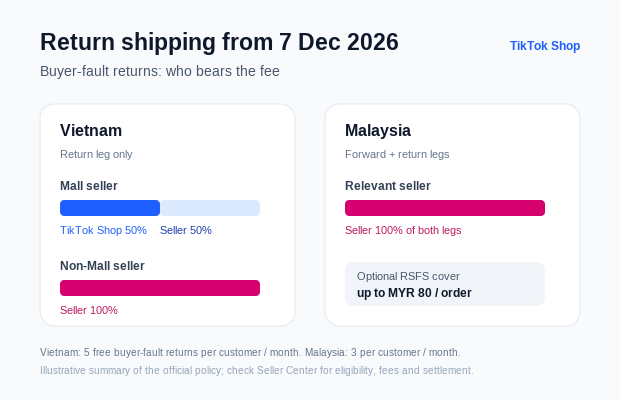
From 7 December 2026, TikTok Shop Vietnam makes Mall sellers bear 50% and all other sellers 100% of the return shipping fee for eligible buyer-fault returns; Malaysia requires relevant sellers to bear both forward and return shipping. This article separates the two markets, the Mall/non-Mall split and seller-fault versus buyer-fault returns, recomputes the contribution impact at different return rates, and compares the SFR/RSFS service fee with expected reimbursement. It also lists the settlement fields to watch and the actions and stop rules before and after 7 December.

TikTok Shop return-shipping new rules: Vietnam and Malaysia from 7 December
Industry Research

US Section 301 proposed tariffs: China 20% or 40%, Vietnam 35% — a landed-cost stress test

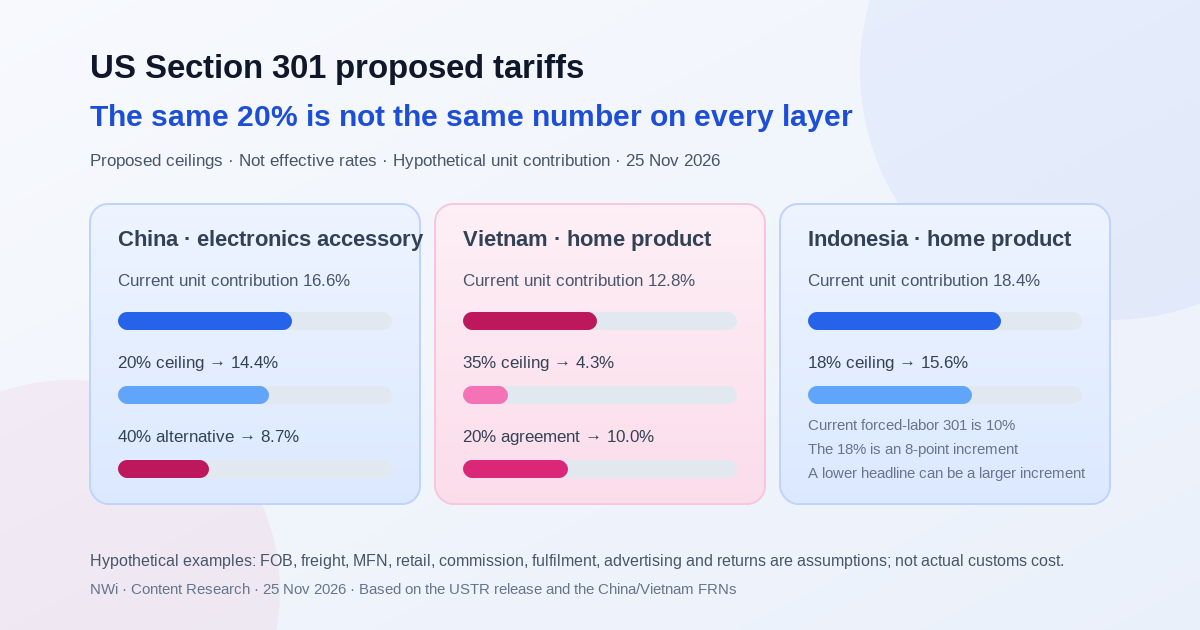
On 25 November 2026 USTR made Section 301 determinations for 14 economies and proposed additional tariffs: China up to 20% (40% alternative), Vietnam up to 35% (20% with an agreement), Indonesia/Malaysia/Thailand/Cambodia/Bangladesh up to 18%, and India up to 25% (17% with an agreement). Comments are due 5 January 2027 and the hearing is on 25 January 2027. These are proposed ceilings, not effective rates. This article separates what each proposal nets out, builds a reproducible landed-cost table for a China-made electronics accessory, a Vietnam-made home product and an Indonesia-made home product, and sets thresholds for repricing, moving origin or pausing replenishment.

US Section 301 proposed tariffs: China 20% or 40%, Vietnam 35% — a landed-cost stress test
Industry News

Vietnam's new rules for e-commerce import duty: VND 1m per order, VND 48m per buyer a year

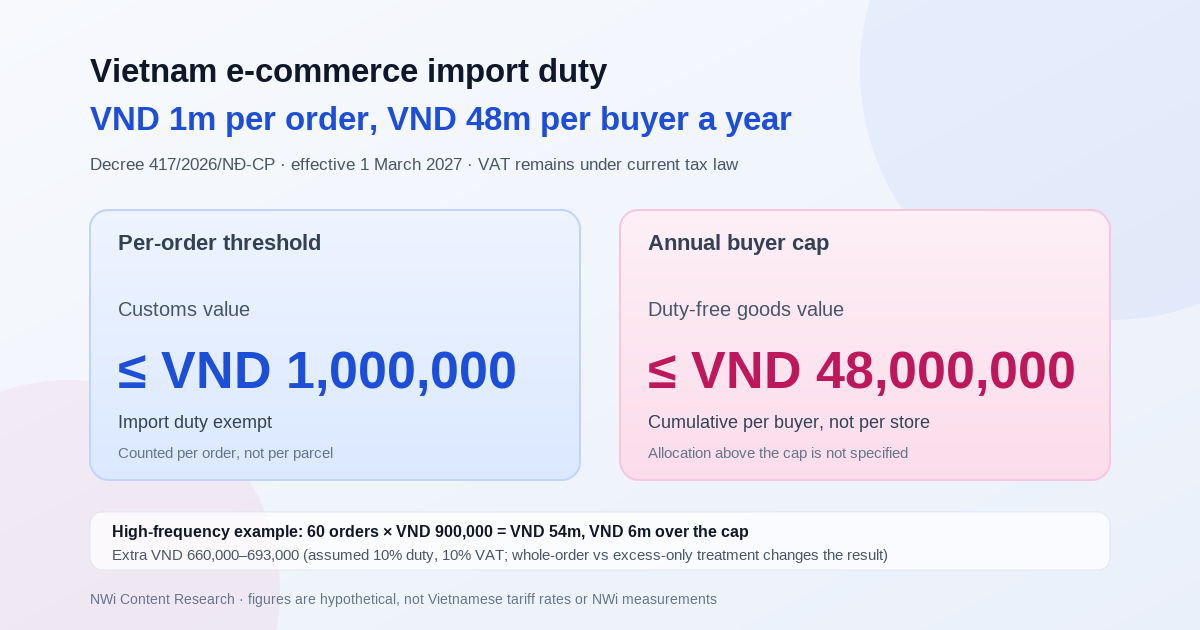
Vietnam's Decree 417/2026/NĐ-CP, effective 1 March 2027, exempts imports through e-commerce platforms from import duty when the customs value is VND 1 million or less per order, but caps each buyer's duty-free goods at VND 48 million a year; VAT and other taxes remain under current tax law. The decree also requires platform order data before arrival, identity checks and a customs declarant. This article separates the per-order threshold from the annual buyer cap, recomputes three scenarios (low-frequency, high-frequency and split orders), and lists the settlement fields, actions and stop conditions sellers should watch.

Vietnam's new rules for e-commerce import duty: VND 1m per order, VND 48m per buyer a year
Industry News

Alibaba.com Logistics Evidence Spot Checks Switch to Cumulative Penalties: 15 Orders to Trigger, 30 Days to Appeal, Counted per Main Account — How Export Sellers Avoid Points or Losing EXW Drafting Rights

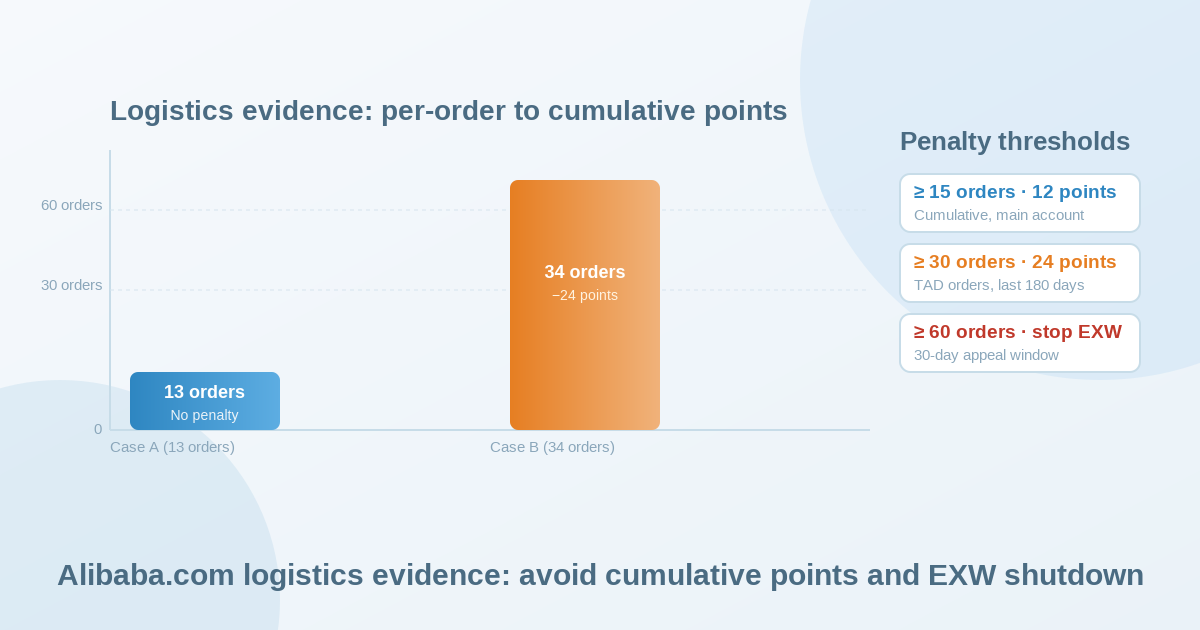
Alibaba.com's logistics evidence spot checks move from per-order deductions to cumulative penalties: a 30-day appeal window, counting per main account, penalties from 15 orders and EXW drafting rights shut down at 60. This article turns the official penalty table into a recomputable confirmed-anomaly metric, uses two illustrative scenarios to show sensitivity around the 15 and 30 thresholds, and sets out a 30-day countdown for handling evidence.

Alibaba.com Logistics Evidence Spot Checks Switch to Cumulative Penalties: 15 Orders to Trigger, 30 Days to Appeal, Counted per Main Account — How Export Sellers Avoid Points or Losing EXW Drafting Rights
Industry Insights

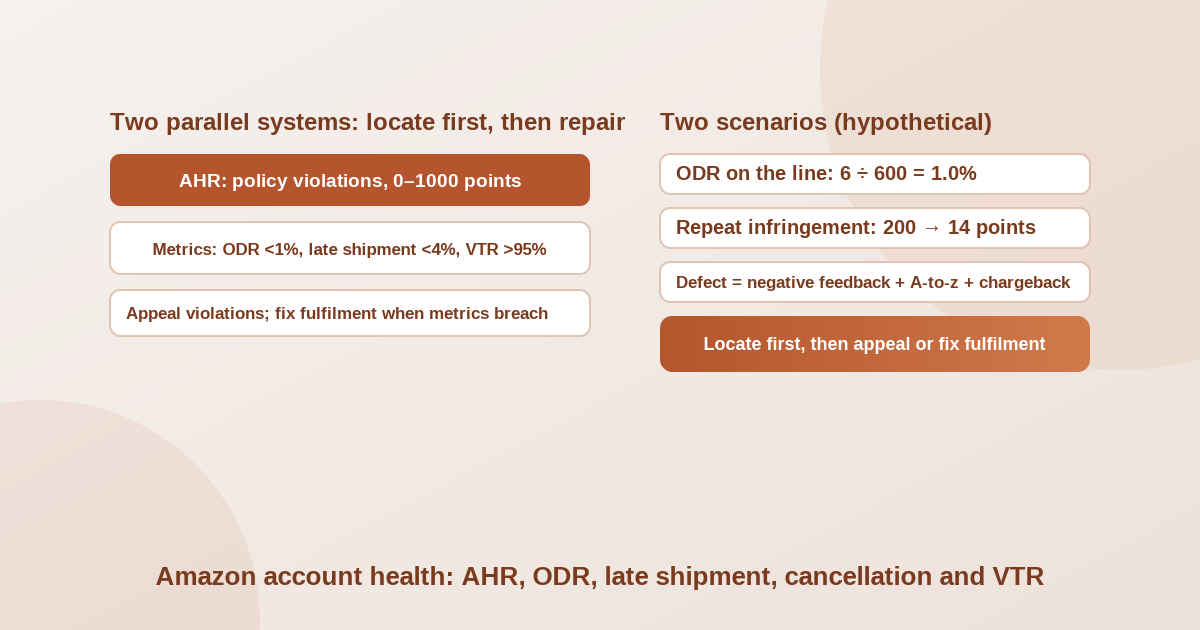
Amazon Account Health: How AHR, ODR, Late Shipment Rate, Cancellation Rate and VTR Decide Whether an Account Is Near Suspension or Still Fixable

Amazon account health is two parallel systems: Account Health Rating (AHR) scores policy violations from 0 to 1000, while order defect rate, late shipment rate, cancellation rate and valid tracking rate set fulfilment thresholds. Two clearly labelled hypothetical scenarios show how an ODR sitting on the 1% line and a doubling repeat-infringement deduction change the account position, so you can decide whether to appeal the violation or fix fulfilment first.

Amazon Account Health: How AHR, ODR, Late Shipment Rate, Cancellation Rate and VTR Decide Whether an Account Is Near Suspension or Still Fixable
Industry News

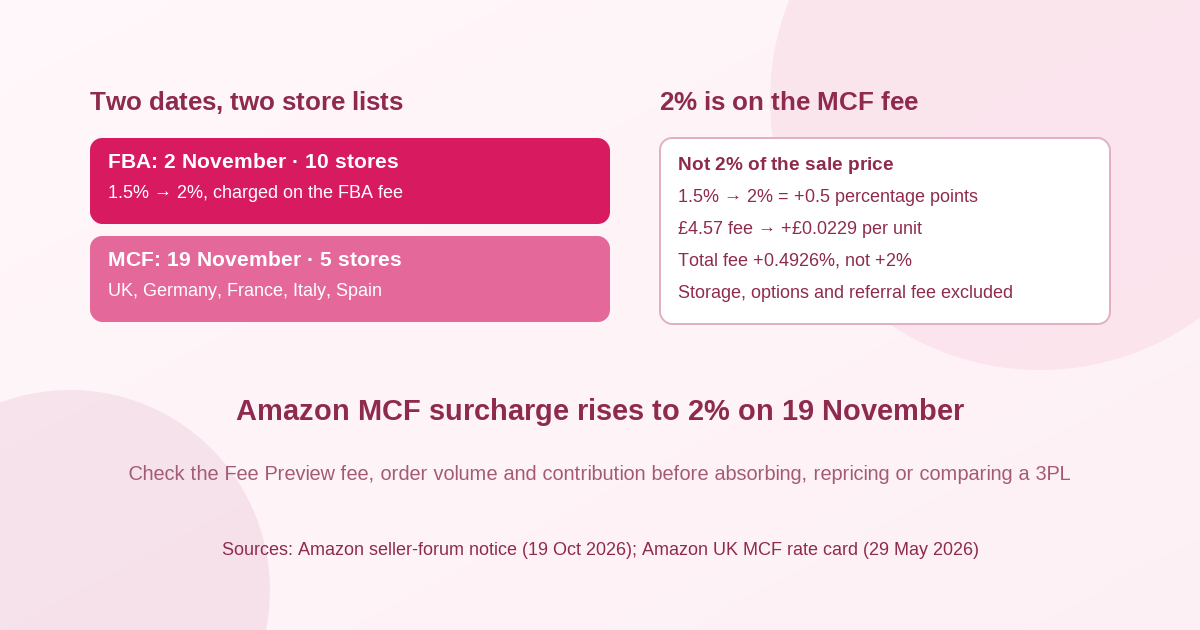
Amazon MCF Surcharge Rises to 2% on 19 November: How UK, German, French, Italian and Spanish Sellers Should Recalculate Non-Amazon Orders

Using Amazon's 19 October 2026 seller-forum notice and its UK MCF rate card, this article separates the FBA increase (2 November) from the MCF increase (19 November) in five stores, explains that the surcharge is charged on the fulfilment fee rather than the sale price, and shows that 1.5% to 2% is a 0.5-percentage-point increment. Two clearly labelled hypothetical scenarios use real UK fee bands to compute the per-order and monthly impact, compare a 3PL switch, and set review and stop conditions.

Amazon MCF Surcharge Rises to 2% on 19 November: How UK, German, French, Italian and Spanish Sellers Should Recalculate Non-Amazon Orders
Industry News

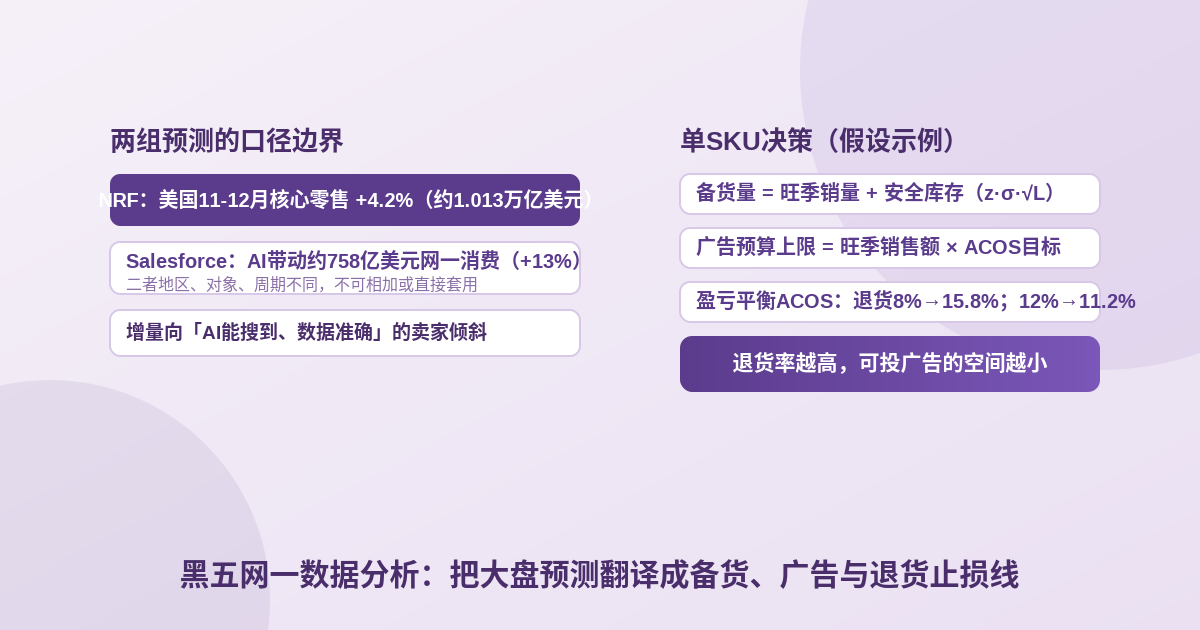
Black Friday and Cyber Monday Data Analysis: Amazon's Black Friday Week Opens 19 November with 12 Days of Daily Deals and Two Drops Each on Black Friday and Cyber Monday, Against US October Retail at +0.2% — How Cross-Border Sellers Should Set Price Floors, Deal Cadence and Ad Budget Caps

Grounded in Amazon's official Black Friday Week mechanics and the actual US October retail data, this article first explains how the 12-day window and two daily drops spread traffic peaks, then sets the Census and NRF retail measures side by side and translates the +0.2% headline and its category divergence into a per-SKU price floor, break-even ACOS and advertising budget cap, recomputing unit net profit in two illustrative scenarios (enrolled in a Deal vs not enrolled).

Black Friday and Cyber Monday Data Analysis: Amazon's Black Friday Week Opens 19 November with 12 Days of Daily Deals and Two Drops Each on Black Friday and Cyber Monday, Against US October Retail at +0.2% — How Cross-Border Sellers Should Set Price Floors, Deal Cadence and Ad Budget Caps
Industry Insights

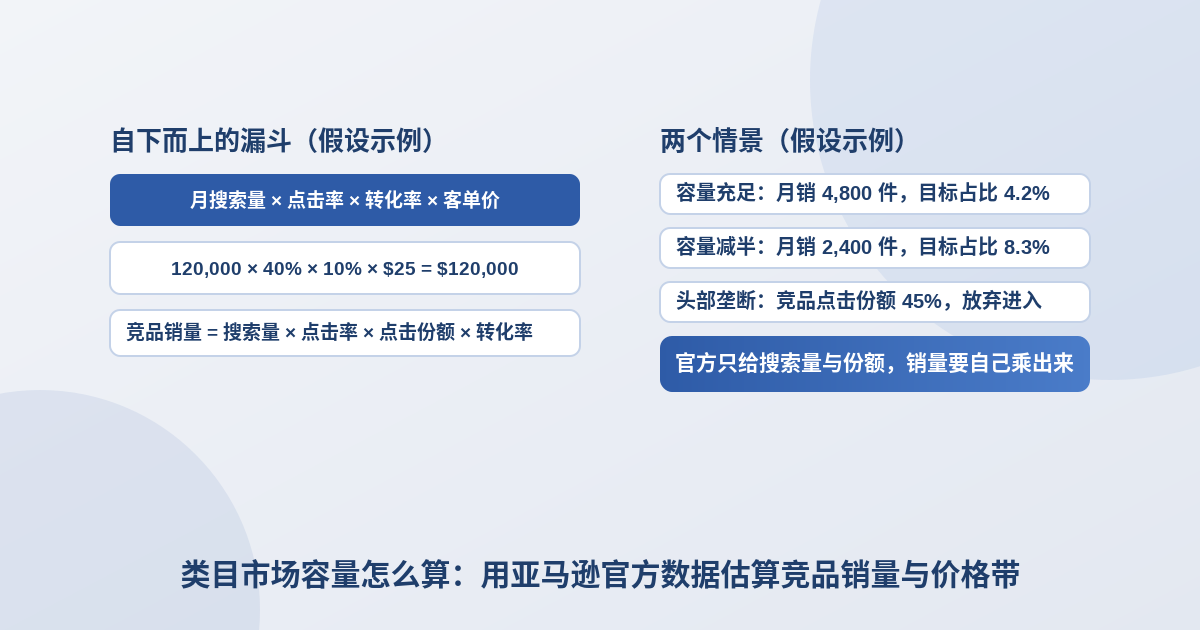
Category Market Sizing: How to Estimate Competitor Sales and Price Bands with Amazon's Official Data and Decide Whether a Category Is Worth Entering

This article connects the search volume, clicks, add-to-carts, purchases and competitive shares from Amazon's Product Opportunity Explorer and Brand Analytics into a bottom-up funnel, estimates a category's monthly units and monthly GMV range as search volume × click-through rate × conversion rate × average order value, then back-solves leading competitors' sales from click share, adds price-band analysis using the Top 3 products in Top Search Terms, and uses two recomputable scenarios (ample capacity and capacity halved) to decide whether to enter, place a trial order or walk away.

Category Market Sizing: How to Estimate Competitor Sales and Price Bands with Amazon's Official Data and Decide Whether a Category Is Worth Entering
Industry News

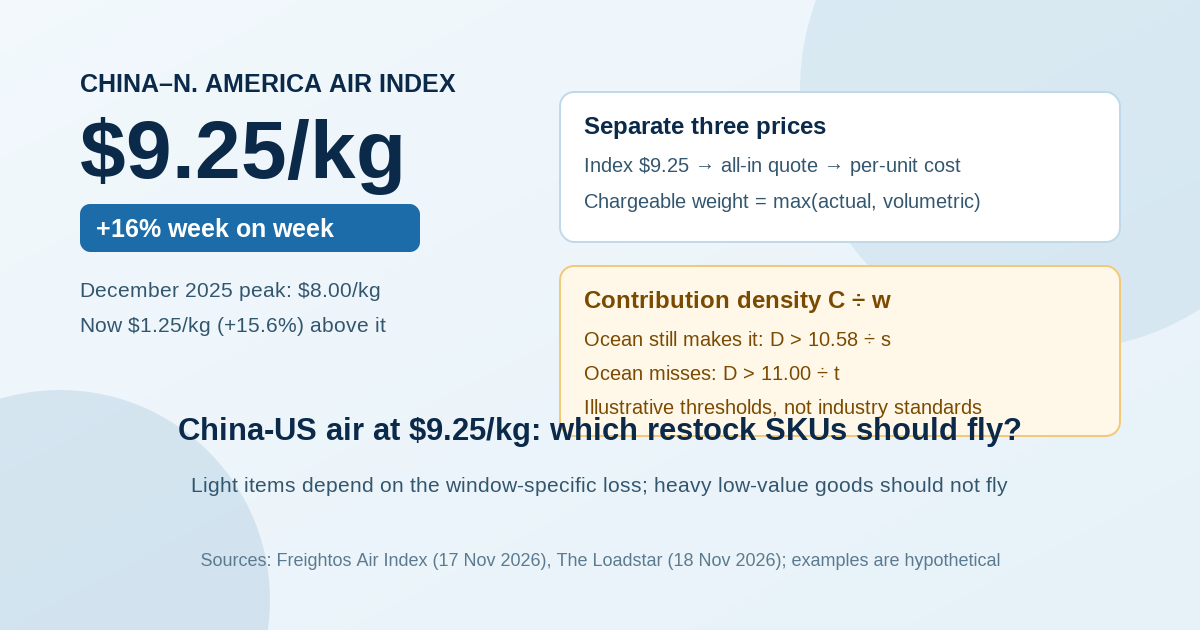
China-US Air Freight Rates Hit $9.25/kg: Which Black Friday and Cyber Monday Restock SKUs Still Clear Contribution After Air, and Which Should Wait for Ocean

Using Freightos Air Index updates for 17 and 3 November 2026, plus Loadstar/ExFreight lane data, this article separates the $9.25/kg China–North America benchmark from a forwarder's all-in quote and a seller's per-unit cost. It gives a contribution-density rule (unit contribution ÷ chargeable kilograms), computes three labelled scenarios, and sets the quote, timing and stop conditions a seller should check before booking air for Black Friday, Cyber Monday or December.

China-US Air Freight Rates Hit $9.25/kg: Which Black Friday and Cyber Monday Restock SKUs Still Clear Contribution After Air, and Which Should Wait for Ocean
Industry News

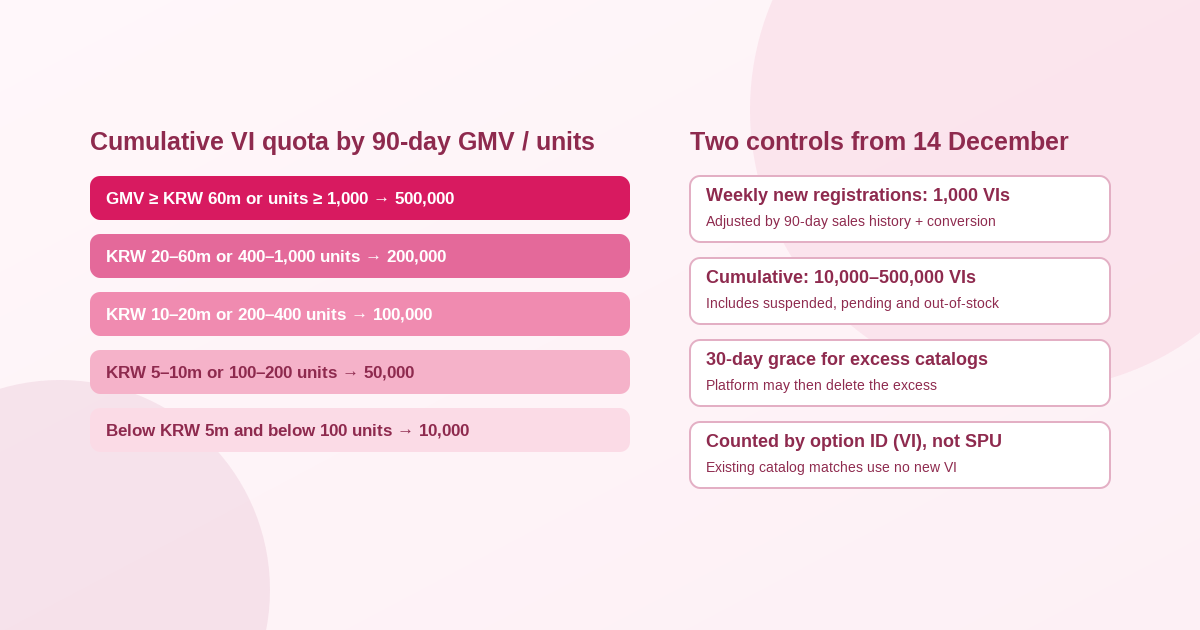
Coupang Listing Limits from 14 December: VI Quotas Set by 90-Day GMV or Units, and How Wide-Catalog Sellers Can Cut SKUs in 30 Days Without Losing High-Converting Slots

Using Coupang Developer Center's official notice, this article checks the listing-quota change effective 14 December 2026: a default 1,000 new VIs a week, a cumulative cap set by 90-day GMV or units in five tiers, and a 30-day grace period for excess catalogs. A recomputable excess formula and two clearly labelled hypothetical scenarios show how a wide-catalog seller can clean the catalog in 30 days and turn a finite weekly quota into higher GMV.

Coupang Listing Limits from 14 December: VI Quotas Set by 90-Day GMV or Units, and How Wide-Catalog Sellers Can Cut SKUs in 30 Days Without Losing High-Converting Slots
Industry News

EU Recycled Plastics Compliance Rule Takes Effect on 18 November: Which Declaration of Conformity Do Recycled-PET Tableware, Bottles and Sheet Need at Customs Clearance, and How Long Can Old Stock Still Be Sold?

Using the first-hand EUR-Lex text of Commission Regulation (EU) 2026/2376, this article sets out which declaration of conformity recycled-PET tableware, bottles, film and sheet must submit under Table 6 when released for free circulation after 2026-11-18 (upstream material submits P/A/B, downstream finished goods submit C), splits the transition period — declarations A or B may be placed until 2027-02-18 and declarations C or P until 2027-05-18 — into two decision paths (old-rule compliant vs no upstream declaration), and uses two scenarios plus a port-storage cost example to judge whether to keep selling, obtain the declaration before shipping, or hold the shipment.

EU Recycled Plastics Compliance Rule Takes Effect on 18 November: Which Declaration of Conformity Do Recycled-PET Tableware, Bottles and Sheet Need at Customs Clearance, and How Long Can Old Stock Still Be Sold?
Industry Insights

Inventory Turnover and Replenishment Decisions: Using Amazon's 28-Day Supply Threshold and Mercado Libre's 60-Day Storage Tiers to Calculate Safety Stock, Reorder Points and Stockout Stop-Loss Lines

Using the inventory turnover and days-of-supply formulas, combined with Amazon's low-inventory fee threshold at 28 days of supply and Mercado Libre's monthly storage fee that steps up by inventory age after 60 days, this article gives the reorder point, safety stock and hold-or-clear decision for a fast-moving and a slow-moving scenario.

Inventory Turnover and Replenishment Decisions: Using Amazon's 28-Day Supply Threshold and Mercado Libre's 60-Day Storage Tiers to Calculate Safety Stock, Reorder Points and Stockout Stop-Loss Lines
Industry Insights

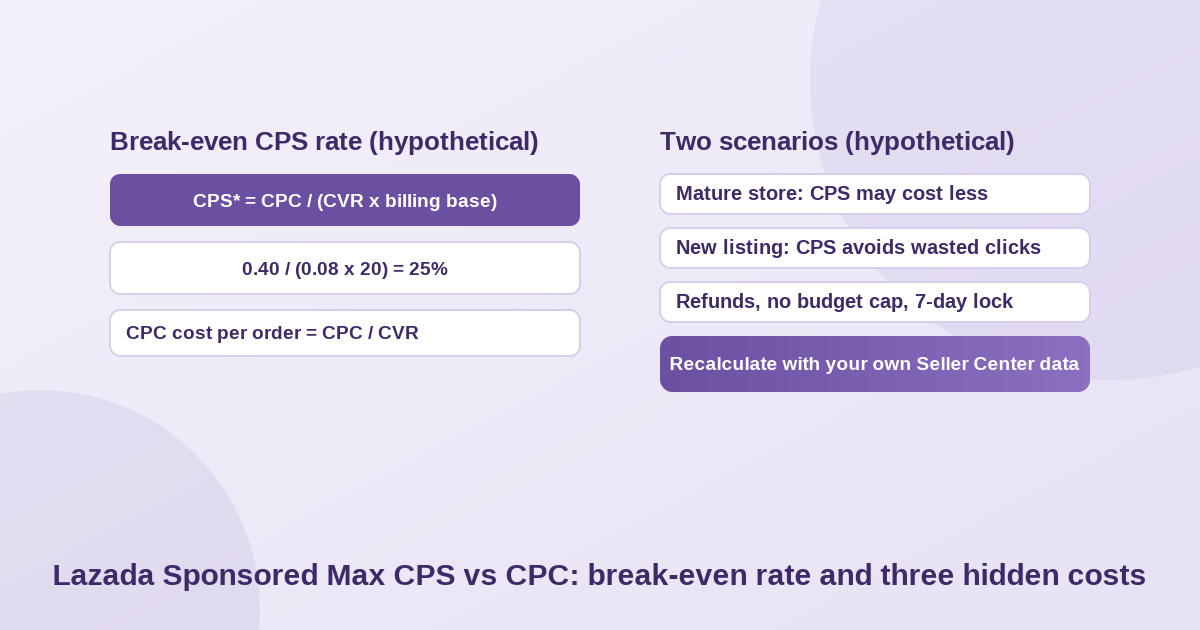
Lazada Sponsored Max CPS vs CPC: Break-Even Rate, Refund Rules and the 7-Day Lock

For cross-border sellers running Sponsored Max - Store in Malaysia, the Philippines, Singapore, Thailand, Vietnam or Indonesia, Sponsored Max Cost Per Sale Mode (BETA) charges only on confirmed orders. This article converts CPS and CPC into the same cost per order, gives the break-even formula (break-even CPS rate = cost per click / (conversion rate x billing base)), checks what counts as a confirmed order and what the rate is applied to, and compares a high-conversion mature store with a low-conversion new listing. All CPC, conversion, base and rate figures are labelled hypothetical examples.

Lazada Sponsored Max CPS vs CPC: Break-Even Rate, Refund Rules and the 7-Day Lock
Industry News

Ozon Data Analysis: Manual Pushes Rise to RUB 3 per Recipient from 3 December While Automatic Push Holds at RUB 2, and How Russia-Site Sellers Should Recalculate Reach Cost Using Their Historical Seasonal Coefficients

From 3 December, Ozon raises manual (one-off) pushes to RUB 3 per recipient, keeps automatic push at RUB 2 and removes the seasonal coefficient for both notification types. Using the official current formula (RUB 2 × recipients × seasonal coefficient), this article reconstructs two hypothetical scenarios, shows that the manual break-even coefficient is 1.5 and the automatic one is 1.0, and sets out how to regroup historical coefficients, recalculate reach cost and shrink the manual list.

Ozon Data Analysis: Manual Pushes Rise to RUB 3 per Recipient from 3 December While Automatic Push Holds at RUB 2, and How Russia-Site Sellers Should Recalculate Reach Cost Using Their Historical Seasonal Coefficients
Industry Insights

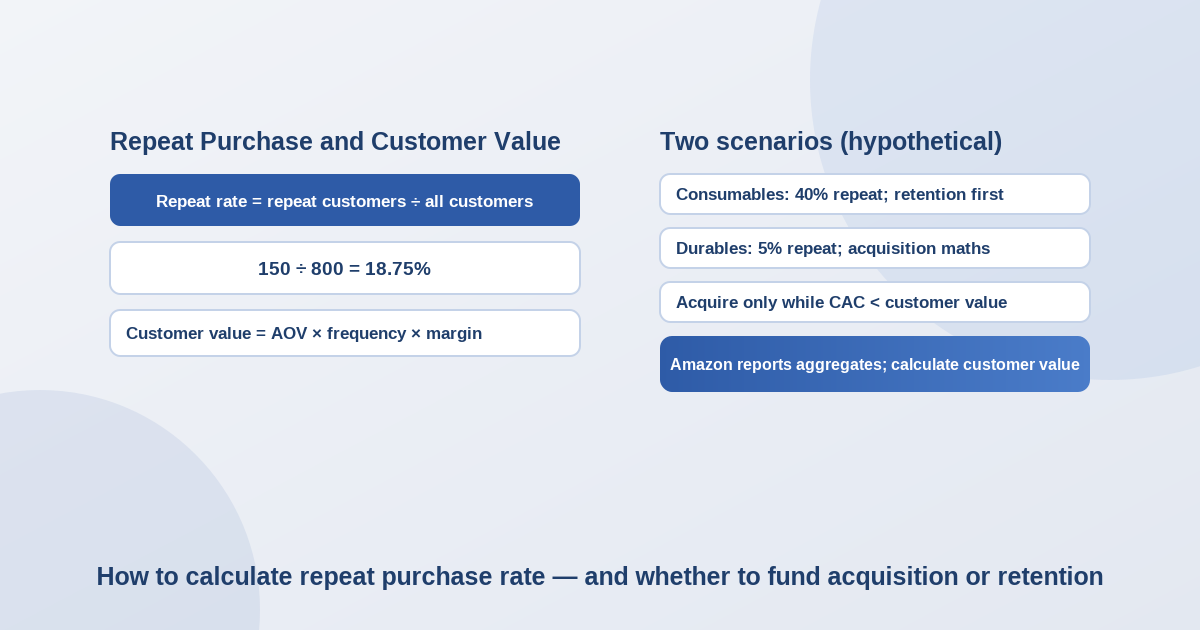
How to Calculate Repeat Purchase Rate: Using Amazon Repeat Purchase Behavior and Customer Loyalty Data to Decide Whether to Fund Acquisition or Retention

Connect Amazon Brand Analytics' Repeat Purchase Behavior (orders received, sales from repeat purchases and number of repeat customers) with Customer Loyalty Analytics (customer lifetime value and customer segments) into four recalculable metrics: repeat-customer rate, average purchase frequency, average contribution margin per customer and customer acquisition cost (CAC). Use a customer-value-versus-CAC inequality to decide whether the next dollar should go to acquisition or retention, with two scenarios — high-frequency consumables and low-frequency durables — that reach different conclusions.

How to Calculate Repeat Purchase Rate: Using Amazon Repeat Purchase Behavior and Customer Loyalty Data to Decide Whether to Fund Acquisition or Retention
Industry Insights

Cross-Border E-Commerce Return Rate: How Much Does One Return Actually Cost? Separating Size, Quality and Fraudulent Returns, Calculating the Real Cost of Returns and Setting a Stop-Loss Line

Using NRF's US retail return-rate definitions and Amazon's returns policy, this article breaks the return rate into five accounts — refund, non-refunded fulfilment fee, refund administration fee, above-threshold processing fee and unsellable purchase value — uses two hypothetical scenarios to judge whether low-price small items should offer returnless refunds and how high-price electronics should avoid crossing the threshold and triggering the frequent-returns badge, and gives a reproducible break-even return rate.

Cross-Border E-Commerce Return Rate: How Much Does One Return Actually Cost? Separating Size, Quality and Fraudulent Returns, Calculating the Real Cost of Returns and Setting a Stop-Loss Line
Industry Insights

Advertising ROAS and Break-Even ACoS: Work Out Pre-Ad Profit, Then Decide Whether an Amazon Campaign Should Get More Budget, Lower Bids or Be Shut Down

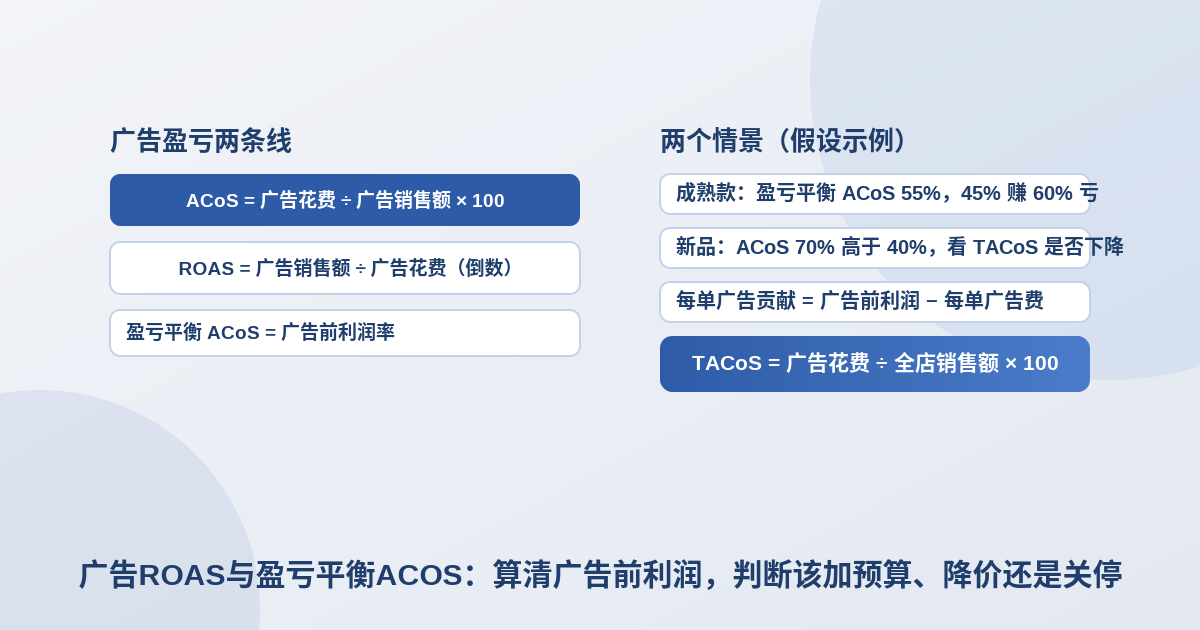
Using Amazon Ads' official ACoS and ROAS formulas, this article turns the rule that break-even ACoS equals the pre-ad profit margin into recalculable examples: two scenarios, a mature product and a new launch, decide whether advertising should get more budget, lower bids or be shut down, and TACoS separates buying rank at a loss from simply losing money.

Advertising ROAS and Break-Even ACoS: Work Out Pre-Ad Profit, Then Decide Whether an Amazon Campaign Should Get More Budget, Lower Bids or Be Shut Down
Industry Insights

Temu Data Analysis: Why PDD's Filings Show No Standalone Temu GMV and Temu Publishes No Rate Card, and How Cross-Border Sellers Can Work Out Per-Unit Profit for Fully Managed and Semi-Managed Models After the EU's €3 Duty Plus €2 Handling Fee

PDD's filings disclose only group transaction services revenue and do not break out Temu GMV; Temu publishes no rate card either. Using the EU's verifiable €3 per-item duty plus €2 handling fee (€5 per item in total), this article calculates per-unit profit separately for fully managed and semi-managed models and sets out the conditions for entry, model choice and pricing.

Temu Data Analysis: Why PDD's Filings Show No Standalone Temu GMV and Temu Publishes No Rate Card, and How Cross-Border Sellers Can Work Out Per-Unit Profit for Fully Managed and Semi-Managed Models After the EU's €3 Duty Plus €2 Handling Fee
Industry News

Temu Compliance: EU Preliminarily Finds Temu in Breach of the Digital Services Act, and the Three Gaps in Product Checks, Content Moderation and Seller Penalties That Decide Whether Sellers Should Fill Test-Report Gaps or Diversify Platforms

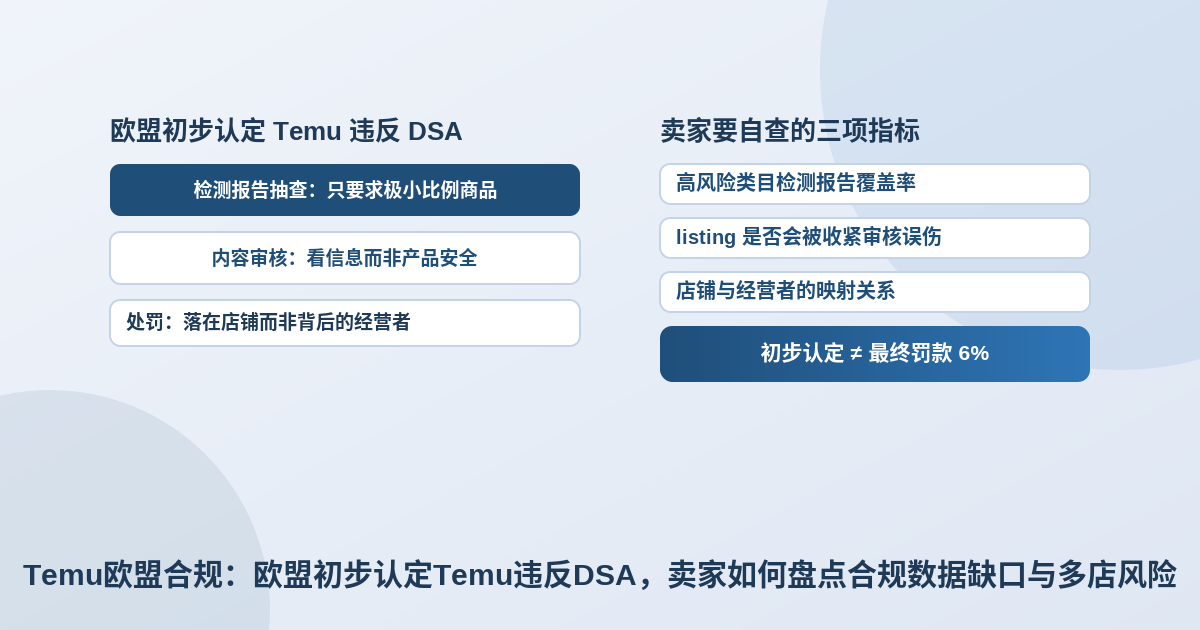
On 17 November 2026 the European Commission preliminarily found Temu in breach of the Article 35 risk-mitigation obligation of the Digital Services Act, citing three shortcomings in product compliance checks, content moderation and seller penalties, with a maximum fine of 6% of global annual turnover if confirmed. This article translates the three gaps into three metrics sellers can self-audit - test-report coverage in high-risk categories, wrongful-hit risk in listing moderation, and the mapping between stores and operators - and uses two hypothetical scenarios to set out the conditions for filling reports, delisting or diversifying platforms.

Temu Compliance: EU Preliminarily Finds Temu in Breach of the Digital Services Act, and the Three Gaps in Product Checks, Content Moderation and Seller Penalties That Decide Whether Sellers Should Fill Test-Report Gaps or Diversify Platforms
Industry News

TikTok Shop Southeast Asia Order Fees: Philippines PHP 5 per Item, Malaysia MYR 0.54, Thailand THB 1.07, Vietnam VND 3,000 and Singapore 3.27% — How Cross-Border Sellers Calculate the Minimum Sellable Price and Multi-Packs

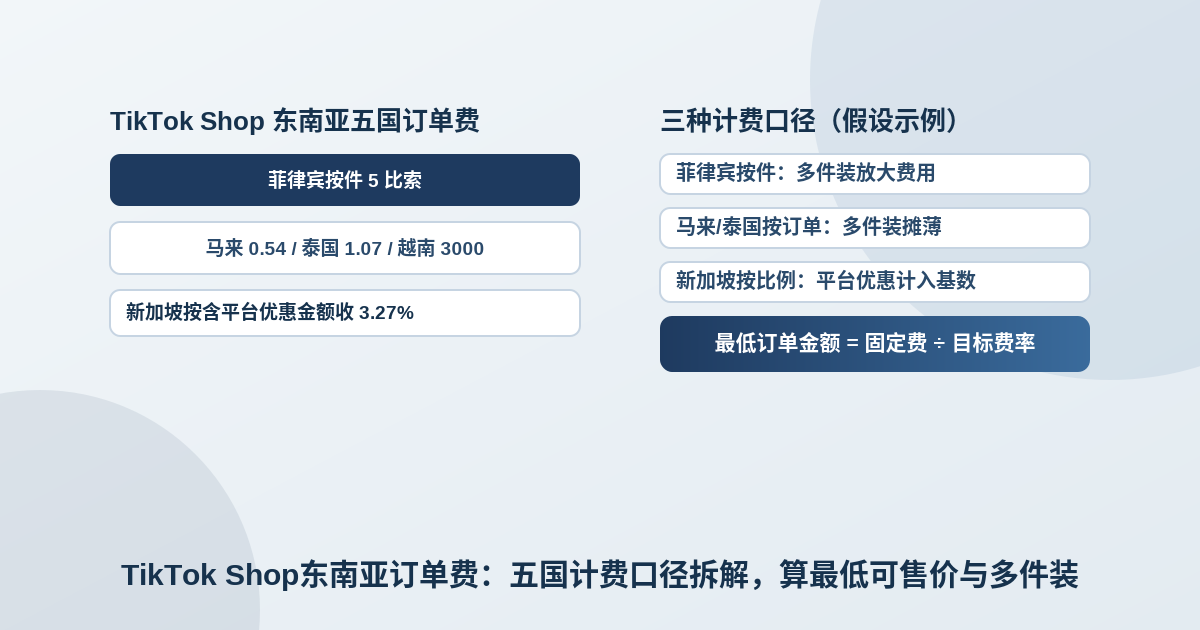
On 2026-11-17 TikTok Shop published its notice on Southeast Asia cross-border order fees, setting out in one place the per-order platform fees for the Philippines, Malaysia, Thailand, Vietnam and Singapore. This article separates the per-item, per-order and proportional bases, uses the formula fixed fee ÷ target rate to derive the minimum order value in each market, and gives the decisions on multi-packs, price rises and refunds.

TikTok Shop Southeast Asia Order Fees: Philippines PHP 5 per Item, Malaysia MYR 0.54, Thailand THB 1.07, Vietnam VND 3,000 and Singapore 3.27% — How Cross-Border Sellers Calculate the Minimum Sellable Price and Multi-Packs
Industry Research

TikTok Shop US Black Friday: Official vs Your Data

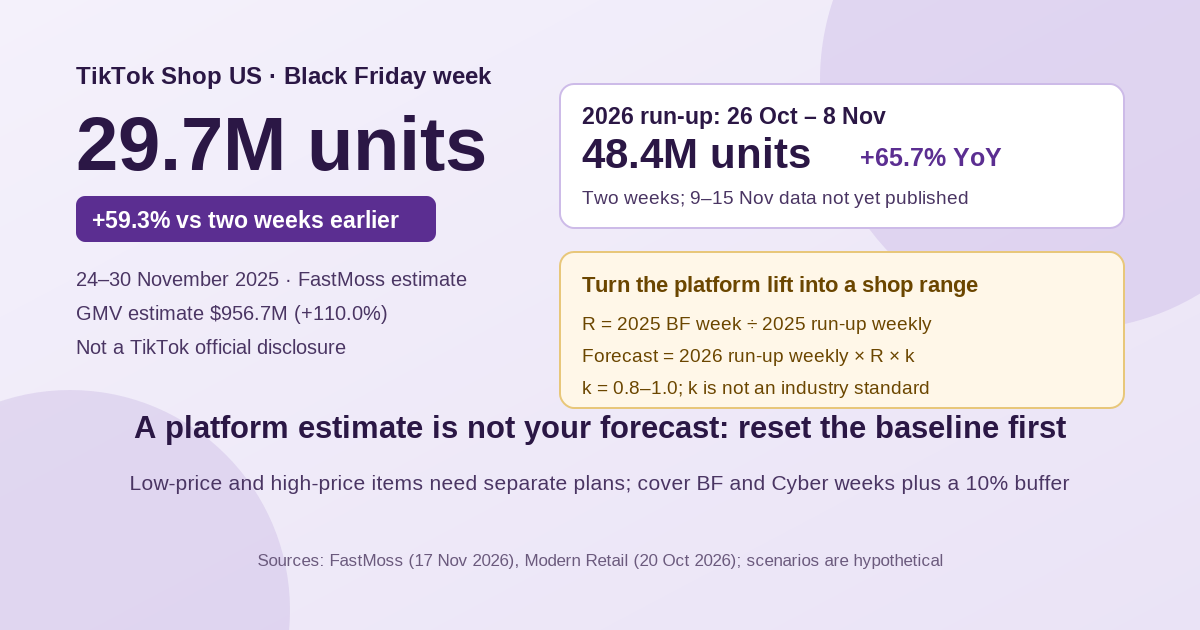
TikTok disclosed more than $500 million in US sales over the 2025 four-day Black Friday–Cyber Monday window, 84% sales growth for livestreaming sellers over the campaign period, and more than 760,000 LIVE sessions with 1.6 billion views. This article explains why those platform figures cannot become your shop's growth rate, sets out a baseline-reset method using your own seasonal ratio R, your 2026 run-up and a pass-through k, and uses the 2026 campaign window, fulfilment extensions and the return window to 10 February 2027 to recalculate stock gaps, creator commission, ad ceilings and stop conditions in two hypothetical scenarios.

TikTok Shop US Black Friday: Official vs Your Data
Industry News

US Importer of Record Rule: From 5 January 2027, Shell US Companies Face a Harder Customs Path

US Customs and Border Protection's interim final rule (91 FR 69977, published 6 November 2026) takes effect on 5 January 2027: a foreign importer of record that does not qualify as a US IOR must be CTPAT validated itself or use a CTPAT-validated licensed customs broker for formal entry, and at present only Canadian foreign IORs can apply for CTPAT validation. This article breaks the US IOR test into four checks, explains what CBP's 16%/0.4%/68%/32% statistics do and do not measure, and compares a US LLC with real substance, a shell US LLC and a duty-inclusive forwarder, with a cost formula, a sensitivity case and a checklist for the end of December 2026.

US Importer of Record Rule: From 5 January 2027, Shell US Companies Face a Harder Customs Path
Industry Research

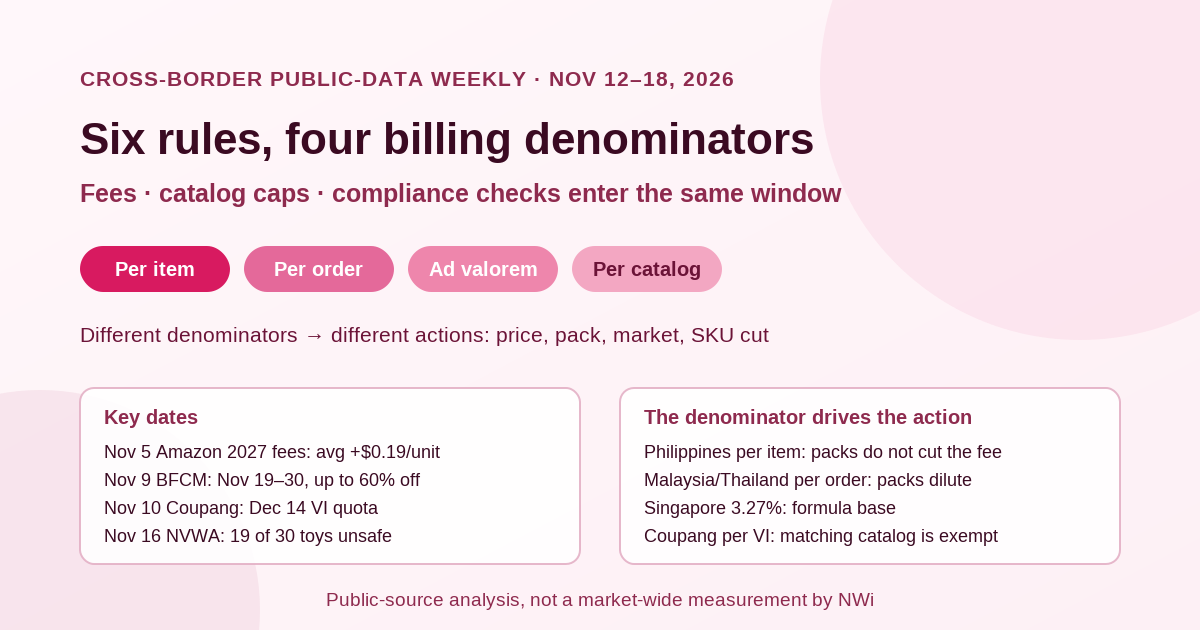
Cross-Border E-Commerce Public-Data Weekly (Nov 12–18): Fees, Catalog Caps and Toy-Safety Checks Tighten Together

A public-source weekly, not NWi market measurement: Amazon's 2027 US FBA fee averages +$0.19 per unit (~0.8% of price) but varies by SKU; TikTok Shop SEA order fees use different denominators (per item in the Philippines, per order in Malaysia/Thailand, 3.27% in Singapore); Thailand's commission relief is limited to eligible local SMEs; Coupang caps catalog VIs from 14 December; NVWA found 19 of 30 sampled toys unsafe. The article converts each rule into a contribution bridge and gives three seller scenarios, next-week tests and stop conditions.

Cross-Border E-Commerce Public-Data Weekly (Nov 12–18): Fees, Catalog Caps and Toy-Safety Checks Tighten Together
Industry News

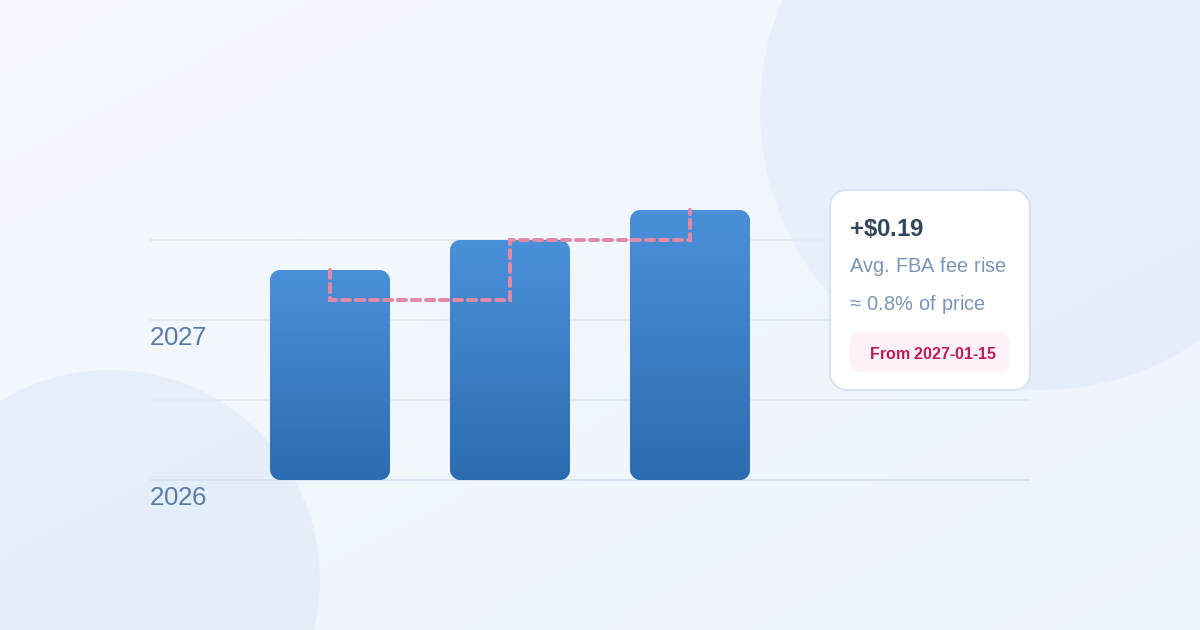
Amazon FBA Fees for 2027: US Delivery Fees Up an Average of $0.19, AWD/MCD Transport and the 3.5% Surcharge Expand, and How Sellers Should Recalculate Cost per SKU

Using Amazon's official announcements, this article sets out the 2027 US fee changes precisely: FBA delivery fees up an average of $0.19, simplified storage fees, updated low-inventory-level fee rules, and the 3.5% fuel and logistics surcharge expanding to AWD transportation fees and MCD logistics fees from 1 February 2027. A hypothetical per-unit contribution and AWD/MCD transport model shows how to recalculate cost by price band, inventory age and fulfilment method, and sets out the conditions for raising prices, clearing stock, changing packaging or switching to third-party logistics.

Amazon FBA Fees for 2027: US Delivery Fees Up an Average of $0.19, AWD/MCD Transport and the 3.5% Surcharge Expand, and How Sellers Should Recalculate Cost per SKU
Industry News

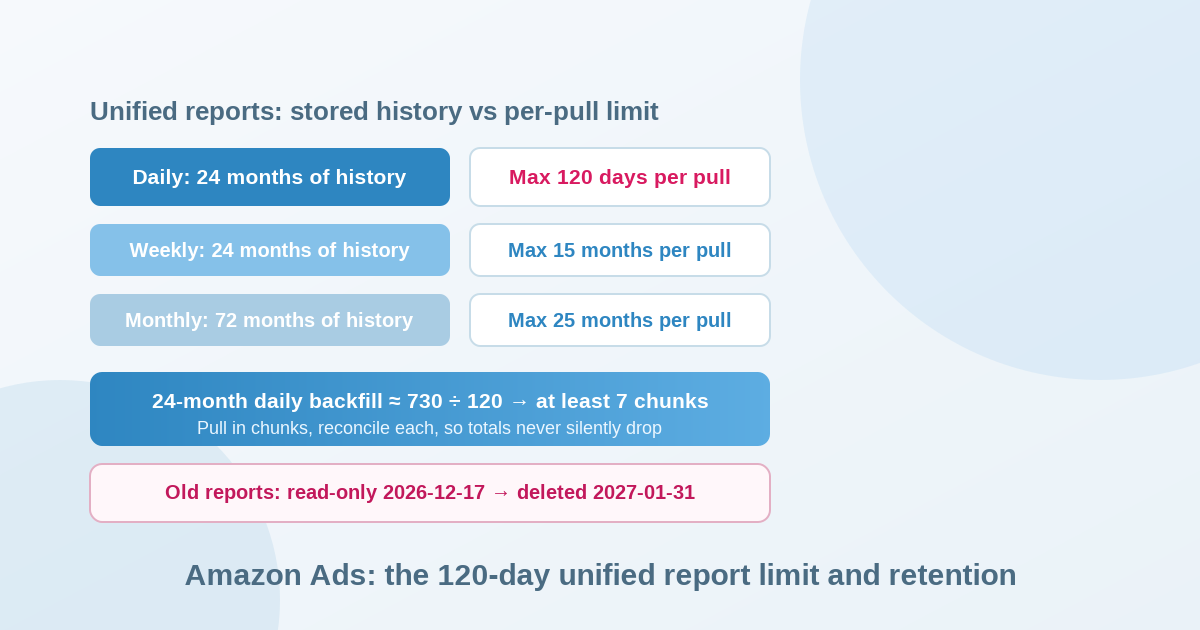
Amazon Advertising Data Analysis: Daily Unified Reports Cap at 120 Days per Pull Against a 24-Month History, and How to Rebuild Year-over-Year Comparisons and Retention Before Legacy Reports Close on 31 January 2027

Drawing on Amazon Ads' official Support Center and PPC Land, this article separates 'historical depth' from 'maximum single pull' in unified reporting, recalculates the number of backfill pulls for the 120-day, 15-month and 25-month windows, and sets out two hypothetical scenarios for rebuilding year-over-year comparisons and retention SLAs, so that data is not silently lost before the legacy reports close.

Amazon Advertising Data Analysis: Daily Unified Reports Cap at 120 Days per Pull Against a 24-Month History, and How to Rebuild Year-over-Year Comparisons and Retention Before Legacy Reports Close on 31 January 2027
Industry News

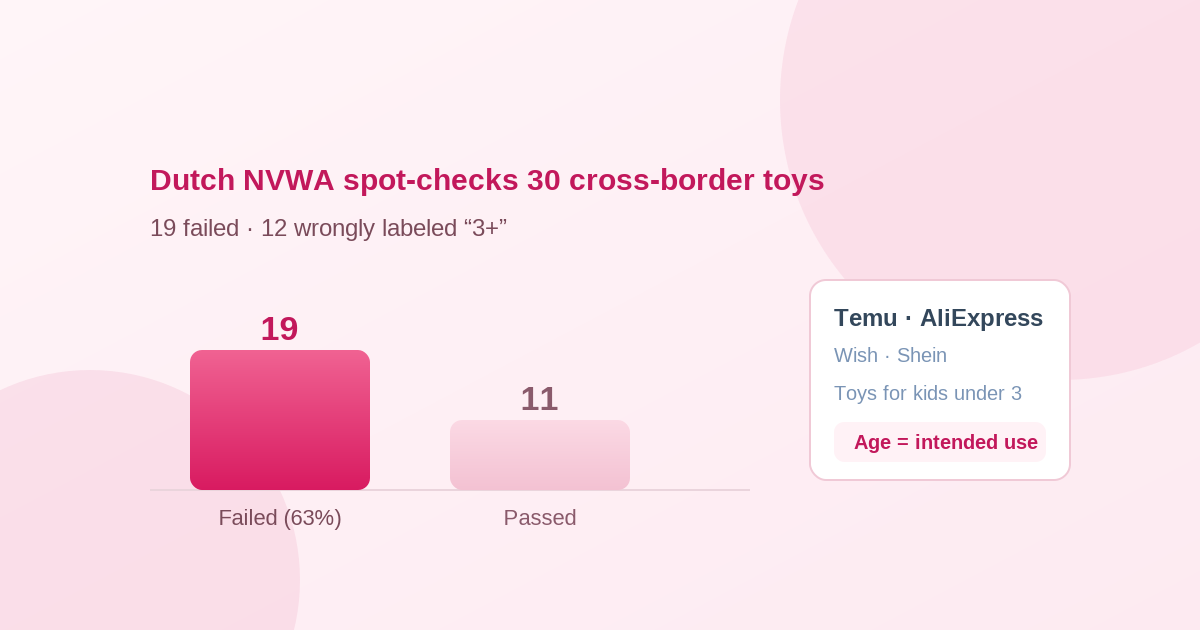
EU Toy Compliance: 19 of 30 Cross-Border Toys Fail Dutch Inspections — a "3+" Label Won't Dodge Under-Three Testing, and How Sellers Can Fix Listings Before Delisting

Using the Dutch NVWA's first-hand inspection results, this article clarifies what the "63% failure rate" sampling basis actually is, explains why age is judged by intended use rather than the label on the packaging, and uses a hypothetical peak-season revenue exposure with a stop-selling and retest decision tree to set out tiered actions for wooden toys, collectible figures and magnetic SKUs.

EU Toy Compliance: 19 of 30 Cross-Border Toys Fail Dutch Inspections — a "3+" Label Won't Dodge Under-Three Testing, and How Sellers Can Fix Listings Before Delisting
Industry News

Indonesia E-commerce Data Analysis: The Rupiah Hits a Record Low — How Sellers Recalculate Unit Contribution and Settlement Exposure, and Choose Between Price Rises, Shorter Settlement Cycles and Local Sourcing

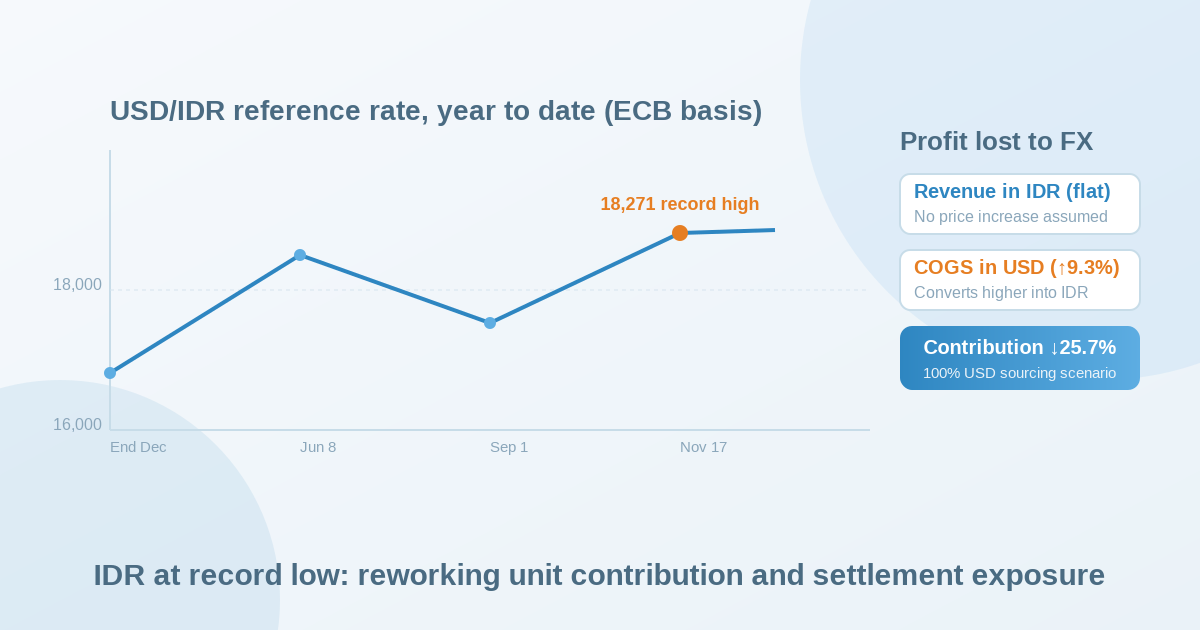
Using the European Central Bank's first-hand reference rates, this article verifies that USD/IDR rose to a record 18,271 on 17 November, explains how depreciation squeezes unit contribution through two chains — purchasing cost and revenue conversion — recomputes two hypothetical scenarios (100% US-dollar purchasing and 70% local purchasing), and sets out the triggers for three paths: raising prices, shortening settlement and sourcing locally.

Indonesia E-commerce Data Analysis: The Rupiah Hits a Record Low — How Sellers Recalculate Unit Contribution and Settlement Exposure, and Choose Between Price Rises, Shorter Settlement Cycles and Local Sourcing
Industry Insights

Joybuy Data Analysis: Why JD.com's Filings Show No Standalone GMV — and How Sellers Should Judge an Invite-Only Curated Marketplace and Cost Out Per-Unit Economics

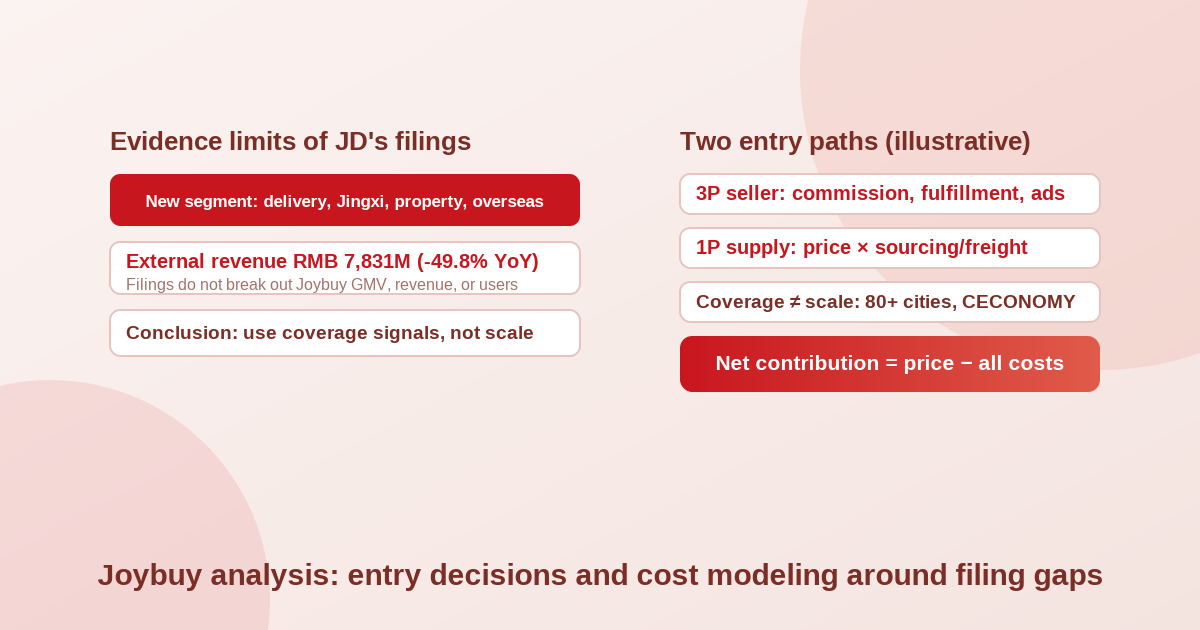
Based on JD.com's third-quarter 2026 results (SEC Form 6-K) and European e-commerce media, this article explains the evidence boundary created by Joybuy being folded into JD's New Businesses segment with no standalone GMV disclosure, separates coverage signals from scale signals, and uses two hypothetical scenarios — 1P brand supply and a 3P curated marketplace — to recompute unit contribution and supply gross margin, before setting out a self-check for the entry decision.

Joybuy Data Analysis: Why JD.com's Filings Show No Standalone GMV — and How Sellers Should Judge an Invite-Only Curated Marketplace and Cost Out Per-Unit Economics
Industry Insights

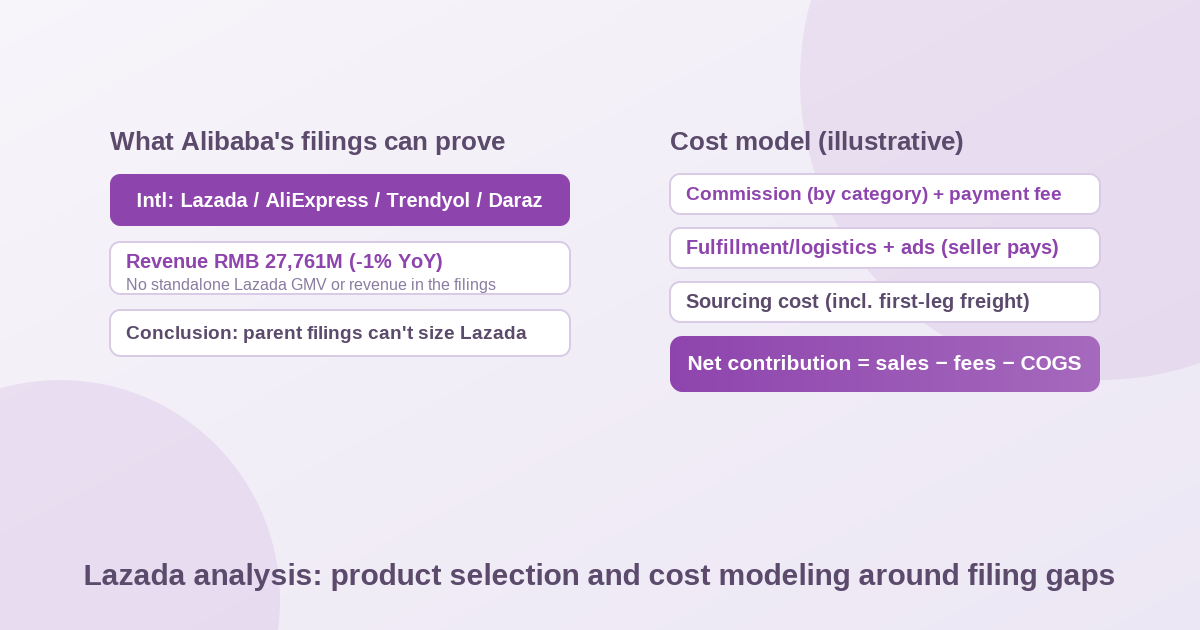
Lazada Data Analysis: Why Alibaba's Filings Show No Standalone Lazada GMV — and How Sellers Work Around the Data Gap on Selection and Fee Modelling

Based on Alibaba's June-quarter 2026 results and its business structure page, this article explains the evidence boundary created by Lazada being folded into the International E-commerce segment with no standalone GMV disclosure, then uses two hypothetical scenarios to recompute unit contribution under commission, payment fees and fulfilment fees, and sets out a self-check for site selection and fee modelling.

Lazada Data Analysis: Why Alibaba's Filings Show No Standalone Lazada GMV — and How Sellers Work Around the Data Gap on Selection and Fee Modelling
Industry Insights

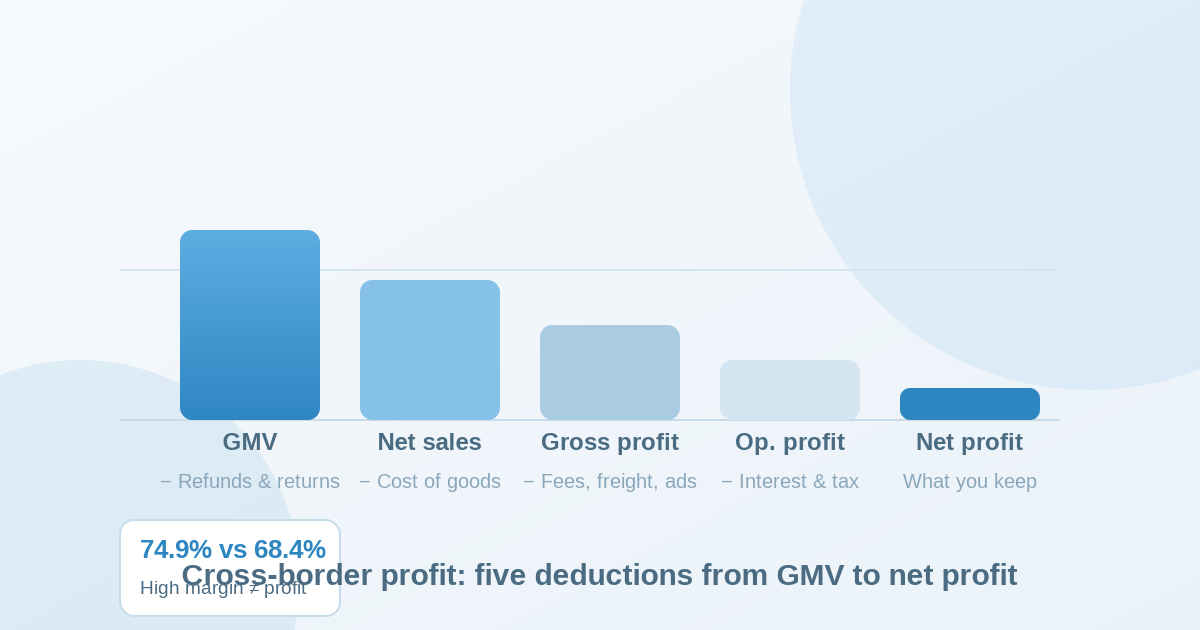
Cross-Border Profit Accounting: The Five-Step Subtraction from GMV to Net Profit, and How to Avoid Overstating Profit

Using the subtraction structure of the US IRS Schedule C and the official fee schedules of Amazon and Shopee as the baseline, this sets out five layers — GMV, net sales, gross profit, operating profit and net profit — uses two recomputable scenarios to show that a high gross margin does not mean profit, and gives the fields to record plus continue and stop conditions.

Cross-Border Profit Accounting: The Five-Step Subtraction from GMV to Net Profit, and How to Avoid Overstating Profit
Industry Insights

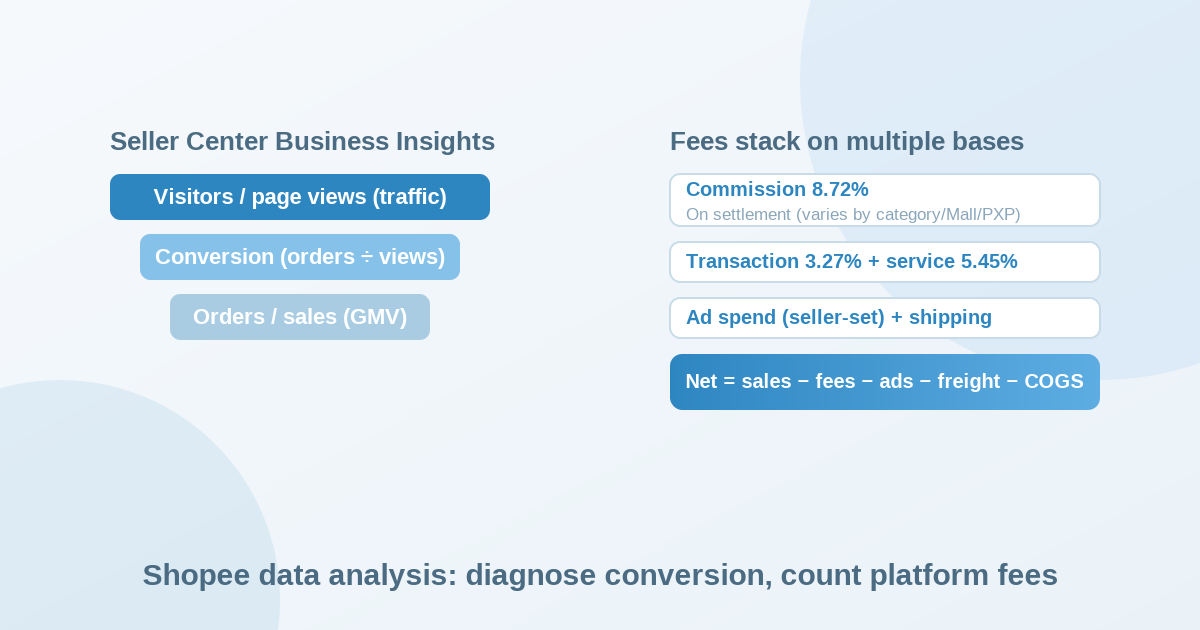
Shopee Data Analysis: Diagnose Conversion with Seller Centre Business Insights and Official Fees, Work Out What the Platform Takes, and Turn GMV Growth into Ad and Market Decisions

Drawing on Sea Limited’s Q3 2026 results and Shopee Seller Centre documentation, this explains the two sources of Shopee data and the multiple bases on which fees are charged, recomputes unit net contribution and break-even advertising in two hypothetical scenarios, and shows how to decide ad spend on incremental profit rather than order count when ad take rates rise.

Shopee Data Analysis: Diagnose Conversion with Seller Centre Business Insights and Official Fees, Work Out What the Platform Takes, and Turn GMV Growth into Ad and Market Decisions
Industry News

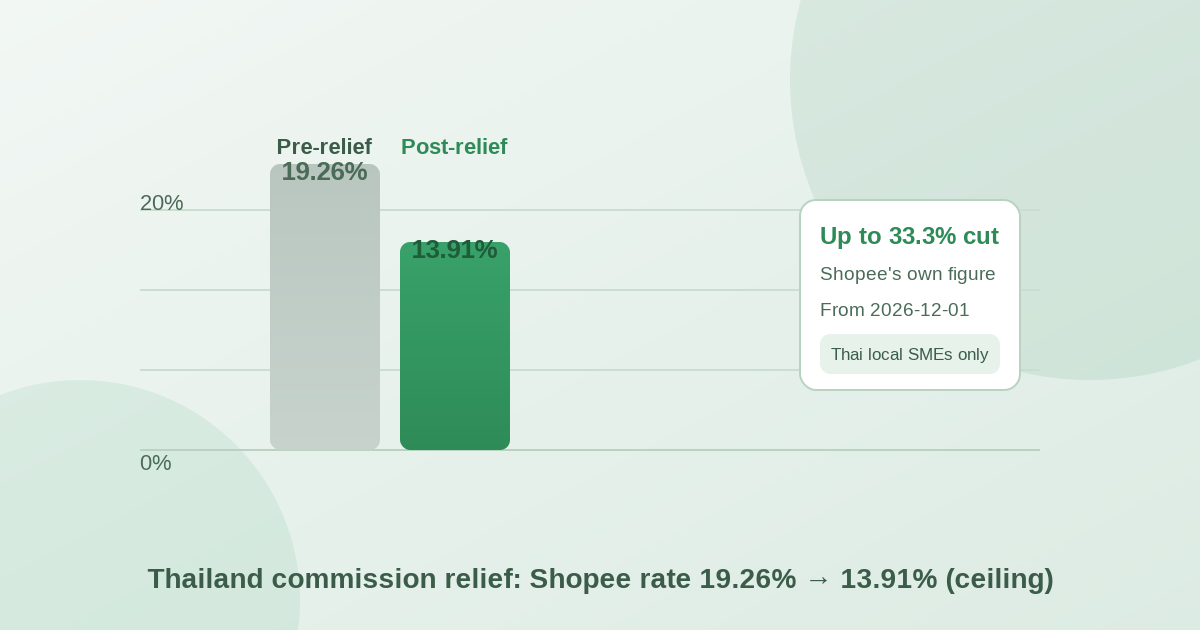
Thailand E-commerce Commission Relief: Shopee’s Cap Falls from 19.26% to 13.91% on 1 December — How Cross-Border Sellers Should Test Eligibility and Size the Saving

Using the Thai government announcement and Shopee seller-centre rules to bound the evidence, this explains the conditions, rate ranges and electronics exclusion under which the three platforms will cut mandatory fees for local SMEs from 1 December, uses a recomputable saving model to compare an eligible Thai seller with a China-based cross-border seller shipping direct, and sets the order of work: test eligibility, then size the saving, then decide whether to move the entity.

Thailand E-commerce Commission Relief: Shopee’s Cap Falls from 19.26% to 13.91% on 1 December — How Cross-Border Sellers Should Test Eligibility and Size the Saving