Alibaba.com (ICBU) published its 'Announcement on Optimising the Penalty Rules for Logistics Evidence Spot Checks' on 18 November, changing logistics evidence anomalies from 'deduct first, appeal later, order by order' to 'cumulative points': when a spot check finds an anomaly, points are no longer deducted per order; instead the seller gets a 30-day appeal window, and only orders whose appeal fails or that go unappealed past the deadline count toward the cumulative number of confirmed anomalies, counted per main account, with penalties starting at 15 orders. For a seller completing about 800 TAD orders a month, with logistics evidence supplied after the fact by freight forwarders and orders drafted separately by each salesperson, the question is how many confirmed anomalies it can carry and which step to fix first before the new rules take effect in early December so that it does not trigger 12 or 24 points in the rolling 180-day assessment. The answer is to keep confirmed anomalies = failed appeals + overdue unappealed below 15, fix the evidence-submission timing inside the 30-day appeal window first, and then fix the root cause of freight forwarders supplying evidence after the fact.
1. What changed: from 'deduct first, appeal later' to 'cumulative points'
According to the official announcement, the old process was 'deduct points first, appeal afterwards': every time the platform identified an order with a logistics evidence anomaly it immediately deducted 1 point, and the seller appealed afterwards, with the deduction reversed only if the appeal succeeded. The new rule is 'appeal first, then decide points on the cumulative number of anomalies': after a spot check finds an anomaly, the platform first pushes it to the seller's back office and starts a 30-day appeal window; orders whose appeal succeeds do not count as anomalies, and only orders whose appeal fails or that remain unappealed past the deadline enter the cumulative anomaly count.
| Dimension | Old rule | New rule |
|---|---|---|
| How points are deducted | 1 point deducted for every anomalous order found | No per-order deduction; points deducted at cumulative confirmed-anomaly thresholds per main account |
| When points are deducted | Points deducted first, appeal afterwards | Appeal first, points deducted afterwards once the anomaly count reaches a threshold |
| Anomaly confirmation | An anomaly found in a spot check is treated as an anomaly | Treated as an anomaly only if the appeal fails within 30 days or no appeal is filed in time |
| Unit of penalty | Penalty per order | Penalty accumulated at the merchant's main-account level |
| Penalty threshold | No threshold; 1 order is enough | Penalty only when confirmed anomalies reach 15 |
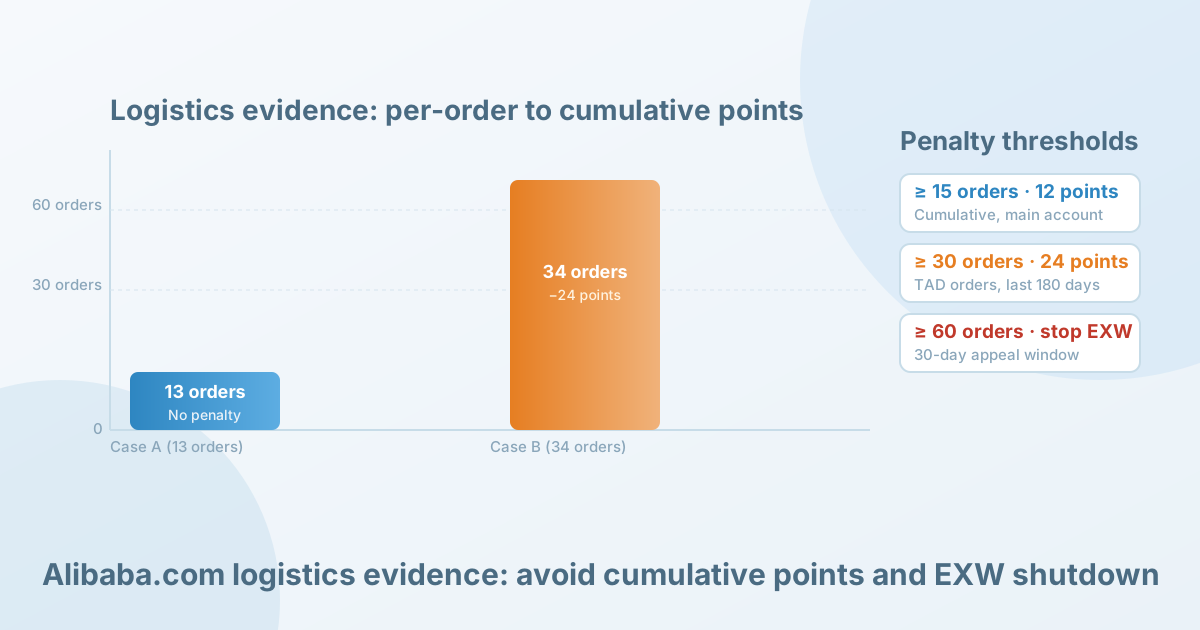
Penalties accumulate at main-account level and are applied in tiers: up to 15 confirmed anomalies there is no penalty but the record is kept; at 15, 12 points are deducted; at 30, 24 points are deducted (an additional 12 on top of the original 12); at 60, EXW order drafting rights are shut down. The assessment period covers TAD orders completed in the last 180 days.
| Confirmed anomalies | Penalty |
|---|---|
| Up to 15 | No penalty; recorded |
| ≥ 15 | 12 points deducted |
| ≥ 30 | 24 points deducted (an additional 12 on top of the original 12) |
| ≥ 60 | EXW order drafting rights shut down |
2. How it works: risk moves from 'a single order' to 'the stock of confirmed anomalies'
What the new rule really changes is the structure of risk: risk is no longer decided by a single anomaly, but by the stock of overdue unappealed and failed appeals; a 180-day assessment period means historical orders keep entering the push pool after the rule takes effect, so operations must turn pushing, evidence submission and review into a pipeline.
The key is the overlap between the 30-day appeal window and the 180-day assessment: every pushed order starts a 30-day countdown from the push date, while the penalty looks at the sum of all 'failed appeals plus overdue unappealed' orders in the last 180 days. That means in the early period after the effective date, historical orders completed on or after 1 July 2026 will enter the push pool one after another, and confirmed anomalies may rise in a cluster rather than evenly.
The rule can be reduced to a manageable metric: confirmed anomaly rate = (failed appeals + overdue unappealed) / orders pushed. The lower this ratio, the more effective the evidence process; two levers push it down — reducing anomalous evidence at the source, and appealing every order that can be appealed within 30 days.
3. Evidence boundaries: which numbers can be derived and which cannot
All figures in this article come from the official announcement and can be checked line by line; but the announcement leaves several points unexpanded, and this article does not fill in definitions on the platform's behalf. The number of confirmed anomalies is the sole basis for penalty decisions, but the announcement does not define TAD, the spot-check ratio or the anomaly criteria; the effective date is also an estimate of about 3 December, inferred as 15 days from publication, and the platform's final notice should prevail.
FAQ item 9 of the announcement says that orders completed on or before 31 June 2026 remain under the old rules and that the optimised rules apply only to orders completed on or after 1 July 2026 — 31 June is not a real date and should be 30 June; until the platform clarifies, sellers should treat 'completed on or after 1 July' as the starting point for the new rules without treating 31 June as a real cut-off.
The 18 November news flash from industry outlet Ennews is a restatement of the same announcement and can serve as a lead, but details such as penalty thresholds and the assessment period should follow the original text in the official rules centre; the two republish each other and do not amount to independent cross-verification.
4. Counter-examples and alternative explanations: who is actually unaffected
Not every seller will change how it operates because of this. If a seller's orders are mostly non-TAD or offline, or logistics tracking is transmitted directly by platform logistics, the probability of a spot-check anomaly is low, and the rule mainly changes process rather than substantive risk; a decline in anomaly confirmations may also come from looser appeal standards rather than operational improvement.
For sellers with small order volumes, if historical pushes are fewer than 15, even a full slate of overdue orders will not trigger a penalty, and the real problem may be the quality of bill-of-lading information rather than penalties. The way to tell them apart: read 'falling confirmed anomalies' together with 'appeal success rate and push volume'; only if push volume is unchanged while the appeal success rate rises clearly is it more likely an improvement in evidence rather than a looser platform standard.
5. A checkable analysis: confirmed anomalies and penalties in two illustrative scenarios
Under the official definition, confirmed anomalies = failed appeals + overdue unappealed, and this is the sole basis for the penalty decision. Every scenario below is an illustrative example, not platform statistics, and is used only to show sensitivity around the thresholds.
Scenario A: Under control (illustrative)
Assume 18 orders are pushed within 180 days, 5 appeals succeed, 3 appeals fail and 10 are overdue without appeal. Confirmed anomalies = 3 + 10 = 13, below the 15-order threshold, so no penalty applies. Within the remaining appeal window, prioritise the orders that can still be appealed, with the aim of pushing confirmed anomalies below 10.
Scenario B: Near the threshold (illustrative)
Assume 40 orders are pushed within 180 days, 6 appeals succeed, 4 appeals fail and 30 are still inside the appeal window and unprocessed. If all of them go overdue, confirmed anomalies = 4 + 30 = 34, triggering 24 points; if supplementary evidence succeeds for 5 of them within the appeal window, confirmed anomalies = 4 + 25 = 29 and only 12 points are deducted. This shows that between the 15 and 30 thresholds the outcome is highly sensitive to supplementary evidence, and orders still inside the appeal window should be handled first rather than left to go overdue.
Reduce the official penalty table to a recomputable metric: confirmed anomalies = failed appeals + overdue unappealed; when 40 orders are pushed, 4 appeals fail and 30 are overdue, confirmed anomalies are 34 and trigger 24 points, and 5 successful supplementary submissions bring that down to 29 and only 12 points, which shows how sensitive the area around the thresholds is to supplementary evidence.
6. Action plan: what to collect, what to use as a baseline, and when to continue or stop
Start by connecting the fields of the back-office 'core transaction data — logistics evidence anomaly module' to your own operations sheet, recording at least seven items: orders pushed, awaiting appeal, under appeal, appeals succeeded, appeals failed, overdue unappealed and confirmed anomalies.
- Source: check before shipping that the bill of lading or tracking number, the tracking trail and the order's delivery address agree, so that evidence back-filled by freight forwarders is neither missing nor distorted
- Evidence: assemble five materials — bill of lading, proof of delivery, logistics tracking screenshots, invoice and communication records with the buyer — into an evidence pack
- Countdown: build a 30-day appeal countdown table starting from each push date, and handle first the orders that fall due earliest and are most likely to fail
- Monitoring: after the new feature goes live at the end of November, use the back-office confirmed anomaly count as a baseline and reconcile it against your manual sheet
Within the remaining appeal window, prioritise orders that are overdue without appeal, aim to push confirmed anomalies below 15, and assemble the five materials — bill of lading, proof of delivery, tracking, invoice and communication records — into an evidence pack, working back 30 days from each push date.
Continue if: confirmed anomalies stay stably below 15 and your own standard for on-time handling within the 30-day window is met, only then consider continuing to take orders under EXW terms; adjust if: push volume rises while the appeal success rate falls, in which case check the source of the evidence rather than simply filing more appeals; stop if: confirmed anomalies approach 60, or the evidence cannot be completed, in which case pause new order drafting, fix the data first and ask the platform about the recovery conditions after EXW rights are shut down.
7. Limitations and uncertainties
The unknowns most likely to change the conclusion are the precise definition of TAD, the spot-check ratio, whether the 15-order threshold resets each assessment period, and the recovery conditions after 60 orders shut down EXW drafting rights; none of these are set out in the announcement.
This article discusses a general analytical method under Alibaba.com's public rules and does not mean that Nuozhou Digital Intelligence already provides real-time order or logistics evidence data for Alibaba.com; whether a penalty is triggered is subject to the platform back office's actual calculation.
Method and notes
Data basis for this article: the penalty standards, the 30-day appeal window, the assessment period and the effective-date terms are all taken from the Alibaba.com rules centre announcement 'Announcement on Optimising the Penalty Rules for Logistics Evidence Spot Checks' (rule number 21002286, modifiedTime 2026-11-18, retrieved on 2026-11-19), and cross-checked against the 18 November 2026 news flash from industry outlet Ennews; all order counts and penalty outcomes in Scenarios A and B are explicitly labelled illustrative examples, not platform statistics.
The incremental value of this analysis is that it reduces the official penalty table to the confirmed anomaly rate as a manageable metric and points out that the 180-day assessment period combined with the 30-day appeal window will make historical orders fall due in a cluster after the effective date — a decision tool that reading a single news flash cannot give you.
To take confirmed anomalies further into profit and operating risk, see Cross-Border E-Commerce Profit Calculation: The Five-Step Subtraction from GMV to Net Profit; for how platform policy affects unit cost and profit, compare Amazon FBA Fee Changes for 2027: US Fulfilment Fees Up $0.19 on Average, Simplified Storage Fees — How Sellers Should Recalculate Profit by SKU.
This article was prepared with the assistance of an automated research workflow, based on the public sources listed at the end, and has not been reviewed by a human.
Sources
- 1. Alibaba.com (ICBU) Rules Centre, 'Announcement on Optimising the Penalty Rules for Logistics Evidence Spot Checks' (primary source, rule number 21002286, modifiedTime 2026-11-18): view original, retrieved on 2026-11-19
- 2. Ennews, 'Alibaba.com Optimises Penalty Rules for Logistics Evidence Spot Checks, Switching to a Cumulative Points Model' (published 2026-11-18): view original, retrieved on 2026-11-19