Noah Wise Insight

News Center

Research Briefs · Industry Trends · Product Updates · Global Expansion Cases

Stay updated on cross-border e-commerce trends, product capability releases, and practical growth cases from global markets.

2026-11-19 · Research Briefs

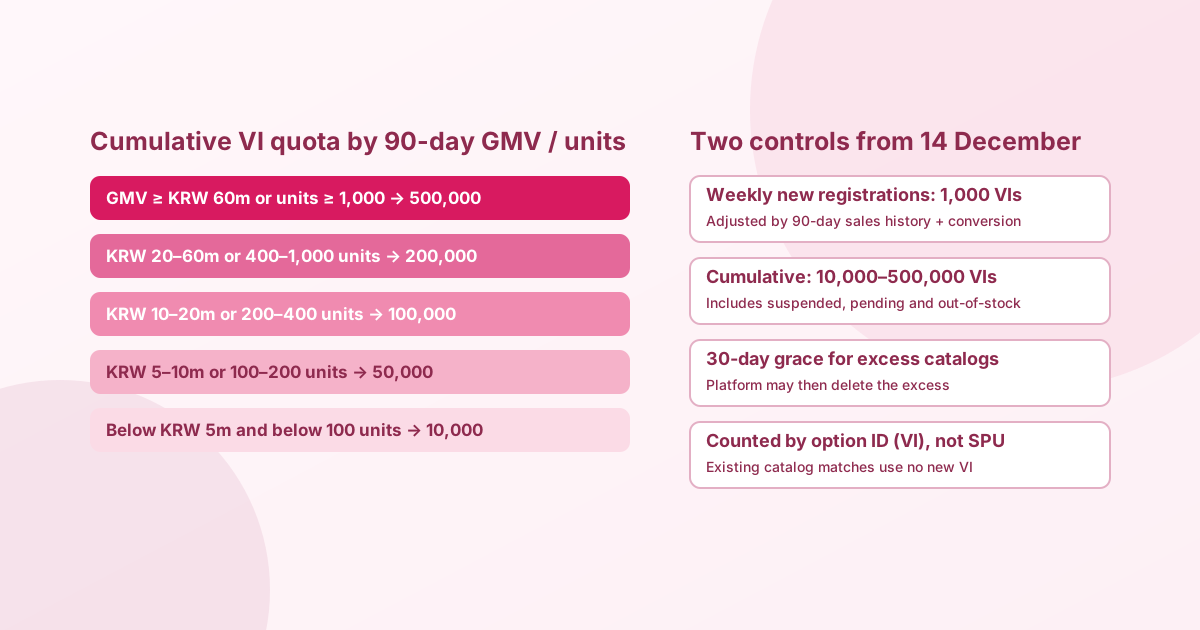
Coupang Listing Limits from 14 December: VI Quotas Set by 90-Day GMV or Units, and How Wide-Catalog Sellers Can Cut SKUs in 30 Days Without Losing High-Converting Slots

Using Coupang Developer Center's official notice, this article checks the listing-quota change effective 14 December 2026: a default 1,000 new VIs a week, a cumulative cap set by 90-day GMV or units in five tiers, and a 30-day grace period for excess catalogs. A recomputable excess formula and two clearly labelled hypothetical scenarios show how a wide-catalog seller can clean the catalog in 30 days and turn a finite weekly quota into higher GMV.

Read more →
2026-11-19 · Research Briefs

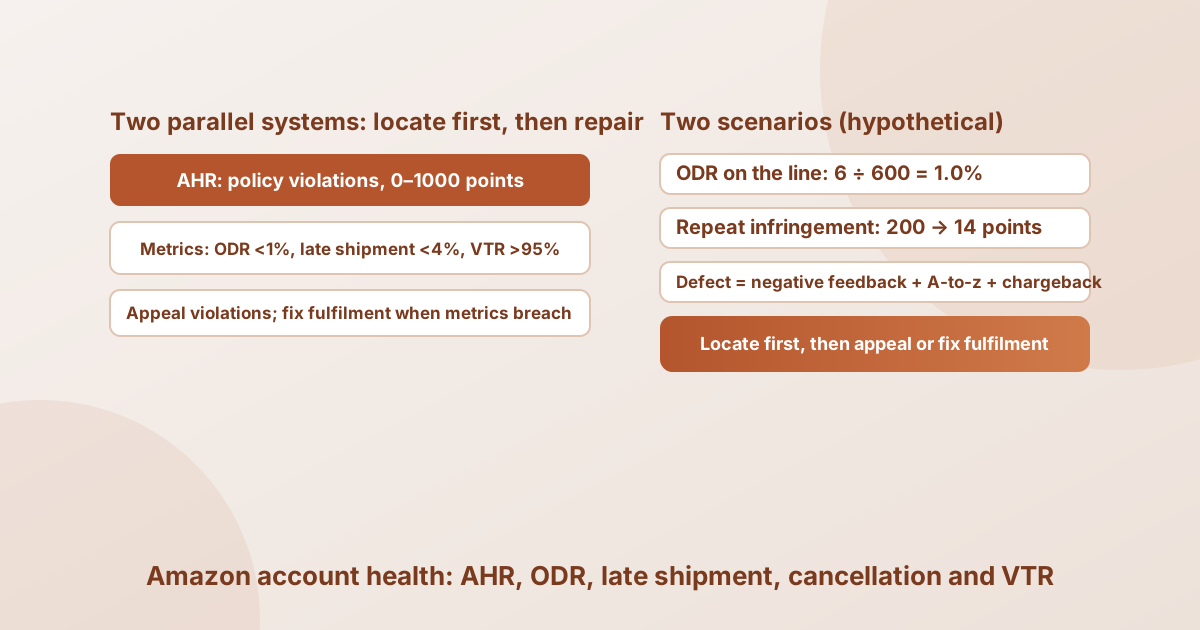
Amazon Account Health: How AHR, ODR, Late Shipment Rate, Cancellation Rate and VTR Decide Whether an Account Is Near Suspension or Still Fixable

Amazon account health is two parallel systems: Account Health Rating (AHR) scores policy violations from 0 to 1000, while order defect rate, late shipment rate, cancellation rate and valid tracking rate set fulfilment thresholds. Two clearly labelled hypothetical scenarios show how an ODR sitting on the 1% line and a doubling repeat-infringement deduction change the account position, so you can decide whether to appeal the violation or fix fulfilment first.

Read more →
2026-11-19 · Research Briefs

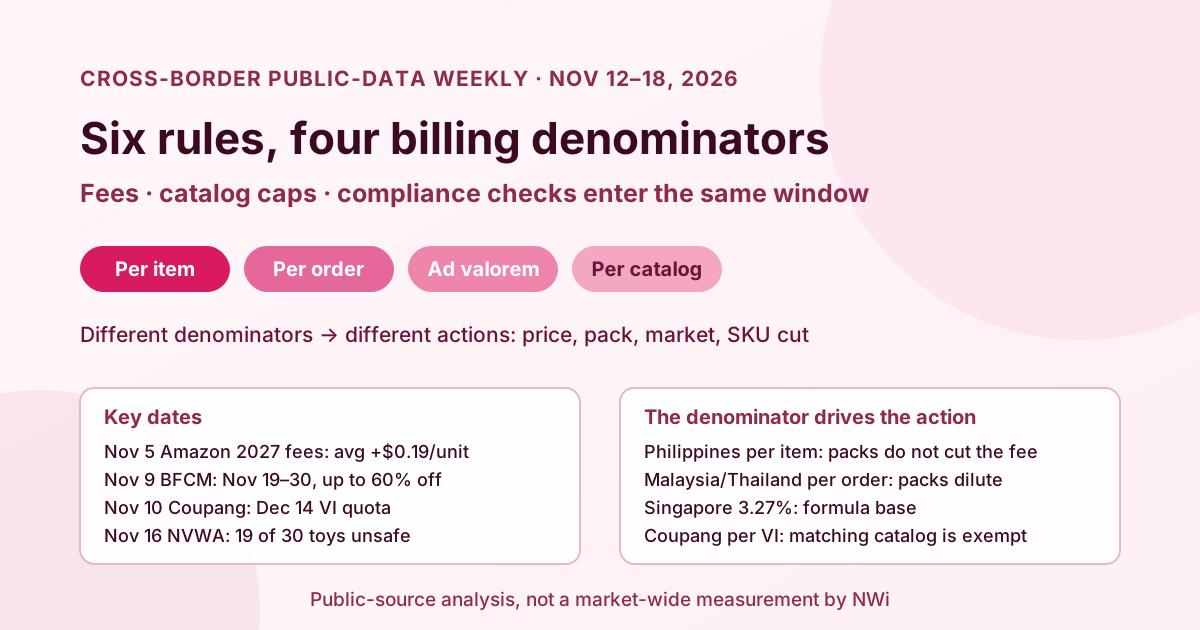
Cross-Border E-Commerce Public-Data Weekly (Nov 12–18): Fees, Catalog Caps and Toy-Safety Checks Tighten Together

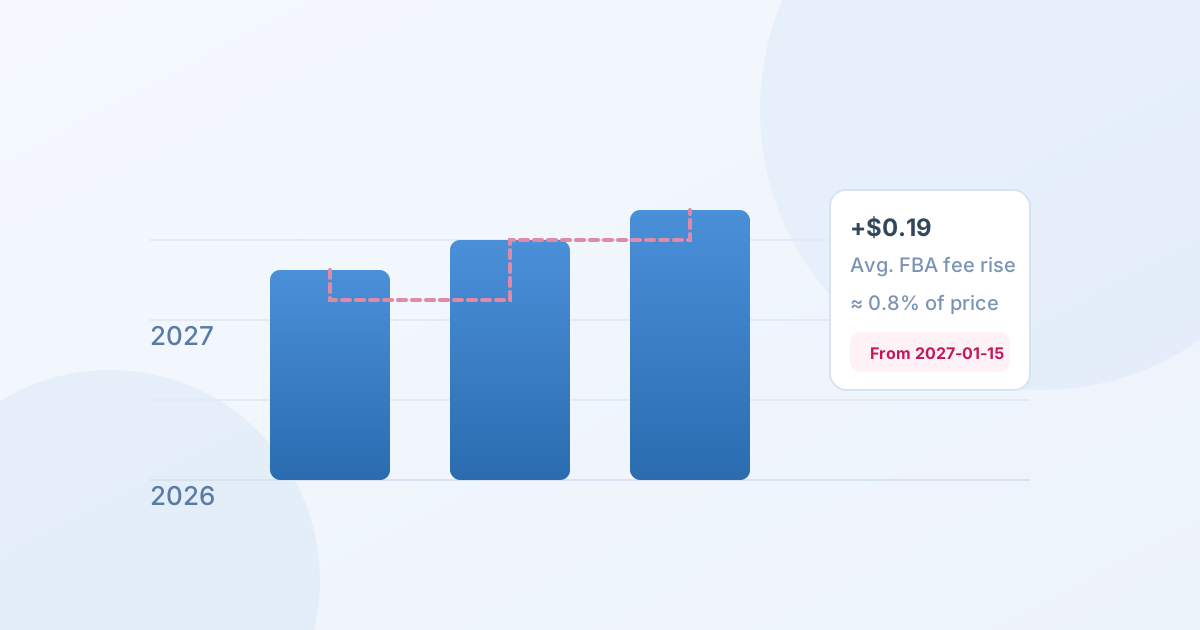
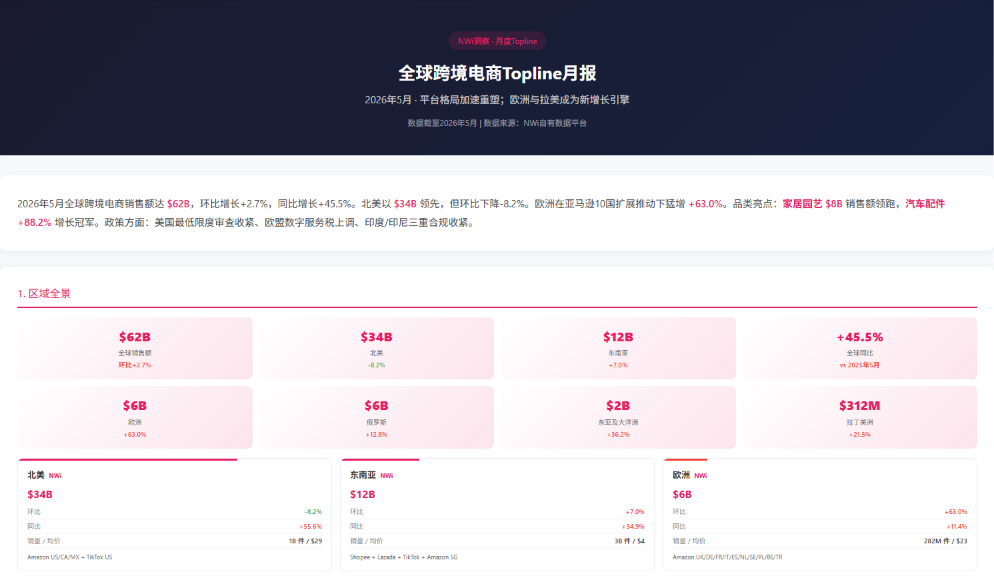
A public-source weekly, not NWi market measurement: Amazon's 2027 US FBA fee averages +$0.19 per unit (~0.8% of price) but varies by SKU; TikTok Shop SEA order fees use different denominators (per item in the Philippines, per order in Malaysia/Thailand, 3.27% in Singapore); Thailand's commission relief is limited to eligible local SMEs; Coupang caps catalog VIs from 14 December; NVWA found 19 of 30 sampled toys unsafe. The article converts each rule into a contribution bridge and gives three seller scenarios, next-week tests and stop conditions.

Read more →
2026-11-19 · Research Briefs

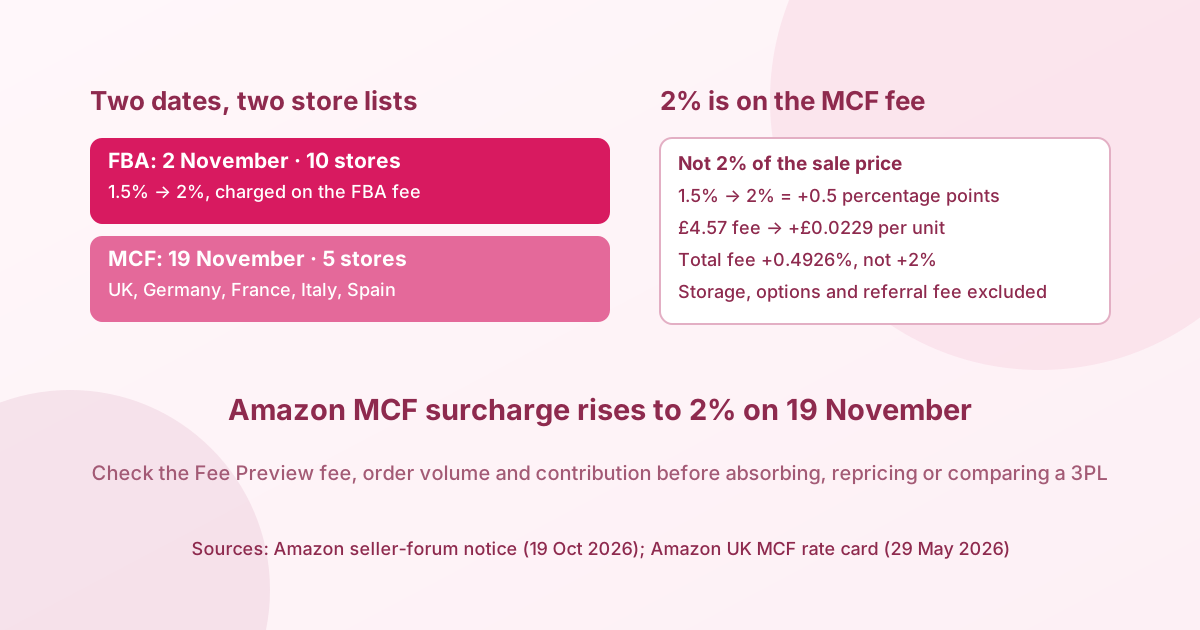
Amazon MCF Surcharge Rises to 2% on 19 November: How UK, German, French, Italian and Spanish Sellers Should Recalculate Non-Amazon Orders

Using Amazon's 19 October 2026 seller-forum notice and its UK MCF rate card, this article separates the FBA increase (2 November) from the MCF increase (19 November) in five stores, explains that the surcharge is charged on the fulfilment fee rather than the sale price, and shows that 1.5% to 2% is a 0.5-percentage-point increment. Two clearly labelled hypothetical scenarios use real UK fee bands to compute the per-order and monthly impact, compare a 3PL switch, and set review and stop conditions.

Read more →
2026-11-19 · Research Briefs

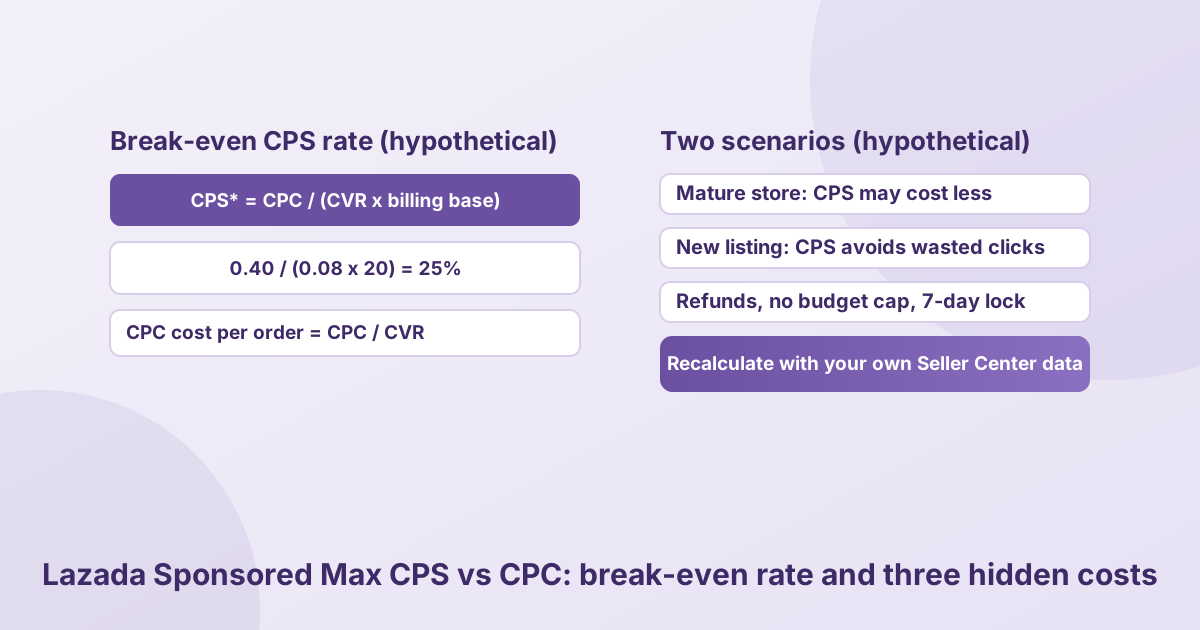
Lazada Sponsored Max CPS vs CPC: Break-Even Rate, Refund Rules and the 7-Day Lock

For cross-border sellers running Sponsored Max - Store in Malaysia, the Philippines, Singapore, Thailand, Vietnam or Indonesia, Sponsored Max Cost Per Sale Mode (BETA) charges only on confirmed orders. This article converts CPS and CPC into the same cost per order, gives the break-even formula (break-even CPS rate = cost per click / (conversion rate x billing base)), checks what counts as a confirmed order and what the rate is applied to, and compares a high-conversion mature store with a low-conversion new listing. All CPC, conversion, base and rate figures are labelled hypothetical examples.

Read more →
2026-11-19 · Research Briefs

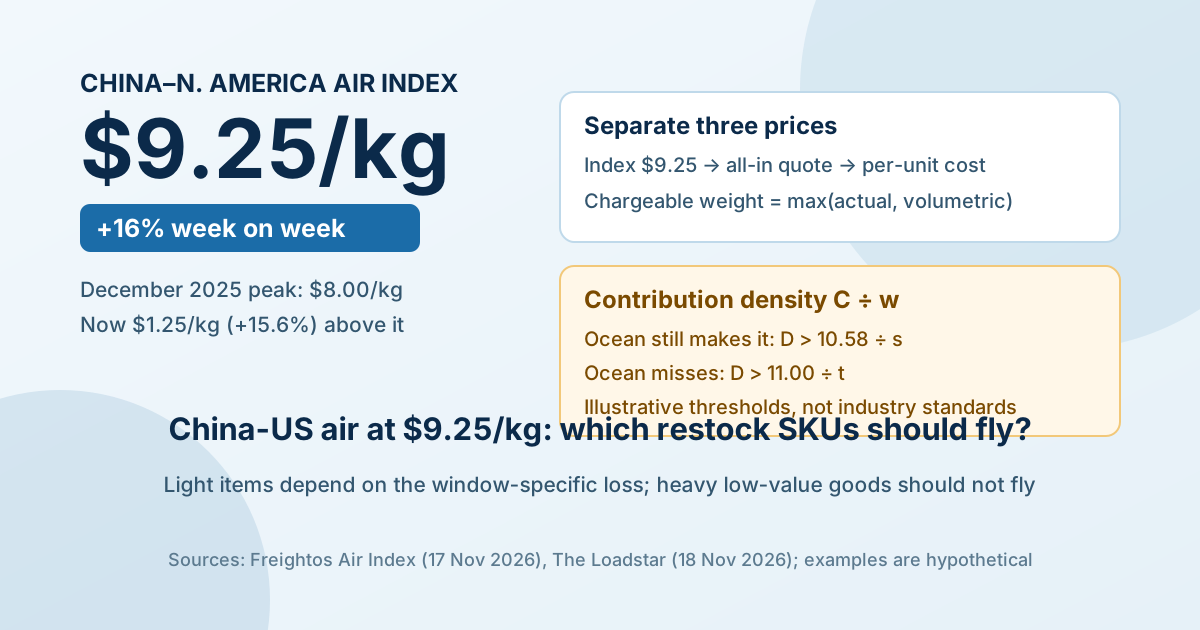
China-US Air Freight Rates Hit $9.25/kg: Which Black Friday and Cyber Monday Restock SKUs Still Clear Contribution After Air, and Which Should Wait for Ocean

Using Freightos Air Index updates for 17 and 3 November 2026, plus Loadstar/ExFreight lane data, this article separates the $9.25/kg China–North America benchmark from a forwarder's all-in quote and a seller's per-unit cost. It gives a contribution-density rule (unit contribution ÷ chargeable kilograms), computes three labelled scenarios, and sets the quote, timing and stop conditions a seller should check before booking air for Black Friday, Cyber Monday or December.

Read more →

2026-11-19 · Research Briefs

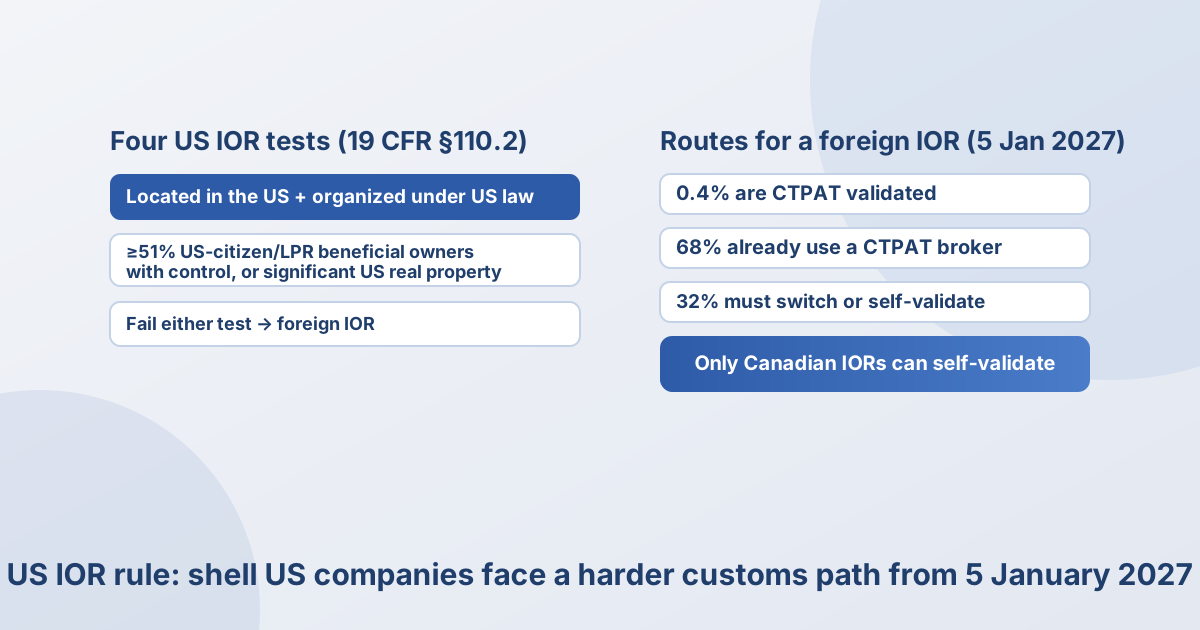
US Importer of Record Rule: From 5 January 2027, Shell US Companies Face a Harder Customs Path

US Customs and Border Protection's interim final rule (91 FR 69977, published 6 November 2026) takes effect on 5 January 2027: a foreign importer of record that does not qualify as a US IOR must be CTPAT validated itself or use a CTPAT-validated licensed customs broker for formal entry, and at present only Canadian foreign IORs can apply for CTPAT validation. This article breaks the US IOR test into four checks, explains what CBP's 16%/0.4%/68%/32% statistics do and do not measure, and compares a US LLC with real substance, a shell US LLC and a duty-inclusive forwarder, with a cost formula, a sensitivity case and a checklist for the end of December 2026.

Read more →

2026-11-19 · Research Briefs

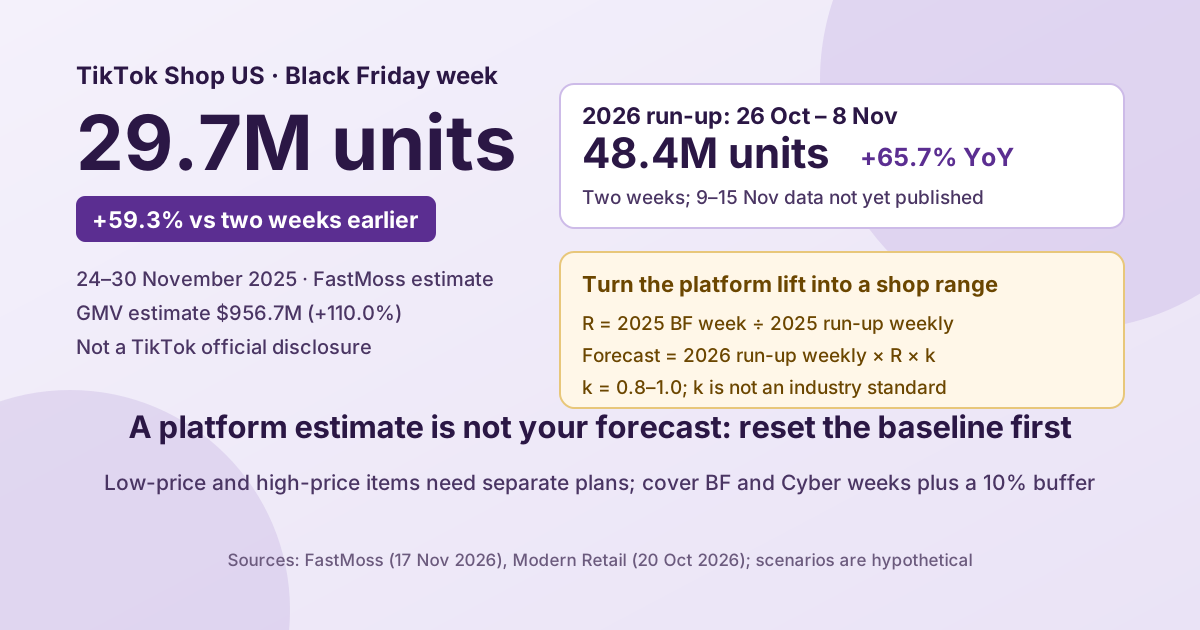
TikTok Shop US Black Friday Data: FastMoss Estimates 29.7 Million Units in 2025 and a 65.7% Run-Up in 2026 — How Sellers Should Convert Estimates into Stock and Creator Budgets

Using FastMoss's 17 November 2026 US weekly estimates, this article separates the 29.746 million units and $956.7 million GMV estimated for Black Friday week 2025 from the 48.449 million units (+65.7%) in the 2026 run-up, and from the 71.9% of units sold at $30 or less. It explains why these are third-party estimates, not TikTok actuals, and gives a baseline-reset method that converts the platform lift into a shop-level stock range. Two labelled scenarios — a $24.99 high-frequency item and a $79 low-frequency item — recompute the stock gap, affiliate commission and ad ceiling, with stop conditions and limits.

Read more →

2026-11-19 · Research Briefs

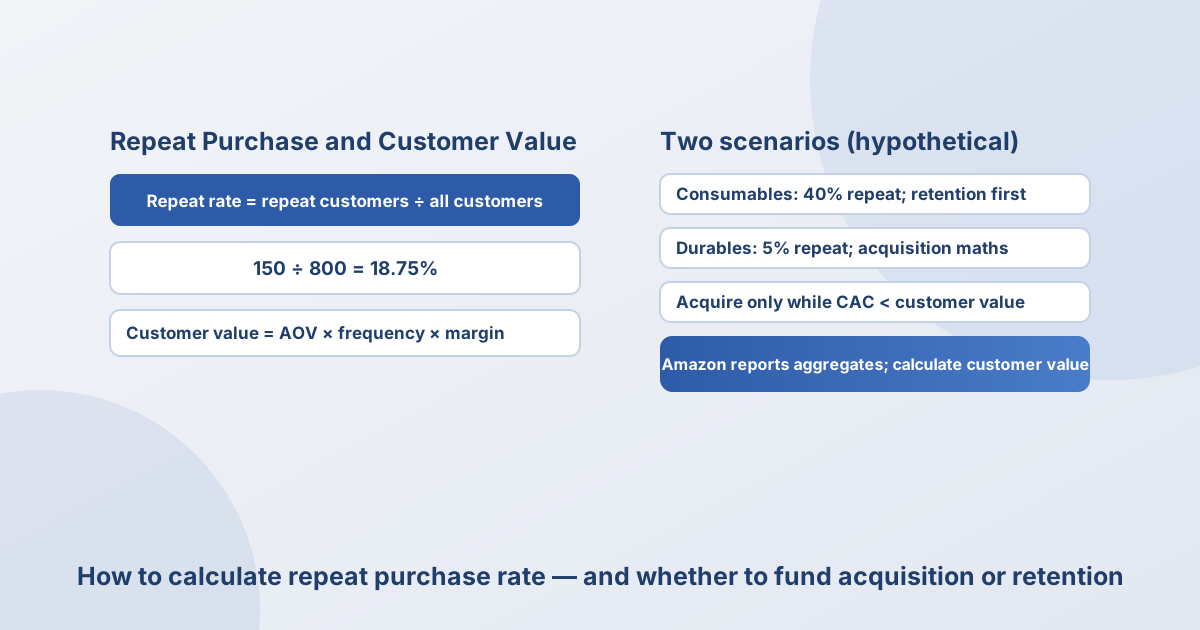
How to Calculate Repeat Purchase Rate: Using Amazon Repeat Purchase Behavior and Customer Loyalty Data to Decide Whether to Fund Acquisition or Retention

Connect Amazon Brand Analytics' Repeat Purchase Behavior (orders received, sales from repeat purchases and number of repeat customers) with Customer Loyalty Analytics (customer lifetime value and customer segments) into four recalculable metrics: repeat-customer rate, average purchase frequency, average contribution margin per customer and customer acquisition cost (CAC). Use a customer-value-versus-CAC inequality to decide whether the next dollar should go to acquisition or retention, with two scenarios — high-frequency consumables and low-frequency durables — that reach different conclusions.

Read more →

2026-11-19 · Research Briefs

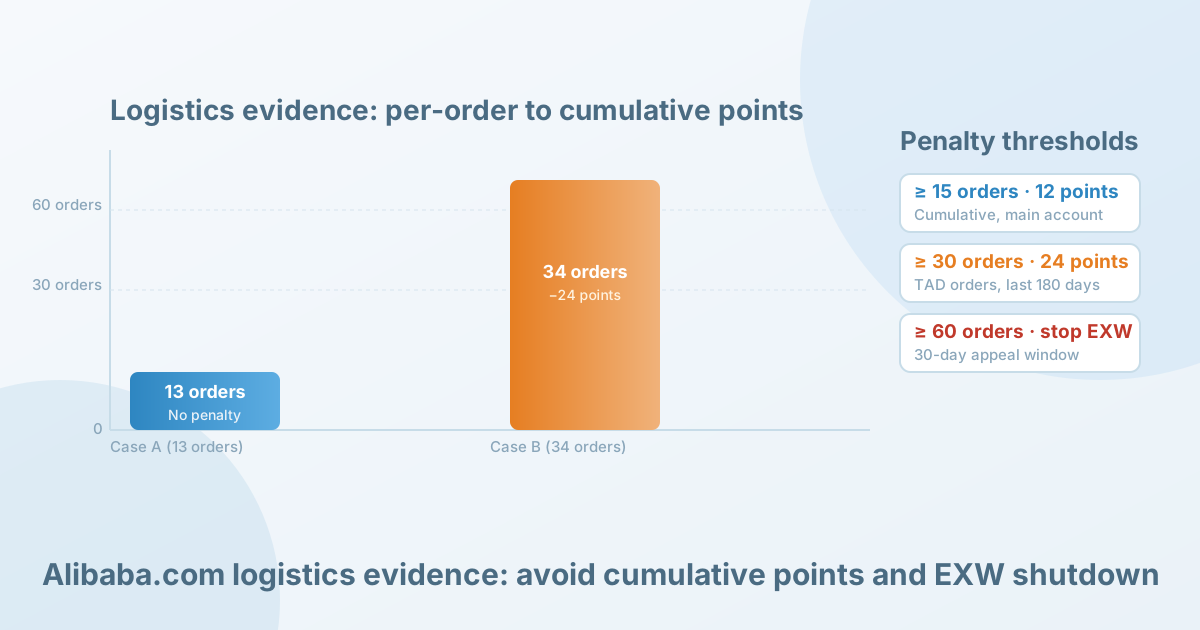
Alibaba.com Logistics Evidence Spot Checks Switch to Cumulative Penalties: 15 Orders to Trigger, 30 Days to Appeal, Counted per Main Account — How Export Sellers Avoid Points or Losing EXW Drafting Rights

Alibaba.com's logistics evidence spot checks move from per-order deductions to cumulative penalties: a 30-day appeal window, counting per main account, penalties from 15 orders and EXW drafting rights shut down at 60. This article turns the official penalty table into a recomputable confirmed-anomaly metric, uses two illustrative scenarios to show sensitivity around the 15 and 30 thresholds, and sets out a 30-day countdown for handling evidence.

Read more →
2026-11-19 · Research Briefs

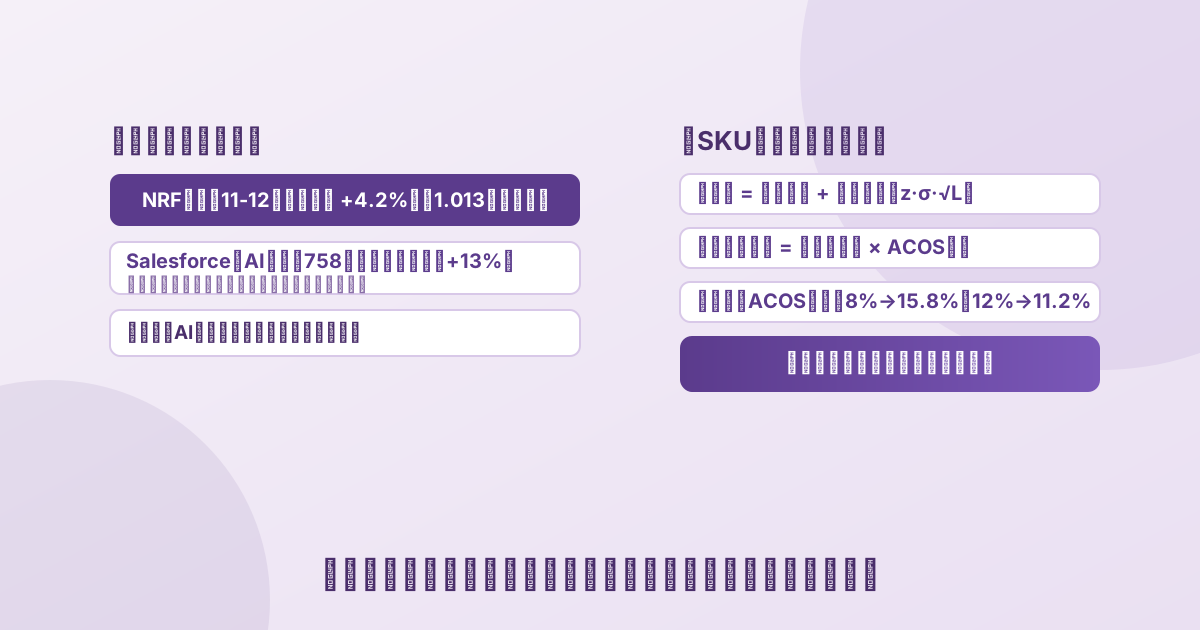
Black Friday and Cyber Monday Data Analysis: Amazon's Black Friday Week Opens 19 November with 12 Days of Daily Deals and Two Drops Each on Black Friday and Cyber Monday, Against US October Retail at +0.2% — How Cross-Border Sellers Should Set Price Floors, Deal Cadence and Ad Budget Caps

Grounded in Amazon's official Black Friday Week mechanics and the actual US October retail data, this article first explains how the 12-day window and two daily drops spread traffic peaks, then sets the Census and NRF retail measures side by side and translates the +0.2% headline and its category divergence into a per-SKU price floor, break-even ACOS and advertising budget cap, recomputing unit net profit in two illustrative scenarios (enrolled in a Deal vs not enrolled).

Read more →

2026-11-19 · Research Briefs

Category Market Sizing: How to Estimate Competitor Sales and Price Bands with Amazon's Official Data and Decide Whether a Category Is Worth Entering

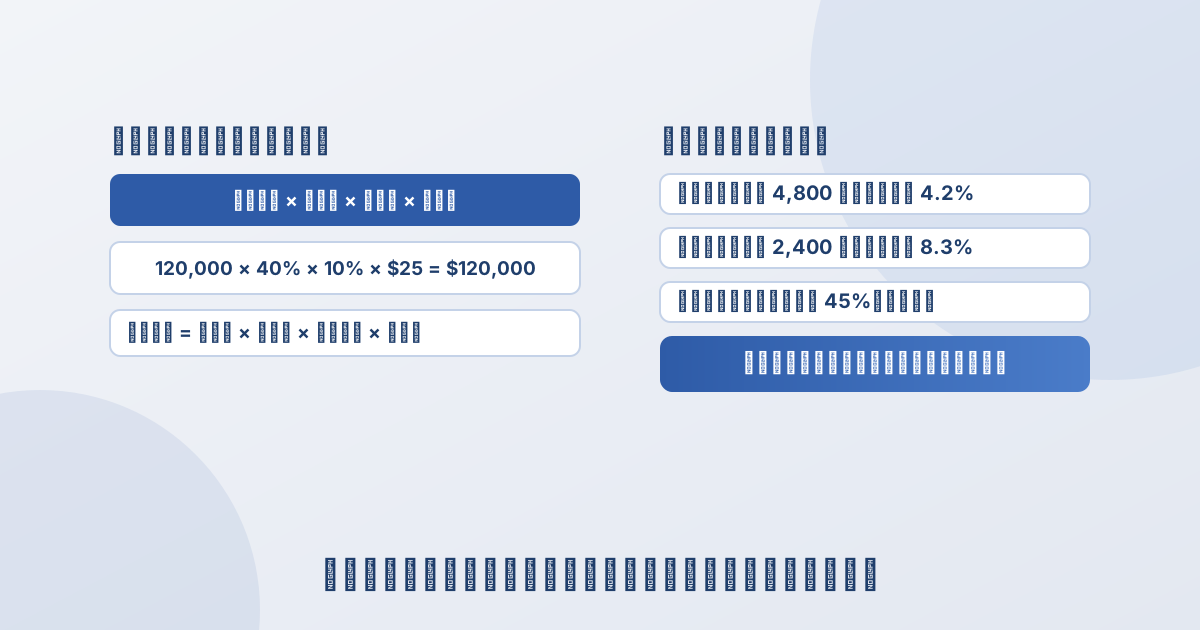
This article connects the search volume, clicks, add-to-carts, purchases and competitive shares from Amazon's Product Opportunity Explorer and Brand Analytics into a bottom-up funnel, estimates a category's monthly units and monthly GMV range as search volume × click-through rate × conversion rate × average order value, then back-solves leading competitors' sales from click share, adds price-band analysis using the Top 3 products in Top Search Terms, and uses two recomputable scenarios (ample capacity and capacity halved) to decide whether to enter, place a trial order or walk away.

Read more →

2026-11-19 · Research Briefs

EU Recycled Plastics Compliance Rule Takes Effect on 18 November: Which Declaration of Conformity Do Recycled-PET Tableware, Bottles and Sheet Need at Customs Clearance, and How Long Can Old Stock Still Be Sold?

Using the first-hand EUR-Lex text of Commission Regulation (EU) 2026/2376, this article sets out which declaration of conformity recycled-PET tableware, bottles, film and sheet must submit under Table 6 when released for free circulation after 2026-11-18 (upstream material submits P/A/B, downstream finished goods submit C), splits the transition period — declarations A or B may be placed until 2027-02-18 and declarations C or P until 2027-05-18 — into two decision paths (old-rule compliant vs no upstream declaration), and uses two scenarios plus a port-storage cost example to judge whether to keep selling, obtain the declaration before shipping, or hold the shipment.

Read more →
2026-11-19 · Research Briefs

Inventory Turnover and Replenishment Decisions: Using Amazon's 28-Day Supply Threshold and Mercado Libre's 60-Day Storage Tiers to Calculate Safety Stock, Reorder Points and Stockout Stop-Loss Lines

Using the inventory turnover and days-of-supply formulas, combined with Amazon's low-inventory fee threshold at 28 days of supply and Mercado Libre's monthly storage fee that steps up by inventory age after 60 days, this article gives the reorder point, safety stock and hold-or-clear decision for a fast-moving and a slow-moving scenario.

Read more →
2026-11-19 · Research Briefs

Ozon Data Analysis: Manual Pushes Rise to RUB 3 per Recipient from 3 December While Automatic Push Holds at RUB 2, and How Russia-Site Sellers Should Recalculate Reach Cost Using Their Historical Seasonal Coefficients

From 3 December, Ozon raises manual (one-off) pushes to RUB 3 per recipient, keeps automatic push at RUB 2 and removes the seasonal coefficient for both notification types. Using the official current formula (RUB 2 × recipients × seasonal coefficient), this article reconstructs two hypothetical scenarios, shows that the manual break-even coefficient is 1.5 and the automatic one is 1.0, and sets out how to regroup historical coefficients, recalculate reach cost and shrink the manual list.

Read more →
2026-11-19 · Research Briefs

Cross-Border E-Commerce Return Rate: How Much Does One Return Actually Cost? Separating Size, Quality and Fraudulent Returns, Calculating the Real Cost of Returns and Setting a Stop-Loss Line

Using NRF's US retail return-rate definitions and Amazon's returns policy, this article breaks the return rate into five accounts — refund, non-refunded fulfilment fee, refund administration fee, above-threshold processing fee and unsellable purchase value — uses two hypothetical scenarios to judge whether low-price small items should offer returnless refunds and how high-price electronics should avoid crossing the threshold and triggering the frequent-returns badge, and gives a reproducible break-even return rate.

Read more →
2026-11-19 · Research Briefs

Advertising ROAS and Break-Even ACoS: Work Out Pre-Ad Profit, Then Decide Whether an Amazon Campaign Should Get More Budget, Lower Bids or Be Shut Down

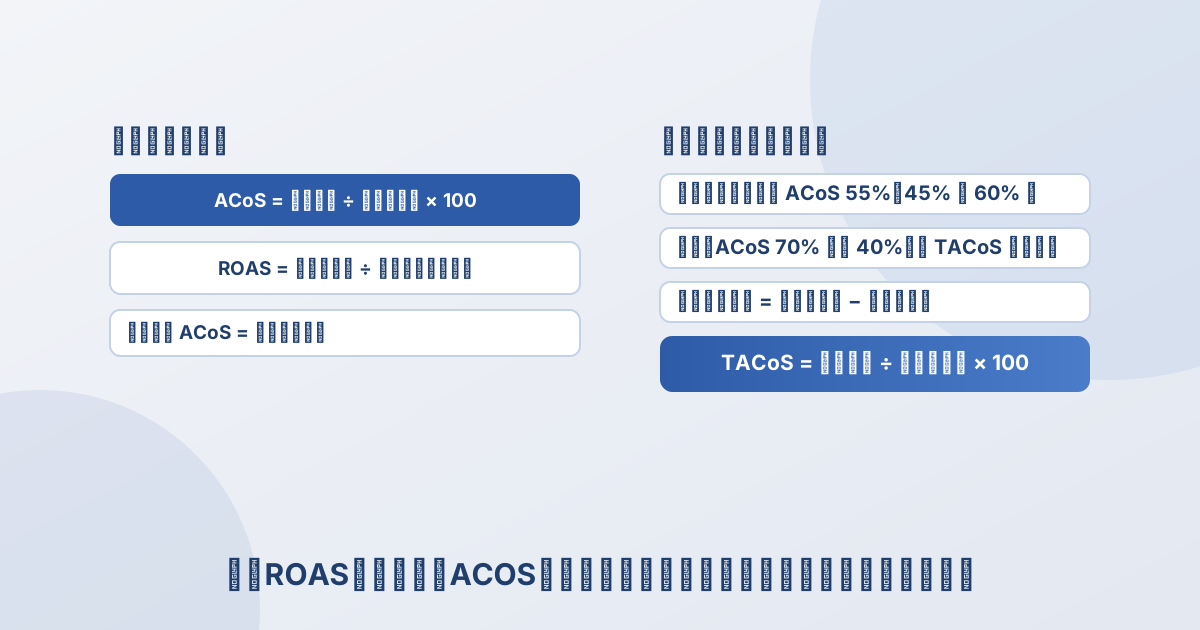
Using Amazon Ads' official ACoS and ROAS formulas, this article turns the rule that break-even ACoS equals the pre-ad profit margin into recalculable examples: two scenarios, a mature product and a new launch, decide whether advertising should get more budget, lower bids or be shut down, and TACoS separates buying rank at a loss from simply losing money.

Read more →
2026-11-19 · Research Briefs

Temu Data Analysis: Why PDD's Filings Show No Standalone Temu GMV and Temu Publishes No Rate Card, and How Cross-Border Sellers Can Work Out Per-Unit Profit for Fully Managed and Semi-Managed Models After the EU's €3 Duty Plus €2 Handling Fee

PDD's filings disclose only group transaction services revenue and do not break out Temu GMV; Temu publishes no rate card either. Using the EU's verifiable €3 per-item duty plus €2 handling fee (€5 per item in total), this article calculates per-unit profit separately for fully managed and semi-managed models and sets out the conditions for entry, model choice and pricing.

Read more →
2026-11-19 · Research Briefs

Temu Compliance: EU Preliminarily Finds Temu in Breach of the Digital Services Act, and the Three Gaps in Product Checks, Content Moderation and Seller Penalties That Decide Whether Sellers Should Fill Test-Report Gaps or Diversify Platforms

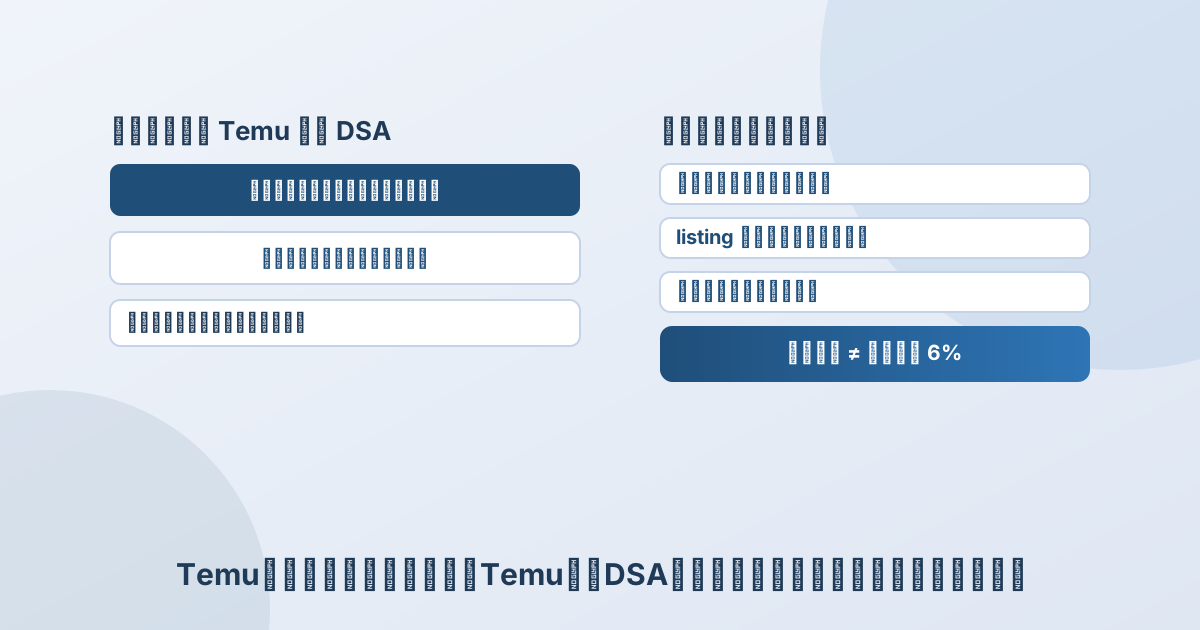
On 17 November 2026 the European Commission preliminarily found Temu in breach of the Article 35 risk-mitigation obligation of the Digital Services Act, citing three shortcomings in product compliance checks, content moderation and seller penalties, with a maximum fine of 6% of global annual turnover if confirmed. This article translates the three gaps into three metrics sellers can self-audit - test-report coverage in high-risk categories, wrongful-hit risk in listing moderation, and the mapping between stores and operators - and uses two hypothetical scenarios to set out the conditions for filling reports, delisting or diversifying platforms.

Read more →
2026-11-19 · Research Briefs

TikTok Data Analysis: Splitting Attributed GMV into Per-Unit Net Contribution on the Official Settlement Basis, and Back-Solving the Creator Commission Ceiling and the Stop Point

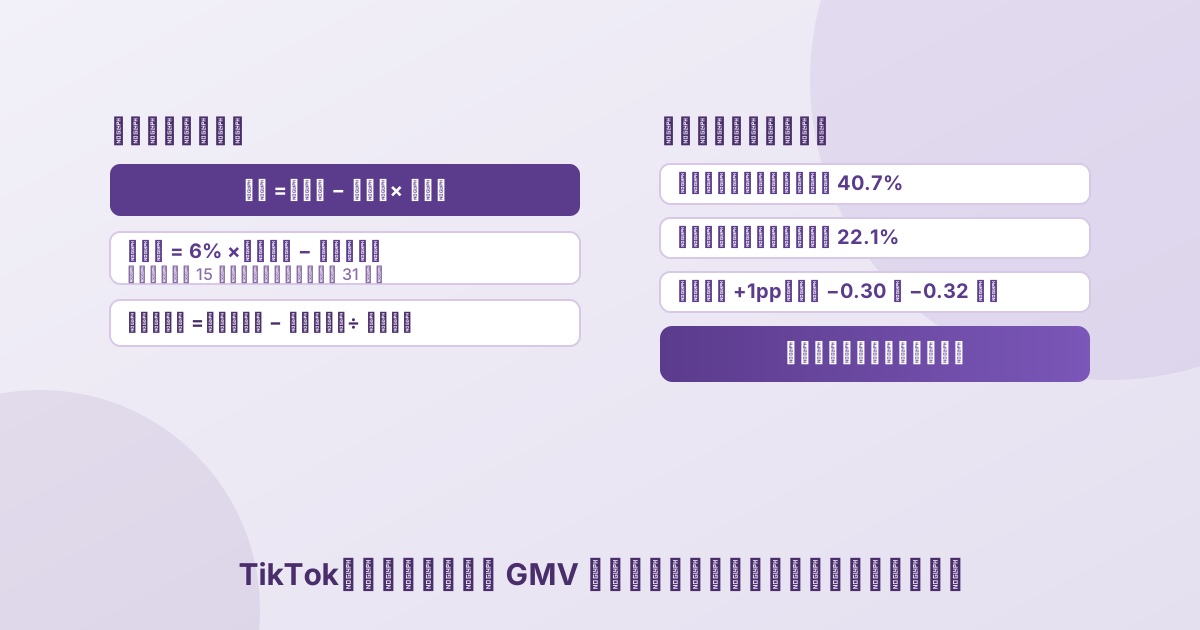
Using the official commission formula (revenue − refunds) × rate and the 6% referral fee basis, this splits attributed GMV into per-unit net contribution, back-solves the bearable commission ceiling, and sets out the conditions for scaling up, compressing commission or stopping.

Read more →
2026-11-19 · Research Briefs

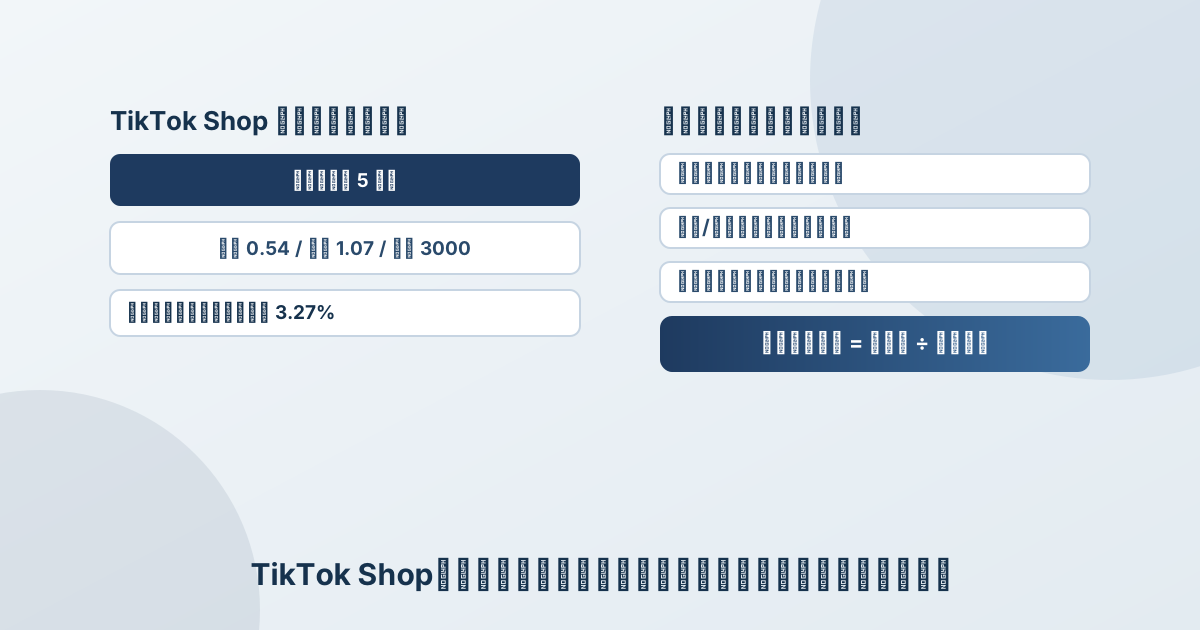
TikTok Shop Southeast Asia Order Fees: Philippines PHP 5 per Item, Malaysia MYR 0.54, Thailand THB 1.07, Vietnam VND 3,000 and Singapore 3.27% — How Cross-Border Sellers Calculate the Minimum Sellable Price and Multi-Packs

On 2026-11-17 TikTok Shop published its notice on Southeast Asia cross-border order fees, setting out in one place the per-order platform fees for the Philippines, Malaysia, Thailand, Vietnam and Singapore. This article separates the per-item, per-order and proportional bases, uses the formula fixed fee ÷ target rate to derive the minimum order value in each market, and gives the decisions on multi-packs, price rises and refunds.

Read more →
2026-11-18 · Research Briefs

Amazon FBA Fees for 2027: US Delivery Fees Up an Average of $0.19, AWD/MCD Transport and the 3.5% Surcharge Expand, and How Sellers Should Recalculate Cost per SKU

Using Amazon's official announcements, this article sets out the 2027 US fee changes precisely: FBA delivery fees up an average of $0.19, simplified storage fees, updated low-inventory-level fee rules, and the 3.5% fuel and logistics surcharge expanding to AWD transportation fees and MCD logistics fees from 1 February 2027. A hypothetical per-unit contribution and AWD/MCD transport model shows how to recalculate cost by price band, inventory age and fulfilment method, and sets out the conditions for raising prices, clearing stock, changing packaging or switching to third-party logistics.

Read more →
2026-11-18 · Research Briefs

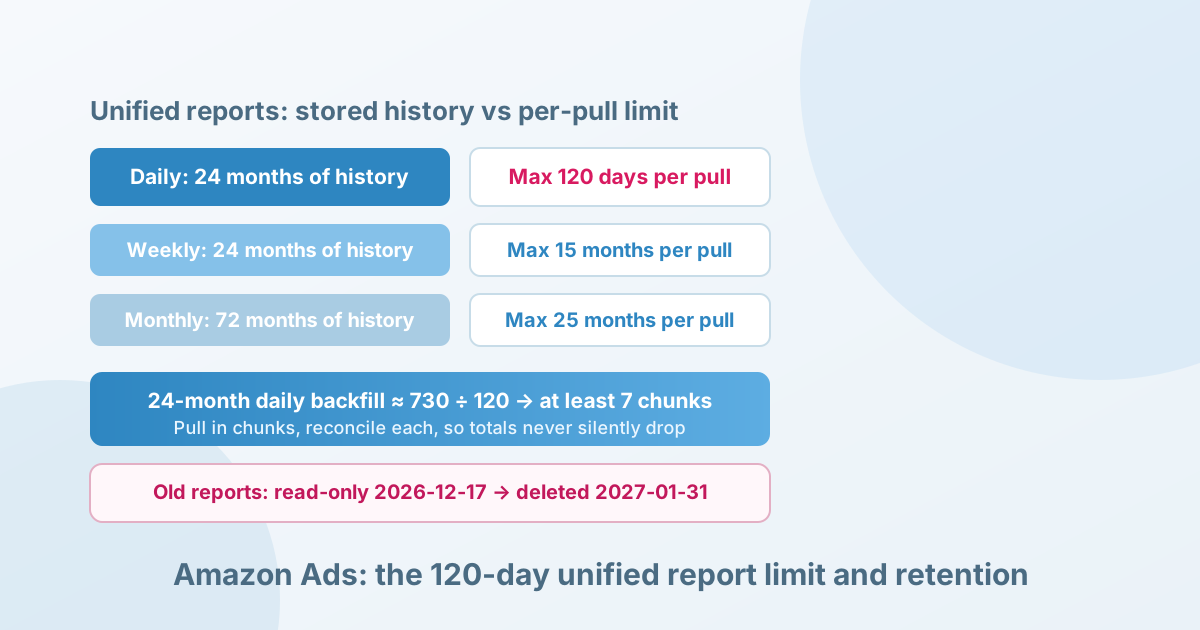
Amazon Advertising Data Analysis: Daily Unified Reports Cap at 120 Days per Pull Against a 24-Month History, and How to Rebuild Year-over-Year Comparisons and Retention Before Legacy Reports Close on 31 January 2027

Drawing on Amazon Ads' official Support Center and PPC Land, this article separates 'historical depth' from 'maximum single pull' in unified reporting, recalculates the number of backfill pulls for the 120-day, 15-month and 25-month windows, and sets out two hypothetical scenarios for rebuilding year-over-year comparisons and retention SLAs, so that data is not silently lost before the legacy reports close.

Read more →
2026-11-18 · Research Briefs

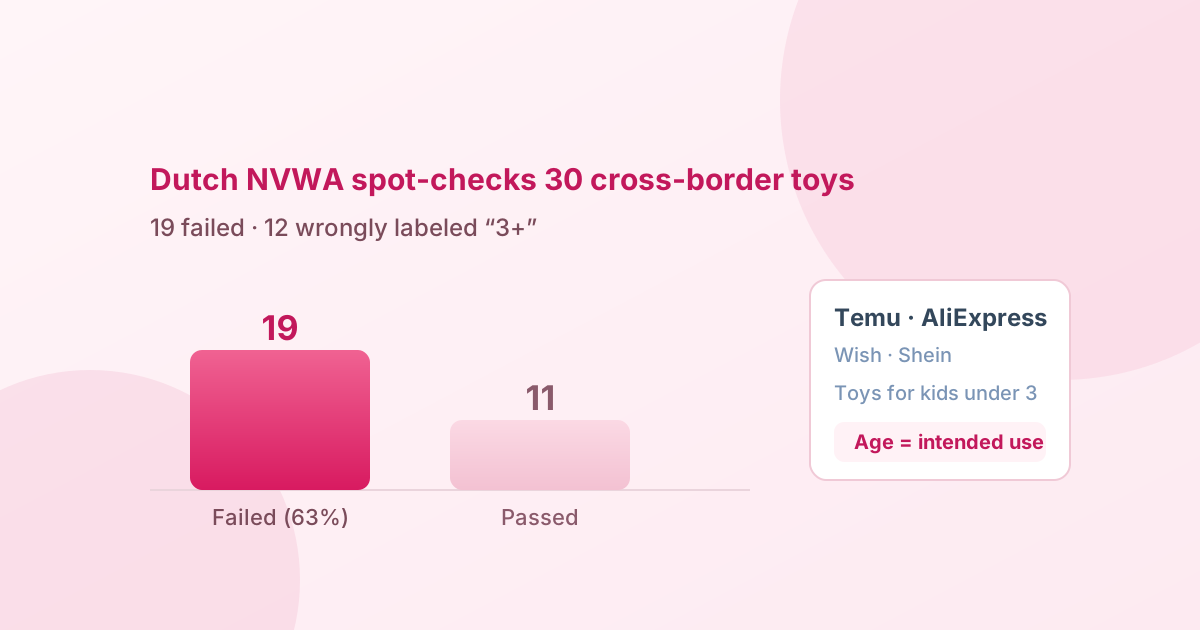
EU Toy Compliance: 19 of 30 Cross-Border Toys Fail Dutch Inspections — a "3+" Label Won't Dodge Under-Three Testing, and How Sellers Can Fix Listings Before Delisting

Using the Dutch NVWA's first-hand inspection results, this article clarifies what the "63% failure rate" sampling basis actually is, explains why age is judged by intended use rather than the label on the packaging, and uses a hypothetical peak-season revenue exposure with a stop-selling and retest decision tree to set out tiered actions for wooden toys, collectible figures and magnetic SKUs.

Read more →
2026-11-18 · Research Briefs

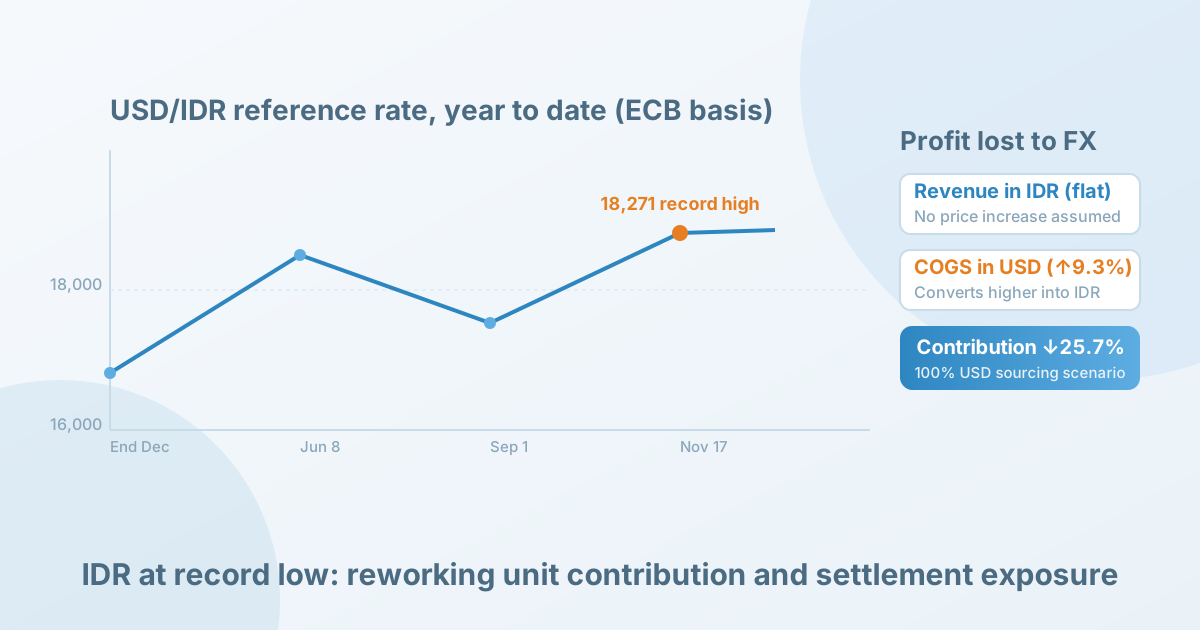
Indonesia E-commerce Data Analysis: The Rupiah Hits a Record Low — How Sellers Recalculate Unit Contribution and Settlement Exposure, and Choose Between Price Rises, Shorter Settlement Cycles and Local Sourcing

Using the European Central Bank's first-hand reference rates, this article verifies that USD/IDR rose to a record 18,271 on 17 November, explains how depreciation squeezes unit contribution through two chains — purchasing cost and revenue conversion — recomputes two hypothetical scenarios (100% US-dollar purchasing and 70% local purchasing), and sets out the triggers for three paths: raising prices, shortening settlement and sourcing locally.

Read more →
2026-11-18 · Research Briefs

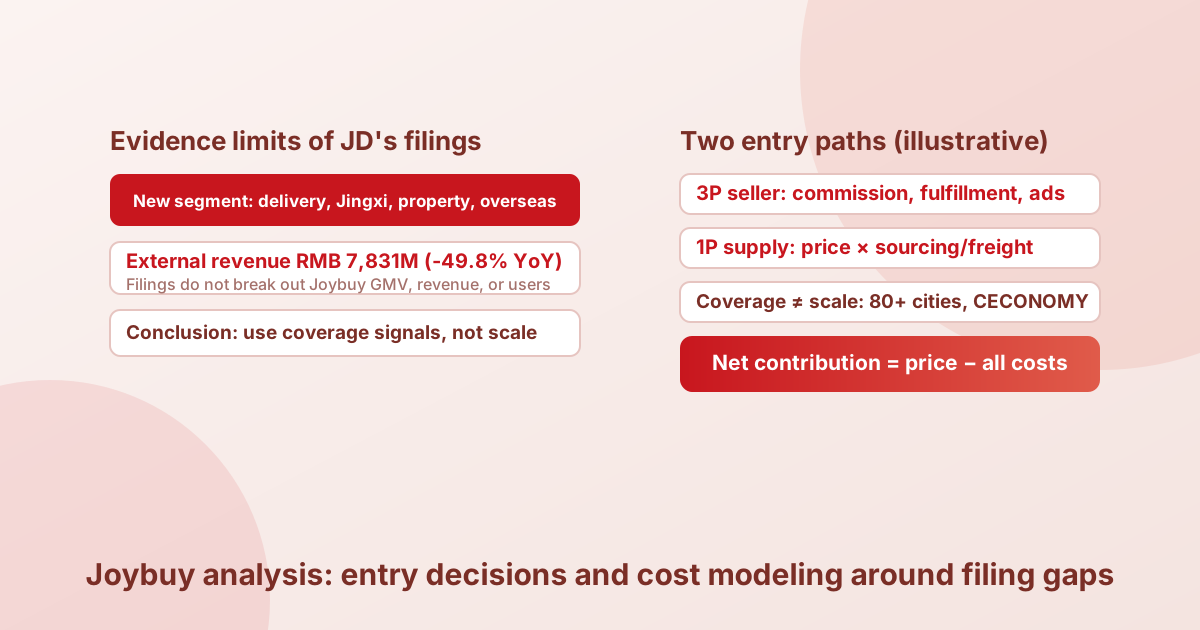
Joybuy Data Analysis: Why JD.com's Filings Show No Standalone GMV — and How Sellers Should Judge an Invite-Only Curated Marketplace and Cost Out Per-Unit Economics

Based on JD.com's third-quarter 2026 results (SEC Form 6-K) and European e-commerce media, this article explains the evidence boundary created by Joybuy being folded into JD's New Businesses segment with no standalone GMV disclosure, separates coverage signals from scale signals, and uses two hypothetical scenarios — 1P brand supply and a 3P curated marketplace — to recompute unit contribution and supply gross margin, before setting out a self-check for the entry decision.

Read more →
2026-11-18 · Research Briefs

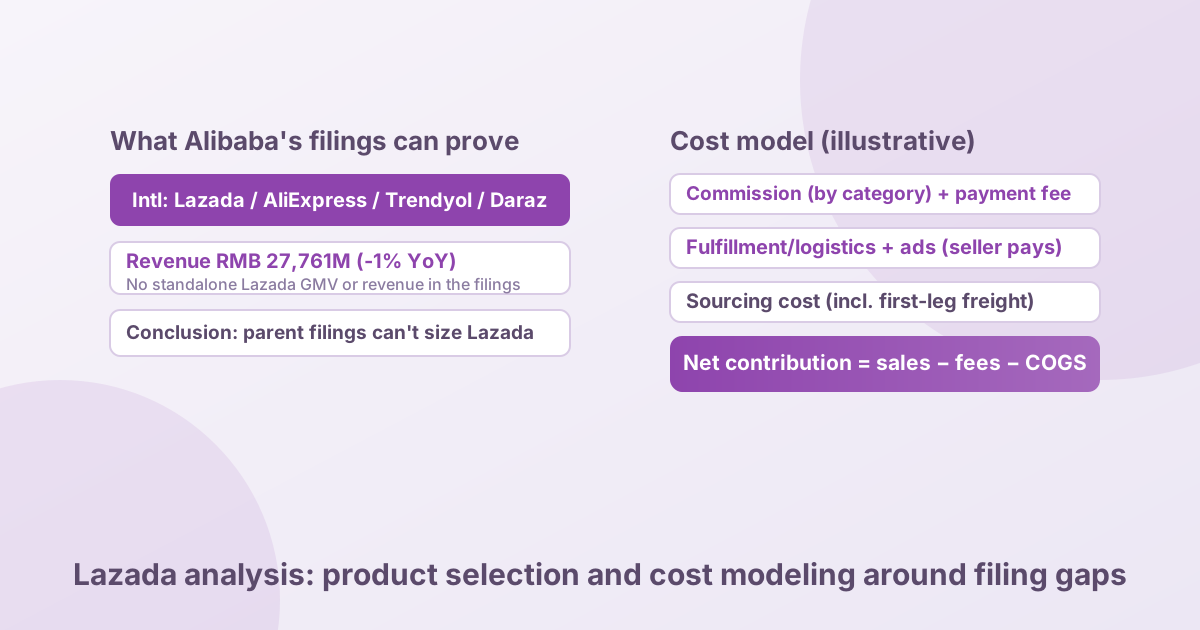
Lazada Data Analysis: Why Alibaba's Filings Show No Standalone Lazada GMV — and How Sellers Work Around the Data Gap on Selection and Fee Modelling

Based on Alibaba's June-quarter 2026 results and its business structure page, this article explains the evidence boundary created by Lazada being folded into the International E-commerce segment with no standalone GMV disclosure, then uses two hypothetical scenarios to recompute unit contribution under commission, payment fees and fulfilment fees, and sets out a self-check for site selection and fee modelling.

Read more →
2026-11-18 · Research Briefs

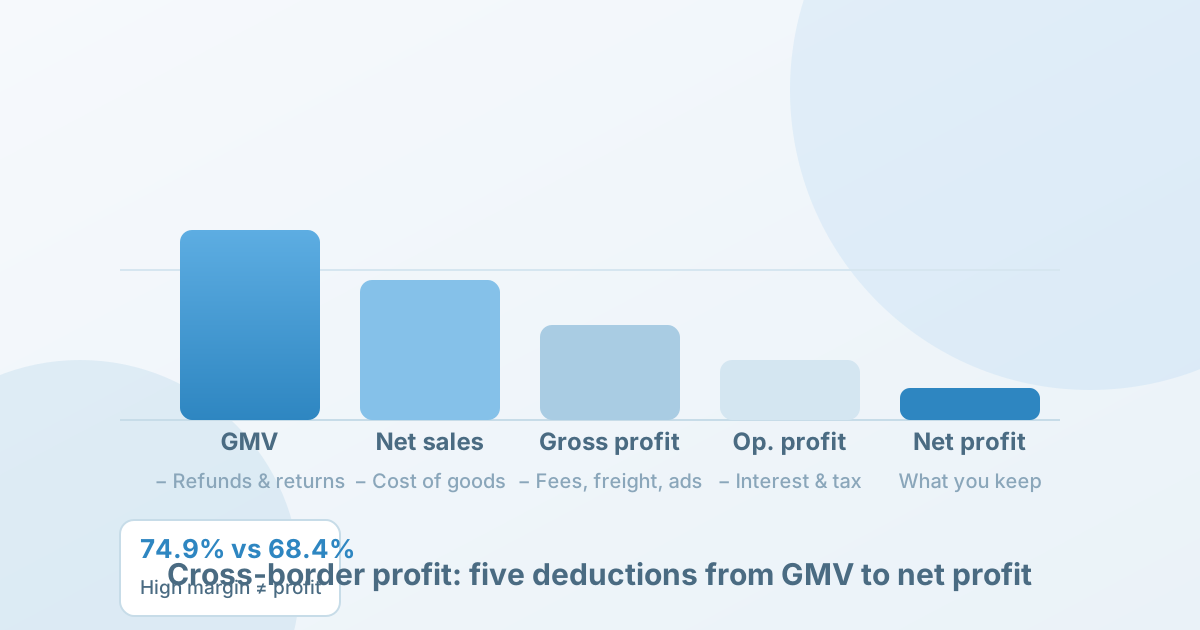
Cross-Border Profit Accounting: The Five-Step Subtraction from GMV to Net Profit, and How to Avoid Overstating Profit

Using the subtraction structure of the US IRS Schedule C and the official fee schedules of Amazon and Shopee as the baseline, this sets out five layers — GMV, net sales, gross profit, operating profit and net profit — uses two recomputable scenarios to show that a high gross margin does not mean profit, and gives the fields to record plus continue and stop conditions.

Read more →
2026-11-18 · Research Briefs

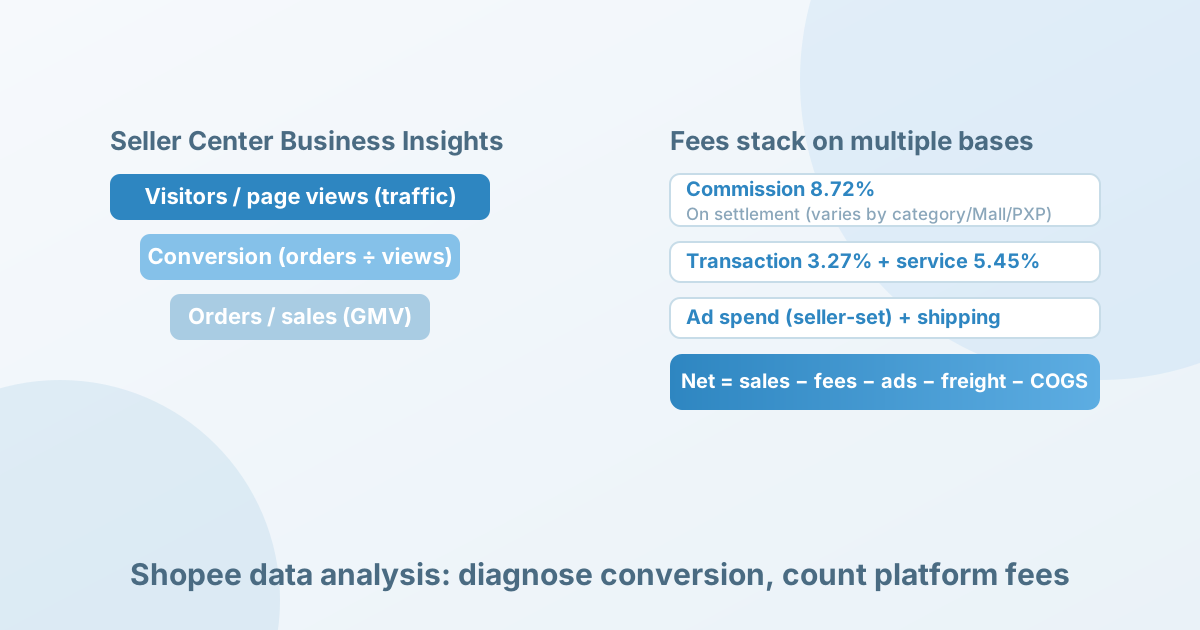
Shopee Data Analysis: Diagnose Conversion with Seller Centre Business Insights and Official Fees, Work Out What the Platform Takes, and Turn GMV Growth into Ad and Market Decisions

Drawing on Sea Limited’s Q3 2026 results and Shopee Seller Centre documentation, this explains the two sources of Shopee data and the multiple bases on which fees are charged, recomputes unit net contribution and break-even advertising in two hypothetical scenarios, and shows how to decide ad spend on incremental profit rather than order count when ad take rates rise.

Read more →
2026-11-18 · Research Briefs

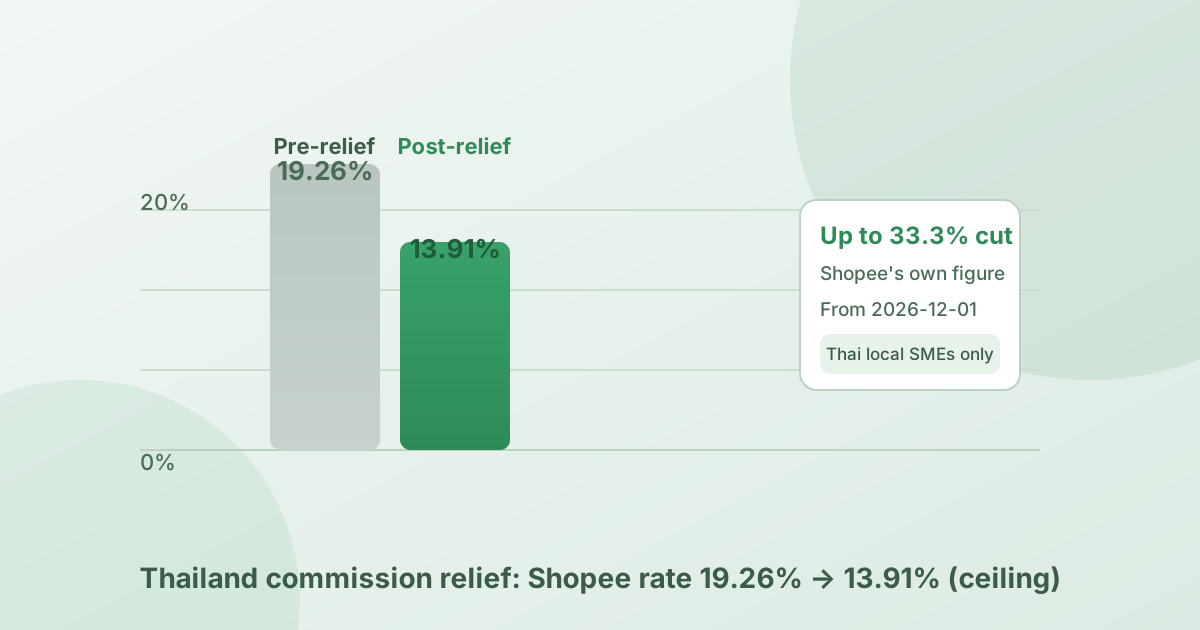
Thailand E-commerce Commission Relief: Shopee’s Cap Falls from 19.26% to 13.91% on 1 December — How Cross-Border Sellers Should Test Eligibility and Size the Saving

Using the Thai government announcement and Shopee seller-centre rules to bound the evidence, this explains the conditions, rate ranges and electronics exclusion under which the three platforms will cut mandatory fees for local SMEs from 1 December, uses a recomputable saving model to compare an eligible Thai seller with a China-based cross-border seller shipping direct, and sets the order of work: test eligibility, then size the saving, then decide whether to move the entity.

Read more →
2025-02-27 · Industry Insights

January 2025 Lazada Southeast Asia Cosmetics Best-Sellers Report

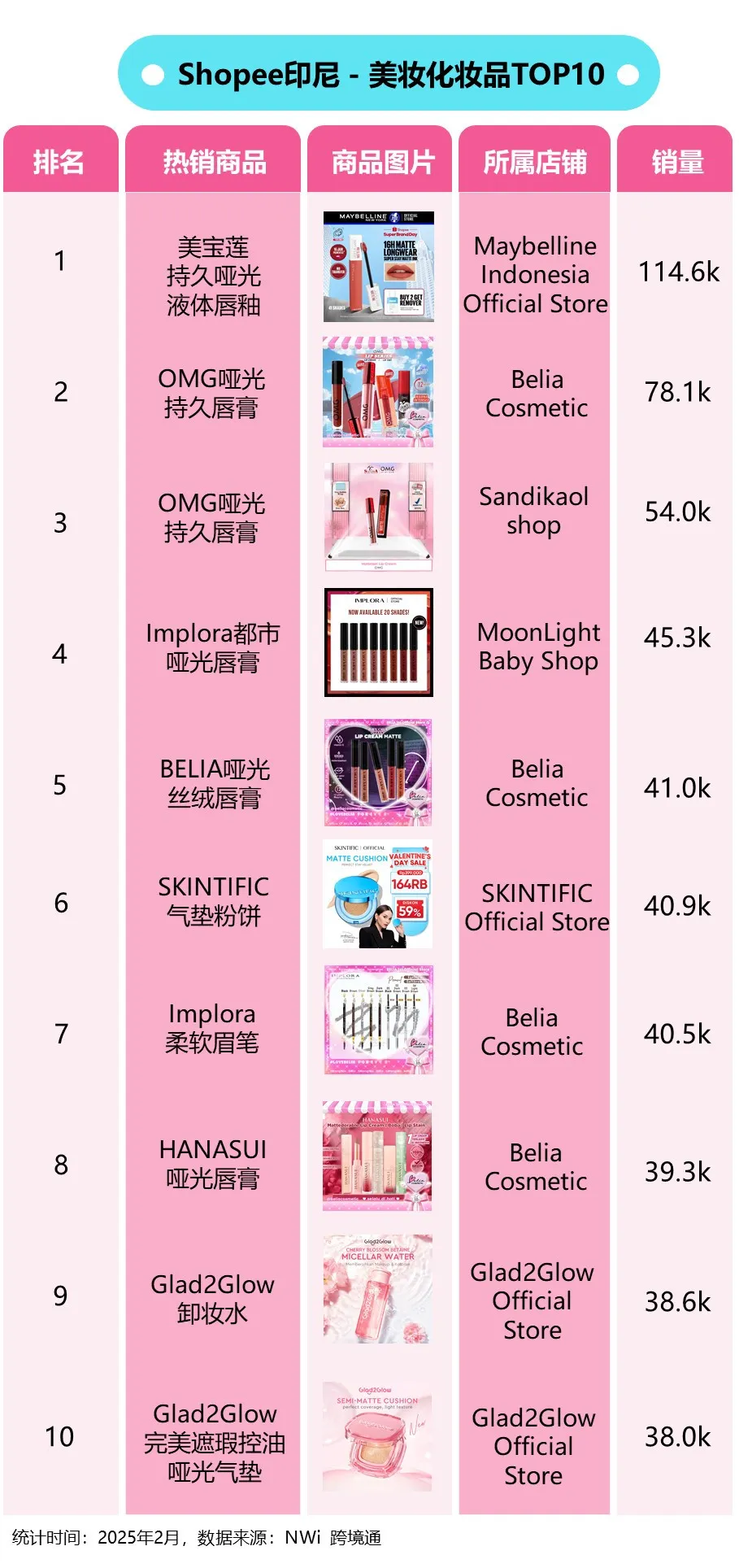
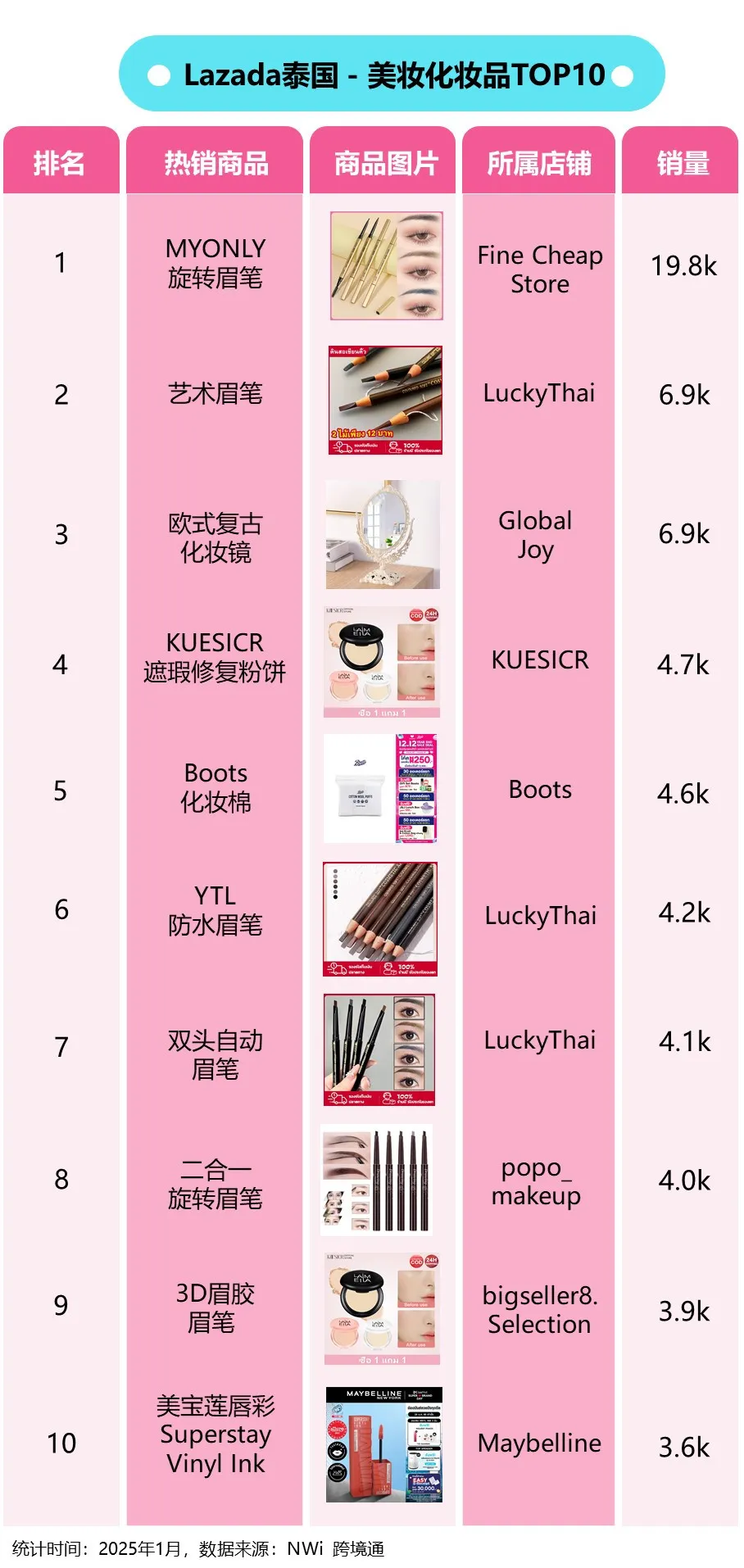
NWi compiles January 2025 Lazada Southeast Asia cosmetics TOP10 best-seller lists across six markets, providing in-depth analysis of beauty trends in Thailand, Vietnam, Singapore, Indonesia, Malaysia, and the Philippines to help cross-border sellers with precise product selection.

Read more →

E-commerce data, methods and reports

Explore NWi EC Data product pages, platform coverage, data definitions and published research. Each source states its scope, definitions and limits.