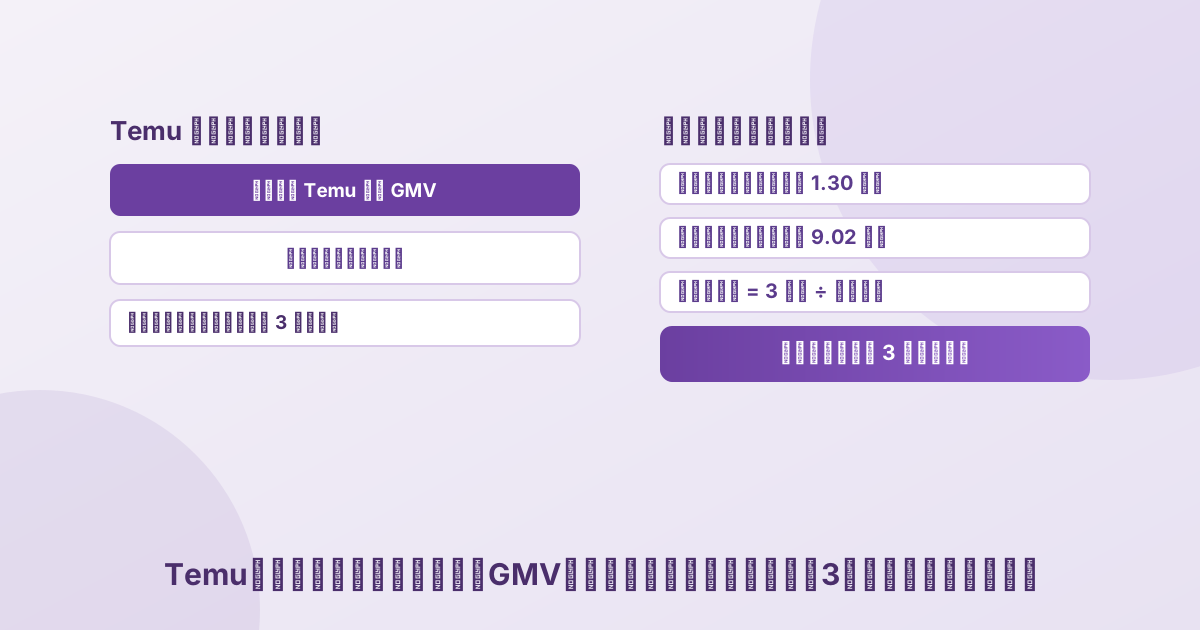
For Chinese cross-border sellers considering Temu, the core question is this: with neither PDD's filings nor Temu itself disclosing standalone platform GMV or a public rate card, how can a seller judge whether to enter, whether to choose fully managed or semi-managed, and whether low-priced goods aimed at the EU still make a profit after the €3 per-item duty plus the €2 handling fee? The answer comes in three steps: first treat the EU's €3 duty plus €2 handling fee on low-value parcels (€5 per item in total) as a publicly verifiable, certain cost; then calculate per-unit profit separately along the two paths - fully managed (supply price, direct shipping) and semi-managed (local fulfilment); finally use the crossover point 'ordinary duty rate × goods value = €5' to judge which path low-priced goods should take. The per-unit net profit in this article's two scenarios is €1.30 (before the fixed fee) and €9.02; at an assumed ordinary duty rate of 8%, goods worth less than about €62.50 are worse off paying the €5 per-item fixed fee (€3 duty + €2 handling fee) than the ad valorem ordinary duty, and local fulfilment is cheaper.
Update note (2026-11-19): the first version of this article calculated only the €3 per-item duty; this revision adds the €2 per-item handling fee (Union handling fee) applicable from 2026-11-01, and corrects the fixed-fee basis in both scenarios from €3 per item to €5 per item (€3 duty + €2 handling fee).
1. The decision: should you still enter Temu when the data is opaque?
A Chinese cross-border seller currently evaluating Temu has three decisions to make: whether to enter the platform at all, whether to go fully managed or semi-managed, and whether low-priced goods aimed at the EU still make a profit after the €3 per-item duty plus the €2 handling fee. What makes this hard is that Temu discloses less than most platforms: PDD's filings do not break out Temu's GMV, Temu publishes no official rate card, and sellers can only approximate with group-level filings, EU customs rules and third-party rate consensus.
2. Mechanism: Temu's data is opaque in two ways
The first layer of opacity is GMV. Temu's parent PDD Holdings (Nasdaq: PDD) discloses only group-level total revenue, online marketing services revenue and transaction services revenue; transaction services revenue bundles the domestic Pinduoduo marketplace and overseas Temu together, and Temu's GMV or order volume is never shown separately.
The second layer of opacity is rates. Temu, unlike Amazon or Shopee, does not publish a single unified fee schedule; the official seller centre requires a login before an account's applicable category rates are visible. Third-party seller guides generally report semi-managed (local seller) commission of about 8%-15% and a fully managed (supply / pricing review) effective take rate of about 2%-5%, but these figures are not confirmed by Temu and should be treated only as planning ranges.
These two layers of opacity hit seller cost and cash through two channels: first, without standalone Temu GMV, a seller cannot size the platform or the category capacity and can only use group transaction services revenue as an upper-bound reference; second, without a public rate card, a seller has no anchor for setting commission or supply price and must rely on third-party ranges and reverse-engineer from their own settlement reports.
| Dimension | Fully managed (supply / pricing review) | Semi-managed (local seller) |
|---|---|---|
| Retail price | Set by Temu; the seller only receives a supply price (pricing review) | Set by the seller |
| Effective take rate | About 2%-5% (third-party consensus) | About 8%-15% (third-party consensus) |
| Fulfilment | Platform cross-border direct shipping; the seller stocks a domestic warehouse | Seller's local warehouse or self-shipping |
| Duty path | Individual parcels shipped direct to the EU; ≤€150 attracts the €3 per-item duty + €2 handling fee = €5 | Bulk entry into an EU warehouse (goods value far above €150); ordinary duty applies |
| Returns | Platform bears them; return cost is folded into the supply price | Seller bears them and must build returns handling |
The certain, publicly verifiable cost is the two fixed charges the EU now levies on low-value parcels: first, from 1 July 2026, imported e-commerce parcels worth no more than €150 (B2C distance sales) attract a €3 duty per item, counted by declared line and product classification, running until 1 July 2028; second, from 1 November 2026, all member states charge a further €2 handling fee (Union handling fee) per low-value distance-sales parcel, stacked on the €3 duty, counted by declared line and non-refundable. Together, a low-value direct-shipped parcel containing a single declared item moves from €3 to €5 in fixed fees per item.
The €2 handling fee is counted per declared line (goods of the same duty classification, description and origin), not per parcel or per physical unit: several units of the same style and colour can be consolidated into one declared item and incur the €2 once; goods from different categories crammed into one parcel accumulate line by line. The €2 handling fee is also non-refundable - a return does not recover it - which multiplies the return rate straight into fixed cost, a layer invisible when only the €3 duty is counted.
3. Evidence boundary: which numbers you can trust, and which cannot be inferred
What this article can verify item by item is the group revenue basis in PDD's Q2 2026 filing, the €3 per-item duty under Council Regulation (EU) 2026/382, the €2 per-item handling fee under the Council policy page and Commission Delegated Regulation C(2026)6694, and the fact that third-party rate consensus is only an unconfirmed range; what cannot be inferred is Temu's standalone GMV, the commission rate that applies to your category, and the proportion in which the €3 duty and €2 handling fee are actually passed between platform and seller.
A few easy misuses: first, transaction services revenue is not Temu GMV, because it includes the domestic Pinduoduo marketplace; second, the 8%-15% semi-managed range is third-party consensus, not an official commitment; third, the €3 per-item duty is counted by declared line, so goods with different HS codes in the same parcel are each assessed and you cannot assume one charge per parcel; fourth, the €2 handling fee and the €3 duty are two different charges, both counted by declared line and levied together, so counting only €3 is wrong.
4. Counter-case and alternative explanation: the €5 fixed fee does not matter equally for all goods
One scenario that overturns 'low price means fully managed direct shipping' is this: the €5 per-item fixed fee is punitive for low-priced goods - on an €8 retail price, €5 equals 62.5%, but on a €40 item it is only 12.5%. The alternative explanation is that semi-managed local fulfilment ships goods into an EU warehouse in bulk, with the consignment value far above €150, so the €3 per-item duty does not apply, and the €2 handling fee is also counted on the low-value distance-sales basis and does not apply to bulk commercial imports; ordinary duty by HS code applies instead. The same product therefore faces completely different fixed-fee treatment when direct-shipped and when locally fulfilled.
How to tell them apart: first see which side of the line your goods value falls on, then look at the ordinary duty rate. At an assumed 8% ordinary rate, when 8% × goods value = €5, the crossover is about €62.50; goods below that value are worse off with the €5 per-item fixed fee on direct shipping than with ordinary duty, and local fulfilment is cheaper.
5. Reproducible analysis: hand calculations and the crossover point for the two scenarios
Both scenarios use the same ledger: per-unit net profit = revenue basis - procurement - commission - fulfilment - payment - duty - handling fee. Both are explicitly labelled hypothetical examples, not statistics from any real shop or platform.
Scenario A: fully managed low-price direct shipping, €1.30 net profit per unit (before the fixed fee, hypothetical example)
Hypothetical example: retail price €8, seller supply price (pricing review) €2.50, procurement cost €1.20, target net profit €0.50 per unit.
Per-unit net profit = 2.50 - 1.20 = €1.30; acceptable supply-price floor = 1.20 + 0.50 = €1.70; tolerance for passing on the fixed fee = 2.50 - 1.70 = €0.80. The €5 per-item fixed fee (€3 duty + €2 handling fee) is 62.5% of the retail price; if the platform passes the full €5 into the pricing review, the supply price falls to 2.50 - 5.00 = -€2.50, below the €1.70 floor.
An €8 item has almost no buffer for a €5 fixed fee under fully managed direct shipping; the seller should push for a higher retail price, switch to a higher-value variant, or evaluate moving to semi-managed local fulfilment; if the pricing review is pushed below €1.70, stop supplying.
Scenario B: semi-managed local fulfilment at a mid price point, €9.02 net profit per unit (hypothetical example)
Hypothetical example: retail price €22, commission rate 12%, procurement cost €5, local warehousing and fulfilment €4, ordinary duty rate 8%.
Commission = 12% × 22 = €2.64; payment processing = 2.9% × 22 + 0.30 = €0.94; ordinary duty = 8% × 5 = €0.40; total cost per unit = 2.64 + 5.00 + 4.00 + 0.94 + 0.40 = €12.98; net profit per unit = 22 - 12.98 = €9.02 (before VAT and returns).
A €22 item sold semi-managed from local stock pays only €0.40 in ordinary duty on the HS code for bulk imports and avoids the €3 per-item duty and €2 handling fee, but adds commission, payment and warehousing; if the commission rate rises from 12% to 15%, net profit per unit falls to €8.36, so confirm the actual rate in Seller Center before setting prices.
Sensitivity: crossover goods value = €5 ÷ ordinary duty rate. At an assumed 8% it is about €62.50; at 6% about €83.33 and at 10% about €50. Goods below the crossover are worse off paying the €5 per-item fixed fee than ordinary duty, and local fulfilment is cheaper; above the crossover the reverse holds.
6. Action plan: what to collect, what to use as a baseline, and when to stop
Start by logging into your own Temu seller centre and exporting the commission rates and settlement rules for your categories, then look up the EU ordinary duty rate for each product's HS code, and check how the €2 handling fee is passed through on your settlement statements; recalculate product by product with per-unit net profit = revenue basis - procurement - commission - fulfilment - payment - duty - handling fee, and set the conditions for continuing, switching model and stopping.
- Data fields to collect: retail price, supply price or commission rate, procurement cost, warehousing and fulfilment fee, payment processing fee, HS code and ordinary duty rate, the €2 handling fee per item, target net profit
- Set a baseline: use settled orders from the last 30 days to calculate actual per-unit net profit and return rate for each product as the comparison baseline
- Observation window: after a model or pricing change, observe for 14-30 days and compare per-unit net profit, return rate and pricing-review outcomes
- Stop conditions: if per-unit net profit falls below target, or the pricing review is pushed below the acceptable floor, stop supplying or switch model
- Fill the data gaps: once you have your own account's Seller Center rates and the contractual allocation of duty liability, replace the hypothetical values in this article and recalculate
7. Limitations and uncertainties
Three unknowns are most likely to change the conclusion: first, the category commission rate that applies to your account and the allocation of duty and handling-fee liability have not been checked word for word; second, the actual pass-through split of the duty and the €2 handling fee between platform and seller is unknown; third, how far semi-managed local fulfilment's warehousing and returns costs are diluted as order volume grows is unknown.
What evidence would update the judgement: if you can obtain your own Seller Center rates and contract and reconcile commission, duty, handling fee and returns to settlement statements order by order, the numerical conclusions here can be further locked down; if you can confirm the HS-code duty rate for semi-managed bulk imports, you can replace the 8% assumption in the crossover formula. This article discusses a general analytical method under Temu's public rules and does not imply that Nuozhou Digital Intelligence provides real-time sales, back-end data or coverage for Temu.
Method and notes
Data basis for this article: PDD Holdings' Q2 2026 results (total revenue RMB112.4 billion, +8% year on year; transaction services revenue RMB54.7 billion, +13%; net income attributable to ordinary shareholders RMB27.2 billion, -12%) are taken from the Form 6-K filed with the U.S. SEC, accessed 2026-11-19; the €3 per-item provisional duty is taken from Council Regulation (EU) 2026/382 and the European Commission's Access2Markets explainer, accessed 2026-11-19; the €2 per-item handling fee (Union handling fee, applicable from 2026-11-01) is taken from the Council of the EU policy page, Commission Delegated Regulation C(2026)6694 and the Irish Revenue notice, accessed 2026-11-19; the 8%-15% semi-managed and 2%-5% fully managed ranges are third-party seller-guide consensus and are not confirmed by Temu. Retail prices, supply prices, commission rates, costs and duty rates in the two scenarios are all explicitly labelled hypothetical examples, not platform or shop statistics.
The increment in this article is to take the two layers of opacity - 'filings do not break out Temu GMV' and 'no official rate card' - and land them on the €5 per-item fixed fee (€3 duty + €2 handling fee) as a verifiable cost, then give the decision formula crossover goods value = €5 ÷ ordinary duty rate, so that sellers who do not know the platform's real rates can still judge whether low-priced goods should go direct-shipped or locally fulfilled.
To take per-unit net profit further down to net profit, see Cross-Border E-Commerce Profit Accounting: The Five-Step Subtraction from GMV to Net Profit; for a comparison of platform commission and settlement bases, see Shopee Data Analysis and Lazada Data Analysis.
This article was assembled with the help of an automated research workflow and is based on the public sources listed at the end; it has not been manually reviewed.
Reference sources
- 1. PDD Holdings Q2 2026 results, Form 6-K (primary source: group total revenue, transaction services revenue and net income attributable to ordinary shareholders): view original, accessed 2026-11-19
- 2. Council Regulation (EU) 2026/382 (primary source: €3 per-item provisional duty, applicable 2026-07-01 to 2028-07-01, goods value ≤€150): view original, accessed 2026-11-19
- 3. European Commission Access2Markets, 'EU applies €3 customs duty per item on low-value e-commerce consignments' (primary source: counted by declared line, B2C distance-sales basis): view original, accessed 2026-11-19
- 4. SellerGains, 'How to Sell on Temu: Complete Seller Guide 2026' (secondary source: no public Temu rate card, 8%-15% semi-managed, fully managed pricing-review model): view original, accessed 2026-11-19
- 5. Council of the European Union, 'EU action on the influx of small parcels' (primary source: €2 per-item handling fee from 2026-11-01, separate from the €3 duty, platforms responsible for clearance and tax): view original, accessed 2026-11-19
- 6. Commission Delegated Regulation C(2026)6694 (primary source: Union handling fee of €2 per item): view original6694_0/090166e533d2f58a), accessed 2026-11-19
- 7. Irish Revenue notice (primary source: €2 counted per distinct item, non-refundable, two identical pens count as one item charged 3+2=€5): view original, accessed 2026-11-19