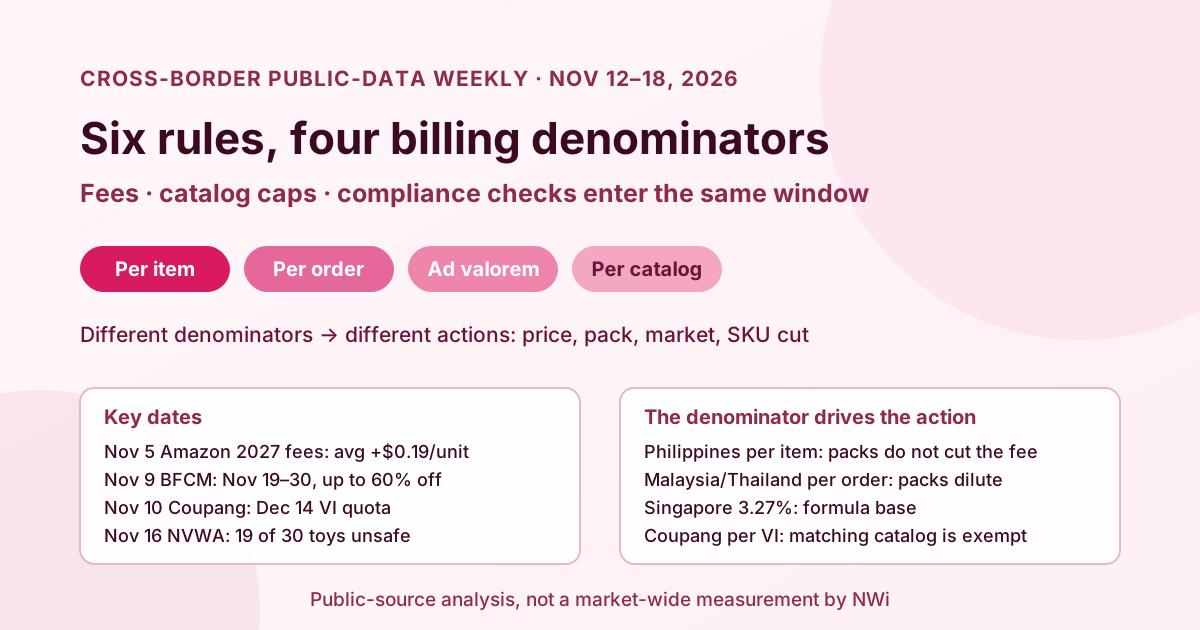
For sellers running Amazon US, TikTok Shop Southeast Asia and Coupang Korea at the same time, the real question in the week of 12–18 November 2026 is: when several fee, catalog and compliance rules enter their implementation windows at once, which action should change first so that different denominators are not mixed into the same profit calculation? The conditional answer: if you sell low-ticket, high-return or wide-catalog SKUs, rebuild contribution per unit this week and prepare a price, pack or SKU cut; if you sell high-ticket, narrow-catalog, low-return products, reconcile the bill rather than reprice. The order of analysis is not the average increase or the headline ceiling. It is: does this rule bill per item, per order, ad valorem or per catalog; who bears it; when does it take effect; and is the fee returned after a refund?
1. This week in one table: six rules, four billing denominators (plus a compliance sample)
The public record for the week compresses into one table. It is not a platform-by-platform news list; it is grouped by the billing denominator. In the same week, Amazon bills fulfillment per unit, TikTok Shop bills per item in the Philippines but per order in Malaysia and Thailand, Coupang caps the catalog, and NVWA judges compliance by sample. Different denominators imply different actions. Mixing all six rules into one conclusion that costs are rising will misprice both low-ticket and high-ticket SKUs.
| Rule | Key date (notice / detail / effective) | Billing denominator | Effective date / window | What it does not prove |
|---|---|---|---|---|
| Amazon 2027 US fees | 5 Nov official notice: FBA fulfillment averages +$0.19 per unit, about 0.8% of average selling price; some products rise, others fall; storage fees simplified | Per unit (FBA), ad valorem (referral) | Most changes 15 Jan 2027; storage 1 Feb 2027 | That every SKU rises by $0.19 |
| Amazon Black Friday / Cyber Monday | 9 Nov notice: 19–30 Nov, 12 days of daily themed deals, two drops each on Black Friday and Cyber Monday, selected deals up to 60% off | Promotional price per order / SKU | 19–30 Nov 2026 | That a longer event or deeper discount proves stronger demand |
| TikTok Shop SEA order fees | 17 Nov official note on five markets | Philippines per item; Malaysia/Thailand per order; Vietnam per delivered order; Singapore 3.27% | Varies by market page | That the five fees can be added together or their exemptions swapped |
| Thailand commission relief | 28 Oct government announcement; 17 Nov Shopee eligibility detail; 1 Dec 2026–31 May 2027 | Order GMV × rate | 1 Dec 2026 (round 1) / 1 Jan 2027 (round 2) | That every Thailand seller gets a cut; sellers without a Thai entity or Thai goods do not |
| Coupang listing cap | 10 Nov official notice: from 14 Dec, VI quota is allocated by 90-day GMV/units | Per VI (catalog) | 14 Dec 2026 | That it counts only live SKUs, or that it is a sales cap |
| EU toy inspection | 16 Nov NVWA: 19 of 30 sampled toys for under-3s unsafe | Per sample / compliance finding | Published | That 19/30 is the market-wide failure rate |
The table includes details published this week as well as rules announced last week that entered their decision window this week. Each row gives the notice, detail and effective dates so that a publication date is not mistaken for the date an event first occurred.
The common mechanism is that platforms and regulators are no longer pricing only growth; they are repricing the unit — per item, per order, per VI, per sample. The denominator changes the action: per-item fees reward lower unit cost or a higher unit price; per-order fees reward order consolidation and higher basket value; ad valorem fees reward price and refund management; per-catalog caps reward SKU deletion and matching existing catalog entries.
That is also the difference from last week. The week of 5–11 November was mostly rule announcement: Amazon published its 2027 fee direction on 5 November and its Black Friday/Cyber Monday dates on 9 November, and Coupang published the quota policy on 10 November. The week of 12–18 November brought implementation detail: NVWA published the toy inspection on 16 November, TikTok Shop explained the five-market order fees on 17 November, Shopee Thailand published eligibility rules on 17 November, and JD.com reported third-quarter results on 17 November. The seller's shift is from reading headlines to calculating denominators and eligibility; the decision window moved from awareness to execution. This is a comparison of publication cadence and implementation nodes, not a year-on-year transaction comparison; the week offers no comparable cross-platform GMV total, and this article does not infer one.
2. Amazon: +$0.19 is an average, not your SKU's increase
Amazon's 5 November 2026 seller notice says that 2027 US FBA fulfillment fees will rise by an average of $0.19 per unit sold, about 0.8% of the average item's selling price; the impact varies by product, size and price; some products rise and others fall; most changes take effect on 15 January 2027. Storage changes separately on 1 February 2027: the storage utilization surcharge is eliminated, the aged-inventory surcharge is removed and combined into a single age-based monthly storage rate; inventory turning in under six months is flat or lower, while aged inventory is higher. The low-inventory-level fee will apply only when inventory falls below 28 days of supply, based on actual shipments in the four weeks before and after the assessment date. The FBA fuel and logistics surcharge remains unchanged.
Mechanically, the average is a weighted result across sellers, not your invoice. Your per-unit change depends on size tier, weight, price band and fulfillment route: a low-ticket bulky item can be far above 0.8%, while a high-ticket small item can be below the average or even fall. Treating +$0.19 as a universal per-SKU increase understates low-ticket items and overstates high-ticket ones.
Amazon publishes only an average of +$0.19 per unit, about 0.8% of the average selling price, and explicitly says some products rise while others fall; it does not publish a rate for each SKU, so the average cannot be used to price an individual SKU.
If your SKU sits in a size tier where the fee falls, a blanket +$0.19 price increase overshoots; if your SKU is a low-ticket bulky item, the 0.8% average understates your increase. The way to distinguish is not the headline but the Fee Change Comparison dashboard and Revenue Calculator in Seller Central, checked SKU by SKU and combined with your own cost, return and advertising data.
A hypothetical example puts the average into one unit: a $24.99 price, $8.00 landed cost, 15% referral fee, FBA fee rising from $4.20 to $4.39, 12% return rate, $4.00 return-handling loss per returned unit and 12% ACOS. The calculation order is: refunded revenue first, referral fee refunded on returns, fulfillment charged on every shipped unit, and return-handling loss listed separately; at a 12% return rate and 12% ACOS, contribution per unit falls from $3.01 to $2.82; the $0.19 change equals 6.3% of the old contribution and 0.76% of the price. If the return rate is 8% and ACOS is 10%, the same $0.19 is only 4.2% of the old contribution; the more returns and advertising consume profit, the larger the relative hit from a fixed fee.
Timing matters: the 2027 fulfillment fee does not change your November 2026 Black Friday fee; it changes unit cost from January 2027. Do not use it to justify a deep Black Friday discount. Its correct use is to set the January 2027 price floor and purchasing budget.
3. Black Friday/Cyber Monday: a 12-day window and 60%-off deals are promotion design, not demand evidence
Amazon's 9 November 2026 release says Black Friday Week and Cyber Monday deals run from 19 to 30 November. Today's Big Deals will feature 12 days of daily themed drops across toys, tech, fashion, beauty, premium gifts and stocking stuffers. For the first time, deals will drop twice on both Black Friday and Cyber Monday, at midnight and 8 a.m. PT, with selected deals up to 60% off. The release also promotes Alexa for Shopping for lists, price tracking and deal alerts.
The release describes promotion design, not demand size: it gives no sales forecast, category revenue or discount coverage. A 12-day window spreads demand and price comparison across themed days; two drops split the daily peak. "Up to 60%" is a ceiling on selected deals, not a sitewide discount or your category average. Treating a longer event and deeper discounts as proof of stronger demand will overstate inventory and advertising budgets.
Break-even price = (4.20 + 8 + 0.48) ÷ (0.88 × 0.85 − 0.12) ≈ $20.19; at $20.99 contribution is about $0.50 per unit, while at $19.99 it is about -$0.13.
Scenario A: Amazon US gift SKU with a 12% return rate (hypothetical example)
Assume a $24.99 price, $8.00 landed cost, 15% referral fee, $4.20 FBA fulfillment fee, 12% return rate, $4.00 return-handling loss per returned unit and 12% ACOS.
Break-even price = (4.20 + 8 + 0.48) ÷ (0.88 × 0.85 − 0.12) ≈ $20.19; at $20.99 contribution is about $0.50 per unit, while at $19.99 it is about -$0.13.
Keep the Black Friday deal price at or above about $20.19; test $20.99 first, and if volume falls but contribution stays positive, keep observing rather than matching $19.99.
Sensitivity: if the return rate is 5% rather than 12%, with the same landed cost, fulfillment, return handling and ACOS assumptions, the break-even price falls to about $18.44; if the return rate rises to 18%, it rises to about $21.98. Each percentage point of return rate moves the price floor by about $0.25–0.30, which is why a sitewide discount cannot substitute for your own return data.
Counter-case: if your SKU is an industrial part or a recurring consumable, the 12-day window barely moves demand, and stocking to a peak-season multiplier overstocks. If your category already contracted in October, a deal push may pull future orders forward while returns and advertising consume the margin. Distinguish by watching your own add-to-cart, conversion, return and repeat-purchase data, not the event theme.
Check the old and new fulfillment fee for each SKU in Fee Change Comparison, then set the Black Friday deal price above the break-even price; if contribution is still negative after a price test, change the pack or the fulfillment route rather than following the discount. Continue if the deal price is above break-even and the return rate is inside your historical range; adjust if contribution is positive but below your target, starting with returns or advertising; stop if repeated tests leave contribution negative, or if the return rate leaves its historical range without an explanation.
4. Southeast Asia: the same order fee is per item in the Philippines and per order in Malaysia/Thailand
TikTok Shop's 17 November 2026 official note puts five markets in one table, but the denominators differ. The Philippines charges PHP 5 per successfully delivered order and per item in the order; Malaysia charges MYR 0.50 plus 8% sales and service tax, or MYR 0.54 per order; Thailand charges THB 1.07 per order; Vietnam charges VND 3,000 per successfully delivered order; Singapore is not a fixed amount but 3.27% of a formula base.
| Market | Fee name | Amount | Denominator | Refund / exemption point |
|---|---|---|---|---|
| Philippines | Order processing fee | PHP 5 | Per successfully delivered order and per item | Full and partial refunds are treated differently; check the official table |
| Malaysia | Platform support fee | MYR 0.50; MYR 0.54 after 8% SST | Per order, regardless of amount or item count | Full and partial cancellations are treated differently; check the official table |
| Thailand | Platform infrastructure fee | THB 1.07 | Per order | Full and partial refunds are treated differently; check the official table |
| Vietnam | Order processing fee | VND 3,000 | Per successfully delivered order | Full and partial refunds are treated differently; check the official table |
| Singapore | Transaction fee | 3.27% | Formula base: buyer payment minus refunds, plus platform discount minus discount refunds | Put refund amounts into the formula; do not apply a fixed-fee rule |
Singapore's formula is: transaction fee = [(buyer payment − order refund) + (platform discount − platform discount refund)] × 3.27%. That means "the order was refunded, so the fee must be returned" is not a valid rule. Exemptions and refund treatment differ across the five markets; the Philippine per-item rule cannot be applied to Malaysia, and Singapore's percentage rule cannot be applied to Thailand.
The Philippine example also shows that an order with two items pays PHP 5 × 2 = PHP 10. The detail matters: in the Philippines, a multi-pack does not reduce a per-item fee; in Malaysia and Thailand, where the fee is per order, a multi-pack dilutes it. Treating "Southeast Asia order fees" as one number will misprice both the Philippines and Malaysia.
Scenario B: TikTok Shop Philippines low-ticket, single-item order (hypothetical example)
Assume a PHP 99 price, PHP 45 landed cost, PHP 34 of fulfillment and advertising variable cost, and a PHP 5 order-processing fee charged per item.
Contribution before the fee is PHP 20; after the fee it is PHP 15, so the fee takes 25% of contribution and 5.05% of the price; a two-item order pays PHP 10, still 25% of contribution, so bundling does not reduce a per-item fee.
In the Philippines, do not treat multi-packs as a fee-reduction tool; first test a PHP 199 price (the fee falls to about 12.4% of contribution) or compare Malaysia/Thailand, where the fee is per order, before changing market.
Sensitivity on the same assumptions: at PHP 199, if the pre-fee contribution margin stays about 20.2%, the fee is about 12.4% of contribution and 2.51% of price; at PHP 499 it is about 4.96% of contribution and 1.00% of price. A low ticket is not "a little less profit"; the same fixed fee takes a quarter of contribution. In Malaysia, by contrast, the fee is MYR 0.54 per order: at MYR 99 with MYR 19.80 pre-fee contribution, it is 2.73% of contribution; a three-item order still pays MYR 0.54, cutting the share to 0.91%. This does not prove Malaysia is better — demand, logistics and competition differ — only that multi-pack fee dilution works in per-order markets.
Thailand commission relief: eligibility matters more than the headline
Thailand's government announced on 28 October 2026 that Shopee, Lazada and TikTok Shop would roll mandatory fees for eligible local SMEs back to the 1 January 2026 level for six months, from 1 December 2026 to 31 May 2027. The government's rate ranges are Shopee 8.03–19.26% to 8.03–13.91%, Lazada 9.00–17.50% to 7.50–11.60%, and TikTok Shop 13.38–21.94% to 11.24–17.66%; it estimates about 1.2 million merchants and THB 1.93 billion in total relief.
This is not a universal cut for every Thailand seller. Shopee Thailand's 17 November 2026 seller-centre rules require all four conditions: the shop opened by 30 September 2026; a Thai individual or Thai-registered legal entity selling Thai goods, excluding electronics; a DBD business registration for individuals or a 13-digit number for legal entities; and NMV from 1 October 2025 to 30 September 2026 of no more than THB 1.8 million for an individual or THB 3.5 million for a legal entity. Applications are separate on each platform, and multi-store NMV is combined by ID or legal-entity number. The first round closed on 15 November and starts on 1 December; the second closes on 16 December and starts on 1 January 2027.
For a China-based direct-to-consumer seller with no Thai entity, or one selling electronics, the Thai-entity and Thai-goods conditions usually both fail, so the saving is zero. Creating a Thai legal entity or changing sourcing just for a six-month, low-threshold commission relief is usually not worth it. The government's THB 1.93 billion divided by 1.2 million merchants averages about THB 1,608 per merchant over six months; that is an average of the total package, not any merchant's actual saving. A ceiling move from 19.26% to 13.91% also does not mean your subcategory falls by 5.35 percentage points.
Counter-case: a Thai-registered company that mainly resells Chinese-made goods may still fail the "Thai goods" test, because the announcement does not define origin, brand or sourcing. Do not infer that a Thai company automatically qualifies; confirm with the platform or the seller centre. Another counter-case: a Thai legal entity above THB 3.5 million NMV also fails; suppressing GMV to qualify is usually uneconomic.
Action order: test the three conditions — entity, goods and NMV — first. If eligible, apply in the second round before 16 December for a 1 January 2027 start; if not, keep the relief out of the December budget and check TikTok's per-item/per-order fees and Amazon's 2027 fees instead. Continue if all three conditions hold and your subcategory rate actually falls; stop if any condition fails or the "Thai goods" definition cannot be confirmed.
5. Coupang: the catalog cap is inventory, not a fee
Coupang's Developer Center notice of 10 November 2026 changes the maximum registrable product count from 14 December 2026. The cap has two controls: a weekly new-registration limit, defaulting to 1,000 VIs and adjusted by 90-day sales history and conversion; and a cumulative registration limit set by the higher of 90-day GMV or units, in five tiers of 10,000, 50,000, 100,000, 200,000 and 500,000. Live, suspended, pending-approval and out-of-stock products all count toward the cumulative limit; both limits are reviewed in the first week of each month.
| 90-day GMV | 90-day units | Cumulative VI limit |
|---|---|---|
| ≥ KRW 60 million | ≥ 1,000 | 500,000 |
| KRW 20–60 million | 400–1,000 | 200,000 |
| KRW 10–20 million | 200–400 | 100,000 |
| KRW 5–10 million | 100–200 | 50,000 |
| Below KRW 5 million | Below 100 | 10,000 |
Mechanically, the cumulative cap constrains catalog width, not the number of live SKUs. One T-shirt in three colours and four sizes counts as 12 VIs; suspended, pending and out-of-stock items also consume quota. If the catalog exceeds the cap, the platform gives a 30-day grace period; after that it may delete items with no sales in the last 13 months, oldest final modification first. The only route that does not consume a new VI is matching an existing Coupang catalog entry, which remains available even at the cap. The weekly limit controls launch pace; the cumulative limit controls long-tail retention; they are not the same ceiling.
Scenario C: Coupang wide catalog with KRW 8 million 90-day GMV (hypothetical example)
Assume 120,000 current VIs, KRW 8 million of 90-day GMV and 150 units, which puts the cumulative cap at 50,000 VIs under the higher tier.
The excess is 70,000 VIs, or about 2,333 VIs per day over the 30-day grace period; if nothing is done, the platform may delete items with no sales in the last 13 months, oldest final modification first, after the grace period.
Within 30 days, rank by gross profit × sell-through probability and cut to below 50,000; keep SKUs that can match an existing Coupang catalog entry so they do not consume a new VI.
Counter-case: a high-GMV seller is not necessarily constrained. At 90-day GMV above KRW 60 million or units above 1,000, the cumulative limit is 500,000 VIs; with only 30,000 VIs, the cumulative cap is not the bottleneck. The real constraint may be the weekly limit: 8,000 new VIs a month is about 1,850–2,000 a week, above the 1,000 default. An alternative explanation is that a tighter cap forces sellers to clear dead inventory and improve conversion, so it is not automatically bad.
Action: pull current VI count, 90-day GMV and 90-day units from WING; compute the cap using the higher tier and subtract current VIs. If the excess is positive, generate a pre-deletion list using the platform's order — no sales in 13 months, oldest final modification first — then rank retention by gross profit × sell-through probability. If weekly launches exceed 1,000, spread them across later weeks. Continue if the VI count is below the cap and weekly launches no longer hit the limit; stop if deletion losses exceed retention value, or if it is still unclear whether cross-border and Korean domestic sellers face the same rule.
6. Compliance and evidence: 19 of 30 is a risk-based sample, not a market failure rate
The Dutch NVWA reported on 16 November 2026 that it tested 30 toys for children under three sold to Dutch consumers through non-EU webshops. Nineteen had serious safety risks: small parts detached, cords were too long, or small balls or figures were present, creating a choking hazard; the products may not be sold in the EU. The samples were bought on Temu, AliExpress, Wish and Shein. NVWA shared the results with the platforms, required the unsafe products to be taken offline, and submitted the findings to the European Commission and other member states.
Evidence boundary: 19 of 30 (about 63%) is a risk-based sample, not the failure rate of all toys in the EU, and it does not prove that 63% of Chinese sellers' toys are unsafe. NVWA explicitly targeted toys for young children; the sourcing, category and age positioning were selected. The useful question for a seller is not the percentage but whether the SKU is positioned for under-3s, carries small-parts, magnet or cord risks, and has a test report and correct age label.
Counter-case: if you do not sell toys or children's products, the inspection is an indirect signal — platforms may tighten under-3 category checks, but it does not directly change your fees. Distinguish by checking your category, age label and platform compliance notices rather than treating 19/30 as an industry-wide risk premium.
Action: toy and children's-product sellers should do three things first: check that the age label and packaging agree; run an internal risk list for small parts, magnets and cord length; and ask the supplier for test reports under the EU Toy Safety Directive and EN 71 series. Stop condition: if the age positioning or test report cannot be confirmed, pause advertising and replenishment for the SKU rather than waiting for a platform takedown.
Joybuy: coverage is not scale
In the same week, JD.com's third-quarter 2026 report (17 November 2026) still did not disclose standalone Joybuy GMV, revenue or users. Joybuy sits inside the "new business" segment alongside JD Food Delivery, Jingxi, JD Property and overseas businesses; the report gives only a qualitative line that GMV and the user base grew steadily. JD completed the CECONOMY acquisition on 12 November 2026, taking 59.8% for EUR 1,335 million; that is a coverage and consolidation signal, not Joybuy's transaction scale.
The implication: do not treat "Joybuy expansion" as a measurable market size, and do not infer GMV from covered cities, brand partnerships or consolidation. If you consider entering, get the invitation and the actual fee schedule first, then build a contribution model. Without standalone GMV, only conditional judgments are possible; scale forecasts are not. This is a different evidence tier from Coupang or Shopee, which publish segment data or seller back-office data.
7. Cross-event mechanism: conflicting evidence and next week's testable hypotheses
Put the six rules together and three conflicts appear. The first is average versus unit: Amazon averages +$0.19 but explicitly has increases and decreases. The second is one name versus different denominators: TikTok Shop calls them all order fees, but the Philippines is per item, Malaysia/Thailand per order and Singapore ad valorem. The third is headline versus eligibility: Thailand's 19.26% to 13.91% ceiling covers only eligible local SMEs. Add Coupang's cap versus matching exemption, NVWA's sample versus population, and Joybuy's coverage versus scale, and the week's core skill is not memorising six numbers. It is deciding which denominator, sample and entity each number belongs to.
| Surface reading | Correct reading | How to test next week |
|---|---|---|
| Amazon raises every unit by $0.19 | It is an average; your SKU may rise, stay flat or fall | Check old and new fees by SKU in Fee Change Comparison |
| TikTok charges an order fee in all five markets | Philippines per item; Malaysia/Thailand per order; Vietnam per delivered order; Singapore ad valorem | Reconcile the next statement by fee name, item count, order count and refund line |
| Thailand's ceiling falls to 13.91% | Only eligible local SMEs; sellers without a Thai entity or Thai goods get zero | Check the approval notice and the 1 Dec / 1 Jan statement rate |
| Coupang tightens listing volume | A VI-based cumulative cap; matching an existing catalog entry does not consume a new VI | Check the WING quota notice and current VI count |
| NVWA found 19 of 30 unsafe | A risk-based sample, not a population failure rate | Check your under-3 SKUs, test reports and age labels |
| Joybuy is expanding in Europe | Coverage and consolidation signals; no standalone GMV | Wait for standalone disclosure, or get the invitation and fee schedule first |
Next week's hypotheses should be written so that data can disprove them, not as "watch the trend":
- H1: by 26 November, at least one of your top 20 SKUs shows a 2027 fulfillment-fee change different from +$0.19. If all equal the average, your size/price mix happens to be close to average; it does not make the average universal.
- H2: on the next TikTok statement, a two-item Philippine order shows PHP 10, while a two-item Malaysian order shows MYR 0.54. If not, check the market, fee name, order status and refund scope before concluding.
- H3: on 1 December, eligible Thai SME statements show the lower rate and cross-border statements do not. If cross-border statements also change, the eligibility or platform execution differs from the announcement and must be rechecked.
- H4: in the first week of December, Coupang WING shows the new cumulative cap; if current VIs exceed it, the 30-day grace period starts after the quota notice. If there is no notice, do not assume you are exempt.
The value of these hypotheses is that they can be tested with your own statement, back office or platform notice rather than by rereading the news. If a test contradicts this article, your statement wins; return to the three-step check of denominator, eligibility and refund.
8. What different sellers should do next week: three conditions, three playbooks
| Seller condition | First action next week | Continue / adjust / stop |
|---|---|---|
| Amazon US, low ticket, high returns | Check the 2027 fee by SKU; compute the Black Friday break-even price with your return rate and ACOS; set the deal price above break-even | Continue if contribution is positive and returns are inside the historical range; adjust if positive but below target; stop if tests remain negative |
| TikTok Shop Philippines, low ticket | Compute the fee share of contribution; do not use multi-packs as a fee fix; test PHP 199 or compare Malaysia/Thailand per-order markets | Continue if the higher price meets the target; adjust if demand falls but contribution stays positive; stop if logistics or demand make the new market worse |
| Coupang, wide catalog, slow sellers | Compute the cap and excess; within 30 days cut by gross profit × sell-through probability; match existing catalog entries first | Continue if VIs fall below the cap; adjust if weekly launches hit 1,000; stop if deletion losses exceed retention value |
| Thai local SME, non-electronics | Check entity, goods and NMV; apply in the second round by 16 December | Continue if approved and the subcategory rate falls; stop if any condition fails or "Thai goods" cannot be confirmed |
| Toys / children's products | Check age labels, small parts, magnets and cords; obtain test reports | Continue if reports and labels agree; stop if compliance cannot be confirmed and pause ads and replenishment |
The analytical increment is to put platform fees, catalog caps and compliance checks into one denominator map, then use contribution per unit to turn each rule into a price, pack, market or SKU decision. It does not offer one sitewide optimal strategy, because in the same week a low-ticket Philippines seller and a narrow-catalog Coupang seller face different denominators. Mixing them produces the unusable conclusion that all costs are rising.
9. Limitations and uncertainty
The unknowns most likely to change the conclusion are each SKU's actual new rate, the return rate and return-handling cost, and the conversion response to a price increase; all of these must be replaced with your own back-office data.
Other gaps: this article analyses TikTok Shop's order fees only, not commission, affiliate commission, logistics or payment-service fees, so the order fee is not the total take rate; Thailand's definition of "Thai goods" (origin, brand or sourcing) is not specified in the announcement, and the Lazada and TikTok Shop application pages and deadlines were not read one by one; Coupang's conversion weighting formula, temporary-quota approval standard, and whether cross-border and Korean domestic sellers face the same rule are not public; NVWA is a risk-based sample and cannot be extrapolated to the population; Joybuy has no standalone GMV, so no scale estimate is possible. This article uses public sources only, contains no NWi proprietary transaction data, and does not claim full coverage of any platform or market.
What would change the judgment: your own Fee Change Comparison results, TikTok and Shopee settlement statements, the Coupang WING quota notice, Thai platform approval notices, toy test reports, or a new platform fee/eligibility notice. When those arrive, rerun the scenarios rather than defending the assumptions in this article.
10. Method and disclosure
The statistical window is 12–18 November 2026, the seven complete Beijing calendar days before publication. The article uses public sources only and contains no NWi proprietary transaction data or market-wide measurement. Amazon's 2027 US fee figures come from the Amazon Selling Partners notice of 5 November 2026 (average +$0.19 per unit, about 0.8% of the average selling price, some products up and some down, most changes effective 15 January 2027, storage changes on 1 February 2027). Black Friday/Cyber Monday mechanics come from Amazon's 9 November 2026 release (19–30 November, 12 days of daily themed deals, two drops each on Black Friday and Cyber Monday, selected deals up to 60% off). TikTok Shop's five-market order fees come from its 17 November 2026 note. Coupang's listing cap comes from its Developer Center notice of 10 November 2026. The NVWA inspection comes from its 16 November 2026 release. Thailand's relief comes from the Thai Government announcement of 28 October 2026 and Shopee Thailand's seller-centre rules of 17 November 2026. Joybuy's evidence boundary comes from JD.com's third-quarter 2026 Form 6-K (17 November 2026). Fee names, denominators, currencies, refund rules and exemptions differ by platform and market; this article compares them side by side and does not add, convert or rank them across markets. All operating figures, return rates, ACOS, VI counts and GMV are explicitly hypothetical examples, not any real store's data.
This article was prepared with the assistance of an automated research workflow, based on the public sources listed at the end. It was not reviewed by a human editor.
For the metric definitions used in this article, see Cross-Border Data Analytics and E-commerce Data Definitions and Methods; for platform economics, see Amazon Data Analysis; for TikTok Shop, see TikTok Shop Data Analysis; for Shopee and Lazada, see Shopee Data Analysis and Lazada Data Analysis; for Coupang, see Coupang Data Analysis; for Joybuy, see Joybuy Data Analysis; for more reports, see the Cross-Border E-commerce Reports library.
Sources
- 1. Amazon Selling Partner Services, "Update to US Referral and Fulfillment by Amazon fees for 2027" (primary, 5 November 2026): original, accessed 19 November 2026.
- 2. Amazon, "Amazon's Black Friday Week and Cyber Monday Return November 19-30 with Millions of Deals to Deliver Joy This Holiday Season" (primary, 9 November 2026): original, accessed 19 November 2026.
- 3. TikTok Shop Global Selling, "TikTok Shop Southeast Asia Cross-Border Order Fees" (primary, 17 November 2026): original, accessed 19 November 2026.
- 4. Coupang Developer Center, "Change in Listing Product Quantity Limit Policy" (primary, 10 November 2026): original, accessed 19 November 2026.
- 5. Netherlands Food and Consumer Product Safety Authority (NVWA), "NVWA: more than half of inspected toys from foreign webshops unsafe" (primary, 16 November 2026): original, accessed 19 November 2026.
- 6. Thai Government, "Government and private sector integrate to cut GP fees on three online platforms, supporting 1.2 million SMEs" (primary, 28 October 2026): original, accessed 18 November 2026.
- 7. Shopee Thailand Seller Education Hub, "Commission Fee Relief Program to support Thai SME growth" (primary, 17 November 2026): original, accessed 18 November 2026.
- 8. JD.com, "JD.com Announces Third Quarter 2026 Results" (Form 6-K Exhibit 99.1, primary, 17 November 2026): original, accessed 18 November 2026.
- 9. Bangkok Post, "Platforms agree to 6-month fee rollback for small firms" (29 October 2026): original, accessed 18 November 2026.
- 10. Ecommerce News Europe, "Joybuy opens up to European and Chinese sellers" (11 June 2026): original, accessed 18 November 2026.
This article was prepared with the assistance of an automated research workflow, based on the public sources listed above. It was not reviewed by a human editor.