For a wide-catalog seller on Coupang Korea with 30,000–100,000 VIs and 90-day GMV of KRW 10–20 million, the question before 14 December is not what the platform changed again, but whether the cumulative quota will truncate the catalog, which SKUs to delete first, and how to turn the limited weekly new-VI quota into higher GMV. The answer is conditional: calculate your cumulative cap and excess from the official tier table first, then clean the catalog along the platform's own deletion order instead of waiting for the 30-day grace period to end and letting Coupang delete the excess for you.
1. What changed: the listing quota from 14 December 2026
According to Coupang Developer Center's official notice (published 10 November 2026), the standard for the maximum number of registrable products changes from 14 December 2026. The policy splits listing quota into two complementary controls: a weekly new-registration limit and a total cumulative registration limit. Both are counted in product option IDs (VIs), not product types (SPUs).
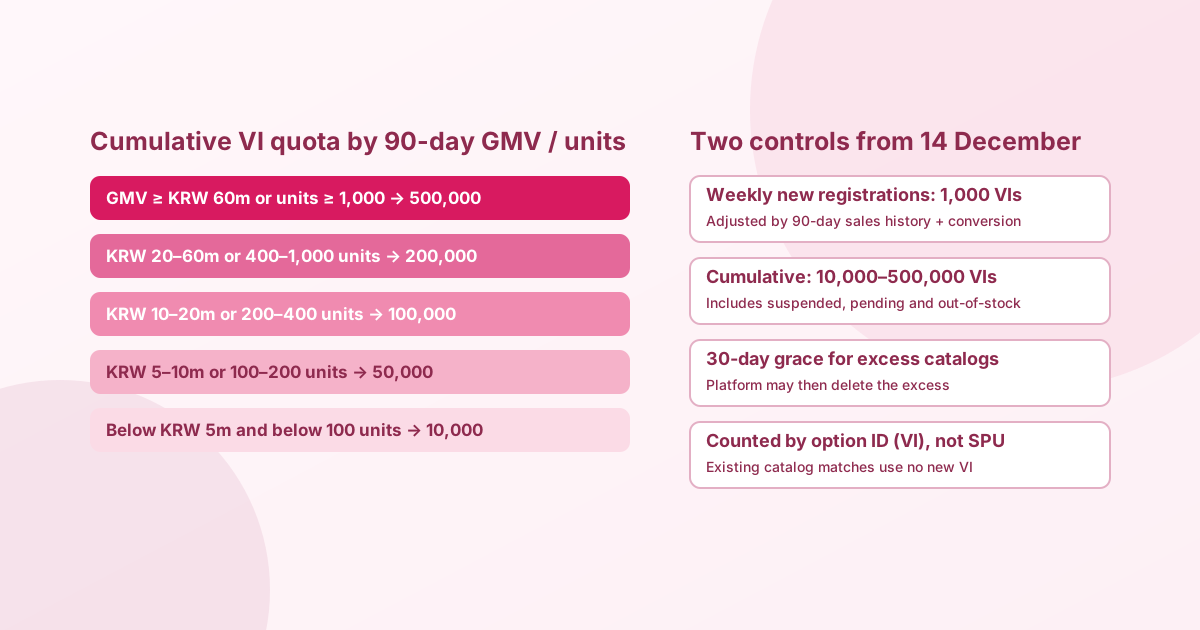
According to Seoul Economic Daily's English report (17 November 2026), the old policy allowed sellers to list up to 5,000 products a day, with unlimited cumulative listings for sellers whose average monthly revenue over the previous three months was KRW 40 million or more; the new policy sets a weekly new-listing baseline of 1,000 VIs and a cumulative cap based on 90-day GMV or units in five tiers. The report calls it the first overhaul in about five years. The tier table below follows the official notice:
| 90-day GMV | 90-day units | Cumulative registration limit (VI) |
|---|---|---|
| KRW 60 million or more | 1,000 or more | 500,000 |
| KRW 20–60 million | 400–1,000 | 200,000 |
| KRW 10–20 million | 200–400 | 100,000 |
| KRW 5–10 million | 100–200 | 50,000 |
| Below KRW 5 million | Below 100 | 10,000 |
The official notice says the cumulative quota is set by the higher of the two 90-day measures: a seller's GMV and unit volume are each mapped to a tier, and the higher tier applies. The cumulative count includes products that are on sale, suspended, pending approval and out of stock. The weekly new-registration limit defaults to 1,000 VIs and is adjusted up or down for each seller based on 90-day sales history and sales conversion rate (the share of listed products that sell). Both limits are reviewed in the first week of each month, and changes are announced through the WING seller back office and by email.
2. Mechanism: how the two limits reach a wide-catalog seller
The cumulative quota counts suspended, pending-approval and out-of-stock items, so dead inventory consumes quota just like live inventory; 90-day GMV or units sets the tier, creating a positive feedback loop in which higher sales earn a larger allowance. What is constrained is catalog width, not the number of SKUs currently selling: if one T-shirt is offered in three colours and four sizes, the official FAQ counts 12 VIs, with each colour and size variant consuming its own quota.
The two limits pull in different directions. The weekly new-registration limit controls launch pace: there is a ceiling on new VIs per week, and new VI creation above that level may be temporarily restricted. The cumulative limit controls long-tail retention: once total catalog size reaches the cap, new VI creation is blocked even if weekly headroom remains, until the total falls below the cap. The one route that does not consume a new VI is matching a product to an existing Coupang catalog entry; the official notice says this remains possible even after a seller reaches the limit.
3. Evidence boundary and counter-cases: what the notice cannot tell you
The official tier table and FAQ can be checked directly, but the exact weighting formula for sales conversion and the approval standard for temporary quota increases are not public, so the table can only give a range, not an exact quota for an individual seller. The 1,000 weekly figure is a default baseline, not a fixed ceiling for every seller, and it must not be confused with the cumulative limit.
A high-GMV seller can still be truncated by the cumulative cap if the catalog is too wide; sellers who mostly match existing Coupang catalog entries rather than creating new VIs are less affected than they look. For a seller with poor long-tail sell-through, the cap may actually force a cleanup of dead inventory and lift overall conversion, so a tighter quota is not automatically bad.
4. Calculate the excess first: turn the tier table into an audit formula
Your cumulative tier is the higher of the 90-day GMV tier and the 90-day unit tier, and the excess equals current VIs minus the cumulative cap; a negative or zero result means the cumulative quota is not binding. On the weekly side, calculate a second number: planned monthly new listings divided by the number of weeks in the month, compared with the 1,000 weekly baseline. Any excess either has to be cut or spread across later weeks.
Start the audit by pulling three figures from your back office: current VI count, 90-day GMV and 90-day units. Map each of the two performance figures to the tier table to get a cumulative cap, take the higher of the two caps as the final cumulative limit, and subtract it from current VIs to get the excess. All operating inputs above are hypothetical examples; the quota that actually applies is the one shown in WING and the email notice.
5. Two scenarios: same policy, different catalog sizes
Scenario A: low excess, weekly launch limit binds (hypothetical example)
Assume 30,000 current VIs, 90-day GMV of KRW 15 million and 250 units, with 8,000 new listings a month (hypothetical example, not any real store's data). GMV falls in the KRW 10–20 million tier and units fall in the 200–400 tier, so both map to a cumulative cap of 100,000 VIs; the higher tier is still 100,000.
The cumulative cap is 100,000 VIs and the excess is negative (30,000 − 100,000 = −70,000), so the cumulative quota is not binding; but 8,000 new listings a month is about 1,860 a week (8,000 ÷ 4.3), above the 1,000 default weekly limit.
Freeze low-velocity launches first, reserve the weekly new-VI quota for validated high-conversion items, and spread launches across weeks when a single week would exceed 1,000.
Scenario B: high excess, cumulative limit binds (hypothetical example)
Assume 120,000 current VIs, 90-day GMV of KRW 8 million and 150 units (hypothetical example, not any real store's data). GMV falls in the KRW 5–10 million tier and units fall in the 100–200 tier, so both map to a cumulative cap of 50,000 VIs.
The cumulative cap is 50,000 VIs and the excess is 70,000 (120,000 − 50,000); after 14 December the account enters a 30-day grace period, after which the platform may delete up to 70,000 VIs.
Within 30 days, rank by gross profit × sell-through probability and cut below 50,000 rather than waiting for the platform to delete the excess after the grace period.
6. Action plan: what to delete, how much, and when to stop
Start with the platform's deletion order — no sales in the last 13 months, oldest final modification first — to build a pre-deletion list, then reserve the weekly new-VI quota for validated high-conversion items and spread launches across weeks when a single week would exceed 1,000. For each candidate SKU, record 90-day gross profit, sell-through status, last modification date and whether it can match an existing catalog entry; estimate retention value as gross profit × sell-through probability rather than ranking only by unit sales or inventory age.
Continue if total VIs are below the cumulative cap and the weekly launch schedule no longer hits the 1,000 baseline. Stop if you reach a pre-set deletion ceiling, or if the loss from deleting a SKU exceeds the value of keeping it; first check whether that SKU can be retained by matching an existing catalog entry. The observation window should cover at least one monthly recalculation cycle, so you can confirm that the quota recalculated in the first week of the month matches your audit.
7. Limitations and uncertainty
The unknowns most likely to change the conclusion are the weighting formula for sales conversion, the approval standard and duration of temporary quota increases, and whether cross-border and Korean domestic sellers face the same rules. The official notice uses the phrase “all sellers” (모든 판매자) and does not separately distinguish cross-border sellers from Korean domestic sellers; after you obtain the actual quota shown in WING and the response to any temporary-quota request, recalculate the excess.
8. Method and disclosure
Data basis: the tier table, the default weekly limit and the deletion rules come from Coupang Developer Center's official notice (accessed 19 November 2026); the old policy of 5,000 listings a day and unlimited accumulation comes from Seoul Economic Daily's English report (accessed 19 November 2026). Every operating input — VI count, GMV, unit volume and launch volume — in the scenarios is a clearly labelled hypothetical example; the tier limits themselves come from the official notice.
The increment here is to turn the official tier table into an executable audit from current VI count to tier, excess and deletion order, while separating the weekly new-VI limit from the cumulative limit as two different constraints. It translates a one-page policy notice into a checklist a seller can execute inside the 30-day grace period, without promising a quota for any category or store.
To connect the listing quota with the broader Coupang catalog and unit-economics framework, see NWi's Coupang Data Analysis; the policy is also covered in the Cross-Border E-Commerce Public-Data Weekly (Nov 12–18); for more reports, see the Cross-Border E-commerce Reports library.
This article was prepared with the assistance of an automated research workflow and is based on the public sources listed at the end; it has not been reviewed by a human editor.
Sources
- 1. Coupang Developer Center, “Change in Listing Product Quantity Limit Policy” (primary, published 10 November 2026; tier table, default weekly limit, VI counting, 30-day grace period and deletion order): original, accessed 19 November 2026.
- 2. Seoul Economic Daily (English), “Coupang to Cap Seller Product Listings Based on Sales Performance” (secondary, published 17 November 2026; old policy of 5,000 listings a day and unlimited accumulation, first overhaul in about five years): original, accessed 19 November 2026.