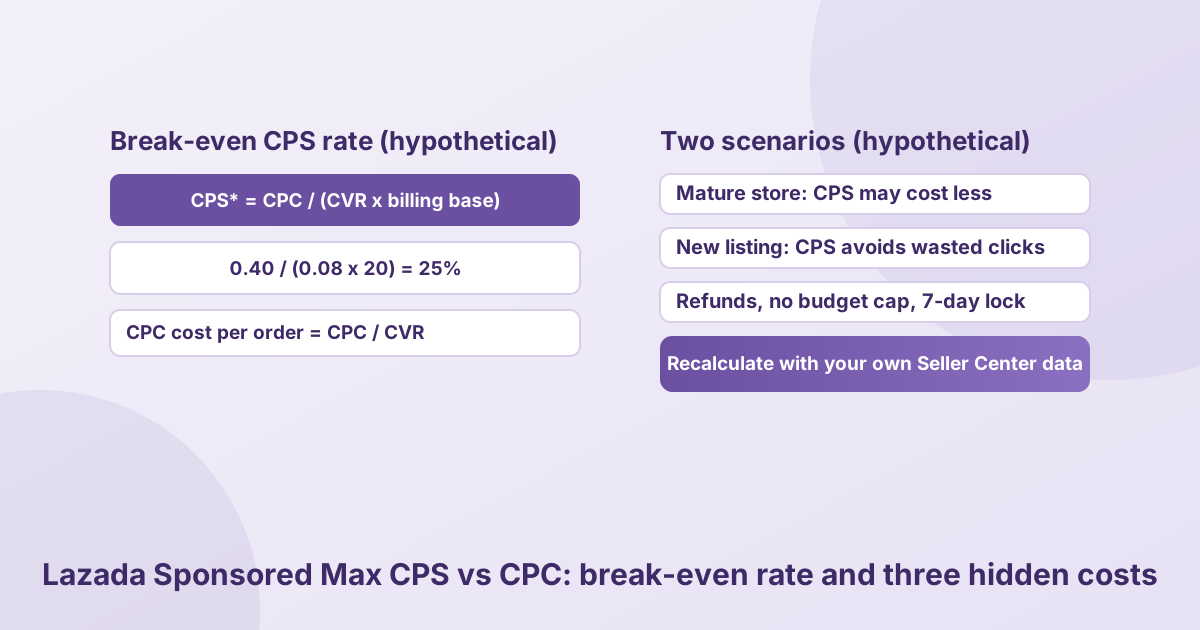
For cross-border sellers advertising a Lazada store in Malaysia, the Philippines, Singapore, Thailand, Vietnam or Indonesia, the question is not whether cost per sale (CPS) sounds cheaper than cost per click (CPC). It is whether the CPS rate Lazada offers your store sits below your own break-even rate. The break-even rate is average cost per click / (conversion rate x billing base). Take a store with a SGD 0.40 average cost per click, an 8% conversion rate measured as confirmed orders / clicks, and a SGD 20 billing base: the break-even CPS rate is 25%. At a 10% minimum rate the CPS charge would be SGD 2.00 per order against SGD 5.00 under CPC; at 30% it would be SGD 6.00 and lose to CPC. Three rules decide whether that arithmetic survives contact with the invoice: charges on confirmed orders are not refunded when an order is later cancelled, returned or refunded; the campaign has no budget field, so there is no campaign-level spending cap; and creation, restart or a rate change begins a new seven-day lock. Every CPC, conversion, base and rate figure below is a labelled hypothetical example and must be replaced with your own Seller Center data.
1. What changed, and what CPS actually replaces
Lazada Sponsored Solutions introduced Sponsored Max Cost Per Sale Mode (BETA) for Sponsored Max - Store in a notice published on 17 November 2026. The page lists entry points for Malaysia, the Philippines, Singapore, Thailand, Vietnam and Indonesia, but states that the mode is available to selected sellers only and subject to Lazada's discretion. An entry point in a market does not mean a particular store has been invited. CPS here applies to Sponsored Max - Store, which promotes eligible products across the whole store automatically; manual product selection and product exclusions are not supported.
The mechanical difference is where the charge is triggered. Under CPC you pay for each click whether or not the visitor orders. Under CPS, in Lazada's wording, campaign charges apply only when confirmed orders are generated, and if there are no sales there is no charge. There is no wallet to top up and no budget to set; costs are deducted from store earnings, or the GMV account balance where applicable, on the following day. A store already running Sponsored Max - Store on CPC must pause that campaign before switching, while CPS can run alongside MSA campaigns and Sponsored Max - Product.
That sounds like a pure transfer of risk to the platform, and for a low-conversion listing it partly is. But the price of that transfer is set by two definitions - what counts as a confirmed order and what the rate is applied to - plus a lock that limits how quickly the decision can be reversed. Those are the subjects of the next section.
2. Confirmed order and billing base: the two definitions that set your real cost
Lazada defines confirmed orders as orders that have successfully completed payment, including orders that are later cancelled, returned or refunded, and states that charges applied to confirmed orders are non-refundable. The charge therefore starts at payment, not at the end of the return window. A buyer who pays and then cancels, returns the item or receives a refund still leaves the CPS charge behind. This is the single most expensive misreading of the model, because it turns a sales-based fee into a fee on payment events.
The rate is not applied to the sale price or to a GMV figure in a report. Lazada says the charge applies to the eligible CPS billing base, which includes eligible shipping fees and platform-funded subsidies after deducting applicable platform fees and seller-funded discounts, with applicable VAT or GST then added under local tax rules. In practice the base can be higher or lower than the item price depending on shipping charged to the buyer, subsidies, platform fees and your own discounts. The only reliable way to know your base is to reconcile those components in the store statement; substituting the GMV number from another report gives a different charge.
Attribution has its own timing. Orders are attributed on a 30-day last-click window, and Lazada states that even if the campaign is paused, any order already attributed within that window will still be confirmed and charged. A rate change takes effect the following day and begins a new seven-day lock, and each confirmed order is charged at the rate that was active at the shopper's last qualifying click. A pause is therefore not a stop-loss, and a rate change is not a retroactive correction.
| Item | Official definition | Common misreading |
|---|---|---|
| Confirmed order | Payment completed, including later cancellation, return or refund; charge non-refundable | Only final, retained orders are charged |
| Billing base | Eligible shipping fees + platform-funded subsidies - platform fees - seller-funded discounts, plus VAT/GST | Sale price or report GMV x rate |
| Attribution | 30-day last-click; paused campaigns can still be charged for attributed orders | Pausing stops all charges immediately |
| Rate change | Effective the next day, with a new seven-day lock; the rate at the last qualifying click applies | The new rate applies to every later payment |
| Deduction | Next day from store earnings or the GMV account balance | A low balance stops the campaign |
3. The break-even rate: formula, worked example and sensitivity
To compare the models, convert both into the same unit: advertising cost per order. Under CPC, cost per order = average cost per click / conversion rate, where conversion rate is confirmed orders / clicks measured on the same campaign and market. Under CPS, cost per order = CPS rate x billing base. Setting the two equal gives the break-even CPS rate: average cost per click / (conversion rate x billing base). Below that rate CPS is cheaper per order; above it, CPC is.
Worked example (hypothetical). A Singapore store has an average cost per click of SGD 0.40, a historical conversion rate of 8% (0.08) and a billing base of SGD 20 per order. CPC cost per order = 0.40 / 0.08 = SGD 5.00. Break-even CPS rate = 5.00 / 20 = 25%. If the minimum rate available to the store is about 10% (hypothetical), the CPS charge is 10% x 20 = SGD 2.00 per order, well below SGD 5.00. If the minimum is about 30% (hypothetical), the charge is 30% x 20 = SGD 6.00 and CPS becomes the more expensive route.
The answer moves with both inputs. If the conversion rate falls from 8% to 4% (hypothetical), CPC cost per order rises to 0.40 / 0.04 = SGD 10.00 and the break-even rate rises to 10.00 / 20 = 50%: CPS becomes easier to justify because CPC is paying more for the same sale. If the billing base rises from SGD 20 to SGD 30 (hypothetical), the break-even rate falls to 5.00 / 30 = 16.7%: the same percentage now collects more money, so CPS becomes harder to justify. The decision is always a comparison between two store-specific numbers, not a general claim that pay-per-sale is cheaper.
Refunds deserve their own line because they are often mixed into the comparison by mistake. Let R be the share of confirmed orders later cancelled, returned or refunded. CPC cost per retained order = cost per click / (conversion rate x (1 - R)); CPS cost per retained order = rate x base / (1 - R). Equalising them cancels (1 - R) entirely, so the break-even rate does not depend on the refund rate: refunds scale both models by the same factor. What R does decide is whether the advertising is profitable at all. That is why the refund rate belongs in the margin account, not in the CPS-versus-CPC choice.
4. Two scenarios: a mature high-conversion store and a low-conversion new listing
Scenario A - mature beauty store, high conversion, CPS likely cheaper. Assume a beauty store with an average cost per click of SGD 0.40, a conversion rate of 8% and a billing base of SGD 20, giving a break-even CPS rate of 25%. At a hypothetical minimum rate of 10%, CPS costs SGD 2.00 per order against SGD 5.00 under CPC. With a 10% refund rate, the cost per retained order is 2.00 / 0.9 = SGD 2.22 for CPS and 5.00 / 0.9 = SGD 5.56 for CPC. The decision: test CPS, but watch two things at once - the absence of a spending cap, and the non-refundable charge on orders that later return.
Scenario B - new listing, low conversion, CPS avoids paying for wasted clicks. Assume a new listing with an average cost per click of SGD 0.60, a conversion rate of 1.5% (0.015) and a billing base of SGD 15. CPC cost per order = 0.60 / 0.015 = SGD 40.00, and the break-even CPS rate = 40.00 / 15 = 267%, far above any plausible platform rate. The interpretation is not that CPS is cheap in absolute terms; it is that CPC is charging heavily for clicks that do not convert. With a hypothetical 30% refund rate, each retained order carries the CPS charge divided by 0.7, and because there is no budget cap a sudden run of orders scales the fee with it. The decision: CPS can be a reasonable way to test a new listing, but set a minimum contribution per retained order first and stop if the refund rate breaches it for two consecutive review windows.
5. The three costs the headline hides - and the rate floor behind them
No campaign-level spending cap. Lazada states there is no wallet to top up and no budget to set. That removes the CPC habit of capping daily spend: there is no budget field that stops the campaign at a number you choose. The official FAQ adds that if the store earnings or GMV balance is insufficient, the campaign continues and the platform attempts to collect the outstanding amount on following days until it is settled. For a seller with tight cash flow, the relevant gap is between the day the charge is deducted and the day the marketplace payout arrives, not just the per-order fee. No upfront cost describes the payment timing, not the absence of a liability.
Charges survive refunds. Because a confirmed order includes later cancellations, returns and refunds, a high-return category can pay CPS on orders that never become revenue. This is not unique to CPS - under CPC the click fee on a returned order is also not refunded - but the amounts behave differently, because the CPS charge scales with the billing base while the CPC charge per click does not. High-ticket, high-return SKUs deserve a separate refund stress test before switching.
The seven-day lock. Creating, restarting or changing the rate starts a new seven-day lock. Lazada's FAQ says the campaign cannot be paused, stopped or adjusted during the seven-day lock period, while the campaign-settings text on the same page says the rate can be adjusted during this period but takes effect the next day. The two statements conflict. Do not plan on being able to change the rate inside the lock; confirm with Lazada what your store can change, when it takes effect and how a new lock is counted before you activate. The lock is also why the switch is not free to reverse: a wrong rate can run for a week before it can be stopped.
The rate floor and eligibility are store-specific
Lazada says a minimum Cost Per Sale Rate applies to each store and recommends setting a rate above it, but publishes no universal number. The mode is open to selected sellers only. A screenshot from another store, a figure from a third-party article or the 10% and 30% cases in this article are not your floor. Read the minimum rate and the available charging models in your own Seller Center, and treat the absence of a CPS entry as not invited rather than as a technical fault.
Counter-case: why expensive CPC does not automatically mean CPS wins
Two cases overturn the simple rule. First, a mature store with a high conversion rate can already have a low CPC cost per order; if its minimum CPS rate is high, or if shipping fees and platform subsidies inflate the billing base, CPS can be the more expensive route. The break-even comparison is the only test. Second, the refund problem is not unique to CPS: under CPC you also pay for clicks on orders that later return, and that click fee is not refunded either. The refund rate therefore does not decide CPS versus CPC - it decides whether either campaign is profitable. Keep the two questions separate: compare cost per order first, then test profitability against contribution after refunds.
6. What to pull, what to test and when to stop
- Collect from your own Seller Center: average cost per click, conversion rate (confirmed orders / clicks), the billing-base components (shipping, platform-funded subsidies, platform fees, seller-funded discounts), refund rate and contribution per retained order. Do not use external benchmarks.
- Use at least one full month covering a campaign period and a quiet week, so the conversion rate is not flattered by a single sale event.
- Calculate the break-even CPS rate first, then compare it with the minimum rate shown for your store: below it, CPS is worth testing; above it, stay on CPC.
- Before switching, pause any active Sponsored Max - Store CPC campaign, confirm that the store is invited, and record the minimum rate, the terms version and the date.
- Continue only while the CPS cost per retained order stays below the CPC equivalent and contribution per retained order stays positive.
- Stop if the refund rate rises for two consecutive review windows so that advertising cost per retained order exceeds contribution, or if the seven-day lock prevents a timely exit; in that case pause CPS and return to CPC.
- Do not read the first day's report as zero performance: Lazada states that CPS data is updated daily and same-day results are not available.
Threshold note: every CPC, conversion, base, rate and refund figure in this article is a hypothetical example, not an industry standard. If your store has no CPS entry or no minimum rate, you have not been invited; wait for access or stay on CPC rather than forcing an activation.
7. Limits: what this article cannot tell you
Three unknowns can change the answer. First, the minimum CPS rate and eligibility are store-specific and Lazada publishes no universal value, so the 10% and 30% cases only demonstrate the method. Second, the official page contradicts itself on whether the rate can be adjusted during the seven-day lock, so the actual permission and timing must be confirmed with Lazada. Third, the billing base depends on how shipping fees, platform subsidies, platform fees and seller discounts appear in your store statement, and those items differ by market and by order. The mode is also a BETA open to selected sellers, so its rules can change. What would update the conclusion: reading your own minimum rate, conversion rate, billing base and refund rate and replacing the hypothetical inputs, plus any written clarification from Lazada on rate changes inside the lock.
Methodology, sources and disclosure
Data basis: the charging model, confirmed-order definition, billing base, 30-day last-click attribution, seven-day lock, minimum rate, eligibility and market entry points come from the Lazada Sponsored Solutions notice published on 17 November 2026 (accessed 19 November 2026). The conflict between the campaign-settings text and the FAQ, and the warning that the billing base cannot be replaced by a GMV figure from another report, are cross-checked against PuppyIP's review of the same notice (accessed 19 November 2026). All CPC, conversion, billing-base, rate, refund and margin figures in the scenarios are explicitly labelled hypothetical examples, not statistics from any store or platform; they do not imply that Nuozhou Digital Intelligence provides Lazada back-end data, real-time sales figures or advertising management.
The analytical contribution is the connection of Lazada's pay-per-sale model to a reproducible break-even test, and the demonstration that the refund rate scales both models equally: the refund rate changes whether advertising is profitable but not which model is cheaper. That is a decision method built from the official notice rather than a restatement of it.
For the wider metrics and review routine that advertising sits inside, see E-commerce Analytics: Metrics and Business Reviews; for the platform-side definitions behind conversion and GMV, see Lazada Analytics: Category and Brand Research; for the research library on cross-border data, see Cross-Border Data Analytics; and for how platform figures and estimates are treated, see E-commerce Data Definitions, Methods and Citation Guide.
This article was prepared with the assistance of an automated research workflow and is based on the public sources listed at the end; it has not been reviewed by a human editor.
Sources
- 1. Lazada Sponsored Solutions, Sponsored Max: Introducing Sponsored Max Cost Per Sale Mode (BETA), published 17 November 2026 (primary source: charging model, confirmed orders including later cancellation, return or refund with a non-refundable charge, billing base, 30-day last-click attribution, seven-day lock, store-specific minimum rate, selected-seller eligibility and the six market entry points): read the notice, accessed 19 November 2026.
- 2. PuppyIP Resource Center, Lazada CPS: how to check the non-refundable charge and the 7-day lock, published 17 November 2026 (secondary review: the refund does not reverse the CPS charge, the billing base cannot be replaced by a GMV figure, and the campaign-settings text conflicts with the FAQ on adjusting the rate inside the lock): read the review, accessed 19 November 2026.