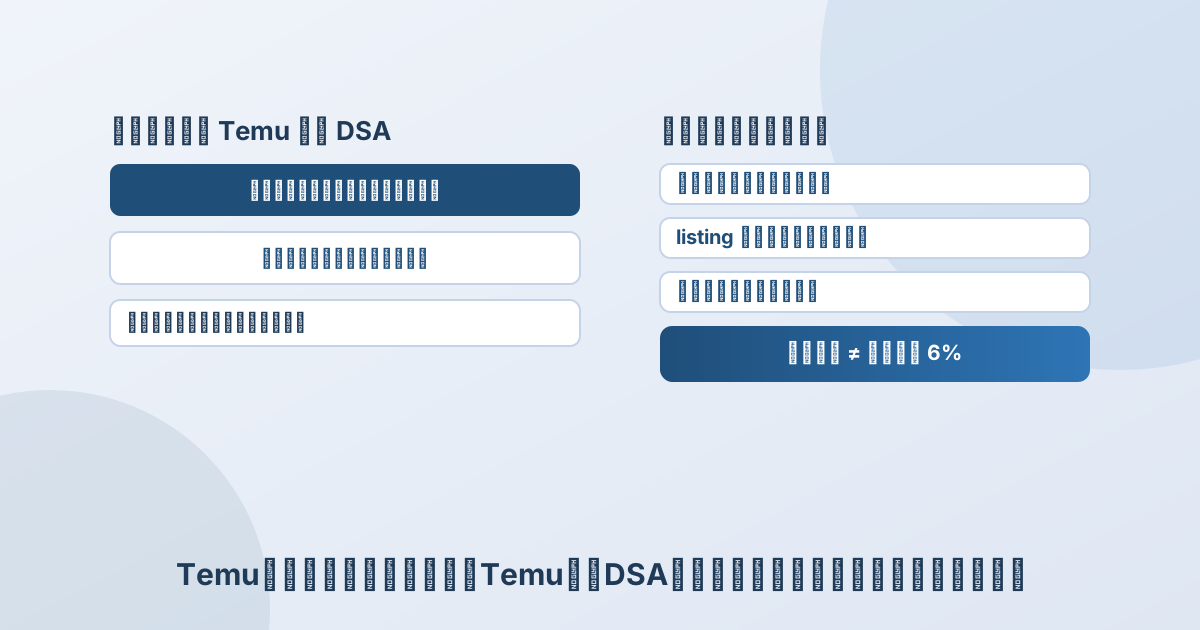
For cross-border sellers of high-risk categories such as toys, electronics and cosmetics on Temu's EU site, the European Commission's preliminary finding on 17 November 2026 that Temu breached the risk-mitigation obligation in Article 35 of the Digital Services Act (DSA) raises a question that is not whether Temu will eventually be fined 6%, but whether your own SKU compliance data (test reports, CE/EN standards, responsible person) is enough to survive the tighter checks the platform is about to apply, and whether your store structure will be caught when penalties escalate from the store to the operator. The answer comes in three steps: first audit test-report gaps by high-risk category, then work out whether you run multiple stores under one operator, and finally decide whether to fill the reports, delist or diversify platforms by asking whether the compliance cost exceeds the SKU's expected gross profit. The two scenarios below deal with compliance data gaps and multi-store structural risk respectively; all costs and volumes are explicitly labelled hypothetical examples.
On 17 November 2026 the European Commission published a press release preliminarily finding that Temu had not complied with Article 35 of the Digital Services Act, which requires very large platforms to adopt reasonable, proportionate and effective risk-mitigation measures, and had not effectively prevented illegal goods from being sold on its platform. The Commission identified three shortcomings: ineffective product compliance checks, weak content moderation, and an ineffective penalty mechanism. This is a preliminary finding, not a final decision; Temu can inspect the investigation file and reply in writing. If confirmed, the Commission can adopt a non-compliance decision, impose a fine of up to 6% of global annual turnover, and order remedial action.
1. The event and the metrics: how three shortcomings become three numbers sellers should watch
Translating the Commission's three preliminary findings into metrics a seller can self-audit comes down to three things. First, test-report coverage: the Commission says Temu required test reports for only a very small share of products and often did not check them even when required; the seller's counterpart is how many of their EU-listed SKUs fall in the named risk categories - toys, electronics, cosmetics - and how many of those hold verifiable test reports. Second, whether content moderation looks at product safety: the Commission says Temu's moderation focuses on product information and platform terms rather than whether the product itself is safe, and that headcount for manual review has not scaled with listing growth; the seller's counterpart is whether their listings will be wrongly caught or delayed once moderation tightens. Third, whether the penalty unit is the store or the operator: the Commission says Temu's penalties fall on an individual store rather than the operator behind it, so an operator running several stores can keep selling elsewhere after one store is closed; the seller's counterpart is how many stores they actually have and whether an escalated penalty would catch them all.
This is not Temu's first penalty under the DSA. In May 2026 the Commission found that Temu had failed to carry out an adequate risk assessment and imposed a €200 million fine; in October 2026 the Commission accepted an action plan Temu submitted to remedy that breach. The 17 November preliminary finding concerns a different obligation - whether the Article 35 risk-mitigation measures themselves are reasonable and effective - and is a separate matter from the May risk-assessment breach.
| Commission's preliminary finding | Metric for the seller to self-audit | How to audit |
|---|---|---|
| Test reports required for only a very small share, and often unchecked | Test-report coverage in high-risk categories | Export EU-listed SKUs, flag toys/electronics/cosmetics, check whether test reports exist |
| Moderation looks at product information and terms, not product safety; manual review has not grown with listings | Whether listings will be wrongly caught by tighter moderation | Check listing information completeness, CE/EN marking and responsible-person details |
| Penalties fall on the store, not the operator; multiple stores can keep selling | Mapping between stores and the operator | List all stores under your name and confirm exposure if penalties escalate |
2. Mechanism: through which links these three gaps affect sellers' costs and risk
The mechanism has three parts. First, test-report gaps raise compliance cost and delisting risk: once Temu requires test reports for more high-risk category products as part of remediation, SKUs without reports face delisting or review delays, and the seller must either pay for testing or drop those SKUs - both change unit profit directly. Second, tighter moderation amplifies wrongful hits and delays: manual review headcount has not grown with listings, so if Temu shifts to moderation that relies more on product-safety judgement, listings that used to pass may be delayed by incomplete information, damaging cash and ranking in peak season. Third, penalties escalating from store to operator amplify contagion risk: if Temu applies penalties to the operator behind the store rather than to a single store, several stores under one operator may be restricted at once for a single breach, removing the old buffer of closing one store and opening another.
3. Evidence boundary: a preliminary finding is not a final decision, and some conclusions cannot be drawn
What this article can verify item by item is the three preliminary findings in the Commission's 17 November press release, the 6% maximum fine, the background of the May €200 million fine and the October approval of an action plan, and Temu's response as relayed by the media (it disagrees with the finding and says it has invested substantial compliance resources); what cannot be inferred is the timing of a final decision, which categories Temu will next require test reports for, and in what form those requirements will reach sellers.
A few easy misuses: first, the 6% maximum is a cap, not a fine already determined, and its base is Temu's global annual turnover, unrelated to any individual seller; second, the preliminary finding gives no number of illegal listings, no consumer-loss figure and no timetable for a final decision; third, the May €200 million fine concerned the risk-assessment obligation and is a different matter from the November risk-mitigation obligation, so they cannot be added together to say Temu has already been fined twice. EU enforcement against similar platforms is also not limited to Temu: according to media reports, in July 2026 the Commission fined AliExpress €550 million and in February opened a formal investigation into Shein, which shows that Chinese cross-border platforms as a group are in the same round of compliance tightening.
4. Counter-case and alternative explanations: when you do not need to remediate for this
If your SKUs already have complete test reports, CE/EN marking and an EU responsible person, and are not in high-risk categories such as toys, electronics or cosmetics, then this preliminary finding targets the platform's process deficiencies and does not necessarily affect your products; your main risk comes from the general moderation Temu may tighten as part of remediation, not from your own compliance gaps.
Another alternative explanation: a preliminary finding is not a final penalty, and Temu has said it disagrees and has invested compliance resources; it may avoid the worst outcome through its reply, a settlement or remediation commitments, and may even absorb part of the compliance cost itself rather than passing all of it to sellers. The way to tell is to watch whether Temu's subsequent announcements explicitly require sellers to supply test reports and whether new seller fees appear; until the platform acts explicitly, there is no need to convert the 6% fine directly into your own cost.
5. Reproducible analysis: compliance data audits and decisions in two scenarios
Because test-report costs, commission and sales volume are private seller data with no public benchmark, the two scenarios below use a conditional decision tree plus explicitly labelled hypothetical examples to demonstrate the method; they are not industry-standard values. Replace them with your own real data and recalculate.
Scenario A: high-risk category missing test reports, fully managed direct shipping (hypothetical example)
Hypothetical example: a toy seller has 50 SKUs on Temu's EU site, only 10 of which hold EN71 test reports, leaving 40 missing; assume a test report costs €300, so closing the gap costs 40 × 300 = €12,000. Assume the top 10 SKUs by sales among the 50 contribute 80% of orders at €2 gross profit per unit, and 6 of those top sellers still lack reports.
Result: filling reports for the top-selling SKUs first costs only 6 × 300 = €1,800 and covers the compliance risk on 80% of orders, whereas filling all 40 at once costs €12,000, which takes 6,000 units of gross profit to break even. Decision: rank by sales contribution and fill test reports for top sellers first; delist long-tail SKUs or move them to another platform if the report cost exceeds their expected gross profit; if the platform ultimately requires reports for all high-risk categories, then assess whether to fill everything at once or narrow the category.
Scenario B: one operator running multiple stores, penalties escalating from store to operator (hypothetical example)
Hypothetical example: a seller runs 5 Temu stores under the same entity and previously avoided store-level penalties by closing one store and opening another; if Temu applies penalties at the operator level, all 5 stores would be restricted at once.
Result: under store-level penalties, a breach at one store costs at most 1 store (about 20% of the estate); once escalated to operator level, a single breach may freeze all 5 stores (100%). Decision: first map the ownership and compliance status of every store under your name, concentrate high-risk categories in a few stores, complete compliance data (test reports, responsible person) uniformly across all stores, or spread part of the budget to other platforms to hedge single-platform contagion risk; do not keep relying on reopening stores as a buffer.
Sensitivity: Scenario A's conclusion is most sensitive to the unit price of test reports - if a report costs €600 rather than €300, filling 6 top-selling SKUs costs €3,600 and filling all 40 costs €24,000, making long-tail SKUs even less worthwhile; Scenario B's conclusion is most sensitive to whether the platform identifies the operator as the same entity - if the platform identifies operators only by business licence or payout account, opening stores under different entities would actually reduce contagion risk, but may trigger new compliance and tax issues that you must verify yourself.
6. Action plan: what to collect, what to use as a baseline, and when to stop
The sequence is: first audit the categories and test-report gaps of EU-listed SKUs and the mapping between your stores and operating entities; then rank by sales contribution to decide whether to fill reports or delist; finally watch Temu's official announcements and the Commission's final decision, and make the decision before the platform's new compliance requirements land.
- Data fields to collect: the category of each EU-listed SKU (whether toys/electronics/cosmetics or another high-risk category), whether each SKU has a test report and its expiry, CE/EN marking and EU responsible-person details, the number of stores under your name and the entity mapping, and each SKU's unit gross profit and monthly sales.
- Set a baseline: use orders from the last 30 days to calculate each high-risk SKU's share of sales contribution and unit gross profit, as the basis for ranking fill-versus-delist.
- Observation window: watch Temu's official seller announcements and the Commission's subsequent decisions for whether the platform explicitly requires additional test reports or introduces compliance fees; observe for 2-4 weeks to see whether your listings are delayed or wrongly caught.
- Stop conditions: when the test-report cost for a high-risk SKU exceeds its expected gross profit over the next 12 months, delist it or move it to another platform; when the platform explicitly requires reports for all high-risk categories and you cannot complete them in time, narrow the category rather than forcing it.
- Fill the data gaps: once you have your account's category rates, test-report quotes and the platform's new rules, replace the hypothetical examples here with real numbers and recalculate.
7. Limitations and uncertainties
Three unknowns are most likely to change the conclusion: first, which categories Temu will ultimately require test reports for and in what form, which currently rests only on the three qualitative descriptions in the preliminary finding; second, real test-report quotes and the standards applicable to your category (EN71, CE/LVD/EMC, cosmetics regulation and so on) vary widely, and the €300 assumption here is only a placeholder; third, whether the platform ultimately absorbs the compliance cost or passes it to sellers, on which there is no public information.
What evidence would update the judgement: if you can obtain Temu's official new compliance requirements and your actual testing quotes, Scenario A's decision tree can turn from a hypothetical example into an executable checklist; if you can confirm the exact basis on which the platform identifies an operator (business licence, payout account or ultimate controller), you can judge how large Scenario B's contagion risk is. This article discusses a general analytical method under Temu's public rules and the EU's DSA enforcement approach and does not imply that Nuozhou Digital Intelligence provides real-time sales, back-end data or compliance coverage for Temu.
Method and notes
Data basis for this article: the three preliminary findings, the Article 35 obligation, the 6% maximum fine, and the background of the May €200 million fine and the October approval of an action plan are all taken from the European Commission press release of 17 November 2026 (IP/26/2463), accessed 2026-11-19; Temu's response (disagreeing with the finding and saying it has invested compliance resources) is taken from media reporting relayed by Euronews and 2eu.brussels, accessed 2026-11-19; the background of the €550 million AliExpress fine and the formal Shein investigation is taken from Brussels Signal, accessed 2026-11-19. The core facts come from the European Commission as a single first-hand source; media second-hand reporting only supplements the response and background and does not independently corroborate the three findings. SKU counts, test-report unit prices, unit gross profit and store counts in the two scenarios are all explicitly labelled hypothetical examples, not platform or shop statistics.
The increment in this article is to translate the EU's three qualitative findings about Temu into three metrics a seller can self-audit - test-report coverage, listing moderation wrongful-hit risk, and the mapping between stores and operators - and to give a conditional decision tree for filling reports, delisting or diversifying platforms, so sellers can audit their own compliance data gaps before the platform's final rules land, rather than reacting only after Temu issues a notice.
To put compliance remediation cost into the full profit ledger, see Cross-Border E-Commerce Profit Accounting: The Five-Step Subtraction from GMV to Net Profit; for Temu's own rates and the EU duty basis, see Temu Data Analysis; for the testing and delisting logic of EU toy compliance, see EU Toy Safety Compliance. This article was assembled with the help of an automated research workflow and is based on the public sources listed at the end; it has not been manually reviewed.
Reference sources
- 1. European Commission press release, 'Commission preliminarily finds Temu in breach of the Digital Services Act' (primary source: the three preliminary findings, Article 35, the 6% maximum fine, and the background of the May €200 million fine and the October action plan): view original, accessed 2026-11-19
- 2. Euronews, 'EU preliminarily finds Temu broke rules on illegal and unsafe products' (secondary source: Temu's disagreement, the 6% fine cap and an independent relay of the three gaps): view original, accessed 2026-11-19
- 3. 2eu.brussels, 'European Commission preliminarily finds Temu's measures against illegal product sales ineffective' (secondary source: Temu's response via Reuters, and the distinction from the May risk-assessment breach): view original, accessed 2026-11-19
- 4. Brussels Signal, 'Brussels accuses Temu of failing to keep illegal products off its platform' (secondary source: background on the €550 million AliExpress fine and the formal Shein investigation): view original, accessed 2026-11-19