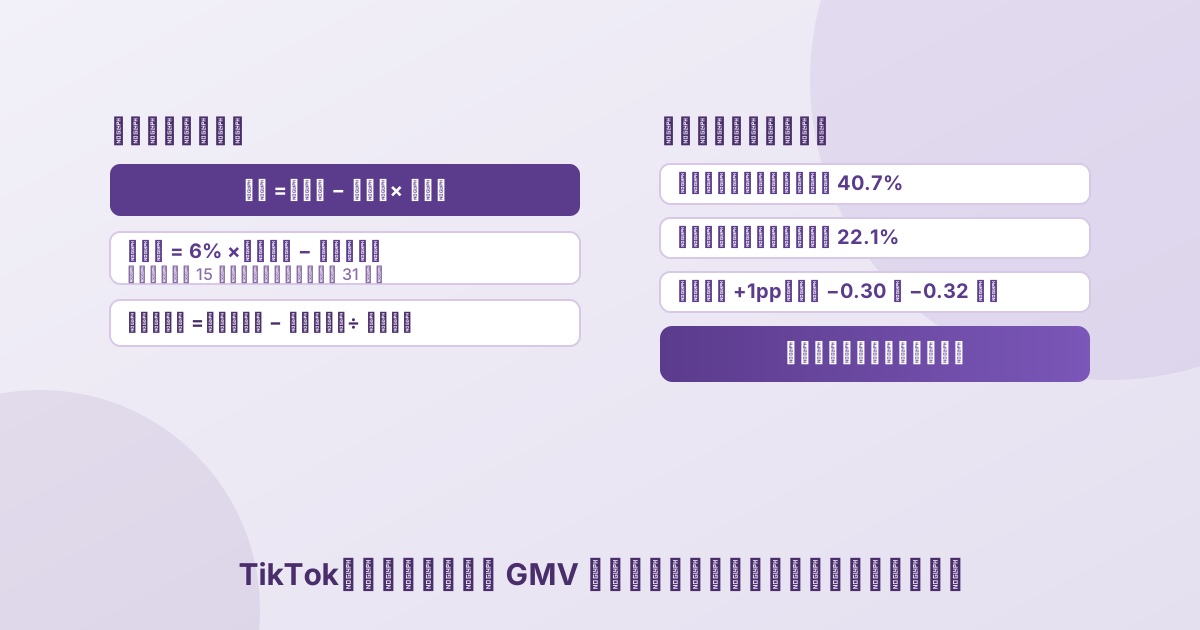
For sellers preparing to run creator affiliate sales on TikTok Shop while also carrying platform referral fees and ad samples, the core question is this: how do you split back-office attributed GMV into per-unit net contribution on the official settlement basis, back-solve the maximum commission rate a product can bear, and then decide whether to scale up, compress commission or stop investing? The answer comes in three steps: first separate attributed GMV from the settlement amount; then recompute with the two official formulas, commission = (revenue − refunds) × commission rate and referral fee = rate × (customer paid + platform subsidy − tax); finally back-solve the ceiling with maximum bearable commission rate = (per-unit contribution − target net profit) ÷ commission base. The ceilings in the two scenarios here are 40.7% and 22.1%; for the same product, higher costs, higher returns and a higher target net profit all lower the ceiling, and thin-margin categories can approach the break-even line even at the market median.
1. The decision question: when affiliate commission needs to be recalculated
A seller running creator affiliate sales on TikTok Shop, given a product's sale price, seller discount, purchasing and logistics costs, target net profit and return rate, has to decide what affiliate commission rate to set and when to stop an unprofitable creator partnership.
This question has to be recalculated in three situations: first, when setting a commission rate as a new product opens its affiliate programme or sends targeted invitations; second, when running Shop Ads that reuse creator assets while the commission rate is set separately; third, when attributed GMV looks high but payouts are low and you suspect creator contribution is overstated. All three decisions share the same definitions, but the risks differ.
2. Mechanism: commission, referral fee and settlement are three separate ledgers
Creator commission, platform referral fee and settlement amount are three independent ledgers: commission multiplies a settlement base by the commission rate and is deducted from the seller's balance only at order settlement; the referral fee is calculated at the time of sale on a base that includes platform subsidies; and the settlement amount is further reduced by refunds and the refund administration fee. Merge the three into a single platform cut and you will overstate or understate what you actually take home.
Under the official definitions, creator commission = (revenue − refunds) × commission rate: estimated commission = amount paid × commission rate, while actual commission is settled after the buyer receives the goods and the after-sales window closes, according to refunds, so a full refund means zero commission. Commission usually arrives on day 15 after delivery, and is deferred if the seller's settlement cycle is longer (for example 31 days after delivery). The commission base is the product price (excluding tax) minus seller discounts, and platform subsidies are not included in the base; TikTok also provides a 30-day commission protection period, under which increases take effect immediately while decreases take effect with a delay for creators already promoting.
| Basis | Meaning | Key point |
|---|---|---|
| Attributed GMV | Sales attributed by order source and content type, including direct and indirect | Includes refunds and returns; not settlement |
| Settlement amount | The amount actually paid to the seller after delivery and with no after-sales refund | Already net of commission, referral fee and refund administration fee |
| Referral fee | Rate × (customer paid + platform subsidy − tax), 6% for most categories | 6% since 2024-04-01, separate from commission |
In April 2026 TikTok unified the attribution logic for sales metrics: GMV is first split by order source (creator vs seller) and then by content type (LIVE, short video, product card), and sales are split into direct (bought on the spot) and indirect (content viewed first, order placed within a later window). Indirect sales can make attributed GMV for LIVE and short video look higher than under the old logic, but store-level total GMV, revenue and commission do not change: the attribution changed, the ledger did not.
3. Evidence boundary: which numbers you can trust and which you cannot derive
What this article can verify item by item is the commission formula, the 30-day commission protection period, the 6% referral fee formula and refund administration fee from TikTok's official Seller University, plus the direct and indirect attribution definitions of April 2026; attributed GMV is not the settlement amount, and the market median commission rate is not your bearable ceiling, and these are boundaries that must be drawn at the level of data definitions.
A few easy misuses: first, attributed GMV includes refunds and returns and cannot be treated directly as net sales; second, direct and indirect attribution only describe the order in which a sale and a piece of content occurred and do not prove the content produced incremental sales, because there is no control group; third, third-party observations (such as a median 9% commission rate on top products in a given week) are descriptive data, not recommended values, and certainly cannot replace the official settlement basis.
4. Counter-case and alternative explanations: a high commission rate is not the same as good conversion
A scenario that would overturn the idea that higher commission always deserves more spend is a product with thin gross margin and a high return rate, where a high commission rate eats straight into net profit or even turns every order into a loss, so following the crowd to the market rate makes things worse; another alternative explanation is that the indirect sales inside attributed GMV may have come from the brand's own paid media or organic search all along, so creator contribution is overstated.
How to tell them apart: separate the commission-rate decision from the creator-contribution assessment. Contribution looks at order source and the direct/indirect split; commission rate looks at how much per-unit contribution is left. Shop Ads that reuse creator assets have a separate commission-rate setting, and if you do not set it separately you may pay both the ad spend and the full commission. If one creator video shows an unusually high share of indirect GMV but few direct orders, suspect attribution overlap first rather than raising commission.
5. Recomputable analysis: hand calculation and sensitivity for the two scenarios
Both scenarios use the same ledger: commission base = product price − seller discount, referral fee = 6% × (product price − seller discount), per-unit contribution = commission base − referral fee − purchasing − logistics − other, maximum bearable commission rate = (per-unit contribution − target net profit) ÷ commission base.
Both scenarios below are explicitly labelled hypothetical examples, not statistics from any real store or platform; tax and platform subsidy cancel out in the referral fee formula, and to make recomputation easier the customer is assumed to pay zero shipping, so the referral fee simplifies to 6% × (product price − seller discount).
Scenario A: no seller discount, low purchasing cost, maximum bearable commission rate 40.7% (hypothetical example)
Hypothetical example: list price USD 30, seller discount 0, platform subsidy USD 4, tax USD 1.6, purchasing USD 8, logistics USD 4, other USD 1, target net profit USD 3.
Commission base = USD 30, referral fee = 6% × (30) = USD 1.80, per-unit contribution = 30 − 1.80 − 8 − 4 − 1 = USD 15.20, maximum bearable commission rate = (15.20 − 3) ÷ 30 = 40.7%; at a 20% commission, commission is USD 6 and per-unit net profit is USD 9.20.
If you can secure a steady supply of creators at a 20% commission with a controllable return rate, scale up; once the commission rate exceeds 40.7% and per-unit net profit falls below the USD 3 target, compress commission or stop working with that creator.
Scenario B: seller discount, high purchasing cost, maximum bearable commission rate 22.1% (hypothetical example)
Hypothetical example: list price USD 40, seller discount USD 8, platform subsidy USD 4, tax USD 1.6, purchasing USD 14, logistics USD 5, other USD 2, target net profit USD 2.
Commission base = 40 − 8 = USD 32, referral fee = 6% × (32) = USD 1.92, per-unit contribution = 32 − 1.92 − 14 − 5 − 2 = USD 9.08, maximum bearable commission rate = (9.08 − 2) ÷ 32 = 22.1%; following the market median at 18%, commission is USD 5.76 and per-unit net profit is USD 3.32.
This product's bearable ceiling is only 22.1%; if you set commission at 30% to chase ranking, per-unit net profit = 9.08 − 9.60 = −USD 0.52, a loss, so you should immediately pull back below 22% or switch to a higher-margin variant.
Sensitivity: for every 1 percentage point increase in the commission rate, per-unit net profit falls by USD 0.30 in Scenario A and USD 0.32 in Scenario B; if Scenario A sees a 10% return rate, commission is reversed on a (revenue − refunds) basis, but reversing the referral fee incurs a 20% refund administration fee capped at USD 5 per SKU, so a USD 1.80 referral fee fully refunded returns only USD 1.44.
6. Action plan: what to collect, what to use as a baseline, when to stop
Start by exporting the order-source and content-type split from Seller Center data analytics, then export estimated commission, actual commission, refunds and payout records from the affiliate centre, recompute product by product with maximum bearable commission rate = (per-unit contribution − target net profit) ÷ commission base, and set continue, compress and stop conditions.
- Fields to collect: product price, seller discount, platform subsidy, tax, purchasing cost, logistics, other costs, target net profit, return rate, creator direct and indirect GMV
- Set a baseline: use settled orders from the last 30 days to calculate each product's actual per-unit contribution and actual commission rate as the comparison baseline
- Observation window: after changing the commission rate, observe for 14–30 days to cover the 15-day payout cycle, comparing per-unit net profit and return rate
- Stop conditions: if per-unit net profit falls below target, or the actual commission rate exceeds the bearable ceiling calculated here, compress commission or stop investing
- Fill the gaps: once you have your own settlement report and the Shop Ads commission floor, replace the assumed values in this article and recompute
7. Limitations and uncertainties
The unknowns most likely to change the conclusion are three: first, the referral fee category rate and Shop Ads commission floor that apply to your account have not been checked word for word; second, whether platform subsidies count towards the commission base may vary by site and policy version; third, the incremental contribution of the return rate and of indirect attribution can only be estimated through your own controlled experiments.
What evidence would update the judgement: if you can export your own settlement report and reconcile actual commission and the settlement base against the official formula order by order, the numerical conclusions here can be further pinned down; if you can run a controlled creator test with the same product and price, half through creators and half organic, you can estimate the incremental contribution of indirect GMV. This article discusses a general analysis method under TikTok Shop's public rules; it does not mean Nuozhou Digital Intelligence already provides real-time TikTok Shop sales, creator data or back-office coverage.
Method and notes
Data definitions in this article: the creator commission formula (revenue − refunds) × commission rate, the 30-day commission protection period and the 15/31-day payout timing come from TikTok Shop's official Seller University, “How Standard Affiliate Commission Works” (accessed 2026-11-19); the referral fee formula rate × (customer paid + platform subsidy − tax), the 6% rate and the refund administration fee come from the official “Referral Fee Updates”; the direct and indirect attribution definitions come from the official “Sales Metrics Breakdown Logic Upgrade”. Sale prices, discounts, costs, tax rates and target net profit in both scenarios are all explicitly labelled hypothetical examples, not platform or store statistics.
The increment in this article is that it aligns the four-step basis, from attributed GMV to commission base to per-unit contribution to bearable commission rate, into one recomputable ledger, and points out the marginal net-profit loss from a high commission rate and the refund administration fee on refunds, which is a decision tool you cannot get from reading a single attribution announcement.
To carry per-unit contribution further down to net profit, see Cross-Border E-Commerce Profit Accounting: The Five-Step Subtraction from GMV to Net Profit on this site; for a comparison of platform commission and settlement bases, see Shopee Data Analysis.
This article was prepared with the assistance of an automated research workflow and is based on the public sources listed at the end; it has not been reviewed by a human editor.
Reference sources
- 1. TikTok Shop Seller University, “How Standard Affiliate Commission Works” (primary source: commission formula, 30-day protection period, payout timing): view original, accessed 2026-11-19
- 2. TikTok Shop Seller University, “Referral Fee Updates - 2024” (primary source: the 6% referral fee formula and the refund administration fee): view original, accessed 2026-11-19
- 3. TikTok Shop Seller University, “Sales Metrics Breakdown Logic Upgrade” (primary source: direct and indirect attribution, order-source split): view original, accessed 2026-11-19
- 4. TikTok Shop Seller University (Cross-border), “Understanding How to Improve Sales” (primary source: the tax-inclusive split in the cross-border commission formula): view original, accessed 2026-11-19
- 5. MediaLabs Research, “Shoppable video carries about two-thirds of TikTok Shop sales” (secondary source: observation of channel and creator shares): view original, accessed 2026-11-19
- 6. MediaLabs, “TikTok Shop affiliate commission rates in 2026” (secondary source: observation of median commission rates): view original, accessed 2026-11-19