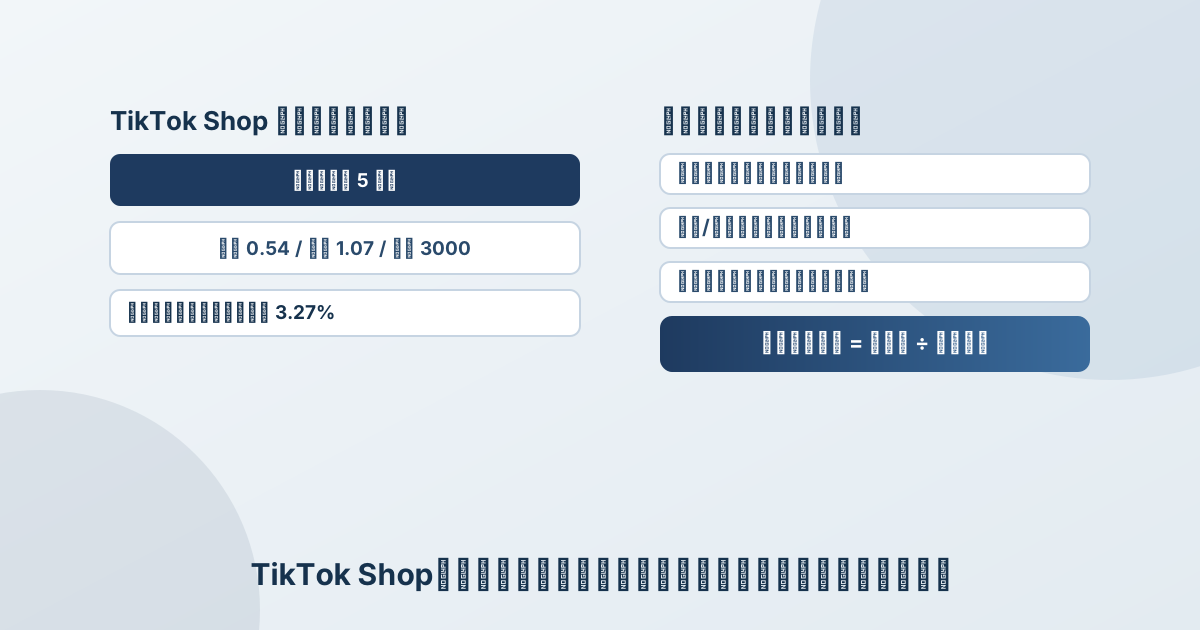
For cross-border sellers selling the same product across TikTok Shop's five Southeast Asian markets, the core question is this: the Philippines charges PHP 5 per item, Malaysia MYR 0.54 per order, Thailand THB 1.07 per order, Vietnam VND 3,000 per order and Singapore 3.27% on an amount that includes platform discounts, so for the same product, in which markets should you use multi-packs, raise prices, or split orders? The answer depends on whether the market charges per item, per order or proportionally: the Philippines charges per item, so multi-packs multiply the fee; Malaysia, Thailand and Vietnam charge per order, so multi-packs dilute the fixed fee; Singapore charges proportionally, so platform vouchers are included in the fee base. The starting point is minimum order value = fixed fee ÷ target rate: at a 2% target rate, the floor is about PHP 250 per item in the Philippines, about MYR 27 per order in Malaysia, about THB 53.50 per order in Thailand and about VND 150,000 per order in Vietnam; in Singapore you multiply 3.27% by the sum of the buyer's payment and platform discounts.
1. The decision question: for the same product in five countries, do you look at the charging basis or the amount first
A seller running a TikTok Shop cross-border store in the Philippines, Malaysia, Thailand, Vietnam and Singapore uses the fixed order fee in different markets and Singapore's proportional fee to judge the minimum sellable price, whether to offer multi-packs, and whether fees come back after a refund. The starting point is not the commission rate but whether that market charges per item, per order or proportionally: the Philippines charges on successfully delivered orders and the number of items in the order, Malaysia and Thailand charge per order, Vietnam charges on successfully delivered orders, and Singapore charges on an amount that includes platform discounts.
On 17 November 2026 TikTok Shop published “Southeast Asia Cross-Border E-Commerce Order Fee Collection Notice”, bringing the previously scattered charging rules for these five markets into one explanation. Note that these are not newly imposed fees: the Philippine order processing fee has been charged since 1 September 2026, the Malaysian platform support fee since 15 February 2026, and Thailand, Vietnam and Singapore are at current rates; the value of the 17 November notice is that it puts five charging bases and the refund rules into a single comparison table, letting sellers reconcile market by market from one official source for the first time.
2. Mechanism: three charging bases determine how hard the fee hits low-ticket orders
The order fees in the five markets fall into three mechanisms. The first is per item (the Philippines): the order processing fee is PHP 5, calculated on successfully delivered orders and the number of items in the order, so two items in one order means PHP 10. The second is per order (Malaysia, Thailand, Vietnam): regardless of amount or item count, Malaysia's platform support fee is MYR 0.50 plus 8% sales and service tax for MYR 0.54, Thailand's platform infrastructure fee is THB 1.07, and Vietnam's order processing fee is VND 3,000. The third is proportional (Singapore): the transaction fee is 3.27% including goods and services tax, calculated on the charging base in the formula, not a fixed amount.
| Market | Official fee name | Rate | Charging basis | Tax note |
|---|---|---|---|---|
| Philippines | Order processing fee | PHP 5 | Calculated on successfully delivered orders and the number of items in the order | Tax inclusive |
| Malaysia | Platform support fee | MYR 0.50, MYR 0.54 including tax | Calculated per order, regardless of amount or item count | 8% sales and service tax added on top of the untaxed amount |
| Thailand | Platform infrastructure fee | THB 1.07 | Calculated per order | Tax inclusive |
| Vietnam | Order processing fee | VND 3,000 | Calculated on successfully delivered orders | Tax inclusive |
| Singapore | Transaction fee | 3.27% | Calculated on the charging base in the formula | Includes goods and services tax |
The three bases hit low-ticket orders differently. The Philippines charges per item, so the more items in an order the higher the fee, and multi-packs do not dilute it but multiply it; Malaysia, Thailand and Vietnam charge per order, so one order is charged once no matter how many items it holds and multi-packs spread the fixed fee across units; Singapore charges 3.27% on an amount that includes platform discounts, so the more platform vouchers are used the larger the base, unrelated to item count but tied to the discount amount.
This order fee affects the seller's per-unit contribution margin through its charging basis: a per-item fee puts the cost on every low-priced unit, a per-order fee puts the cost on a single order, and a proportional fee puts the cost on the buyer's payment plus platform discounts. To judge whether a unit makes money, you cannot look only at the commission rate; you have to look at what percentage points this order fee takes out of the order's merchandise value.
3. Evidence boundary: the official notice can be checked line by line, but rates and exemptions follow the store's market page
What this article can verify item by item is the fee amounts, charging bases, Singapore fee formula, exemption and refund rules for the five markets, all from TikTok Shop's official “Southeast Asia Cross-Border E-Commerce Order Fee Collection Notice” of 17 November 2026; what cannot be derived is whether your store is currently in an exemption period, how much commission and logistics take out of actual settlement, and how the settlement-date exchange rate changes the same product's fee share in a cross-market comparison.
A few easy misuses: first, fee names, currencies, charging objects and refund rules all follow the official page for the market the store belongs to, and an exemption in one market cannot be applied to another; second, this order fee is only one part of cross-border operating costs, and deposits, platform commission, affiliate commission, logistics or payment service fees are not included; third, Singapore's 3.27% is a proportional fee, and reading it as a fixed SGD 3.27 per order will produce wrong calculations.
4. Counter-case and alternative explanations: this fixed fee may not be a profit killer, and 3.27% is not a fixed fee
A scenario that would overturn the judgement that every seller must reprice for this order fee is a store inside an exemption period, where this fixed fee may be zero. New Philippine merchants pay nothing on all orders next month and established merchants pay nothing on the first 50 orders each month; new Malaysian merchants can get 30 days free by completing tasks; Thai merchants with 1 to 100 orders in the past 30 days can apply for a reduction the following month; and the 2026 Flywheel Programme Q4 also offers new stores staged support such as commission-free, fee-free or infrastructure-fee-free periods.
Another alternative explanation is that this order fee is usually far smaller than commission, affiliate commission and logistics, and treating it as a profit killer misjudges priorities. The way to tell them apart is to confirm your store's own exemption status and Flywheel Programme eligibility first, then place the order fee inside the full per-unit contribution-margin ledger and see what percentage points it takes of the order's merchandise value, rather than looking at those few pesos in isolation.
5. Recomputable analysis: the minimum order value formula and three scenarios
The general formula for fixed-fee markets is: minimum order value = fixed fee ÷ target rate. At a 2% target rate, that is at least 5 ÷ 0.02 = PHP 250 per item in the Philippines, at least 0.54 ÷ 0.02 = MYR 27 per order in Malaysia, at least 1.07 ÷ 0.02 = THB 53.50 per order in Thailand and at least 3,000 ÷ 0.02 = VND 150,000 per order in Vietnam; when the target rate is relaxed to 5%, the corresponding floors fall to PHP 100, MYR 10.80, THB 21.40 and VND 60,000. All three scenarios below are explicitly labelled hypothetical examples.
Scenario A: per-item charging in the Philippines, multi-packs amplify the fee (hypothetical example)
Hypothetical example: in the Philippine market the product sells for PHP 99 per item, one order contains 3 items, delivery is successful and no exemption applies.
Order processing fee = 5 × 3 = PHP 15, or 15 ÷ 297 = 5.05% of the order's merchandise value; even splitting the 3 items into 3 orders still totals PHP 15, so the rate does not change.
Because the Philippines charges per item, multi-packs cannot dilute this fee; compare raising the unit price or switching to a paid add-on instead of relying on multi-packs to lower the rate, since a PHP 500 single item is charged only PHP 5, a 1% rate, which shows that raising the price lowers the rate better than adding items.
Scenario B: per-order charging in Malaysia, low-ticket single items are most sensitive (hypothetical example)
Hypothetical example: the Malaysian product sells for MYR 9.90 per item and the Thai product for THB 99 per item, one item of each is bought and no exemption applies.
Malaysia's MYR 0.54 fee is 5.45% of MYR 9.90, while Thailand's THB 1.07 fee is only 1.08% of THB 99; for the same three-item order, Malaysia still charges MYR 0.54 for a 1.82% rate and Thailand still charges THB 1.07 for a 0.36% rate.
Malaysian low-ticket single items are the most sensitive, so test multi-packs or raise the average order value first; Thailand can bear a lower unit price, but commission and logistics still have to be calculated together rather than looking only at this THB 1.07.
Scenario C: proportional charging in Singapore, platform discounts enlarge the fee base (hypothetical example)
Hypothetical example: in Singapore one order has a buyer payment of SGD 90, a platform discount of SGD 10 and refunds of 0 on both components.
Transaction fee = [(90 - 0) + (10 - 0)] × 3.27% = SGD 3.27; excluding platform discounts, 90 × 3.27% = SGD 2.943 alone, so the platform discount adds SGD 0.327 to the fee base.
Singapore charges on an amount that includes platform discounts, so the more vouchers are used the larger the base; when pricing, multiply 3.27% by the payment plus platform discount, not by the list price alone.
6. Action plan: what to collect, what to use as a baseline, when to stop
First log in to the store back office to confirm whether your store is in an exemption period or qualifies for the Flywheel Programme in each market, then recompute market by market with minimum order value = fixed fee ÷ target rate, and check the fees on refunded orders against the rule that a full order refund is returned in full while a partial refund is not returned.
- Fields to collect: each market's charging basis (per item, per order or proportional), fee amount, store exemption status, Flywheel Programme eligibility, number of items in the order, refund scope
- Set a baseline: use settled orders from the last 30 days to calculate each market's average order value and order-fee share as the comparison baseline
- Observation window: after changing multi-packs or raising prices, observe for 14–30 days and compare the order-fee share, average order value and return rate
- Stop conditions: if a market's order-fee share stays above the target rate, or a high share of partial refunds means the fee is not returned, change pricing, change multi-packs or stop the low-priced SKU
- Fill the gaps: once you have the store's actual exemption status and the settlement-date exchange rate, replace the assumed values in this article and recompute
7. Limitations and uncertainties
The unknowns most likely to change the conclusion are three: first, whether your store is in an exemption period or qualifies for the Flywheel Programme in each market has not been checked; second, in a cross-market comparison the settlement-date exchange rate changes the same product's fee share; third, the mix of full and partial refunds in your orders affects whether fees are returned.
What evidence would update the judgement: if you can log in to the store back office to confirm exemption status, export each market's settlement report and check the refund share, the minimum order value floors in this article can be pinned down market by market; if you can obtain the settlement-date exchange rates, you can convert the five markets into one currency for a like-for-like ranking. This article discusses a general analysis method under TikTok Shop's public rules; it does not mean Nuozhou Digital Intelligence already provides TikTok Shop real-time orders, back-office fee rates or data coverage.
Method and notes
Data definitions in this article: the fee amounts, charging bases, Singapore fee formula, exemption and refund rules for the five markets come from TikTok Shop's official “Southeast Asia Cross-Border E-Commerce Order Fee Collection Notice” of 17 November 2026 and “Southeast Asia Cross-Border Store Onboarding Fees and New Merchant Support Notice” of 11 November 2026, accessed 2026-11-19; the sale prices, item counts, payments and platform discount amounts in all scenarios are explicitly labelled hypothetical examples, not statistics from any store or platform.
The increment in this article is that it breaks the platform fee from a vague percentage into three verifiable charging units, per item, per order and proportional, and gives the decision formula minimum order value = fixed fee ÷ target rate, so sellers can judge whether a fixed order fee eats the target rate even without knowing commission and logistics, something a single official notice does not give you.
To place this order fee inside the full profit ledger, see Cross-Border E-Commerce Profit Accounting: The Five-Step Subtraction from GMV to Net Profit on this site; for a comparison of platform commission and settlement bases, see TikTok Data Analysis and Shopee Data Analysis.
This article was prepared with the assistance of an automated research workflow and is based on the public sources listed at the end; it has not been reviewed by a human editor.
Reference sources
- 1. TikTok Shop cross-border official site, “Southeast Asia Cross-Border E-Commerce Order Fee Collection Notice” (primary source: fee amounts, charging bases, the Singapore formula, exemption and refund rules for the five markets): view original, accessed 2026-11-19
- 2. TikTok Shop cross-border official site, “Southeast Asia Cross-Border Store Onboarding Fees and New Merchant Support Notice” (primary source: store deposits, commission and transaction fees settled per order, 2026 Flywheel Programme Q4 support): view original, accessed 2026-11-19