For sellers using FBA in the US store, and for those replenishing through AWD or MCD, the 2027 fee changes raise a question that is not how much more Amazon has charged this time, but how much delivery fees, storage fees, low-inventory-level fees and the AWD/MCD transport surcharge will rise for each of their SKUs after the two batches of changes on 15 January and 1 February 2027, and whether those increases have already eaten the per-unit profit — which in turn determines whether to raise the price, clear stock, change packaging, change the fulfilment method or move to third-party logistics. Only by replacing the official band averages with the real rates for your own SKUs, and by breaking out your own AWD/MCD transport bills separately, can the announcement be turned into executable stocking, pricing and fulfilment decisions.
Update note (19 November 2026): building on the first publication on 18 November 2026, this article adds the scope, calculations and scenarios for the 3.5% fuel and logistics surcharge extending to AWD transportation fees and MCD logistics fees from 1 February 2027, as well as the AWD/MCD/MCF rate changes. The original publication date is retained.
1. The event and its terms: what the 2027 US fee changes actually change
On 5 November 2026, Amazon published the 2027 changes to US referral fees and FBA fees through its official seller announcement. Most of the changes take effect on 15 January 2027, while the storage and low-inventory-level fee changes take effect on 1 February 2027; the Chinese-language announcement is on the Amazon Global Selling page.
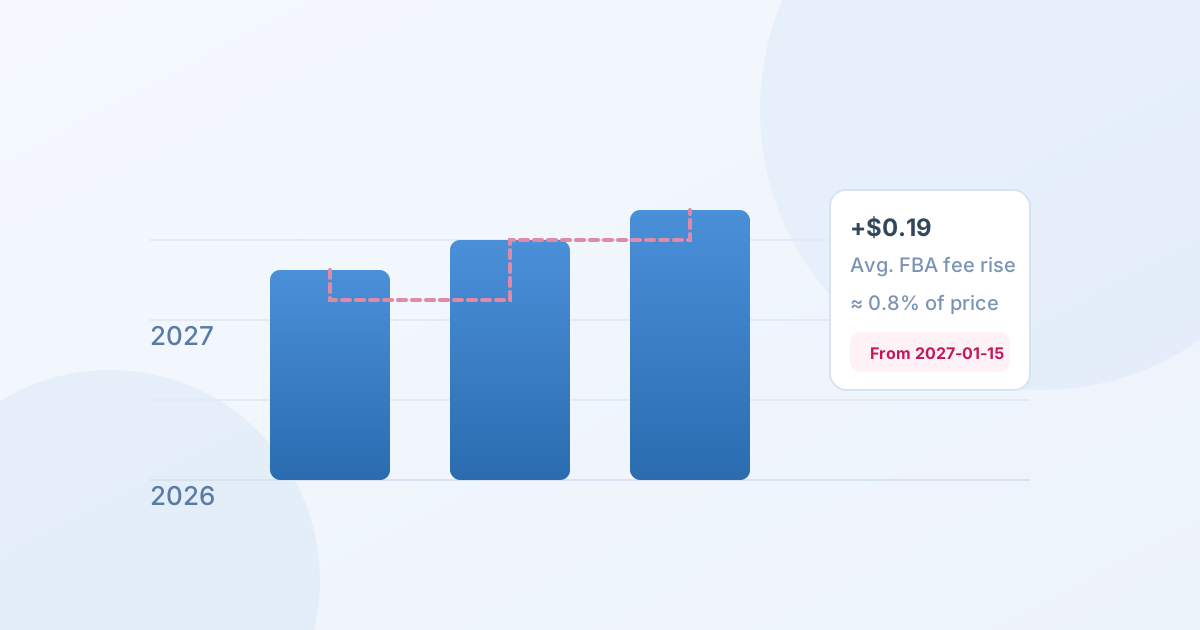
The core official figures are: FBA delivery fees rise by an average of $0.19 per unit sold, about 0.8% of the average selling price, with the actual impact varying by product type, size and price; fuel- and logistics-related surcharges stay at 3.5%; storage fees are simplified and the low-inventory-level fee assessment rules are updated.
The announcement also adjusts three logistics services beyond FBA. From 1 February 2027, according to Amazon Korea's official page, Amazon Warehousing and Distribution (AWD) processing fees are $1.55 per carton and transportation fees are $1.58 per cubic foot, with a 40% discount on single-SKU pallet inbound processing fees where eligible, and the 3.5% fuel and logistics surcharge that currently applies to FBA delivery fees also applies to AWD transportation fees. From the same date, Multi-Channel Distribution (MCD) raises less-than-truckload (LTL) rates by 8% and small parcel delivery (SPD) by 1.5%, with the 3.5% surcharge applying to MCD fees as well. Multi-Channel Fulfillment (MCF) standard delivery and Buy with Prime delivery rise by an average of 3.5% from 15 January 2027 (expedited delivery is unchanged). AWD storage fees move to age-based billing from 1 March 2027, with inventory stored for more than 12 months charged at 2.5 times the standard rate.
| Price range | Small standard size | Large standard size |
|---|---|---|
| Below $10 | Average +$0.20/unit | Non-apparel unchanged; apparel average +$0.08/unit |
| $10 to $50 | Average +$0.40/unit | Average +$0.12/unit |
| Above $50 | Average +$0.70/unit | Average +$0.47/unit |
The table above shows the official average FBA delivery fees by price range and size band. It cannot simply be added to the overall $0.19 average, and it does not equal the actual increase for any individual SKU. The change for a single product may differ, so it must be checked against the fee-change comparison dashboard or the revenue calculator in Seller Central.
2. How the changes affect per-unit profit and cash flow
Delivery fees are charged per unit sold and are a variable per-unit cost, so they directly reduce per-unit contribution; the fuel surcharge is charged on the delivery fee rather than the selling price, and although the rate stays at 3.5%, a higher delivery fee raises the surcharge in absolute dollars slightly. Storage fees are charged on inventory age and volume and are a holding cost; slow-moving inventory becomes more expensive after six months, draining cash without adding sales.
The low-inventory-level fee no longer looks only at past sales. It first looks at actual shipments in the 28 days before the assessment date, then at actual shipments in the 28 days after it, and charges only when the days of supply fall below 28 in both assessments. This mechanism penalises only SKUs that genuinely need replenishment and are out of stock, reducing false charges for products hit by a demand spike, a season-end or an end-of-life cycle.
The 3.5% surcharge on AWD and MCD applies only to transportation fees, not to storage or processing fees; AWD transport is measured in cubic feet and MCD in pallets or cartons, so the surcharge scales with transport volume. The expansion therefore falls mainly on sellers with frequent replenishment and a high transport share of cost, and does not directly apply to sellers who use only FBA and never use AWD/MCD.
3. Evidence boundaries: which numbers can be applied directly and which cannot
The verifiable figures in this article come from Amazon's official announcements and industry media reports. The $0.19 and the band averages are Amazon's own averages, not a fixed increase for any SKU; Amazon's fee-change comparison dashboard provides estimates based on 2026 rates and sales data from 1 July to 30 September 2026, and actual invoice amounts may differ.
The 3.5% surcharge on AWD/MCD, MCD's LTL +8% and SPD +1.5% all come from Amazon's official pages and can be checked line by line. However, the order in which the surcharge and the rate changes stack is not specified in the announcement, and the official rate tables themselves exclude the surcharge, so the actual invoice in Seller Central governs. Media summaries that say 'logistics is up 3.5% overall' misread the change: the 3.5% applies only to the transportation fee line, not to the whole logistics bill.
4. A checkable worked example: translating fee changes into per-unit contribution
All operating inputs below are hypothetical examples in US dollars; they are not platform averages, recommended prices or any seller's actual results. Take a small standard-size SKU priced at $25 with a 15% referral fee.
- Selling price P = $25; referral fee 15% → $3.75
- 2026 FBA delivery fee = $3.50; fuel surcharge 3.5% → $0.12
- Purchase cost of goods = $6.00; first-mile and inbound allocation = $1.50
- In 2027 this SKU falls in the $10 to $50 small standard band, so the delivery fee uses the official band average of +$0.40
Under the +$0.40 band-average assumption, the 2027 delivery fee moves from $3.50 to $3.90, an increase of $0.40 per unit, or 1.6% of the $25 selling price; the fuel surcharge rate stays at 3.5%, and because the delivery fee base rises, the surcharge rises by about $0.01, for a total increase of about $0.41 per unit. Using the official overall average of $0.19 instead, the delivery fee rises by only $0.19, or 0.76% of the selling price, close to the official statement of about 0.8% of the average selling price. The two figures differ by about $0.21, which shows that the overall average understates the actual increase for this small standard-size SKU in the $10 to $50 band.
The AWD transport surcharge is calculated the same way, as transport fee base × 3.5%. In the industry-reported example, moving 500 cubic feet of AWD inventory to FBA costs $790 at the new $1.58 per cubic foot rate, and about $817.65 after the 3.5% surcharge of about $27.65. This surcharge is a transportation-fee item, not a storage or processing item, and cannot simply be added to the per-unit delivery fee increase.
Scenario A: Low-price best-seller, small standard size
Assume a best-selling SKU in small standard size priced at $12 with about 200 units a month, inventory age consistently below two months, falling in the $10 to $50 band, with the delivery fee at the +$0.40 average.
Per-unit delivery fee rises by $0.40 at the band average, about 3.3% of the $12 selling price; because turnover is fast and inventory age is below six months, storage fees stay flat or fall under the 2027 storage reform, and holding four weeks of inventory avoids the low-inventory-level fee.
This type of product should make fast turnover the main strategy: first model the effect of a $0.5 to $1 price increase on conversion, then decide whether to pass the cost on or absorb it; do not clear stock or change fulfilment over a single $0.40 increase.
Scenario B: High-price, large-item slow mover
Assume a slow-moving large standard-size SKU priced at $80 with about 20 units a month and inventory age already above six months, falling in the above-$50 band, with the delivery fee at the +$0.47 average.
Per-unit delivery fee rises by $0.47 at the band average, and the storage rate for aged inventory rises from 1 February 2027, so delivery and storage both increase; the longer the stock is held, the higher the carrying cost.
This type of product should be promoted, removed or marked down before 1 February 2027, cutting aged inventory first; if the clearance price is already below the purchase cost plus delivery fee, assess the cost of removal or disposal rather than continuing to pay the higher aged-inventory storage fee.
Scenario C: Low-frequency AWD replenishment
Assume a US seller stores 500 cubic feet of inventory in AWD and transfers it four times a year, with an AWD transport fee of $1.58 per cubic foot and a 3.5% surcharge.
A single 500-cubic-foot transfer costs $790, or $817.65 with the 3.5% surcharge of about $27.65; four transfers a year add about $110.6, or about $0.011 per unit across 10,000 units.
Sellers with annual transport fees below $50,000 should absorb the increase and watch it rather than switch to a third-party logistics provider over 3.5%; they should first batch high-frequency replenishment SKUs to reduce the number of transfers.
Scenario D: High-frequency MCD LTL replenishment
Assume a seller's monthly MCD palletised less-than-truckload (LTL) transport fee is $10,000, rising to $10,800 after the 8% LTL rate increase, with about $378 added by the 3.5% surcharge.
The monthly total is about $11,178, up about $1,178 (about +11.78%) from before; the break-even point for switching to a third-party logistics provider is a 3PL total cost below $11,178, not below the original $10,000.
Request quotes from third-party logistics providers and compare 'transport fee + surcharge + switching cost'; switch only if the 3PL total cost is below $11,178, otherwise keep MCD and move to full pallets to reduce LTL frequency.
The four scenarios differ by price band, inventory age and fulfilment method: fast-selling small items bear only the delivery fee increase, slow-moving large items also bear the aged-inventory storage increase, the low-frequency AWD scenario has a small absolute surcharge, and the high-frequency MCD LTL scenario has a large absolute increase once the surcharge and the rate increase stack. If scenario B's inventory age were below six months rather than above, its storage fee would stay flat or fall, turning a double increase into a single one; if scenario D used only FBA, the surcharge expansion would not apply.
The increment in this analysis is that, after the 3.5% surcharge expanded from FBA delivery fees to AWD transportation fees and MCD logistics fees, it is calculated separately as transport fee base × 3.5% and kept distinct from LTL +8% and SPD +1.5%, so sellers can judge the actual dollar amount by transport volume instead of treating Amazon logistics as a flat 3.5% increase.
5. Counter-examples and alternative explanations: when not to raise prices, clear stock or switch logistics
An easy misjudgement is a SKU that happens to fall in one of the new large or extra-large size bands where delivery fees fall: Amazon explicitly adds four size bands for large and extra-large products, with delivery fees moving both up and down. In that case the overall +$0.19 average does not apply at all, and raising prices along with the crowd would cost price competitiveness.
Another alternative explanation is that the main cause of falling per-unit profit may not be this fee change at all, but purchase cost, ad bids or return rates. Before deciding on a price change, check each SKU's 2026 delivery fee, storage fee, ad spend and return losses separately to confirm which line moved, so that the fee change does not become the scapegoat for every profit problem. Before raising prices, see How Cross-Border Sellers Can Avoid the 'Price Trap' in Product Selection and confirm your relative position against competitors in the target price band.
A third misjudgement concerns logistics fees: sellers who use only FBA and never use AWD/MCD are not directly affected by this 3.5% surcharge expansion, and a hasty move to a third-party logistics provider would instead expose them to stock-outs during the switch and the cost of running two fulfilment lines. Conversely, for SKUs where transport is a very small part of landed cost, the 3.5% surcharge may be lower than the switching cost of renegotiating with a third-party logistics provider.
6. Action plan: what to collect, how to verify, and when to continue or stop
Build a cost table for each SKU grouped by order month, recording selling price, referral fee, delivery fee, fuel surcharge, monthly storage fee, low-inventory-level fee, purchase cost, first-mile cost and return losses, then compare it with the 2027 rate card and the fee-change comparison dashboard estimates to confirm the actual movement of each fee line. For the full subtraction structure of profit accounting, see Cross-Border Profit Accounting: The Five-Step Subtraction from GMV to Net Profit.
- Start with the official band averages as a first-pass screen, flagging SKUs whose increase exceeds your own threshold
- Then check SKU by SKU in Seller Central's fee-change comparison dashboard and revenue calculator, replacing band averages with actual rates
- For inventory approaching six months of age, decide on promotion, removal or continued holding before 1 February 2027
- List the fuel surcharge, delivery fee and storage fee separately, and do not conflate the 3.5% surcharge with the delivery fee increase
- If you use AWD/MCD, book transport fees separately, check the surcharge as transport fee base × 3.5%, then layer on LTL +8% or SPD +1.5%
Continue if: after recalculation, per-unit contribution still meets your target and the clearance and price-increase options have been tested at small scale. Adjust if: contribution is positive but below target — check purchasing, advertising or returns first rather than only changing the price. Stop if: recalculated per-unit contribution turns negative, or you cannot confirm your real rates and inventory age — collect the data before deciding.
For AWD/MCD sellers there is one more step: break the 2026 transport bill into cubic feet, pallets or cartons, compare each month with the 2027 rates plus surcharge, and calculate the per-unit cost increase to the warehouse; switch only if the third-party logistics total cost plus switching cost is below the 2027 new price, otherwise stay — do not decide on the surcharge percentage alone.
7. Limitations and uncertainties
The unknowns most likely to change the conclusion are the actual new rates for an individual SKU, the age distribution of your own inventory, and the real effect of a price increase on conversion. Neither the official band averages nor the fee-change comparison dashboard estimates equal an actual invoice, so recalculate once you have your own account's rate card and mature sales data.
For the AWD/MCD part, the order in which the surcharge and the rate changes stack is not specified in the announcement. Scenario D estimates a monthly increase of about $1,178 on the basis of 'apply 8% first, then 3.5%'; if the surcharge were calculated on the pre-increase transport fee, the increase would be about $1,150 (about +11.5%). The difference is about $28 a month, which does not change the judgement that $11,178 — the 2027 new price — is the break-even point; the actual invoice in Seller Central governs.
This article discusses publicly announced fee changes for Amazon's US store. It does not cover rates in Europe, Japan or other stores, and it does not imply that Nuozhou Digital Intelligence already provides Amazon's official rate data or real-time sales coverage for any platform.
Method and notes
Data basis: the 2027 US fee-change figures come from Amazon's official English seller announcement and Amazon Korea's official page (accessed 19 November 2026), and the year-on-year base of $0.08 comes from Supply Chain Dive's report; the rate and surcharge definitions for AWD/MCD/MCF follow Amazon's official pages, with media and tool-site summaries used only as supplements. The official averages are kept distinct from the actual rates for an individual SKU, and every operating calculation in this article is a hypothetical example.
References
- 1. Amazon Selling Partner Services, 'Update to US Referral and Fulfillment by Amazon fees for 2027' (primary source, published 2026-11-05): view original, accessed 2026-11-19
- 2. Amazon Global Selling, '2027 Changes to Amazon US Referral Fees and Fulfillment by Amazon Fees' (primary source): view original, accessed 2026-11-19
- 3. Amazon Korea (official Amazon seller site), '2027년 아마존 미국 판매 수수료 및 아마존 주문 처리 서비스(FBA) 수수료 변경' (primary source, published 2026-11-06): view original, accessed 2026-11-19
- 4. SellerKit, 'Amazon Warehousing and Distribution 2027 Fee Changes' (secondary source, published 2026-11-05): view original, accessed 2026-11-19
- 5. Supply Chain Dive, 'Amazon to expand fuel and logistics surcharge to more services' (secondary source, published 2026-11-17): view original, accessed 2026-11-19
This article was prepared with the assistance of an automated research workflow and is based on the public sources listed at the end; it has not been reviewed by a human editor.