For cross-border sellers offering toys for young children on Temu, AliExpress, Wish or Shein to the Netherlands and the wider EU, the question the Dutch NVWA's inspection, published on 16 November 2026, really answers is not whether the EU is about to ban cross-border toys. It is whether your own SKUs, judged by their intended use, are toys for children under three. If the function, size and features point to a young age group, the packaging can say 3+ and the product still has to meet the extra testing requirements for under-three toys; fail an inspection and the platform will delist the listing and you lose peak-season revenue. Before you reprice everything or start clearing stock, sort your catalogue first by whether the product is genuinely for under-threes and whether it contains small parts, strong magnets or long cords.
1. The event and the denominator: what 19 failures out of 30 means
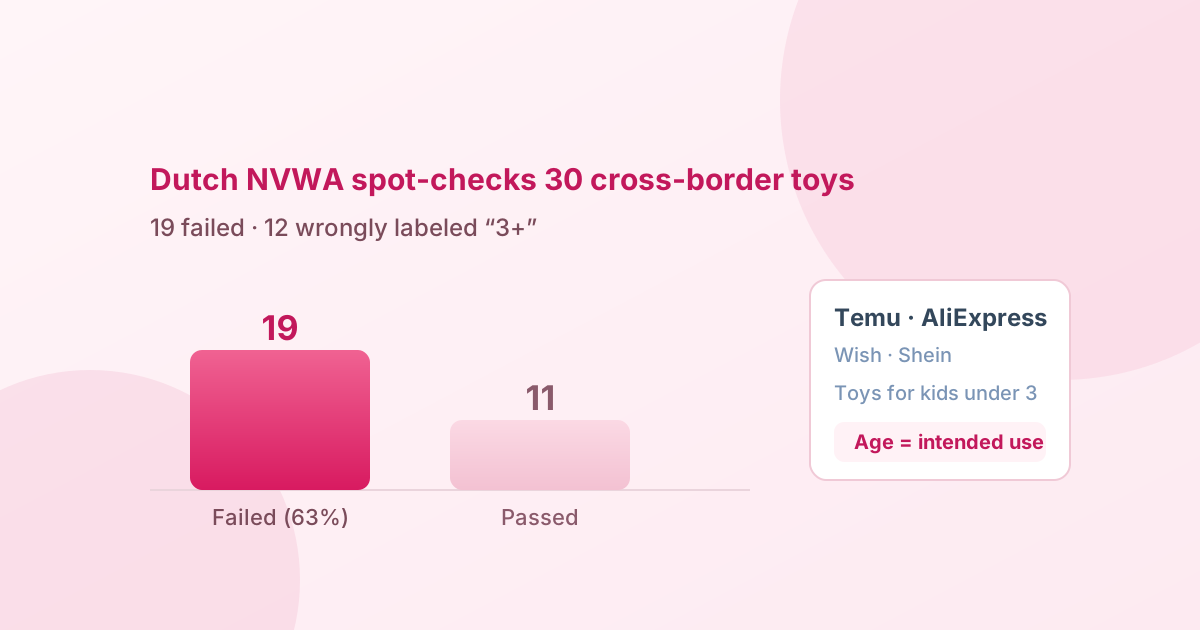
The Netherlands Food and Consumer Product Safety Authority (NVWA) ran a toy safety inspection in 2026 on products sold to Dutch consumers through non-EU online stores, and published the results on 16 November 2026 (press release): 30 toys intended for children under three were tested, and 19 carried a serious safety risk, or 63%. The samples were bought from Temu, AliExpress, Wish and Shein, with a focus on wooden toys, magnetic toys and character sets with dolls. The inspection results page gives the item-by-item breakdown:
- 12 items carried a warning that they are unsuitable for children under three, wrongly placed on products clearly aimed at children under three
- 11 items had small parts that came loose during testing and could be swallowed by a small child, causing suffocation
- 8 items had balls or dolls that were too small and could lodge at the back of the throat
- 3 items had magnets that were too strong; if swallowed, they can attract each other inside the body and cause serious internal injury such as intestinal perforation
- 2 items had cords or long components that were too long and could strangle a child
- 1 item lacked the CE mark and mandatory information such as the manufacturer's or importer's address
Note that the 63% is a detection rate from risk-oriented sampling, not the failure rate of all toys on these platforms. The inspection results page states explicitly that the products were selected on a risk basis — in other words, the authority already suspected these were unsafe products. What it establishes is that problems are widespread among high-risk toys for young children; it cannot be extrapolated to mean that six in ten cross-border toys fail.
On enforcement, the NVWA sent the results to the four platforms and asked them to delist the unsafe products, and notified the EU-based responsible persons for the products concerned. It also submitted the results to the European Commission, which is investigating Temu and other very large platforms, and shared them with other member states through the ICSMS system. The NVWA said explicitly that enforcement against sellers outside the EU is difficult, because platforms are often only intermediaries for a large number of sellers who are hard to trace.
2. Mechanism: why labelling a young-child toy 3+ does not avoid testing
A toy's age grading is decided by intended use: the product's function, size, features and marketing audience, not the age label on the box. The EU Toy Safety Directive 2009/48/EC, the corresponding Dutch rules and the EN 71-1 test standard all require toys intended for children under three to pass additional tests for small parts, balls, magnets and cords.
The most typical violation in this inspection was exactly the 12 mislabelled items: sellers put a warning that a product is unsuitable for under-threes onto toys clearly meant for children under three, possibly to avoid the extra testing they would otherwise have to do. But a wrong label does not remove the testing obligation for under-three toys. A warning has to match what the product is actually for; where it contradicts the use or is misused, the regulator judges by intended use.
For a cross-border seller the transmission chain runs like this: a risk-based sample is inspected, a laboratory finds the product unsafe, the results go to the platform, the platform delists the item to reduce its own compliance risk and may widen the review to similar listings, and the delisted SKU loses traffic and revenue in the Q4 peak. What changes is not the platform commission but whether the product can still be sold in the EU and whether peak-season cash comes back.
3. Evidence boundary: which numbers transfer directly and which do not
The only facts that can be quoted directly are the sample and the categories the NVWA published: 19 failures out of 30, the item counts by violation, the list of platforms, the note on risk-based sampling and the direction of enforcement. The NVWA does not disclose which item came from which platform, seller or importer, so the results cannot be used to argue that one platform has a higher failure rate or that one platform's toys are the most dangerous.
Dutch enforcement is not the same as an EU-wide inspection programme, and a platform delisting is not the same as customs necessarily seizing goods. The public material contains no data on lost sales, delisting duration, retesting fees or appeal success rates, so no figure should be invented to run a net-benefit comparison. The EU's new Toy Safety Regulation does not fully apply until 1 August 2030; this inspection was carried out under the current Toy Safety Directive 2009/48/EC, and it would be wrong to write that the new rules are already in force.
4. Counter-cases and alternative explanations: when 3+ is lawful
A collectible figure genuinely intended for children over three, containing small parts and carrying the correct age warning, CE mark and manufacturer information, can be sold lawfully. These failures do not mean every toy labelled 3+ is non-compliant.
Another alternative explanation is that a delisting or a fall in sales need not be driven by compliance at all; it could be price, seasonal stock or a change in advertising. Check compliance risk, price band and traffic source separately by SKU to establish which one is actually causing the problem, and avoid treating one inspection as the explanation for everything.
5. A reproducible analysis: peak-season revenue exposure and a tiered decision for three SKU types
The formula below, with three comparison scenarios, shows how to turn "sell and retest, or not" into a conditional decision. Every operating input is a hypothetical example, not a platform average, a real seller's result or a recommended price. Single-month revenue exposure = quarterly revenue × the share of quarterly revenue that the SKU earns in the peak Q4 month, in euros throughout; it measures how much revenue might not be collected if the listing is down for around 30 days, not net profit, and it excludes retesting, storage and relisting costs.
Scenario A: an under-three wooden train wrongly labelled 3+ (hypothetical example)
Assume a wooden animal train whose function, size and marketing all target children aged two to three, but whose packaging says 3+, with quarterly sales of 5,000 units at €8 each and quarterly revenue of 5,000 × €8 = €40,000.
If the peak Q4 month accounts for 40% of quarterly revenue, the single-month revenue exposure is €40,000 × 40% = €16,000; at 30% it falls to €12,000, and at 50% it rises to €20,000. A wrong label does not remove the testing obligation for under-three toys: once an inspection judges the product to be for young children, a delisting and the lost peak-season traffic can reach this order of magnitude.
Pull the SKU first and send it for EN71-1 testing, change the marking back to under three based on actual function, complete the technical file and EU responsible person, then relist. The cost and lead time of retesting and remediation have to be quoted separately; no invented number should be used to offset the revenue exposure.
Scenario B: a collectible figure genuinely intended for over-threes (hypothetical example)
Assume a collectible figure whose function, size and marketing all target children over three, containing small parts, with the correct age warning, CE mark and manufacturer information on the packaging.
It is not a case of an under-three toy labelled 3+, so it can stay on sale, but the technical file, declaration of conformity and EU responsible person still have to be in place. These documents are what you produce if a platform or a regulator asks questions.
Keep selling, file the age-grading basis, test reports and warning wording, and do not delist the whole catalogue because of this news story.
Scenario C: toys with detachable strong magnets or long cords
Assume the product contains detachable strong magnets or cords that are too long, and the target customer group includes children under three. In this inspection, 3 items had magnets that were too strong and 2 had cords that were too long; swallowed magnets can attract each other inside the body and cause serious internal injury such as intestinal perforation. Delisting and recall take priority for these products over ordinary wooden toys; the public material contains no reliable recall cost data, so no monetary estimate is given. Stop selling immediately until the EN71-1 magnet or cord requirements are met, rather than gambling on changing the label and carrying on.
The increment in this analysis is to reduce the 63% to what it is — a detection rate from risk-based sampling — and to split the mistaken belief that a 3+ label avoids under-three testing into three independent tests: age is judged by intended use, a warning cannot contradict the product's purpose, and small parts, magnets and long cords each trigger different tests. It then sets three actions by peak-season revenue exposure and risk level: stop and retest, keep and file, or stop magnetic products first.
6. Action plan: what to collect, what to use as a baseline, and when to continue or stop
Start by building one compliance file per SKU: the basis for the age positioning, existing EN71 test reports, the CE mark and manufacturer or importer details, the EU responsible person, the exact wording of the packaging age warning, and whether the product contains small parts, magnets or long cords.
- Highest risk (detachable strong magnets, cords that are too long, balls that are too small): stop selling until the relevant test is passed
- Young-child product labelled 3+ (function, size and features point to under three): stop selling and retest, restore the correct age marking and complete the documents
- Genuinely for over-threes (contains small parts but the warning is correct and the CE mark and manufacturer information are complete): keep selling and file the documents
Use the most recent complete peak season — last year's Black Friday and Cyber Monday cycle, for example — as the baseline for the SKU's units and revenue share, to judge how much revenue a delisting of about 30 days would expose. Set the observation window to the actual retesting and remediation lead time; there is no need to wait out a calendar month for the sake of it.
Continue when retesting passes, the documents are complete, the marking matches actual use, and existing stock is confirmed to meet the new standard. Adjust when testing shows the design or supplier has to change — change first, then relist. Stop when testing cannot be passed, when remediation costs more than the SKU's peak-season revenue exposure with no alternative, or when the EU responsible person cannot be confirmed; delist first to cap the loss.
7. Limitations and uncertainty
The unknowns most likely to change the conclusion are the true age grading of your own SKUs, the quoted cost and lead time of additional testing, and the actual delisting period and appeal scope on each platform. This article relies only on two public NVWA pages; it did not enter any seller back office or laboratory, and it has no layered data on which platform, seller or importer each SKU came from. Every operating figure in the article is a hypothetical example.
This article discusses public information and methods on EU toy safety compliance; it does not mean that Nuozhou Digital Intelligence already offers toy compliance testing or real-time sales coverage on any platform. Age grading and test conclusions ultimately rest with an accredited laboratory and the regulator's interpretation.
Method and disclosure
Data basis: the sample, the violation categories and the direction of enforcement come from the Dutch NVWA press release and inspection results page (both accessed 18 November 2026, primary sources); the 63% is explicitly labelled a detection rate from risk-based sampling, and every operating calculation in the article is a hypothetical example.
If you already have a product but have not settled on a first market, see "Not Sure Which Country to Sell In? A Data Matrix That Locks In Your First Market"; for repricing after retesting and remediation, see "How Cross-Border Sellers Avoid the Price Trap in Product Selection: Five Data Signals That Matter".
References
- 1. NVWA, "NVWA: More Than Half of the Toys Inspected from Foreign Web Shops Are Unsafe" (primary source, published 16 November 2026): read the original, accessed 18 November 2026
- 2. NVWA, "Inspection Results for Toys from Foreign Web Shops 2026" (primary source): read the original, accessed 18 November 2026
This article was prepared with the assistance of an automated research workflow and is based on the public sources listed at the end; it has not been reviewed by a human editor.