A new rule is changing how Chinese-owned sellers clear goods into the United States. US Customs and Border Protection's interim final rule (91 FR 69977, published 6 November 2026) takes effect on 5 January 2027: an importer that does not qualify as a US importer of record (US IOR) is a foreign IOR, and a foreign IOR making a formal entry must either be CTPAT validated itself or use a CTPAT-validated licensed customs broker. At present, only Canadian foreign IORs can apply for CTPAT validation. For a seller that imports through a US LLC whose operations, staff and assets are actually in China, the question is whether that LLC can still clear in its own name after 5 January 2027, or whether the seller must switch to a CTPAT-validated broker or change the importing entity. The answer is conditional: first test the entity against the four US IOR criteria, then check the broker's CTPAT status. If either test fails, switch the clearance chain or build US substance before the effective date; otherwise the current structure cannot continue to clear. All fees and maintenance costs below are explicitly labelled hypothetical examples.
1. What the rule says: who can be a US importer of record after 5 January 2027
The rule was published in the Federal Register at 91 FR 69977 (read the original, accessed 19 November 2026). It was issued under Section 2 of Executive Order 14411, 'Strengthening Customs Enforcement', as an interim final rule that also opens a comment period. Its central move is to write the definition of a 'US importer of record' into 19 CFR §110.2 for the first time: an importer that does not meet the US IOR criteria is a foreign IOR, and a foreign IOR making a formal entry must either be a CTPAT-validated participant itself or use a CTPAT-validated licensed customs broker.
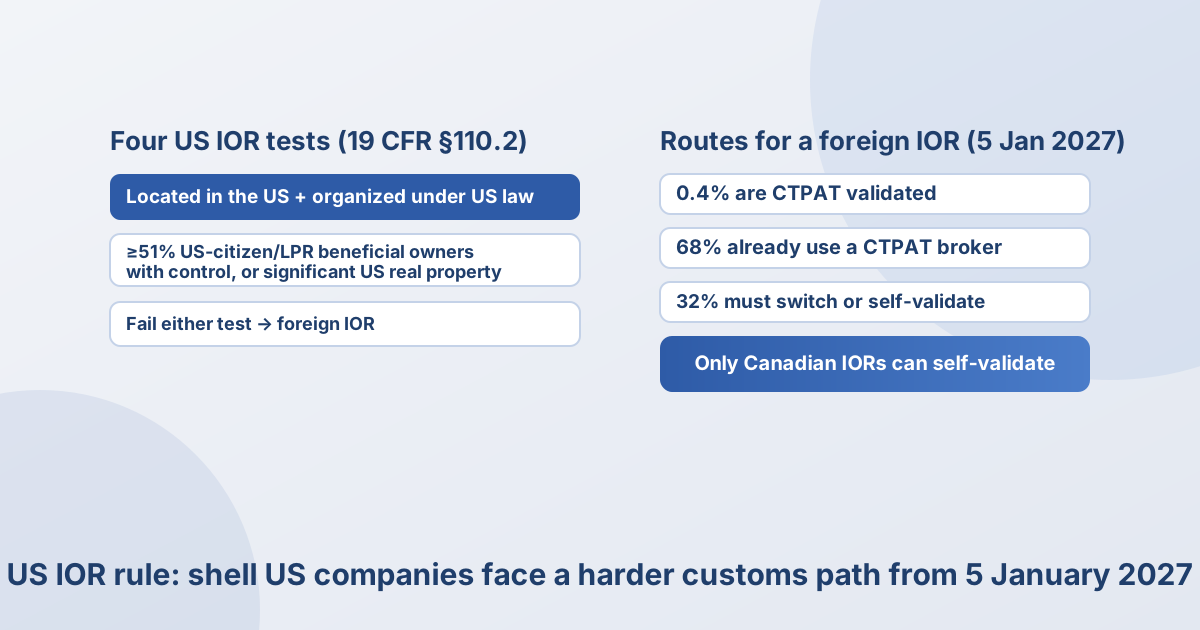
The US IOR test has two tracks. For an individual, the person must be a US citizen or lawful permanent resident. For an entity, three conditions must hold at the same time: (i) it is located in the United States; (ii) it is organized under US law; and (iii) it meets either (A) at all times at least 51% of its beneficial owners are US citizens or lawful permanent residents and control the entity, or (B) it directly owns a significant amount of unencumbered US real property.
'Beneficial owner' means a natural person who, directly or indirectly, exercises substantial control over the entity or owns or controls at least 25% of its ownership interests; the definition follows layers of corporate ownership back to the individual. 'Located in the United States' is decided case by case. CBP's non-exhaustive list in §110.2(b) includes: the principal place of business is in the US; a US physical presence where substantial business transactions are conducted (paying employees, generating revenue, operating retail locations); sufficient unencumbered physical domestic assets; direct ownership of enough unencumbered US real property; gross sales generally exceeding cost of goods sold with a structure expected to generate its own profit; and sufficient capitalisation.
| Importer type | Qualification (19 CFR §110.2) | Requirement for formal entry after 5 January 2027 |
|---|---|---|
| US importer of record (US IOR) | An individual who is a US citizen or lawful permanent resident; or an entity located in the US, organized under US law, and either (at least 51% of beneficial owners are US citizens or LPRs with control) or (direct ownership of significant unencumbered US real property) | May continue to file in its own name; the broker must verify and keep records |
| Foreign importer of record (foreign IOR) | Does not meet any US IOR criterion above | Must be CTPAT validated itself, or use a CTPAT-validated licensed broker |
| CTPAT eligibility for a foreign IOR | At present only Canadian foreign IORs can apply for CTPAT validation | Non-Canadian foreign IORs can only use a CTPAT-validated broker |
2. How the rule changes clearance, cost and liability
The new rule changes the test of who is a US importer from the place of incorporation to the place of substance, and moves the verification duty to the licensed customs broker. For a foreign entity without US operating substance, the clearance path changes from 'acting as IOR in its own name' to 'using a CTPAT-validated broker'. CTPAT validation changes three things: the per-entry agency cost, the liability chain, and the probability of a hold or delay. Before filing, the broker must verify that the client meets the US IOR qualifications (§111.29(a)(2)) and keep records of that verification for five years; CBP can request them while they are retained. If the verification is wrong, the operating risk ends up with the importer.
The key restriction is easy to miss. The rule says a foreign IOR can avoid switching by becoming a CTPAT-validated participant. Under the current CTPAT rules, however, only Canadian foreign IORs are eligible to apply for validation. Once a Chinese entity or its US shell company is classified as a foreign IOR, there is effectively no self-validation route; it has to use a CTPAT-validated licensed broker.
Informal entry is not completely prohibited. For an informal entry that requires CBP Form 3461 or 7501, a foreign IOR may continue only if it is a CTPAT-validated participant or uses a CTPAT-validated licensed broker. CBP says it will monitor foreign-IOR informal entries after the effective date and reserves the right to prohibit them altogether if it sees risk.
3. Evidence boundary: what 16%, 0.4%, 68% and 32% actually measure
CBP published a set of statistics in the rule (91 FR 69977). Among IORs that filed an entry summary between 1 October 2020 and 6 February 2026, 16% were foreign and 84% were US IORs. Within the foreign-IOR group, only 0.4% were CTPAT validated, 68% already used a CTPAT-validated broker, and the remaining 32% could not continue importing unless they switched brokers or became CTPAT validated. Mind the denominator: the 16% figure refers to all IORs that filed entry summaries, while 0.4%, 68% and 32% are shares within the foreign-IOR group, so the 32% cannot be read as 32% of cross-border sellers being banned from importing. The sample covers importers that filed entry summaries, not real-time clearance data. CBP's own regulatory impact analysis adds another caveat: it classified IORs by the physical address on CBP Form 5106 and accepts that some IORs with a US address may in fact be foreign, so the true foreign share may be underestimated.
4. Counter-cases: who is less affected than they look
At least four groups are less affected than they look. First, 68% of foreign IORs already use a CTPAT-validated broker; for them the change is mainly extra document verification and record-keeping, not a switch. Second, a CTPAT-validated foreign IOR, or a foreign IOR that files through a CTPAT-validated broker, can still make informal entry; CBP has only reserved the possibility of a future blanket prohibition. Third, a broker may request delayed compliance before 5 January 2027, and brokers are expected to reach full compliance no later than 6 May 2027, so enforcement may lag the effective date. Fourth, if a platform is the actual importer or IOR under a particular fulfilment programme, the seller-level test may not apply; this has to be checked programme by programme and entry by entry, not assumed.
5. Worked analysis: eligibility and cost comparison across three scenarios
Compare switching the clearance chain with building substance in two steps: first decide whether the entity is still a US IOR; then check whether the broker is CTPAT validated. Only when both fail does the cost comparison matter. The three cases below cover the common structures.
Scenario A: a US LLC with real operating substance
Assume the US LLC has local employees, inventory or a warehouse lease, and real revenue, and that at least 51% of its beneficial owners are US citizens or lawful permanent residents who control the entity. It most likely still qualifies as a US IOR; the main risk is evidence and broker verification, not a mandatory change of importing entity. Keep the entity, assemble the ownership, payroll, lease and financial records, and have the broker verify each §110.2 criterion and retain the file.
Scenario B: a US LLC with nothing but a registered address
Assume the controller, purchasing, customer service and assets are all in China, and the US LLC has no employees, inventory or US revenue substance. It is likely to be treated as a foreign IOR and, because it is not Canadian, cannot self-validate for CTPAT; the only route is a CTPAT-validated broker. Check the current broker's CTPAT status and switch if needed, then add the extra agency fee to the per-entry cost and reprice.
Scenario C: a duty-inclusive forwarder
Assume the seller does not contract the broker directly; the forwarder handles clearance and duty and the seller does not know the actual IOR or broker. The seller cannot tell whether the clearance chain is compliant, and the duty-inclusive quote does not address responsibility or cost after 5 January 2027. Require the forwarder to disclose in writing the IOR, the broker's CTPAT status and who bears a customs hold, and add a compliance clause covering the period after 5 January 2027.
Now put numbers on the choice (the figures below are hypothetical examples, not quotes from any broker or forwarder). Switch-link annual incremental cost = (CTPAT broker fee per entry - current broker fee per entry) × average monthly entries × 12. Build-substance annual cost = US registered maintenance (registered agent, annual report, bank account, tax filing) + the minimum substance needed to satisfy 'located in the United States' (staff, warehousing or a lease). Assume a seller files 50 entries a month, pays $25 per entry to its current broker and would pay $35 to a CTPAT-validated broker. The switch costs (35 - 25) × 50 × 12 = $6,000 a year. In this example, if meeting the substance test required at least one US employee plus warehousing, the annual cost would exceed $6,000, so switching would be cheaper. Sensitivity: at 20 entries a month, the switch costs (35 - 25) × 20 × 12 = $2,400; if the seller already needed a US warehouse as an FBA forward-stock location, the marginal cost of substance could be lower and the conclusion could reverse.
6. Action plan: checks to finish by end-December 2026
By the end of December 2026, complete five checks: entity eligibility, the broker's CTPAT status, the platform's IOR arrangement, the forwarder's disclosure, and a per-entry cost recalculation.
- Entity eligibility: write down the actual IOR name and entry type (formal or informal) on the Entry Summary (CBP Form 7501), then self-test against §110.2: is it located in the US, is it organized under US law, are at least 51% of beneficial owners US citizens or LPRs with control, or does it hold a significant amount of unencumbered US real property?
- Broker CTPAT status: ask the current broker in writing to confirm its CTPAT validation status and whether it will accept your entity as a client after 5 January 2027.
- Platform IOR arrangement: ask Amazon FBA, TikTok Shop US or your direct-to-consumer fulfilment provider who is the actual IOR under that programme; do not treat the platform terms as your own qualification.
- Duty-inclusive forwarder disclosure: require the forwarder to disclose in writing the actual IOR, the broker's CTPAT status, and who bears a customs hold or entry amendment.
- Per-entry cost recalculation: once you have quotes from a CTPAT-validated broker and your current broker, put them into the formula, add the result to the P&L and reprice.
Stop conditions: if the self-test shows the entity is plainly a shell - no US employees, no inventory, no revenue, no real property - do not wait for the effective date. Start switching to a CTPAT-validated broker or building substance now, and add delay risk to the delivery schedule. Continue if the entity has real US substance and the broker has confirmed CTPAT validation; keep the current chain, but have the broker complete verification under §111.29(a)(2) and tick the qualification statement on CBP Form 3461/7501 at filing.
7. Limits and uncertainty
Three unknowns are most likely to change the conclusion. First, CBP has published no quantitative test for 'substantial presence', and platforms do not disclose in every fulfilment programme who is the actual IOR, so the same entity can produce different answers under different programmes. Second, delayed compliance by brokers makes timing uncertain: there is a window of about four months between the effective date and full compliance, so in the short run the practical bottleneck may not be visible. Third, the unit cost of a customs delay, entry amendment or return depends on your own forwarder's quote; this article can only give the formula, not the number. What would update the judgement: if CBP publishes a quantitative 'substantial presence' test or platform IOR guidance, rerun the scenarios; once brokers provide real quotes, replace the assumptions and recalculate.
Method and notes
Data basis: the US importer of record rule comes from the full text of Federal Register 91 FR 69977 (accessed 19 November 2026); the CBP press release comes from cbp.gov (accessed 19 November 2026); the four US IOR tests, the beneficial owner definition, CTPAT eligibility and the 16%/0.4%/68%/32% statistics are taken from the Federal Register text; the Wiley and Mayer Brown analyses are used only as a cross-check. All broker per-entry fees, agency fees, maintenance costs, entry volumes and margins in this article are explicitly labelled hypothetical examples. They are not quotes from any broker or forwarder, and they do not imply that Nuozhou Digital Intelligence provides customs brokerage or platform back-end data.
The analytical increment is to break the common assumption that 'a US company equals a US importer' into four verifiable tests, use the 32% figure as a triage line, and separate three layers of timing and responsibility: the rule's effective date (5 January 2027), the broker's delayed-compliance window (no later than 6 May 2027), and the platform as IOR. That turns a compliance story into a set of conditional decisions a seller can check, rather than a headline to panic about.
To put the added cost of switching or building substance into the full P&L, see Data Methodology; for the effect of fulfilment and fee changes on landed cost, see Amazon Data Analysis; for timing risk when air freight is used to protect a launch window, see the China-US air freight restock analysis.
This article was prepared with the assistance of an automated research workflow and is based on the public sources listed at the end; it has not been reviewed by a human editor.
Sources
- 1. U.S. Customs and Border Protection, 'Heightened Requirements for Foreign Importers of Record' (primary; full text of 91 FR 69977; the four US IOR tests, beneficial owner definition, CTPAT eligibility, 16%/0.4%/68%/32% statistics, broker verification and five-year record retention, and delayed compliance to 6 May 2027): original, accessed 19 November 2026.
- 2. U.S. Customs and Border Protection, 'CBP announces heightened requirements for Foreign Importers of Record' (primary; brokers verify a client's US IOR qualification before filing, effective 5 January 2027; release date 5 November 2026): original, accessed 19 November 2026.
- 3. Wiley Rein LLP, 'CBP Expands Requirements for Foreign Importers of Record and for Customs Brokers' (secondary analysis; the three entity requirements and Canada as the only foreign IOR currently eligible for CTPAT validation): original, accessed 19 November 2026.
- 4. Mayer Brown, 'CBP Issues Interim Final Rule Restricting Foreign Importers of Record and Expanding Customs Broker Liability' (secondary analysis; a US-registered subsidiary with limited substance may be treated as a foreign IOR, and operational risk ultimately returns to the importer): original, accessed 19 November 2026.