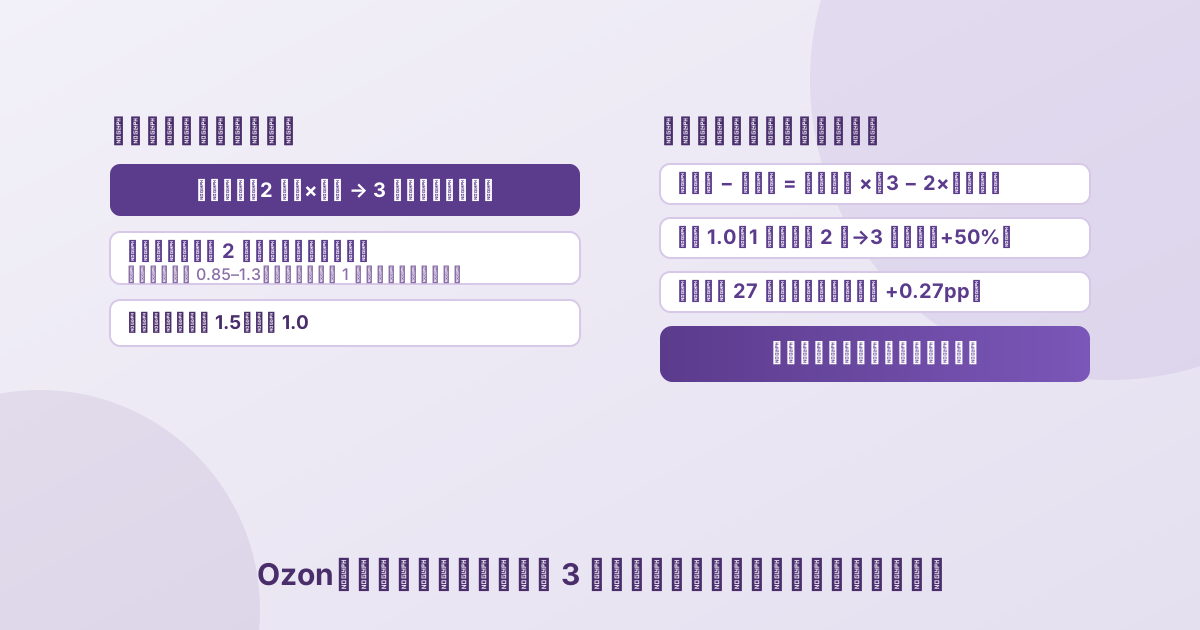
For sellers on Ozon Russia who use manual pushes for repeat purchases and peak-season reminders, the core question to answer by 3 December is this. Should a cross-border seller sending 10,000–50,000 manual recipients a month on Ozon Russia, with an average order value of about RUB 1,500, cut the manual list and move the budget to automatic push, or keep manual push before the new rates take effect on 3 December? The answer comes in two steps: first confirm your historical seasonal coefficient, then recalculate with new cost - old cost = recipients × (3 - 2 × original coefficient). For most accounts (the coefficients visible in the official document range from 0.85 to 1.3) manual push cost will rise, while automatic push becomes cheaper in peak season, when the coefficient is above 1.
1. What happened: manual push moves to RUB 3, automatic push stays at RUB 2, and the seasonal coefficient is removed
According to the Cifnews (Yuguo Kuajing) brief of 19 November 2026, Ozon will raise manual (one-off) push from the base price of RUB 2 per recipient to RUB 3 from 3 December, keep automatic push at RUB 2, and remove the seasonal coefficient for both notification types. The report corresponds to the push notification section of the version of Ozon's official rate document effective from 3 December 2026; the official document splits push into one-off (manual) and automatic (trigger-based) types, which sellers choose as needed in the Buyers section of the back office.
| Dimension | Manual push (one-off) | Automatic push (trigger-based) |
|---|---|---|
| Current billing (before the change) | RUB 2 × recipients × seasonal coefficient | RUB 2 × delivered × seasonal coefficient |
| Relayed new billing (from 3 December) | RUB 3 × recipients (coefficient removed) | RUB 2 × delivered (coefficient removed) |
| What is charged | Planned recipients, regardless of opens or orders | Actual deliveries; only notifications sent are charged |
| Budget method | One-off per send | Budget set per calendar month, minimum RUB 3,000 |
What can be verified line by line here is the current formula in Ozon's official rate document — RUB 2 × recipients × seasonal coefficient — and the coefficient tiers for December 2025 to June 2026; the move to RUB 3 for manual pushes from 3 December and the removal of the coefficient come from the Cifnews report of 19 November and could not be verified word for word on an official Ozon page at the time of research.
| Period (as stated in the document) | Seasonal coefficient | Manual/automatic price per recipient |
|---|---|---|
| 27 December 2025 – 9 February 2026 | 1.0 | RUB 2 |
| 10 – 15 February 2026 | 1.1 | RUB 2.2 |
| 16 February – 1 March 2026 | 0.85 | RUB 1.7 |
| 2 – 7 March 2026 | 1.3 | RUB 2.6 |
| 8 – 31 March 2026 | 1.1 | RUB 2.2 |
| 1 April – 1 June 2026 | 1.0 | RUB 2 |
The seasonal coefficient tiers in the official document (covering December 2025 to June 2026) run from a low of 0.85 to a high of 1.3; that window is the snapshot found for this article, the actual coefficients for the November–December 2026 peak season do not appear in it, and sellers should rely on their own back-office records for the relevant period.
2. Mechanism: how per-recipient billing and the seasonal coefficient set your marginal cost
Manual push is billed per recipient and is unrelated to opens or orders, so the real marginal cost is the fixed rate per recipient, and the marginal benefit is the number of extra orders that recipient places because of the push within the observation window, multiplied by the contribution per order; once the seasonal coefficient is removed, the direction of the cost depends entirely on the account's original coefficient.
The seasonal coefficient used to let the platform charge more for pushes in peak season (coefficient above 1) and less in the off season (coefficient below 1), and sellers had to forecast their account's coefficient for the next period. With the coefficient removed, manual cost is fixed at RUB 3 and automatic at RUB 2, so cost no longer moves with the calendar — but the off-season discount is gone too. Automatic push fires on triggers (add to cart, add to wishlist, no repeat purchase, no purchase of related items) within the monthly budget and charges only for notifications actually delivered; the Premium Pro subscription includes a RUB 5,000 allowance each month.
3. Reproducible analysis: cost and break-even point in two scenarios
Both scenarios below are explicitly labelled hypothetical examples, not data from any real store. Calculation basis: old manual price = RUB 2 × original coefficient, new price = RUB 3; new automatic price = RUB 2.
Scenario A: original coefficient 1.0, 10,000 recipients, manual cost up 50% (hypothetical example)
Hypothetical example: original seasonal coefficient k = 1.0, 10,000 manual recipients, average order value RUB 1,500, contribution rate 25% per order, no allowance for the natural lift in orders during a major promotion.
Old cost = 10,000 × 2 × 1.0 = RUB 20,000; new cost = 10,000 × 3 = RUB 30,000, an increase of RUB 10,000 (+50%); breaking even requires RUB 10,000 ÷ RUB 375 ≈ 27 incremental orders, i.e. a lift of about 0.27 percentage points in the recipient conversion rate.
If the incremental conversion rate from past pushes is above 0.27 percentage points, keep all 10,000; if below, compress the list to 8,000 (24,000 ÷ 3), prioritising buyers who repurchased or added to cart in the last 90 days, and move the rest to automatic push.
Scenario B: original coefficient 1.3, 10,000 recipients, switching to automatic is actually cheaper (hypothetical example)
Hypothetical example: original seasonal coefficient k = 1.3 (the peak tier in early March in the document), 10,000 manual recipients, all other conditions as in Scenario A.
Old manual cost = 10,000 × 2 × 1.3 = RUB 26,000; new cost = RUB 30,000 (+15.4%); switching to automatic push costs 10,000 × 2 = RUB 20,000, saving RUB 10,000 against the new manual price and 23.1% below the old manual price.
Move repeat-purchase and add-to-cart reminders that triggers can cover to automatic push; keep manual only for one-off promotion notices that automatic cannot cover, and set a stop condition: if within 14 days of switching the unsubscribe rate is double the baseline, or incremental orders fall below the break-even line, stop.
Taken together: the break-even coefficient for manual push is 1.5 (2 × 1.5 = 3) and for automatic push is 1.0 (2 × 1.0 = 2); so accounts with an original coefficient below 1.5 see manual cost rise, and only those above 1.5 see it fall, while accounts with an original coefficient above 1 see automatic cost fall.
4. Counter-examples and alternative readings: when the price-rise story does not hold
If an account's original seasonal coefficient happens to be above 1.5, the new manual price is actually lower than the old one, and the price-rise story does not hold for it; another alternative reading is that the higher manual cost merely makes explicit a seasonal premium the platform used to charge in peak season, and the optimal allocation of the seller's total marketing budget need not change.
How to tell them apart: look at the change in manual cost and total marketing ROI separately. If your main use of manual push (one-off promotion notices) cannot be covered by automatic triggers, keep it even though the cost rises, and simply compress the list; if the use (repeat-purchase reminders) can be replaced by automatic triggers, switch to automatic regardless of whether the cost rises or falls. One more easily missed point: automatic push opens and orders happen after the trigger action, so if your existing customers rarely return and triggers rarely fire, automatic reach may be far lower than manual, and cheaper automatic is not necessarily more effective automatic.
5. Action plan: what to collect, what to use as a baseline, when to stop
First export the past 12 months of sends, deliveries, clicks and orders from Buyers → Push in the back office, recording the seasonal coefficient in force at each send; then recalculate the net cost change for each coefficient band with new cost - old cost = recipients × (3 - 2 × original coefficient), and set stop conditions.
- Fields to collect: sends, deliveries, clicks, orders, average order value, seasonal coefficient at the time of the push, unsubscribes
- Baseline: use the last manual push before 3 December as the baseline, recording its cost per recipient and the incremental orders it produced
- Observation window: watch for 14 consecutive days after the new rates take effect, comparing manual and automatic on cost per recipient, conversion rate and unsubscribe rate
- Stop conditions: if within 14 days of switching to automatic the unsubscribe rate is double the baseline, or incremental orders fall below the break-even line (about 27 per 10,000 recipients in this example), stop and review
- Fill in data: once you have the official quote for the version effective 3 December and your own historical coefficients, replace this article's assumed coefficients and recalculate
6. Limitations and uncertainty
Three unknowns are most likely to change the conclusion: first, the official rate text for the version effective 3 December and its tax basis have not been verified word for word; second, the actual seasonal coefficients for the peak season (November–December) do not appear in the snapshot found for this article; third, the open rate, unsubscribe rate and attribution window of manual and automatic push are unknown.
What evidence would update the judgement: if the official rate text effective 3 December can be read, confirming RUB 3 for manual, RUB 2 for automatic, the removal of the coefficient and the tax basis, the numerical conclusions here can be locked down further; if evidence emerges that the actual peak-season coefficient is above 1.5, the conclusion that manual push became more expensive has to be reversed. This article discusses a general analytical method under Ozon's public rules and does not imply that Nuozhou Digital Intelligence already provides Ozon push-reach or seller back-office data.
Method and notes
Data basis for this article: the current push formula of RUB 2 × recipients × seasonal coefficient, the seasonal coefficient tiers (0.85–1.3) and the RUB 3,000 minimum monthly budget for automatic push are taken from Ozon's official rate document Полный список комиссий и тарифов and the official help page Автоматическая рассылка (accessed 2026-11-19); the move to RUB 3 for manual pushes from 3 December and the removal of the coefficient are taken from the Cifnews (Yuguo Kuajing) news brief of 2026-11-19. The recipient counts, average order values and contribution rates in the two scenarios are explicitly labelled hypothetical examples, not platform or store statistics.
The increment here is to break the manual push price rise into a directional judgement by original coefficient band (break-even coefficient 1.5 for manual, 1.0 for automatic), and to point out that automatic push actually gets cheaper in peak season when the coefficient is above 1, a decision tool a single news brief cannot give you.
To take contribution per unit and reach cost further into profit, see Cross-Border Profit Accounting: The Five-Step Subtraction from GMV to Net Profit; for the basis of advertising and reach cost, compare Amazon Advertising Data Analysis.
This article was assembled with the help of an automated research workflow and is based on the public sources listed at the end; it has not been manually reviewed.
References
- 1. Ozon official rate document Полный список комиссий и тарифов (primary source: the push notification formula and the seasonal coefficient tiers): read the original, accessed 2026-11-19
- 2. Ozon official help Автоматическая рассылка (primary source: how automatic push works and the RUB 3,000 minimum budget): read the original, accessed 2026-11-19
- 3. Cifnews, Ozon raises manual push rates to RUB 3 per recipient from 3 December (published 2026-11-19 00:04): read the original, accessed 2026-11-19