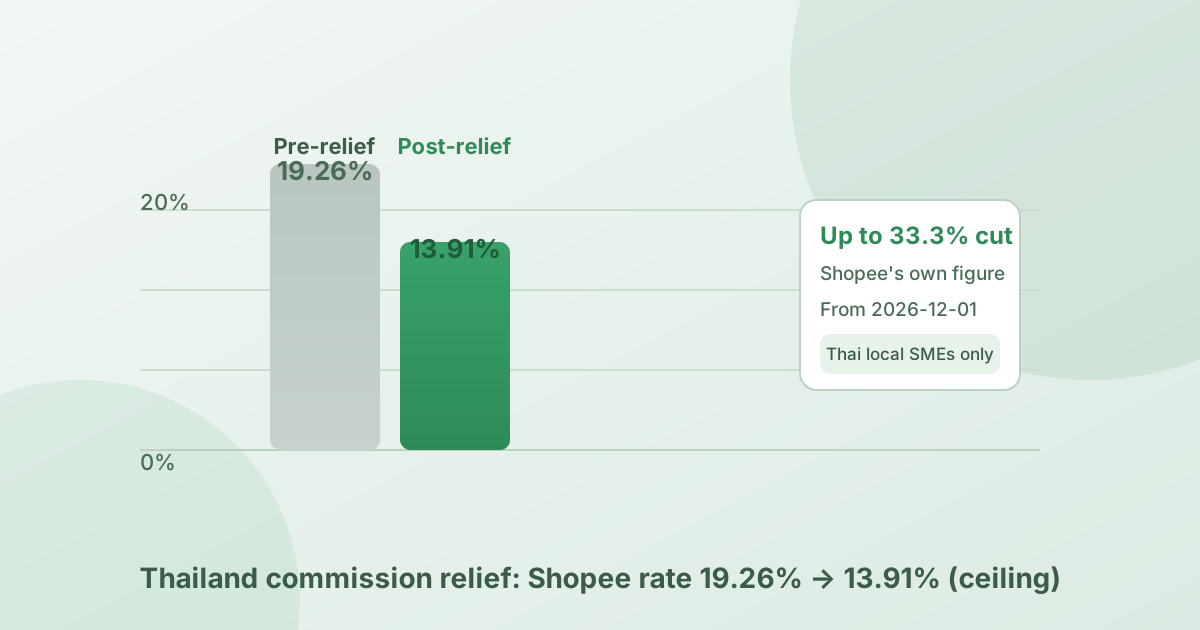
For sellers operating on the Thai marketplace, the real question is whether you qualify for the platform commission relief that starts on 1 December, how much you would save, and whether it is worth adjusting your corporate entity or product mix to qualify. The relief applies only to local SMEs that are a Thai national individual or a Thai-registered juristic person, sell Thai goods (electronics excluded) and stay below the annual sales threshold, so most cross-border sellers shipping direct from China are not eligible; confirm eligibility, the threshold and the actual rate for your subcategory before deciding whether to move your entity, rather than seeing “the cap falls from 19.26% to 13.91%” and immediately repricing at the lower rate.
1. The event and its definitions: what is being cut, and from when
On 28 October 2026, the Thai government (thaigov.go.th) announced an agreement with Shopee, Lazada and TikTok Shop to return “mandatory fees” for Thai local SMEs to their 1 January 2026 levels for six months, from 1 December 2026 to 31 May 2027. The government estimates the measure will relieve about 1.2 million merchants of roughly THB 1.93 billion in fees in total, including about 1.02 million individual sellers and 180,000 juristic persons. This is not a blanket cut for every seller on the three platforms; it is a targeted relief with identity, category and sales thresholds.
| Platform | Rate range before relief | Rate range after relief |
|---|---|---|
| Shopee | 8.03–19.26% | 8.03–13.91% |
| Lazada | 9.00–17.50% | 7.50–11.60% |
| TikTok Shop | 13.38–21.94% | 11.24–17.66% |
The ranges above come from the Thai government announcement; the top of each range corresponds to high-fee categories and the bottom to low-fee categories. Note that Shopee’s floor of 8.03% is unchanged, while both the floor and the cap fall at Lazada and TikTok Shop; the “maximum reduction” is 33.3% at Shopee, 35% at TikTok Shop and 42.9% at Lazada, with the Shopee figure from its official rules and the other two from media reports.
Government rate ranges and the figures of about 1.2 million merchants and THB 1.93 billion describe total policy coverage, and cannot be read as the actual rate or the individual benefit for any subcategory or merchant. For each merchant, whether the rate in your subcategory rises or falls, and by how much, depends on the actual tier shown in the seller back office and statements, not on the top of the published range.
2. Eligibility: four conditions, and why most cross-border sellers do not qualify
According to the official Shopee Thailand seller-centre rules published on 17 November 2026, a seller must meet all four conditions to be approved for the relief:
- Shop: already open on Shopee before 30 September 2026.
- Entity and goods: a Thai national individual or a Thai-registered juristic person, selling Thai goods (electronics excluded).
- Business registration: individuals must hold a business registration certificate from the Thai Department of Business Development (DBD); juristic persons can use their 13-digit registration number and do not need to register again.
- Sales threshold: platform net merchandise value (NMV) from 1 October 2025 to 30 September 2026 of no more than THB 1.8 million a year for individuals or THB 3.5 million a year for juristic persons; multiple shops under the same ID card or juristic-person number are combined.
Of the four, the second is the one most likely to trip up cross-border sellers. The rule says “selling Thai goods”, and electronics are excluded entirely; Bangkok Post also reports that GP fees on electronics are outside the relief. A cross-border seller shipping direct from China, without a Thai entity, or focused on electronic accessories usually fails both the “Thai national or Thai-registered entity” and the “Thai goods” conditions, and will not qualify even at very low annual sales.
Applications are separate per platform: Shopee’s official FAQ states that eligible merchants can apply on each of the three platforms but must register on each; the application channel is a push-notification link inside the Shopee app, not a public web form.
3. The mechanism: why the relief is a cap reduction, and how the rate reaches each order
The relief applies to “mandatory fees”, which the government defines as including commission, infrastructure service fees and transaction fees, but not optional services such as advertising and promotions. That means the mandatory fee on each transaction is charged at the category rate, so the higher the category rate, the bigger the per-unit saving from a given percentage-point cut; conversely, the absolute saving in low-rate categories is small, and Shopee’s 8.03% floor has not moved at all.
Nor does the platform change the rate to the new value on its own: the new tier applies only after an eligible merchant is approved. Shopee runs two rounds: the first closes on 15 November 2026, with approvals notified on 30 November and effective from 1 December; the second closes on 16 December 2026, with approvals notified on 29 December and effective from 1 January 2027. In other words, being eligible without applying does not bring the relief automatically, and anyone applying after 16 November will not be effective before 1 January at the earliest.
4. A recomputable analysis: estimating whether you save, and how much
Everything below is a hypothetical example in Thai baht (THB) and does not represent any platform average, recommended price or real merchant result. The saving is calculated only for the part that is eligible and approved: saving = platform GMV during the relief period × (rate before relief − rate after relief), provided the subcategory rate really is cut and the merchant is approved during the period.
Scenario A: a Thai individual seller in home goods (hypothetical example)
Assume a Thai individual seller in Shopee home goods, an NMV window of THB 1,500,000 (within the THB 1.8 million threshold), an existing DBD business registration, non-electronic Thai goods, and a subcategory in the top tier falling from 19.26% to 13.91%.
The rate falls by 5.35 percentage points; on GMV of THB 750,000 over the six-month relief period, the saving = 750,000 × 5.35% = THB 40,125, equivalent to keeping an extra THB 5.35 on every THB 100 order.
Apply before 15 November, then check each statement after 1 December to confirm the relief tier has been applied; if it has not, appeal with the approval notice.
Scenario B: a China-based cross-border seller of electronic accessories (hypothetical example)
Assume a seller registered in China, shipping goods direct from China and focused on electronic accessories, which fails the “Thai national or Thai-registered entity” condition and is excluded as electronics.
The relief does not apply; the six-month saving is 0 and the rate stays on the original tier.
Do not reprice on the basis of “the cap falls 5.35 percentage points”; if you want to pursue eligibility, first weigh the cost of setting up a Thai juristic person, sourcing Thai goods or local production, rather than moving your entity for a few percentage points of fees.
A third boundary scenario: a Thai juristic person with platform NMV of THB 3,600,000 (above the THB 3.5 million threshold) also fails and saves 0, and suppressing GMV to qualify is usually not worth it. On sensitivity, the saving is most sensitive to two variables: whether your subcategory really moves tier (anywhere from 5.35 percentage points to 0) and the actual GMV during the relief period. The government’s THB 1.93 billion divided by 1.2 million merchants averages about THB 1,608 per merchant over six months, which shows that most eligible merchants are very small; individual savings are far below the number you get by applying “the cap falls 5.35 percentage points”, and the average is not an individual expectation.
5. Action plan: test eligibility, then size the saving, then decide whether to move the entity
First test eligibility: check the entity (Thai national individual or Thai-registered juristic person?), the goods (Thai goods or not, electronics or not) and the NMV window (combined platform net sales from 2025-10-01 to 2026-09-30 against the threshold). If any one of the three fails, the saving is 0.
Continue only if all three eligibility conditions hold, the subcategory rate really moves tier and the application was filed before the deadline; then use the new rate as the basis for pricing. Stop if any condition fails or the subcategory is on an unchanged tier (such as Shopee’s 8.03% floor): do not reprice on the basis of “the cap falls 5.35 percentage points”.
On moving your entity: setting up a new Thai juristic person, sourcing Thai goods or producing locally for a commission relief that lasts at most six months and has a low threshold is usually not worth it; calculate the saving against the cost of the entity and sourcing first, and do not move merely because you saw “13.91%”.
6. Counterexamples and alternative explanations
An easy misjudgement is to treat “the platform cap falls from 19.26% to 13.91%” as a blanket cut for every seller on the Thai marketplace and reprice at the lower rate. In fact Shopee’s 8.03% floor has not moved, so low-rate categories save nothing; Lazada and TikTok Shop cut both floor and cap, but by different amounts; and electronics are excluded entirely. Another counterexample: a seller with a Thai-registered company that mainly resells goods made in China. The rules say “Thai goods” without defining origin, brand or sourcing location, so whether it qualifies has to be confirmed with the platform or in the back office; you cannot assume that having a Thai company is enough.
7. Limitations and uncertainty
Three unknowns are most likely to change the conclusion: first, the official definition of “Thai goods” (origin, brand or sourcing location) is not yet written into the announcement; second, the application channels, deadlines and detailed rules for Lazada and TikTok Shop have not been read one by one, their rate ranges come from the government announcement and media reports, and the specific subcategory rates are governed by each seller back office; third, whether rates fall back after the relief ends on 31 May 2027, and to what level, has not been set out by the government. Recompute once you have your own entity documents, back-office rates and application status.
This article discusses a public research method for the Thai platform commission relief; it does not mean that Nuozhou Digital Intelligence provides commercial data, real-time commission rates or coverage for Shopee, Lazada or TikTok Shop in Thailand. Fees and eligibility are governed by official Thai terms and platform contracts, and applicability for cross-border sellers is subject to the platform’s review outcome.
Method and notes
Data definitions in this article: rate ranges and relief scale come from the Thai government announcement (accessed 2026-11-18), eligibility rules come from the Shopee Thailand seller centre (2026-11-17), and the electronics exclusion and registration channels are supplemented by media including Bangkok Post; the article separates platform-wide rate ranges from individual subcategory rates, and government totals from individual savings. All operating calculations in the text are hypothetical examples. The increment of this analysis is to break “a cut in the platform rate range” into three checks — the three eligibility conditions, whether the subcategory really moves tier, and the application round — so that sellers first decide which scenario they are in rather than repricing at the lower rate as soon as the cap falls.
If you have not yet decided whether to enter Southeast Asia, see “Going Global in Southeast Asia: How to Choose Your First Market?”; for the regional backdrop, see “Southeast Asia E-commerce Review – September 2026: Indonesia Stacks Volume, Vietnam Grabs Growth, Thailand Banks on Ticket Size” and “Double 11 Southeast Asia E-commerce Data: TikTok Cross-Border GMV Up 2.3x — the Market Saw It Coming”.
Sources
- 1. Thai Government (thaigov.go.th), “Government integrates public–private cooperation to cut GP fees on 3 online platforms, supporting 1.2 million SMEs” (primary source, published 2026-10-28): read the original, accessed 2026-11-18
- 2. Shopee Thailand Seller Education Hub, “Commission Fee Relief Programme to support the growth of Thai SME shops” (primary source, published 2026-11-17): read the original, accessed 2026-11-18
- 3. Bangkok Post, “Platforms agree to 6-month fee rollback for small firms” (published 2026-10-29): read the original, accessed 2026-11-18
This article was prepared with the assistance of an automated research workflow and is based on the public sources listed at the end; it has not been reviewed by a human editor.