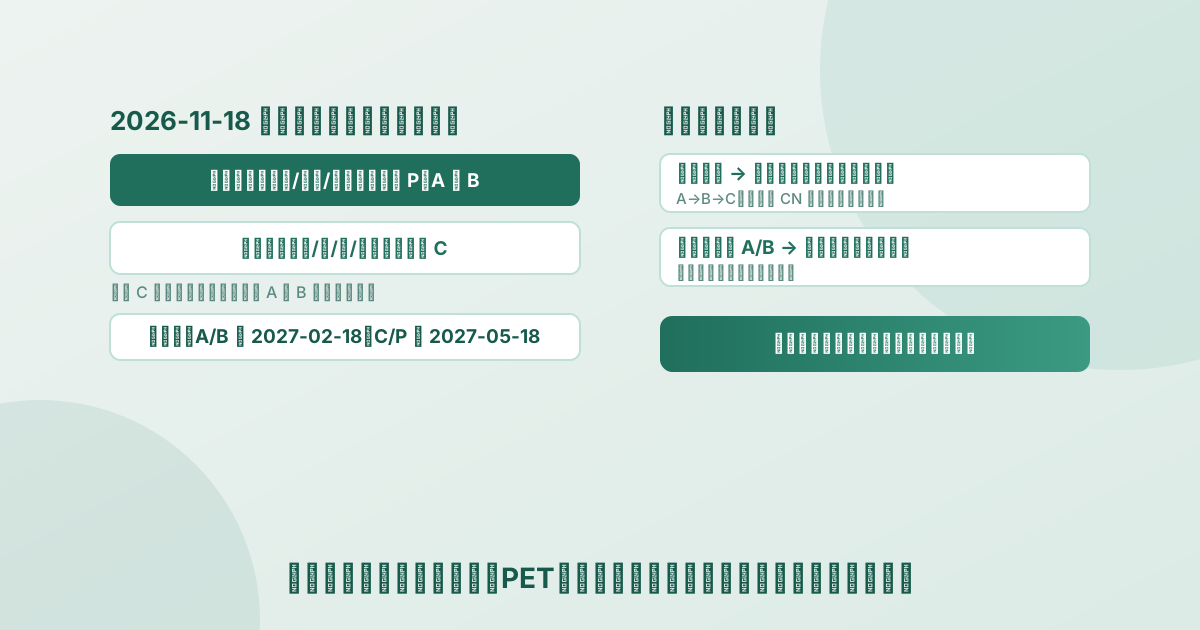
Cross-border sellers preparing to export to the EU, or already selling recycled-plastic products there, face one real question: does this consignment need a declaration of conformity at customs clearance, which one, and can unsold old stock keep selling until the transition period ends. The answer: Commission Regulation (EU) 2026/2376 took effect on 18 November 2026, and from that date specific recycled-PET products must submit a declaration of conformity under Table 6 when released for free circulation (upstream material submits P/A/B, downstream finished goods submit C); but products that complied with the old rules have a transition period — declarations A or B may be placed on the market until 2027-02-18, and declarations C or P until 2027-05-18. This article gives three checks and two scenarios to help you decide whether to ship new stock and whether to stop old stock; all amounts and fees are explicitly labelled hypothetical examples.
1. What happened: a new rule that moves the compliance-document obligation forward to the customs gate
Adopted on 28 October 2026 and published in the Official Journal of the European Union on 29 October, Commission Regulation (EU) 2026/2376 (accessed 2026-11-19) amends the base Regulation (EU) 2022/1616, and its subject is precisely 'registration management, conformity documentation, test methods, and the documents to be submitted on release for free circulation'. Article 3 sets entry into force on the 20th day after publication, that is 18 November 2026.
What did it change? The core is the new Article 5a(7): from the entry-into-force date, the following products must submit the documents listed in Annex I, Table 6 to customs on release for free circulation (that is, customs clearance) — (a) products made with suitable recycling technology that contain recycled plastics, together with the pre-treated feedstock, plastic material and recycled plastic used to make them (excluding packaged food, food-processing equipment and household appliances); (b) tableware and kitchenware containing recycled plastics under CN codes ex 3924 10 00 and ex 3924 90 00; (c) multilayer sheet containing at least one recycled-PET layer behind a functional barrier.
| CN code (Table 6) | Goods | Declaration required at clearance |
|---|---|---|
| ex 3907 61 00 | PET (intrinsic viscosity ≥78 ml/g, recycled from waste, food-contact use) | Declaration P, A or B |
| ex 3907 69 00 | Other PET (recycled from waste, food-contact use) | Declaration P, A or B |
| ex 3915 90 20 | PET waste (food-contact use) | Declaration P |
| ex 3923 30 10 | Bottles, jars, flasks, etc. (≤2 litres, containing recycled PET) | Declaration C |
| ex 3923 30 90 | Bottles, jars, flasks, etc. (>2 litres, containing recycled PET) | Declaration C |
| ex 3920 62 19 / 3920 62 90 | PET plates, sheets, film, foil (containing recycled PET) | Declaration C |
| ex 3919 10 80 / 3919 90 80 | Self-adhesive plates, sheets, film, foil (PET, containing recycled PET) | Declaration C |
| ex 3923 10 90 / 3923 90 | Boxes, cases and similar for transport or packing (PET, containing recycled PET) | Declaration C |
| ex 3924 10 00 | Tableware and kitchenware (PET, containing recycled plastics) | Declaration C |
| ex 3924 90 00 | Other household articles (PET, containing recycled plastics) | Declaration C |
2. Mechanism: who issues each of the four declarations, and why clearance has become a gate
Clearance (release for free circulation) is a single-point gate: if you cannot produce the Table 6 declaration at declaration time, the goods may be asked for additional documents or detained, creating port-storage cost and tied-up capital — rather than, as before, an authorisation only at the production stage with no separate document obligation in the distribution chain.
The four declarations map onto different links in the supply chain: declaration A is issued by the recycler (Part A of Annex III), declaration B by the converter (Part B of Annex III), declaration P covers the pre-treatment step and the batches of plastic material produced from it, and declaration C is the simplified declaration at the final production step. The new Article 6a makes clear that declaration C can only be issued by an operator that has received declaration A or B from its supplier, or by an operator that has established and kept equivalent records internally — which means a downstream finished-goods seller cannot conjure up a C: it must either obtain A or B upstream, or already hold equivalent records.
Why put a gate at clearance? Recitals 8 and 9 explain: to stop non-compliant recycled-plastic materials and articles from entering the EU market and to trace the origin of imported material, customs must receive a declaration of conformity when release is requested; and because only PET is currently produced with suitable technology and is subject to EU recycled-content targets under environmental legislation, commodity codes are introduced first only for tableware, kitchenware and PET (including multilayer material), with no codes for packaged food, household appliances or food-processing equipment.
3. How sellers verify: a four-item checklist and counter-examples
In practice, check four things consignment by consignment: whether the CN code hits Table 6, whether the goods contain recycled PET, whether they are products that complied with the old rules and can use the transition period, and whether the supplier can issue declaration A, B or P — then land on one of three paths: keep selling old stock, obtain the declaration before shipping new stock, or hold new shipments.
- Check 1 (is it in scope?): see whether the first six digits of the HS/CN code fall inside a Table 6 code range and whether the goods contain recycled PET; tableware and kitchenware are caught as soon as they contain recycled plastics (not limited to PET).
- Check 2 (which declaration?): upstream material (PET sheet, bottle flake, waste) submits declaration P, A or B; downstream finished goods (bottles, film, sheet, tableware) submit declaration C.
- Check 3 (old stock vs new stock): products that complied with the old rules — declarations A/B — may be placed on the market until 2027-02-18, and declarations C/P until 2027-05-18; recycled-plastic articles made from transition-period products may be sold until stock is exhausted.
- Check 4 (can you obtain the declaration?): to sign declaration C, a downstream finished-goods seller must first receive declaration A or B from the recycler or converter upstream, or already hold equivalent records.
What the regulation text gives you is which CN codes, which materials, which declaration class and the two transition deadlines — not how strictly a given port's customs actually inspects, not the probability that your goods will be detained, and nothing from which you could infer whether your supplier can produce a declaration.
Counter-examples and alternative readings
One easily misjudged counter-example: products that contain no recycled plastics, or that fall within the explicitly excluded packaged food, food-processing equipment and household appliances, do not trigger this clearance-document requirement even if their CN code sits inside a Table 6 range; another is goods already placed on the market before 2026-11-18 — old stock — which follows the transition period rather than an immediate top-up declaration.
4. Two paths: the transition period for old-rule stock vs new stock with no upstream declaration
Translating 'in force on 18 November' into two paths a seller can execute is more useful than memorising a date. Scenario A (old-rule compliant, transition period available): suppose a seller has a batch of recycled-PET tableware produced under the rules in force before the 2022/1616 amendment, with production-stage authorisation already obtained, and the goods are placed on the EU market during the transition period. If the batch falls under declarations A or B it may continue to be placed on the market until 2027-02-18, and if under declarations C or P until 2027-05-18 without a new declaration. The conclusion is to check the CN code, recycled content and placement date consignment by consignment, and treat the transition period as a window to complete the declaration chain A→B→C rather than stopping sales or shipments immediately.
Scenario B (new stock with no upstream declaration): suppose a seller has a batch of recycled-PET bottles or sheet shipping from China to Germany in December and the supplier can only provide material test reports, not declaration A or B. Under Table 6 this batch must submit declaration C at clearance, but because the seller has not received A or B it cannot issue C itself, so the goods may be asked for additional documents or even detained. The conclusion is that before ordering, require the upstream recycler or converter to issue declaration A or B, or switch to a registered recycling plant; if no declaration is available, do not ship yet, to avoid port storage.
5. Reproducible analysis: the cost of topping up documents at clearance vs obtaining them in advance
Take a batch of recycled-PET tableware worth EUR 10,000, due to ship to Germany in December (hypothetical example): if clearance is detained 7 days for lack of declaration C, the direct cost is port-storage or warehousing fees (assumed EUR 50 per day) × 7 = EUR 350, plus the capital cost of the EUR 10,000 goods value for 7 days (about EUR 15 at an 8% annualised rate), a certain loss of about EUR 365; asking the supplier for declaration A or B in advance and assembling declaration C yourself is mainly a paperwork and time cost.
The arithmetic is highly sensitive to the number of detained days: at 14 days the storage fee doubles to about EUR 700 and the capital cost is about EUR 30, for a total of about EUR 730. So the core judgement is not 'comply or not' but 'collect the whole declaration chain before shipping', which usually costs less than the certain loss from topping up documents after arrival. All amounts above are hypothetical examples; port storage, demurrage and inspection intensity vary widely between ports, so substitute your own quotes.
6. Limitations and unknowns
Three unknowns are most likely to change the conclusion: first, your product's CN code and recycled content must be confirmed by a customs broker or supplier — the regulation text cannot decide it for you; second, there is no public benchmark for how strictly German, Dutch and other ports inspect Table 6 documents; third, whether a supplier is registered in the EU and can issue declaration A or B on time is a commercial fact, not something the regulation confers. What evidence would update the judgement: a broker confirming your HS/CN code and recycled content, a supplier issuing declaration A or B, or one actual clearance feeding back the port's inspection posture would turn 'am I in scope' and 'can I get the declaration' from assumptions into facts.
7. Method and notes
Data basis for this article: the entry-into-force dates, scope (the a/b/c categories of the new Article 5a(7)), the 12 CN codes in Table 6 and their corresponding declarations, the issuing bodies for the four declarations P/A/B/C, and the transition deadlines (2027-02-18, 2027-05-18, stock exhaustion) for Regulations (EU) 2026/2376 and (EU) 2022/1616 are taken from the official EUR-Lex texts (accessed 2026-11-19); the event date and the Chinese-language framing that 'previously there was no separate document obligation in the distribution chain' are cross-checked against the Chuwang report of 2026-11-17. The port-storage or warehousing fees, annualised capital cost rate, goods value and detention days in this article are all explicitly labelled hypothetical examples, not statistics from any port or industry; nothing here implies that Nuozhou Digital Intelligence provides real-time data or customs-clearance services for any platform.
The increment here is to break the 'in force on 18 November' headline into four executable judgements: which products are in scope, who issues each of the four declarations, which transition period applies to old and new stock, and which document to demand before placing an order — so sellers can decide whether to ship new stock and whether to pause old stock, instead of just remembering an effective date.
To put the compliance obligation into a full cost account, see Cross-Border E-Commerce Profit Calculation: The Five-Step Subtraction from GMV to Net Profit; for the same EU-market compliance method, see EU Toy Compliance.
This article was assembled with the help of an automated research workflow and is based on the public sources listed at the end; it has not been manually reviewed.
References
- 1. European Commission, Commission Regulation (EU) 2026/2376 (primary source: entry-into-force date, scope of Article 5a(7), the 12 CN codes in Table 6 and their declarations, issuing bodies of the four declarations, transition deadlines): read the original, accessed 2026-11-19
- 2. European Commission, Regulation (EU) 2022/1616 (primary source: the amended base regulation, the authorisation and compliance framework under which recyclers and converters issue declarations A/B): read the original, accessed 2026-11-19
- 3. Chuwang, 'EU recycled-plastic food-contact materials must carry a declaration of conformity from 18 November' (secondary source: Chinese-language context for the event date of 18 November 2026 and for the statement that 'previously such materials only required authorisation at the production stage, with no separate document obligation in the distribution chain'): read the original, accessed 2026-11-19