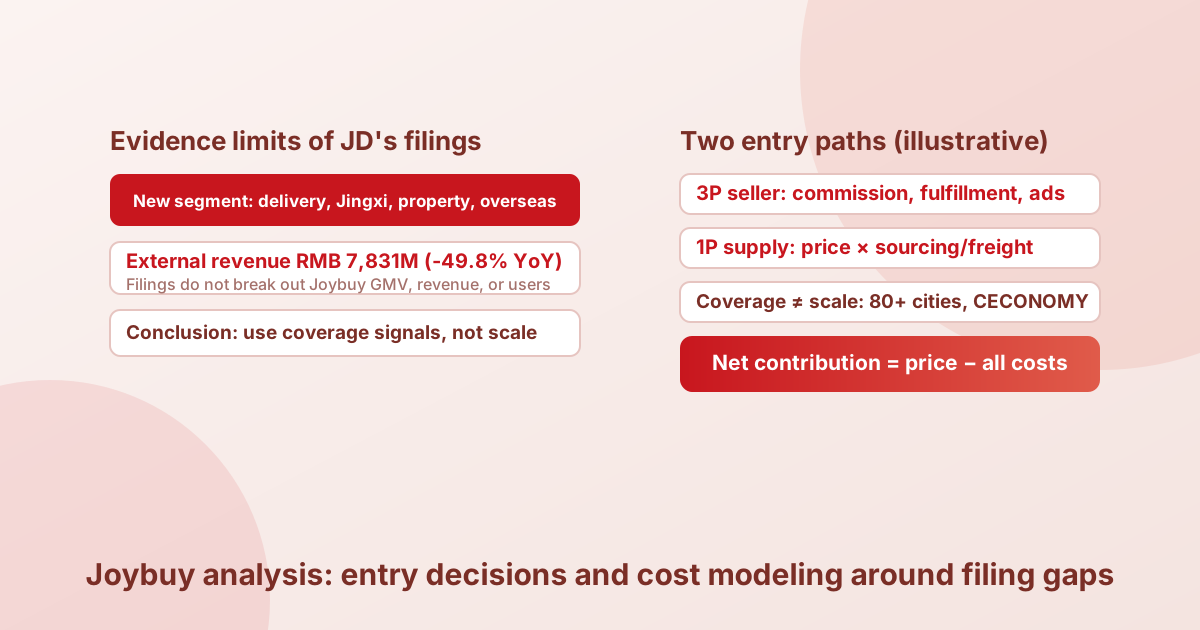
Chinese cross-border sellers and brands wanting to enter the European market hit a wall as soon as they start researching Joybuy, JD.com's European e-commerce arm: JD's filings show no standalone Joybuy GMV, revenue or user number, because it is folded into JD's New Businesses segment and reported together with JD Food Delivery, Jingxi, JD Property and overseas businesses, with only a qualitative sentence and no figures. So the real question is not how big Joybuy's overall business is, but how, when the company discloses no standalone scale and the seller entry point is an invite-only curated marketplace, I should judge whether entry is worth it and which data to use for selection and fulfilment costing. The answer comes in three layers: accept that evidence boundary first and separate coverage signals from scale signals in JD's filings; then distinguish Joybuy's two routes in, 1P brand supply and the 3P curated marketplace; finally use hypothetical examples to turn commission, fulfilment, advertising and goods cost into unit contribution, and replace those hypothetical values once an invitation and real rates arrive before committing spend.
1. Start with the evidence boundary: JD's filings contain no standalone Joybuy figures
JD.com's third-quarter 2026 results (SEC Form 6-K, Exhibit 99.1, published 17 November 2026, accessed 18 November 2026) report net revenue of RMB 309.6 billion (about US$46.2 billion, up 3.5% year on year) and split the business into three reportable segments: JD Retail, JD Logistics and New Businesses. New Businesses mainly comprises JD Food Delivery, Jingxi, JD Property and overseas businesses, and Joybuy sits within the overseas businesses. The filing gives only a qualitative description of Joybuy, with no GMV, revenue, user number or loss figure.
The headline segment numbers deserve extra care. External revenue of New Businesses was RMB 7,831 million (about US$1.168 billion) in the third quarter of 2026, against RMB 15,592 million a year earlier, down 49.8% year on year; but that steep fall is mainly because JD Logistics reclassified instant-delivery revenue out of New Businesses from January 2026, and it cannot be read as Joybuy or New Businesses shrinking by about half. The segment's operating loss was RMB 9,642 million, narrower than RMB 15,736 million a year earlier. The segment is muddled twice over — by revenue reclassification and by the merger of several businesses — so you can see neither Joybuy's scale nor its trend.
This is clearly different from Shopee, Coupang and Mercado Libre: Sea discloses Shopee as a separate segment, and Coupang and Mercado Libre each publish their own financial reports, so a filing-to-market judgement is possible. Joybuy is more like Lazada, where the parent company's filings cannot help. Compare this site's "Shopee Data Analysis", "Coupang Data Analysis", "Mercado Libre Data Analysis" and "Lazada Data Analysis".
2. The signals that do exist: keep coverage apart from scale
JD's filing gives no scale figure for Joybuy, but it does contain a number of verifiable coverage signals. First, Joybuy's "211" delivery service covers more than 80 towns across Europe, and customers in the covered areas can order an iPhone 18 Pro and receive it the same day. Second, Joybuy has partnerships with brands including Bose, Danone, Dyson, LG IT, Sandisk and SharkNinja, and offers trade-in plus JoyCare extended warranty and insurance. Third, on 12 November 2026 JD completed its voluntary public takeover offer for CECONOMY AG (XETRA: CEC), acquiring 59.8% of the shares and voting rights for total consideration of EUR 1,335 million, with CECONOMY consolidated into JD from 12 November 2026; together with the 25.3% retained by partner Convergenta, the combined stake is 85.2%. CECONOMY is the parent of the European consumer electronics retailer MediaMarktSaturn.
What these signals have in common is that they describe Joybuy's capability and coverage, not its scale. Coverage of more than 80 towns, a list of brand partnerships and a consolidation cannot produce GMV or conversion. Treating them as scale signals is the error of mistaking coverage for sales — covering 80 towns does not mean those towns produce orders, and a brand joining does not mean it sells.
3. The seller model: from first-party retail to an invite-only curated marketplace, and two routes in
According to European e-commerce outlet Ecommerce News Europe's report of 11 June 2026, Joybuy launched in March 2026 in six countries — the UK, Germany, France, the Netherlands, Belgium and Luxembourg — and until then sold only goods it sourced and held in its own inventory. From the second half of 2026 Joybuy began opening third-party sales to selected Chinese and European brands, testing a curated marketplace, in its own words testing it together with trusted brands. Fulfilment is hybrid: marketplace sellers' goods can go into a Joybuy warehouse and be fulfilled by the platform, or be shipped directly by the seller.
For a seller this means two different routes in, with completely different fee structures and data. Route one is 1P brand supply: you sell to JD or Joybuy at a supply price, the platform sets the retail price and handles fulfilment, you have no retail pricing power, and payment terms and returns are set by contract. Route two is a 3P curated marketplace seller: you join by invitation, set your own prices, and pay commission, fulfilment and advertising. The object of analysis differs: the first looks at supply gross margin and payment terms, the second at unit contribution and conversion.
4. A reproducible analysis: turning commission, fulfilment, advertising and goods cost into unit contribution
The formula below, with two scenarios, turns the cost of entering Joybuy into unit contribution. Every operating input is a hypothetical example in euros; Joybuy publishes no single commission or fulfilment rate and its seller centre is invite-only, so the commission rate and fulfilment fee are hypothetical values that must be replaced with the contract and the back-office statement once an invitation arrives. Base formula (before refunds and taxes): net contribution per unit = selling price × (1 − commission rate) − fulfilment and storage fee − advertising − goods cost.
Scenario A: a 3P marketplace seller, low-ticket 3C accessories, stock in a Joybuy warehouse (hypothetical example)
Assume a selling price P = €25, a commission rate of 8% (hypothetical), a fulfilment fee of €3.50, advertising of €2.00 and goods cost of €6.00. Commission = 25 × 8% = €2.00; net contribution per unit = 25 × 0.92 − 3.50 − 2.00 − 6.00 = €11.50, a net contribution rate of about 46%.
Scenario A is positive but thin on the hypothetical inputs, so cap advertising at your own limit and fix conversion first rather than adding budget; until you have real rates, do not use these hypothetical figures as a pricing basis.
Scenario B: a 1P brand supplier, high-ticket small appliances, supply-price model (hypothetical example)
Assume a retail price of €400, a supply price of €240 (60% of retail, hypothetical), a manufacturing cost of €140, and €15 for first-leg freight and certification. Supply gross profit = 240 − 140 − 15 = €85, a supply gross margin of about 35.4%.
Scenario B is positive on the hypothetical inputs, but you have no retail pricing power and you carry inventory and payment-term risk; confirm payment terms, returns and slow-moving stock clauses before signing, rather than looking only at the supply gross margin.
Sensitivity: in Scenario A, if advertising falls from €2.00 to €1.00, net contribution per unit = 25 × 0.92 − 3.50 − 1.00 − 6.00 = €12.50 (50%); if it rises to €3.00, net contribution = €10.50 (42%), which shows that advertising is the most sensitive lever on a low ticket size. In Scenario B, if the supply discount is pushed down to 55%, the supply price is €220 and supply gross profit €65 (29.5%); if you negotiate 65%, the supply price is €260 and supply gross profit €105 (40.4%), which shows that the supply discount is the core variable deciding whether the business is worth doing.
5. Counter-cases and alternative explanations: when not to enter Joybuy
A scenario that would overturn the case for entering Joybuy: your selection depends on public GMV or bestseller rankings to make purchasing decisions, and you are not a brand or category that JD considers curated. Joybuy discloses no GMV and invites only selected sellers, so public data simply cannot support a judgement about how large your category is on Joybuy; forcing your way in at that point is a bet placed where information is most asymmetric.
Another alternative explanation is this: Consolidating CECONOMY does not mean Joybuy benefits. CECONOMY's retail network (MediaMarktSaturn) and Joybuy's online store are two separate lines, the synergy is potential, and JD's own wording is that it believes the combination will be further strengthened, not that growth has already materialised. The way to tell them apart is to separate JD's strategic emphasis on Europe — verifiable through the CECONOMY consolidation and coverage of more than 80 towns — from verifiable demand for your category on Joybuy, which cannot be checked because there is no public GMV; the first does not directly support the second.
6. Action plan: what to collect, what to use as a baseline, and when to continue or stop
Before an invitation arrives, run a first coarse screen on public information: check whether your category is among the strengths Joybuy already showcases (branded categories such as 3C, appliances and personal care), and list your real selling prices, return rates and fulfilment costs on Amazon Europe and other European platforms as a comparison baseline. Once an invitation arrives, request the commission, fulfilment, storage, advertising and returns terms immediately and replace the hypothetical values in this article.
- Coarse screen: confirm whether the category falls within what Joybuy already partners with or promotes, and note which of the six countries launched first and what fulfilment capability you have
- Comparison: build a baseline from your real ticket size, return rate and fulfilment cost on Amazon Europe or other channels; do not use the platform's advertised low commission as the basis
- Ask for data: request the real rate card, payment terms, and returns and slow-moving stock clauses, then recompute unit contribution after replacing the hypothetical values
- Small-scale test: list a small number of SKUs first, watch conversion, returns and payouts across one complete settlement cycle, then decide on expansion
Continue when, after recomputing on real rates, net contribution per unit or supply gross profit is positive and meets your own target, and you can absorb the low-volume early period before Joybuy reaches scale. Adjust when traffic is high but conversion is low: fix the main image, price and listing first. Stop when you cannot obtain real rates, cannot confirm the settlement entity and tax responsibility, or unit contribution stays negative — collect the data first rather than expanding on hypothetical values.
7. Limitations and uncertainty
The unknowns most likely to change the conclusion are Joybuy's real commission and fulfilment rates (undisclosed; invite-only), the countries and categories actually open to marketplace sellers, and whether JD's subsidies to Joybuy continue. This article could not open the rate section of Joybuy's official seller centre directly, so it quotes no official rate and every rate given is a hypothetical value.
This article discusses a general analytical method for Joybuy's public data and entry routes; it does not mean that Nuozhou Digital Intelligence already provides real-time sales, GMV or commercial data coverage for Joybuy. Fees and taxes must be defined by country, seller entity and contracting model.
Method and disclosure
Data basis: the JD segment and CECONOMY figures come from JD.com's third-quarter 2026 results press release (SEC Form 6-K, Exhibit 99.1, published 17 November 2026, accessed 18 November 2026); Joybuy's six-country launch dates, the curated marketplace and the hybrid fulfilment model come from Ecommerce News Europe's report of 11 June 2026. Joybuy's standalone GMV, revenue, users and rates are not available in public material, so this article makes no estimate of its scale, and every cost calculation uses clearly labelled hypothetical values.
The increment here is to separate coverage signals from scale signals in JD's filings, and to use hypothetical examples on the two routes — 1P brand supply and the 3P curated marketplace — to turn the absence of a standalone GMV figure into a decidable unit contribution and supply gross margin; that is a decision tool the filing itself cannot give you.
To take unit contribution further down to net profit, see "Cross-Border Profit Accounting: The Five-Step Bridge from GMV to Net Profit"; for the same evidence boundary, where a parent company's filings contain no standalone platform GMV, compare "Lazada Data Analysis"; for general methods on choosing a market and a product, see "Not Sure Which Country to Sell In? A Data Matrix That Locks In Your First Market".
References
- 1. JD.com, "JD.com Announces Third Quarter 2026 Results" (primary source, SEC Form 6-K, Exhibit 99.1, published 17 November 2026): read the original, accessed 18 November 2026
- 2. Ecommerce News Europe, "Joybuy opens up to European and Chinese sellers" (published 11 June 2026): read the original, accessed 18 November 2026
This article was prepared with the assistance of an automated research workflow and is based on the public sources listed at the end; it has not been reviewed by a human editor.