
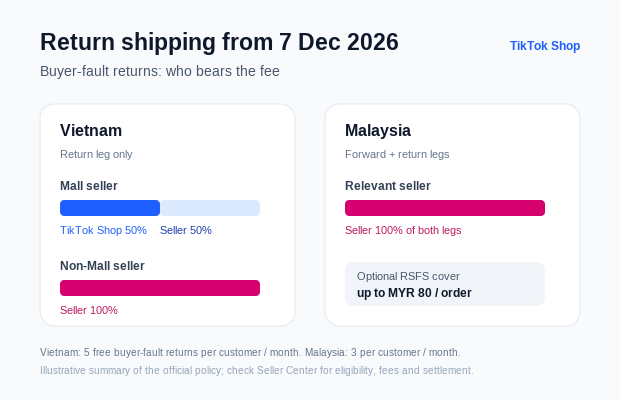
If you sell size-sensitive categories such as apparel, footwear or bags on TikTok Shop in Vietnam or Malaysia, the 7 December 2026 change is not a yes-or-no question. You need to decide three things: which SKUs will exceed your contribution buffer once buyer-fault returns are priced in; how much the Vietnam Mall/non-Mall split and Malaysia's two-way shipping add per order; and whether the platform's optional reimbursement programme is worth its per-order fee. TikTok Shop Vietnam's official returns policy says that, for eligible buyer-fault returns from 7 December 2026, Mall sellers bear 50% of the return shipping fee and all other sellers bear 100%; Malaysia's policy effective the same date requires relevant sellers to bear both the forward and return shipping fee. The two markets are not the same cost model.
1. Two markets, one date, different cost splits
Start with Vietnam. The official policy limits buyer-fault returns to three buyer-selected reasons: Change of Mind, Item is Too Big or Too Small, and Ordered the Wrong Size. The option is available only for products labelled as eligible on the product detail page, and the request must be submitted within the platform's stipulated timeframe. Each customer gets up to five free buyer-fault returns per month; the return is free to the buyer, but the seller still bears its share under the new split. After five returns, the customer pays the return shipping fee.
From 7 December 2026, the return shipping fee — the delivery fee from the buyer back to the seller — is split by seller type: TikTok Shop subsidises 50% for Mall sellers and the seller bears the other 50%; all other sellers bear 100%. Vietnam's 16 November policy update also says the change applies to orders placed on or after 7 December 2026. That order-date cutoff matters: an order placed on 6 December and returned on 10 December does not automatically move into the new split just because the return happens after the effective date.
Malaysia is different. The Malaysia returns policy marks that, effective 7 December 2026, relevant sellers will bear the forward shipping fee and the return shipping fee for eligible buyer-fault returns. The buyer-fault reasons are the same three, and each customer may make up to three such returns per month. The section we read does not carve out a 50% Mall exception as Vietnam does; it uses 'relevant sellers' for both legs. The forward shipping fee is calculated after any shipping subsidy voucher is applied.
Both markets share one boundary: the change applies only to buyer-fault returns. Seller-fault returns (wrong item, defective item, poor packaging, material mismatch) and logistics-provider-fault returns (damage in transit) remain on their existing rules. Treating the change as 'all returns are now chargeable' overstates the impact and points remediation in the wrong direction.
| Item | Vietnam | Malaysia |
|---|---|---|
| Effective date and transition | 7 December 2026; the official notice applies it to orders placed on or after that date | 7 December 2026; the page states the effective date but not an order-date transition rule |
| Buyer-fault reasons | Change of Mind, too big or too small, wrong size | Same |
| Eligible products | Labelled on the product detail page; request within the stipulated window | Same |
| Customer allowance | Five free buyer-fault returns per customer per month | Three buyer-fault returns per customer per month |
| Mall sellers | TikTok Shop subsidises 50%; the seller bears 50% of return shipping | The buyer-fault section states no Mall exception; relevant sellers bear forward + return |
| Non-Mall sellers | Seller bears 100% of return shipping | Relevant sellers bear 100% of forward + return |
| Forward shipping | For Change of Mind, the seller bears it, capped at VND 40,000 per non-instant order and VND 20,000 per instant order; the platform settles the excess | Seller bears it, calculated after the shipping subsidy voucher |
| Optional reimbursement | SFR: VND 1,620 per order (tax included); maximum VND 40,000 per order | RSFS: MYR 0.15–0.18 per order for Mall/Star sellers, higher for others; maximum MYR 80 per order |
The Vietnam forward-shipping caps in the table are the current wording on the policy page, which does not mark that subsection as a new 7 December change; this article treats them as current policy, not as part of the new increment. Malaysia's forward and return shipping are expressly placed in the buyer-fault section effective 7 December. The two markets' 'new' scope is not perfectly symmetrical.
2. Mechanism: only eligible buyer-fault returns enter the new split
The rule is not 'returns became more expensive'. It moves the return-shipping cost from the platform/buyer side to the seller, with the split depending on seller type and market. In Vietnam, non-Mall sellers bear 100% of the return leg and Mall sellers bear 50%; in Malaysia, relevant sellers bear both the forward and return legs. The platform filters eligible cases through four conditions: a product-page label, the buyer's selected reason, the request window, and the buyer's monthly free-return allowance.
Why would the platform design it this way? One plausible explanation is to push part of the cost of 'change of mind' and size-mismatch returns onto sellers, encouraging clearer size charts, images, material and fit information, while the monthly allowance limits abuse by a small number of buyers. That explanation is consistent with the rule's direction, but it does not prove the platform's actual objective or effect; the platform has not published a policy impact assessment.
For a seller, the two variables that matter are the buyer-fault return rate and the average return-shipping fee, not the headline return rate. The headline rate includes seller-fault, logistics-fault and buyer-fault returns; only the last group enters the new split. Multiplying the headline rate by the new fee overstates the cost; ignoring the eligibility label understates it.
There is a second gap: return shipping is only one component of a return. The merchandise refund, the forward shipping fee, packaging and inspection, resale markdown, wasted ad spend and whether the platform commission is returned all sit outside the return-shipping line. The calculations below isolate the new shipping cost; they are not the total cost of a return. Build the total from your own settlement statements.
3. Worked examples: Vietnam non-Mall, Vietnam Mall and Malaysia
All figures below are hypothetical examples, not TikTok Shop rates and not NWi customer data or measurements. The public texts provide the cost split, the buyer allowance, the reimbursement cap and the service fee; the average order value, contribution margin, return rate and average return-shipping fee are examples. Replace them with your own numbers.
Scenario A: Vietnam non-Mall apparel, 1,000 orders/month (hypothetical)
Assume 1,000 orders a month, an average order value of VND 350,000, a 25% contribution margin (VND 87,500 per order), an 8% buyer-fault return rate and an average return-shipping fee of VND 30,000; ignore merchandise refunds, forward shipping, resale markdown and the SFR service fee.
The new return-shipping cost is 1,000 × 8% × VND 30,000 = VND 2.4 million a month, or 0.69% of GMV (VND 350 million) and 2.74% of contribution (VND 87.5 million). At a 15% return rate, the cost is VND 4.5 million, or 1.29% of GMV and 5.14% of contribution.
If you set a 5%-of-contribution absorption cap, the threshold return rate for a non-Mall seller is 14.6% (0.05 × VND 87,500 ÷ VND 30,000). Below 14.6%, you can absorb and monitor; above it, fix the size chart and product page first, then consider repricing, joining SFR or cutting ad spend; above 20%, the new shipping cost alone consumes 6.9% of contribution, so stop adding ad budget to that SKU.
Scenario B: Vietnam Mall, same 1,000 orders/month (hypothetical)
Use the same 1,000 orders, VND 350,000 average order value, 25% contribution margin, 8% buyer-fault return rate and VND 30,000 average return-shipping fee; the Mall seller bears 50%, or VND 15,000 per return.
The new cost is 1,000 × 8% × VND 15,000 = VND 1.2 million a month, or 0.34% of GMV and 1.37% of contribution; at a 15% return rate, it is VND 2.25 million, or 2.57% of contribution. The 5%-of-contribution threshold is a 29.2% return rate.
Mall status halves the new shipping cost, but it does not make the cost disappear: check that the 50% platform subsidy appears in each settlement line and that no other condition disqualifies the order. Treating Mall status as a blanket exemption misses missing subsidies and ineligible products.
Scenario C: Malaysia, 1,000 orders/month (hypothetical)
Assume 1,000 orders a month, an average order value of MYR 80, a 20% contribution margin (MYR 16 per order), an 8% buyer-fault return rate and an average two-way shipping fee of MYR 10 per return (the official example uses MYR 5 forward + MYR 5 return for illustration only, not as a standard rate); ignore merchandise refunds, resale markdown and the RSFS service fee.
Because the Malaysian seller bears both legs, the new cost is 1,000 × 8% × MYR 10 = MYR 800 a month, or 1.0% of GMV (MYR 80,000) and 5.0% of contribution (MYR 16,000). At a 12% return rate, the cost is MYR 1,200, or 1.5% of GMV and 7.5% of contribution. If two-way shipping is MYR 16 instead of MYR 10, the 8% case costs MYR 1,280, or 8.0% of contribution.
With the same 5%-of-contribution cap, the threshold return rate is 8.0% when two-way shipping is MYR 10, and 5.0% when it is MYR 16. Malaysia bears both legs, so at the same return rate the cost is a larger share of contribution than Vietnam non-Mall; that is why the two markets should not share one model.
| Market / seller type | New shipping cost per return | Contribution per order | Return rate at 5% of contribution |
|---|---|---|---|
| Vietnam non-Mall | VND 30,000 | VND 87,500 | 14.6% |
| Vietnam Mall | VND 15,000 | VND 87,500 | 29.2% |
| Malaysia (MYR 10 two-way) | MYR 10 | MYR 16 | 8.0% |
| Malaysia (MYR 16 two-way) | MYR 16 | MYR 16 | 5.0% |
4. SFR/RSFS: the break-even between the service fee and expected reimbursement
Vietnam's Shipping Fee Reimbursement Program (SFR) official page states a service fee of VND 1,620 per order (tax included) and a maximum reimbursement of VND 40,000 per order; it covers eligible forward and return shipping, with exclusions such as seller-own-fleet (SOF) orders, unsuccessful returns, orders placed before enrolment and buyer-arranged returns. Malaysia's Return Shipping Fee Saver (RSFS) official page states a service fee of MYR 0.15–0.18 per order for Mall or Star sellers, possibly higher for other seller types, and a maximum reimbursement of MYR 80 per order; exclusions include SOF, unsuccessful returns, pre-enrolment orders and buyer-arranged returns.
The programme is not automatically a saving, because the service fee is charged on every successful forward order, including orders that never return. Compare expected reimbursement per order with the service fee per order. In Vietnam, assume the average eligible return-shipping fee is VND 30,000 and the reimbursement covers only the return leg (a conservative reading): expected reimbursement per order = return rate × VND 30,000; at a VND 1,620 service fee, the break-even return rate is 1,620 ÷ 30,000 = 5.4%. At an 8% return rate, expected reimbursement is VND 2,400 and the net benefit is VND 780 per order; at 4%, expected reimbursement is VND 1,200 and the net cost is VND 420 per order.
Malaysia uses the same logic: with MYR 10 two-way shipping and a MYR 0.18 service fee, the break-even return rate is 0.18 ÷ 10 = 1.8%; at 8%, expected reimbursement is MYR 0.80 and the net benefit is MYR 0.62 per order. At the official illustrative fee of MYR 0.28, the break-even rises to 2.8%; at MYR 16 two-way shipping, it falls to 1.75% (0.28 ÷ 16). These numbers only illustrate the decision method; actual service fees and reimbursements follow the Seller Center statement.
| Market / programme | Service fee per order | Average reimbursable shipping | Break-even return rate | Net benefit per order at 8% returns |
|---|---|---|---|---|
| Vietnam SFR | VND 1,620 | VND 30,000 (return leg only, conservative) | 5.4% | +VND 780 |
| Malaysia RSFS | MYR 0.18 | MYR 10 (two-way example) | 1.8% | +MYR 0.62 |
| Malaysia RSFS (official example fee) | MYR 0.28 | MYR 10 | 2.8% | +MYR 0.52 |
| Malaysia RSFS (higher shipping) | MYR 0.28 | MYR 16 | 1.75% | +MYR 1.00 |
The key limitation: Vietnam's SFR terms page lists 'registered for local-to-local transactions only' as an eligibility condition, while the returns policy page does not repeat that restriction. Cross-border sellers cannot assume they can join SFR; check in Seller Center whether the programme is open, what the service fee is and whether it is active before putting reimbursement into the cost model. Malaysia's RSFS also has eligibility review and exclusions, and the service fee varies with seller history.
5. Counter-cases: who may not need to change anything
First, low-return standard products. If the product page does not carry the buyer-fault return label, or the buyer-fault return rate has stayed below 5%, the new shipping cost may be only 1%–2% of contribution; repricing or changing packaging may not be worth it. Pull the data before acting.
Second, shops whose returns are mostly seller-fault or logistics-fault. The new rule changes only buyer-fault returns; if the returns come from wrong items, quality defects or transit damage, fix inspection, packaging and logistics first. Mixing the two groups misdirects the action.
Third, shops already enrolled in a reimbursement programme with a return rate above break-even. SFR/RSFS may cover most of the new cost; the priority is then to reconcile each reimbursement and check exclusions, not to reprice. Conversely, if the service fee is above expected reimbursement, leaving the programme or self-insuring may be cheaper.
One alternative explanation: the rule may raise conversion. A visible free-return label can make buyers more willing to order; if the incremental contribution from higher conversion exceeds the return cost, the net effect could be positive. Public data cannot verify that effect, so this article does not treat it as a certain gain. Sellers can test it with a controlled comparison, but 'it may raise conversion' is not a reason to skip the cost calculation.
6. Actions and stop rules: before and after 7 December
Before 7 December, do four things. First, pull the last 90 days of returns by market, SKU, size and reason, and calculate the buyer-fault return rate separately; do not use the headline rate. Second, list the SKUs with the buyer-fault label on the product page and check the size chart, images, material, fit and target body type; size problems are rarely solved by a price cut. Third, replace the assumptions in the three scenarios with your own average order value, contribution margin and average return-shipping fee, and calculate each SKU's 5%-of-contribution threshold. Fourth, check Seller Center: whether the Vietnam shop is Mall or non-Mall, whether SFR is open, its service fee and status; whether Malaysia's RSFS is open, its service fee and exclusions.
From 7 December to 20 December, focus on reconciliation. Record the order ID, return reason, product eligibility, return shipping fee, forward shipping fee (Malaysia), Mall subsidy (Vietnam), SFR/RSFS reimbursement and service fee per order; keep the subsidy, reimbursement and fee as separate columns rather than looking only at the net deduction. If a buyer-fault return is treated as seller-fault, or an unlabelled product is charged, appeal with the order ID and the official policy page.
If a SKU's buyer-fault return rate stays above its 5%-of-contribution threshold for two consecutive weeks, pause ads and fix the size information; above the 10%-of-contribution level (about 29% for Vietnam non-Mall, or about 16% for Malaysia at MYR 10 two-way shipping), pause additional 12.12 inventory for that SKU. If the actual SFR/RSFS service fee is above expected reimbursement, leave the programme or self-insure; if the platform subsidy or reimbursement is missing for two billing cycles, stop treating the channel as covered and revert to the conservative cost model.
| Field | Definition | Use |
|---|---|---|
| Order ID | Platform order number | Anchor for appeals and reconciliation |
| Return reason | Buyer-selected reason and platform final decision | Separate buyer-fault, seller-fault and logistics-fault |
| Product eligibility | Whether the product page carries the buyer-fault label | Whether the new split should apply |
| Return shipping fee | Delivery fee from buyer back to seller | Calculate the new cost |
| Forward shipping fee (Malaysia) | Amount after the shipping subsidy voucher | Calculate the two-way cost |
| Mall subsidy (Vietnam) | Whether the 50% platform subsidy arrives | Reconcile the net cost for Mall sellers |
| SFR/RSFS reimbursement and fee | Per-order reimbursement, service fee, exclusions | Calculate the programme's net benefit |
| Net cost | Return + forward − subsidy − reimbursement + fee | Decide whether to absorb, reprice or stop |
7. Unknowns and limitations
Five unknowns can change the conclusion. First, the platform does not publish average return-shipping fees by market or category; the VND 30,000 and MYR 10/16 figures are assumptions. Second, the platform does not publish seller-level buyer-fault return rates; sellers only see their own last 90 days, and new customers, promotions and 12.12 may produce higher return rates. Third, SFR/RSFS service fees vary with seller history, shop type and risk score; the official pages give a range or an example, and the actual amount is in Seller Center. Fourth, Vietnam's SFR terms state a local-to-local eligibility condition; whether cross-border sellers qualify, and whether Malaysia's RSFS covers cross-border orders, must be confirmed in Seller Center. Fifth, Malaysia's page states the effective date but not an order-date transition rule; orders placed before 7 December and returned after it cannot be mapped to Vietnam's order-date rule by analogy.
One more evidence boundary: this article reads the official TikTok Shop Vietnam and Malaysia returns policies, policy-update pages and the SFR/RSFS pages, plus independent write-ups by Sapo and Open Market Notes. Direct fetches of the official pages timed out; the body text was read through the search channel's full-page view, and the raw HTML was not saved verbatim. The official pages may change; after publication, the Seller Center version should govern. This article does not use any competitor data vendor's text, estimates, charts, screenshots or API output, and does not treat a third-party example fee as a platform-wide rate.
This article does not predict how much any category's return rate will rise, and does not guarantee that joining SFR/RSFS will save money. Treat it as a decision framework, not legal advice on the platform policy; eligibility, fees, reimbursements and appeals are governed by TikTok Shop Seller Center and the official policy pages.
8. Method and disclosure
Data scope: the Vietnam buyer-fault return reasons, five free returns per month, Mall 50%/other sellers 100% return-shipping split, 7 December 2026 effective date, order-date transition and VND 40,000/20,000 forward-shipping caps come from TikTok Shop Vietnam's Customer Order Cancellation, Return and Refund Policy and its 16 November 2026 policy update; the SFR VND 1,620 per-order service fee, VND 40,000 per-order cap, exclusions and local-to-local eligibility come from TikTok Shop Vietnam's SFR page and terms. The Malaysia buyer-fault reasons, three returns per month, relevant sellers bearing forward and return shipping and 7 December 2026 effective date come from TikTok Shop Malaysia's Customer Order Cancellation, Return and Refund Policy and its 12 November 2026 policy update; the RSFS MYR 0.15–0.18 per-order fee, MYR 80 per-order cap, MYR 0.28 example and exclusions come from TikTok Shop Malaysia's RSFS page. The average order values, contribution margins, return rates, average return-shipping fees, two-way shipping fees and 5%-of-contribution threshold in this article are hypothetical examples, not platform rates or NWi measurements.
The article's original contribution is to separate Vietnam Mall/non-Mall and Malaysia's two-way shipping into three reproducible unit-economics models, and to break even the SFR/RSFS service fee against expected reimbursement, rather than repeating that sellers bear the shipping cost from 7 December.
This article was prepared with the assistance of an automated research workflow, based on the public sources listed at the end, and was not manually reviewed.
Put return cost back into the operating process: use NWi CrossborderGo to review market, platform, category, brand, store and product structure and identify SKUs with higher return risk; use NWi Operations to manage size information, creative and listing cadence, with market values treated as third-party estimates; to connect platform or settlement data to your own analysis, review the boundaries on the MCP data access page, where client compatibility, fields and permissions depend on the actual integration; to model your own category and return structure, submit a request through the demo page. NWi Cross-border Agent can support expert research on Vietnam and Malaysia market entry, but review insights are limited to selected brands, the beauty innovation advisor is limited to beauty, and the creator advisor currently covers Vietnam, Indonesia and Malaysia. Site coverage, history and fields in NWi CrossborderGo depend on the contract and account authorisation; it does not execute the platform's return policy or guarantee reimbursement outcomes.
9. Sources
- 1. TikTok Shop Vietnam, 'TikTok Shop Customer Order Cancellation, Return and Refund Policy' (primary: buyer-fault definition, five free returns per month, Mall 50%/other sellers 100% return shipping, 7 December 2026 effective date, VND 40,000/20,000 forward caps): read the source, accessed 2026-11-25.
- 2. TikTok Shop Vietnam, 'Latest Policy Updates — 16th November 2026 Policy Announcements' (primary: effective 7 December 2026, applies to orders placed on or after that date, five free returns per month, SFR from VND 1,500): read the source, published 2026-11-16, accessed 2026-11-25.
- 3. TikTok Shop Malaysia, 'TikTok Shop Customer Order Cancellation, Return and Refund Policy' (primary: three buyer-fault returns per month, relevant sellers bear forward and return shipping, effective 7 December 2026, RSFS up to MYR 80): read the source, page updated 2026-11-18, accessed 2026-11-25.
- 4. TikTok Shop Malaysia, 'Latest Policy Updates — 12th November 2026 Policy Announcements' (primary: effective 7 December 2026, three returns per month, RSFS up to MYR 80): read the source, announced 2026-11-12, page updated 2026-11-24, accessed 2026-11-25.
- 5. TikTok Shop Vietnam, 'Shipping Fee Reimbursement (SFR)' (primary: VND 1,620 per-order service fee, up to VND 40,000 per order, exclusions): read the source, page updated 2025-09-25, accessed 2026-11-25.
- 6. TikTok Shop Vietnam, 'Terms of Service of Shipment Fee Reimbursement Program in Vietnam' (primary: local-to-local eligibility, service fee, exclusions, 14-day exit): read the source, last updated 2025-09-30, accessed 2026-11-25.
- 7. TikTok Shop Malaysia, 'Return Shipping Fee Saver' (primary: MYR 0.15–0.18 per order for Mall/Star sellers, higher for others, MYR 80 cap, MYR 0.28 example, exclusions): read the source, page updated 2026-11-23, accessed 2026-11-25.
- 8. Sapo, 'TikTok Shop thay đổi phí vận chuyển trả hàng từ 07/12/2026: Nhà bán cần chuẩn bị gì?' (independent media: order-date cutoff, VND 30,000 return-shipping example, Mall/non-Mall split): read the source, published 2026-11-18, accessed 2026-11-25.
- 9. Open Market Notes, 'TikTok Shop Vietnam changes who pays return freight before 12.12' (independent analysis: order-date cutoff, older Mall/Star Shop wording difference): read the source, published 2026-11-23, accessed 2026-11-25.
- Note: the first seven items are official TikTok Shop Vietnam and Malaysia pages; the eighth and ninth are independent media/analysis used only to cross-check the order-date interpretation, the illustrative shipping fee and the older wording. This article does not use any competitor data vendor's text, estimates, charts, screenshots or API output; all hypothetical numbers are labelled as examples.