
If you sell consumer goods made in China, Vietnam or Southeast Asia on the US marketplace, the decision on 25 November 2026 is not to wait for the final rate. It is to answer three calculable questions: is your HTS in Annex A or Annex B; which duty layer does the proposed rate net out; and under the worst ceiling, which SKU's unit contribution falls below your floor? USTR made Section 301 determinations for 14 economies and proposed additional tariffs that day, but as of the date of this research it had not published an effective date. Every rate is an 'up to' proposal, not a bill already being collected.
The event first. In its 25 November 2026 release, USTR determined that the acts, policies and practices of China, the European Union, Singapore, Switzerland, Indonesia, Malaysia, Cambodia, Thailand, Korea, Vietnam, Taiwan, Bangladesh, Japan and India are unreasonable and burden US commerce. It made no determination on Mexico or Norway at this time. The proposed action goes to public comment: written comments and requests to appear are due 5 January 2027, and the hearing is scheduled for 25 January 2027.
This is not an effective tariff schedule. The release uses 'proposes', 'consider applying' and 'up to'; the China FRN says USTR 'proposes to determine that action is appropriate', and the Vietnam FRN uses the same structure. Until a final rule is published, the useful work is not forecasting the rate but calculating the cost if the ceiling is applied, and setting triggers.
As of the date of this research, USTR had not published an effective date; every rate is an 'up to' proposal, not a bill already being collected, and the comment deadline is 5 January 2027 with a hearing on 25 January 2027.
1. The rate structure: read what is netted out before comparing percentages
The easiest mistake is to compare the 14 economies by headline percentage. USTR uses different 'net of' bases. China is net of the forced-labor Section 301 rate; Vietnam, Indonesia, Malaysia, Thailand, Cambodia, Bangladesh, India and Singapore are net of existing Section 301 tariffs; the EU, Japan, Korea, Taiwan and Switzerland are net of MFN and existing Section 301 tariffs. The same percentage means a different increment depending on what is netted out.
| Economy | Proposed ceiling | What it nets out | Current forced-labor 301 rate | Increment used in this article | Note |
|---|---|---|---|---|---|
| China | 20% (40% alternative) | Forced-labor 301 (12.5%) | 12.5% | +7.5 points (20%) / +27.5 points (40%) | The 2018 25% and MFN are not netted in the same sentence; Annex A is 10%, Annex B is exempt |
| Vietnam | 35% (20% with ART) | Existing Section 301 | 12.5% | +22.5 points (35%) / +7.5 points (20%) | Section 232 goods, informational materials and other items are in the exemption annex |
| Indonesia | 18% | Existing Section 301 | 10% | +8 points | Lower forced-labor rate than China/Vietnam; a lower headline is not always a smaller increment |
| Malaysia | 18% | Existing Section 301 | 10% | +8 points | Same as Indonesia |
| Thailand | 18% | Existing Section 301 | 12.5% | +5.5 points | Smaller increment than Indonesia/Malaysia |
| Cambodia | 18% | Existing Section 301 | 10% | +8 points | Apparel, solar and tyres are among USTR's named sectors |
| Bangladesh | 18% | Existing Section 301 | 10% | +8 points | Apparel is a focus sector |
| India | 25% (17% with ART) | Existing Section 301 | 10% | +15 points (25%) / +7 points (17%) | The rate could fall to 17% with an ART |
| Singapore | 20% (10% with ART) | Existing Section 301 | 12.5% | +7.5 points (20%) / -2.5 points (10%) | The 10% case is below the current forced-labor rate, a net reduction |
| EU/Japan/Korea/Taiwan/Switzerland | 15% | MFN + existing Section 301 | 10% or 12.5% | Do not apply this table directly | Different basis; recalculate the MFN and 301 stack separately |
Terms: HTS means the Harmonized Tariff Schedule code, MFN means the most-favoured-nation rate, ART means an Agreement on Reciprocal Trade, AD/CVD means anti-dumping and countervailing duties, and IEEPA means tariffs under the International Emergency Economic Powers Act.
This table converts a headline rate into an incremental rate. It is not a customs opinion. Your HTS may fall in Annex A (10% for China), Annex B (exempt) or the exemption annex for Vietnam and other economies; it may also stack with Section 232, AD/CVD or IEEPA/reciprocal tariffs. Every 'does it apply' question needs a written answer from a licensed customs broker, by HTS and origin.
2. Why 'net of' is the most misread phrase in the notice
For China, the FRN says 'up to 20 percent, net of the rate of duty applied to the good under the Section 301 investigation related to ... forced labor'. The forced-labor Section 301 rate for China is 12.5% (effective 24 July 2026). This article therefore reads the 20% as a Section 301 ceiling that replaces the 12.5% layer, an increment of 7.5 percentage points; the 40% alternative is an increment of 27.5 points. It does not mean '25% + 12.5% + 20% = 57.5%'.
But the China FRN does not say, in the same sentence, that the 20% is net of the 2018 25% Section 301 rate, nor that it is net of MFN. Scenario A therefore keeps the 2018 25% and a 2.6% MFN rate in the cost stack. A broker must confirm this reading. If the final rule treats the 20% as an additional layer on top of 25% and 12.5%, the 40% case is materially worse; the formula does not change, only the increment.
Vietnam, Indonesia and the others use a different basis: 'net of existing Section 301 tariffs', so the 35% or 18% replaces the existing 301 layer (including the forced-labor 301 rate), while MFN and Section 232 may still stack. For the EU, Japan, Korea, Taiwan and Switzerland, the 15% is net of MFN and existing Section 301, so it is closer to a total ceiling and cannot be compared directly with the 35%/18% Asian rates.
- Ask the broker: what is the current MFN rate for this HTS, and do AD/CVD, Section 232 or IEEPA/reciprocal tariffs apply?
- Ask the broker: is this HTS in Annex A, Annex B or an exemption annex of the relevant FRN?
- Ask the broker: under the final rule, does the 20%/35%/18% replace a layer or stack on top of it?
- Ask the broker: if origin moves from China to Vietnam or Indonesia, do the HTS classification, origin rules, preferential treatment and certifications change?
3. The decision: size the exposure before changing anything
Not every SKU deserves action before the comment deadline. First calculate tariff exposure: annual units × customs value × incremental rate. Then calculate the contribution buffer: current unit contribution minus your contribution floor. High exposure and a thin buffer go first; low exposure and a thick buffer can wait for the final rule.
| Thick contribution buffer (>10%) | Thin contribution buffer (<5%) | |
|---|---|---|
| High exposure (>USD 50,000 annual increment) | Monitor and prepare a quotation response | Recalculate now: reprice, move origin or pause replenishment |
| Low exposure (<USD 10,000 annual increment) | Wait for the final rule | Negotiate FOB first; do not rush to move origin |
The USD 50,000, USD 10,000, 10% and 5% thresholds in the table are assumptions, not industry standards. They rank work; they do not replace your financial floor. The real floor comes from your cash flow, inventory cycle and customer contracts.
4. Mechanism: duty is charged on customs value, not retail price
Duty is charged on customs value, not retail price: a one-percentage-point increase in the proposed rate raises cost by 1% of customs value, not 1% of the retail price.
The article uses one formula across all three scenarios: landed cost = FOB + freight and insurance + MFN + 2018 Section 301 + forced-labor Section 301 + other duties and fees; unit contribution = retail price − landed cost − marketplace commission − fulfilment − advertising − returns and markdowns. All figures use one currency and one tax basis; do not mix FOB with landed cost.
The three scenarios isolate the Section 301 layer only; they do not include reciprocal/IEEPA tariffs, Section 232 or AD/CVD. Add those layers for a full customs cost, or the absolute cost will be understated. The reciprocal-tariff rate and suspension status may have changed after 10 November 2026 and must be rechecked against the latest notice. The contribution rates in the scenarios are therefore overstated and are not net profit.
A common error is to apply the incremental rate to the retail price. In Scenario A, customs value is USD 7.20, so 7.5 points is USD 0.54; applied to a USD 24.99 retail price it would be USD 1.87, a 3.5× overstatement. Another error is to add the percentages across economies; their 'net of' bases differ, so the sum has no meaning.
5. Scenario A: a China-made consumer electronics accessory (hypothetical example), at 20% and 40%
Assume FOB USD 6.00, freight and insurance USD 1.20, customs value USD 7.20; MFN 2.6%, 2018 Section 301 25%, forced-labor Section 301 12.5%; retail USD 24.99, marketplace commission 15%, fulfilment USD 3.50, advertising USD 2.50, returns and markdowns USD 1.00; all figures are hypothetical, not any store's actual data.
| Item | Current | 20% case | 40% alternative |
|---|---|---|---|
| Customs value | 7.20 | 7.20 | 7.20 |
| MFN 2.6% | 0.19 | 0.19 | 0.19 |
| 2018 Section 301 25% | 1.80 | 1.80 | 1.80 |
| Forced-labor Section 301 | 0.90 | 1.44 (20%) | 2.88 (40%) |
| Landed cost | 10.09 | 10.63 | 12.07 |
| Unit contribution | 4.15 (16.6%) | 3.61 (14.4%) | 2.17 (8.7%) |
| Change vs current | — | -0.54 | -1.98 |
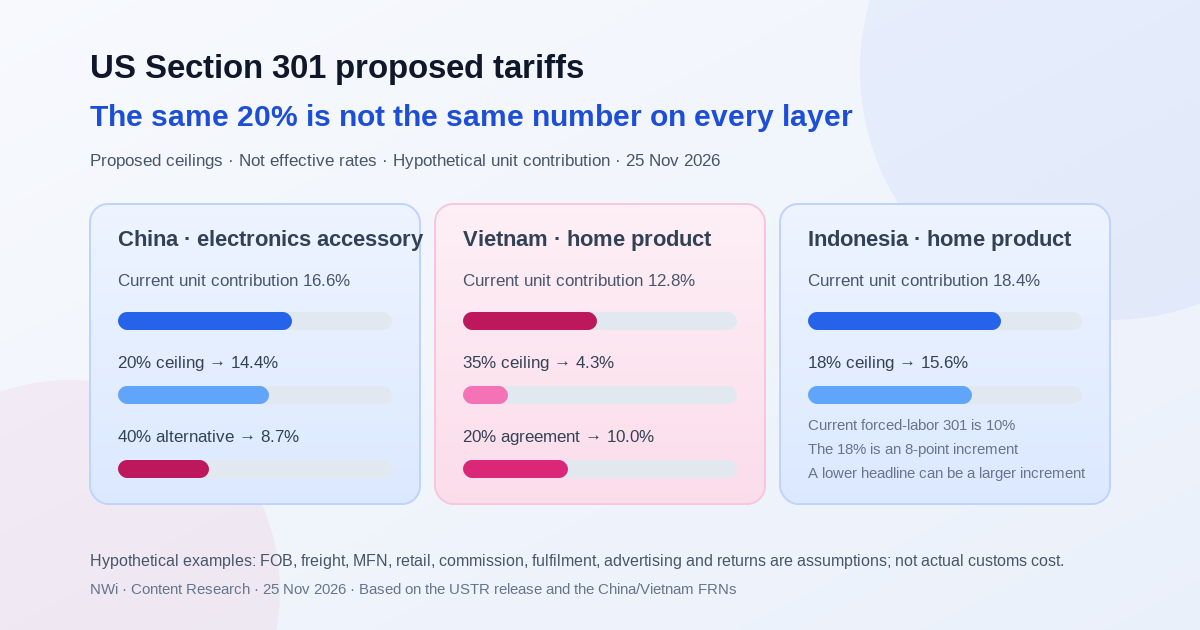
Current landed cost is USD 10.09 and unit contribution is USD 4.15 (16.6%); at 20% landed cost is USD 10.63 and contribution USD 3.61 (14.4%); at 40% landed cost is USD 12.07 and contribution USD 2.17 (8.7%).
If the contribution floor is 10%, the 40% case falls below it and needs at least USD 0.33 of FOB relief or a 1.3% price increase to return to 10%; restoring the original USD 4.15 contribution needs USD 1.98, or a 7.9% price increase. The 20% case remains above 10%, so monitor it and prepare a trigger rather than repricing immediately.
Stop conditions: if FOB relief and price increases together cannot bring contribution back above 10% in the 40% case, pause additional replenishment for that SKU; if the volume loss after a price increase exceeds your break-even, stop raising price and move origin or cut the SKU instead. Do not sacrifice overall cash flow to keep one SKU alive.
6. Scenario B: a Vietnam-made home product (hypothetical example), at 35% and the 20% agreement case
Assume FOB USD 12.00, freight and insurance USD 3.00, customs value USD 15.00; MFN 3.4%, 2018 Section 301 0%, forced-labor Section 301 12.5%; retail USD 39.99, marketplace commission 15%, fulfilment USD 6.00, advertising USD 4.00, returns and markdowns USD 1.50; all figures are hypothetical.
| Item | Current | 35% case | 20% agreement case |
|---|---|---|---|
| Customs value | 15.00 | 15.00 | 15.00 |
| MFN 3.4% | 0.51 | 0.51 | 0.51 |
| 2018 Section 301 | 0.00 | 0.00 | 0.00 |
| Forced-labor Section 301 | 1.88 | 5.25 (35%) | 3.00 (20%) |
| Landed cost | 17.39 | 20.76 | 18.51 |
| Unit contribution | 5.11 (12.8%) | 1.73 (4.3%) | 3.98 (10.0%) |
| Change vs current | — | -3.38 | -1.13 |
Current landed cost is USD 17.39 and unit contribution is USD 5.11 (12.8%); at 35% landed cost is USD 20.76 and contribution USD 1.73 (4.3%); at the 20% agreement case landed cost is USD 18.51 and contribution USD 3.98 (10.0%).
If Vietnam ends at 35%, restoring the original USD 5.11 contribution needs at least USD 3.38 of FOB relief or an 8.4% price increase; to hold a 5% floor, it needs USD 0.27, or a 0.7% price increase. The 20% agreement case contributes USD 3.98 (10.0%), USD 1.13 below the current level, so monitor it rather than moving origin immediately.
Stop conditions: if Vietnam ends at 35% and contribution remains below 5% after FOB relief, pause new replenishment for that SKU; if the 20% agreement case falls below 8% contribution, start a repricing or origin review. Do not treat 'Vietnam 35%' as a single rate for every Vietnam SKU; HTS, annex exemptions and Section 232 goods change the result.
7. Scenario C: an Indonesia-made home product (hypothetical example), at 18%
Assume FOB USD 10.00, freight and insurance USD 2.00, customs value USD 12.00; MFN 3.4%, forced-labor Section 301 10%; retail USD 34.99, marketplace commission 15%, fulfilment USD 5.00, advertising USD 3.50, returns and markdowns USD 1.20; all figures are hypothetical.
| Item | Current | 18% case |
|---|---|---|
| Customs value | 12.00 | 12.00 |
| MFN 3.4% | 0.41 | 0.41 |
| Forced-labor Section 301 | 1.20 | 2.16 (18%) |
| Landed cost | 13.61 | 14.57 |
| Unit contribution | 6.43 (18.4%) | 5.47 (15.6%) |
| Change vs current | — | -0.96 |
Current landed cost is USD 13.61 and unit contribution is USD 6.43 (18.4%); at 18% landed cost is USD 14.57 and contribution USD 5.47 (15.6%).
The 18% case remains above the 15% floor, so no immediate price increase is needed; if freight rises 10% or FOB rises 5%, contribution falls to about USD 5.23 or USD 4.87, both below the 15% floor. Set triggers: start FOB negotiation below 15% contribution and pause replenishment below 10%.
This scenario shows that a lower headline rate is not automatically safer. Indonesia at 18% is two points below China at 20%, but Indonesia's current forced-labor 301 rate is 10%, an 8-point increment, while China's is 12.5%, a 7.5-point increment. The decision variable is the increment, not the headline.
8. Counter-cases: moving origin is not automatically cheaper
Vietnam at the 35% ceiling can be more expensive than China at 20%; Indonesia at 18% is only two points below China's 20%, but Indonesia's current forced-labor 301 rate is 10%, an 8-point increment, while China's is 12.5%, a 7.5-point increment. Do not assume Vietnam is cheaper just because it is not China, and do not assume Indonesia at 18% is safer than China at 20%.
First counter-case: on the customs values used here, China at 20% adds USD 0.54 per unit, while Vietnam at 35% adds USD 3.38; even if Vietnam FOB is USD 1.00 lower, the tariff increment is still USD 1.84 higher. Put the tariff increment difference and the FOB difference in the same table before moving.
Second counter-case: moving origin has hidden costs. A new supplier changes MOQ, lead time, quality, certifications, origin rules, HTS classification and logistics. A five-point tariff saving on a USD 7 customs value is USD 0.35 per unit; if the new FOB is USD 0.50 higher, moving origin loses money. Calculate total landed cost plus switching cost before deciding.
Third counter-case: a price increase can reduce volume. Higher unit contribution is not higher total contribution; if a 10% price increase cuts volume by 15%, total contribution can fall. Run the sensitivity on total contribution = unit contribution × units, not unit contribution alone.
The alternative explanation also deserves weight: the final rate may be lower than the ceiling, comments and the hearing may change the outcome, Annex A/B may exclude a product or reduce it to 10%, and Section 232 goods may be exempt. Waiting has option value. But waiting also has risk: if the final rule takes effect before your next replenishment, you may already be locked into high-cost inventory. Treat waiting as a strategy with a deadline, not the default.
9. A 30-day action list before the comment deadline
Start by exporting the HTS, origin, annual units, customs value and current duty stack for the top 20 SKUs, then have the broker confirm Annex A/B and the 'net of' reading in writing, and finally rerun current, ceiling, agreement and worst-case scenarios for unit and total contribution.
- Export the HTS, origin, annual units, customs value and current MFN/301/232/AD/CVD rates for the top 20 SKUs into a traceable table.
- Have the broker confirm in writing whether Annex A/B or an exemption annex applies, whether 'net of' replaces or stacks, and the likely effective date.
- Rerun four cases: current, proposed ceiling, agreement case and worst case (China 40%); calculate unit and total contribution for each.
- Set a contribution floor (for example 5%/10%/15%) and rank by exposure × buffer; pull out the high-exposure, thin-buffer SKUs first.
- Act in order: negotiate FOB → reprice → move origin → pause replenishment; set a trigger and a stop condition at each step.
- If you decide to comment, file HTS, cost-structure and employment evidence before 5 January 2027; the hearing is on 25 January 2027.
- Rerun after the final rule; do not use a proposed rate for a long-term purchase commitment.
- Share the result with finance, procurement and marketplace operations so you do not raise prices while still replenishing at the old cost.
Stop conditions: if the final rate is below the case you modelled, release the frozen replenishment; if the final rate is at the ceiling and contribution is still below the floor after all actions, stop replenishment; if total landed cost after moving origin is higher than the current origin, do not move; if total contribution after a price increase is lower than before, do not raise the price.
If you want to apply this table to your own SKUs, start with NWi CrossborderGo market, brand, store and product data to map price bands and competitor distribution, then connect the tariff scenarios to unit contribution using the Amazon platform page site definitions. For a joint calculation across your HTS, sites and categories, book a demo. The duty layer and customs treatment remain subject to your broker's written confirmation.
10. Unknowns and limitations
What this article can verify is the proposed rates, netting basis, comment and hearing dates in the USTR release and the China/Vietnam FRNs, and the current forced-labor Section 301 rates. What it cannot verify is the final rate, the effective date, your HTS classification, customs valuation, the 2018 Section 301 lists, how Section 232/AD/CVD/IEEPA/reciprocal tariffs stack, or demand elasticity.
The scenario numbers are assumptions, not any store's actual data; HTS classification, customs valuation, the 2018 Section 301 lists, Section 232, AD/CVD, IEEPA/reciprocal tariffs and demand elasticity can all change the conclusion.
Another limitation is time: comments are due 5 January 2027 and the hearing is on 25 January 2027, but the final rule may come later and may be phased in. Do not treat the comment deadline as the effective date, or the hearing as the final decision.
11. What this analysis adds
The original contribution is a table that separates what each economy's proposal nets out, a recalculation of three scenarios using incremental rather than headline rates, and a set of thresholds and stop conditions for repricing, moving origin or pausing replenishment. First, it separates what each economy's proposal nets out, so the 20%, 35% and 18% are not added or compared directly. Second, it recalculates three scenarios with incremental rather than headline rates, producing USD 0.54 per unit for China at 20%, USD 3.38 for Vietnam at 35% and USD 0.96 for Indonesia at 18%. Third, it turns repricing, moving origin and pausing replenishment into an action list with thresholds and stop conditions.
The article does not name a best origin and does not claim any rate is already in effect. It answers a narrower but more useful question: at the proposal stage, which SKUs deserve action first, how far to go, and when to stop.
12. Sources
- 1. USTR, "USTR Makes Determinations and Proposes Actions in 14 Section 301 Investigations Relating to Structural Excess Capacity and Production in Manufacturing Sectors" (primary, 25 November 2026; 14 economies, proposed rates, comment deadline 5 January 2027, hearing 25 January 2027): read the original, accessed 25 November 2026.
- 2. USTR, "Notice of Determination and Request for Comments Concerning Proposed Action in the Section 301 Investigation of Acts, Policies, and Practices of China Relating to Structural Excess Capacity and Production in Manufacturing Sectors" (primary, China FRN, 25 November 2026; China 20%/40%, Annex A 10%, Annex B exemption, net of forced-labor 301, comment and hearing dates): read the original, accessed 25 November 2026.
- 3. USTR, "Notice of Determination and Request for Comments Concerning Proposed Action in the Section 301 Investigation of Acts, Policies, and Practices of Vietnam Relating to Structural Excess Capacity and Production in Manufacturing Sectors" (primary, Vietnam FRN, 25 November 2026; Vietnam 35%, 20% with an ART, Section 232 and other exemptions, comment and hearing dates): read the original, accessed 25 November 2026.
- 4. USTR, "Notice of Actions in Section 301 Investigations of Acts, Policies, and Practices of Various Economies Related to the Failure of Each Economy To Impose and Effectively Enforce a Prohibition on the Importation of Goods Produced With Forced Labor" (primary, 91 FR 47318, 28 July 2026; current rates including 12.5% for China/Vietnam/Thailand and 10% for Indonesia/Malaysia/Cambodia/Bangladesh/India): read the original, accessed 25 November 2026.
- 5. The White House, "Fact Sheet: President Donald J. Trump Strikes Deal on Economic and Trade Relations with China" (primary, 1 November 2025; Kuala Lumpur arrangement, the 10% reciprocal tariff and the suspension background): read the original, accessed 25 November 2026.
- 6. USTR, "China Section 301-Tariff Actions and Exclusion Process" (primary background, 2018 List 1–4 and the exclusion process): read the original, accessed 25 November 2026.
Data basis: the USTR release of 25 November 2026 and the China/Vietnam FRNs are used for the proposed rates, the netting basis, Annex A/B and the comment/hearing dates; Federal Register 2026-15181 is used for the current forced-labor Section 301 rates by economy; the White House fact sheet of 1 November 2025 is used for the Kuala Lumpur arrangement and the reciprocal-tariff suspension background; the USTR China Section 301 tariff-actions page is used for the 2018 List 1–4 background. FOB, freight, insurance, MFN, the 2018 301 rate, retail price, commission, fulfilment, advertising, returns and contribution floors in the scenarios are explicitly labelled hypothetical examples, not actual data from any store, platform or NWi.
This article was prepared with automated research assistance from the public sources listed at the end. It was not reviewed by a human editor. It is not customs, tax or legal advice; consult a licensed customs broker or professional adviser for HTS classification, origin, duty stacking and compliance obligations.