
If you supply from China or Southeast Asia and already sell on Amazon US/EU, Shopee or Mercado Livre Brazil, the question before Black Friday 2026 is not whether Brazil is big. It is an SKU-level choice: test through Amazon Brazil's international imported catalogue, or move the SKU to local stock or a local seller? The answer depends on each parcel's customs value, ICMS, marketplace fees, delivery promise and all-in local landed cost. This article first separates what Amazon's 23 November numbers do and do not prove, then puts direct mail and local stock on the same contribution table through four scenarios.
On 23 November 2026, Amazon Brasil said its Brazilian site carried more than 55 million imported products, that sales of that international selection grew more than 50% in 2026, and that it added more than 4 million items from the United States and Asia this year, led by physical books, apparel, vinyl records and home utensils. Hayley Muller, who leads international selection at Amazon Brasil, said the goal is more products, competitive prices and fast delivery. The figures are Amazon's own; two Brazilian outlets, Mercado&Consumo and Anti/Hype, reported the same announcement separately. Both rely on the same company briefing, so they are not two independent measurements.
On delivery, Amazon says lead times are about 40% shorter than in 2024, 22% faster in the last 12 months, and orders to São Paulo city arrive in up to seven days. Amazon-sold imported items show a BRL price that includes import taxes; the store accepts Pix and instalments, while third-party international sellers show a tax and fee estimate before checkout. Two distinctions matter: the tax-inclusive price is the checkout price for Amazon-sold items, while an estimate is not a final tax bill; and seven days applies to São Paulo city, not the whole country.
One: 55 million is a listing count, not stock, sales or GMV
Start with the definition. The 55 million is the number of imported listings available for sale, not stock held in Brazil, not units sold and not GMV. The 4 million is the number of new imported items added in 2026, not 4 million units sold. The +50% is Amazon's own reported sales growth for the international selection, with no absolute base disclosed. The 40% and 22% are improvements in the delivery promise, with no baseline days. The seven days applies to São Paulo city. Amazon did not disclose seller count, category mix, conversion, return rate or marketplace fees for the international selection.
What the numbers support is narrower: Amazon has turned cross-border imports into a searchable, checkout-ready catalogue that shows taxes or estimates before checkout, and the catalogue is expanding. What they do not support is that Brazilian consumers will buy on Amazon, that a category has demand, or that a new seller can capture the 50% growth. Treating a listing count as demand is the first error this article avoids.
Two: US$50 is a customs-value line, not a sticker-price line
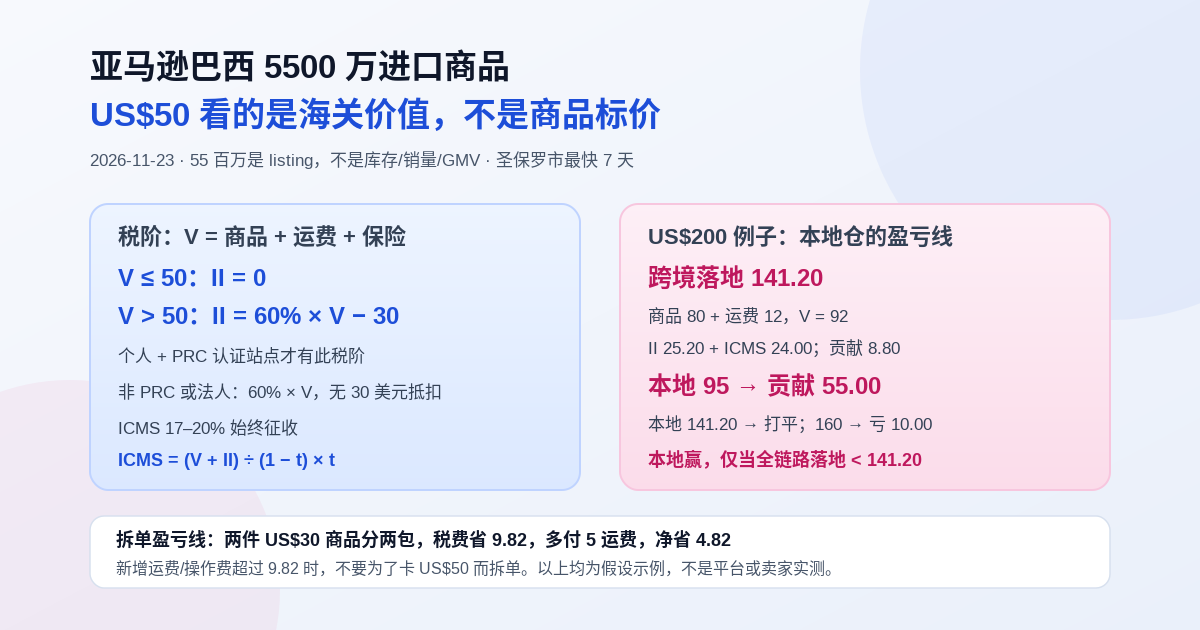
Brazil's simplified tax regime (RTS) applies to international parcels up to US$3,000. The customs value V is goods plus freight plus insurance, not the product sticker price. For an individual buying on a site certified under Receita Federal's Remessa Conforme (PRC) programme: when V is at or below US$50, import duty (II) is zero; above US$50, II = 60% × V − US$30. For a non-PRC site, or a legal-entity buyer, II = 60% × V from the first dollar, with no US$30 deduction.
ICMS always applies, at 17% or 20%, using the 'por dentro' formula: ICMS = (V + II) ÷ (1 − t) × t. Landed cost = V + II + ICMS. The formula explains two things: first, the ICMS base includes the import duty, so taxes compound; second, the US$50 line looks at V, not the product price, so freight and insurance can push a US$49.99 item over the line.
Receita Federal's rule page (updated 14 September 2026) states that for V from US$50.01 to US$3,000, II = 60% × V − US$30; the PRC exemption applies to an individual buying on a certified site; a legal entity or a non-certified site gets neither the US$50 zero rate nor the US$30 deduction. The calculations below use this rule, with ICMS at 17% as the base case and 20% as a sensitivity.
Three: what Amazon disclosed and what it did not
What can be checked: the 23 November announcement exists; the 55 million, +50%, 4 million, 40%, 22% and seven-day figures come from Amazon and were reported separately by two Brazilian outlets; Amazon-sold imports show tax-inclusive prices while third-party international sellers show an estimate; and Receita Federal's RTS rules and ICMS formula are directly readable.
What cannot be checked: Amazon did not disclose GMV, units, seller count, category mix, conversion, return rate or fees for the international selection. How much of the 55 million is an extension of Amazon US inventory versus stock in Brazil; how much of the +50% came from the tax change versus catalogue expansion; the baseline days behind 40% and 22%; and delivery times outside São Paulo. This article does not turn catalogue size into demand, and does not turn a tax-inclusive display into 'the seller has no tax work'.
There is also a timing risk. Anti/Hype reports that the 2027 tax reform may make sub-US$50 imports pay federal CBS again. This article found no primary legal text, so it does not put that change into any calculation; it lists it as a policy variable to watch. If it happens, the direct-mail tax burden here would be understated and the decision must be recalculated.
Local stock also cannot borrow the RTS. A Brazilian company's commercial import is not normally taxed under the retail-parcel RTS; this article does not apply the RTS 60% to local stock, and treats the all-in local landed cost as an assumption that the reader must replace with actual customs, inbound, storage and delivery costs.
Four: a bigger catalogue does not automatically sell better
Countercase one: Much of the 55 million is a cross-border extension of Amazon US inventory; books, apparel, vinyl and home utensils are standardized, price-transparent goods, so a new seller without differentiation enters a price war. Countercase two: seven days covers São Paulo city only; other states and remote areas are slower, and a local seller's one-to-two-day delivery can win conversion. Countercase three: the US$50 exemption applies only to an individual buying on a PRC-certified site; if a seller cuts the sticker price to US$50 but ignores freight and insurance, the customs value can still exceed US$50 and the tax does not disappear. Countercase four: local stock is not automatically cheaper; it ties up inventory cash, carries storage and returns, and faces its own import tax under the commercial regime; in the US$200 example below, local stock earns less than direct mail once its all-in landed cost exceeds US$141.20. Countercase five: treating a possible 2027 CBS change as a long-term moat turns a policy window into a structural advantage.
Five: four calculable scenarios
All scenarios are illustrative, not Amazon data, any seller's actuals or an NWi measurement. Currency is USD, insurance is zero, and marketplace commission, ads, returns, FX and payment fees are excluded; ICMS is 17% in the base case with 20% as a sensitivity. Formulas: V = goods + freight + insurance; PRC individual II = 0 when V ≤ 50, otherwise 60% × V − 30; non-PRC/legal entity II = 60% × V; ICMS = (V + II) ÷ (1 − t) × t; landed cost = V + II + ICMS.
| Scenario | Assumption | Calculation | Result |
|---|---|---|---|
| A | US$30 goods + US$5 freight; PRC individual vs non-PRC; ICMS 17% | PRC: V = 35, II = 0, ICMS = 7.17, landed 42.17; non-PRC: II = 21, ICMS = 11.47, landed 67.47 | Difference 25.30; the US$35 parcel lands near US$67 outside PRC |
| B | US$80 goods + US$10 freight; PRC individual; ICMS 17% | V = 90; II = 24; ICMS = 23.35; landed 137.35 | Total tax 47.35, or 52.6% of V; effective II rate 26.7% |
| C | US$49.99 goods + US$5 freight; PRC individual; ICMS 17% | V = 54.99; II = 2.99; ICMS = 11.88; landed 69.86 | Landed 9.60 above the V = 50.01 case; the tax gap is 4.62, not a US$30 cliff |
| D | US$200 price; cross-border V = 92; local all-in landed 95; fee 15%, ads 10% | Cross-border: II = 25.20, ICMS = 24.00, landed 141.20; contribution 8.80; local contribution 55.00 | Local break-even 141.20; at 95 it earns 46.20 more, at 160 it loses 10.00 |
Scenario A: US$35 customs value, PRC versus non-PRC
Goods US$30, freight US$5, zero insurance; individual buyer; ICMS 17%; PRC-certified site versus non-PRC site; marketplace fees and ads excluded.
PRC: V = 35, II = 0, ICMS = 35 ÷ 0.83 × 0.17 = 7.17, landed 42.17. Non-PRC: II = 60% × 35 = 21, ICMS = 56 ÷ 0.83 × 0.17 = 11.47, landed 67.47. Difference 25.30.
Confirm the store is on a PRC-certified flow first; if it is not, a US$35 parcel lands near US$67 and the direct-mail price advantage may disappear, so change the flow or the product rather than cutting the sticker price further.
Scenario B: US$90 customs value, 60% is not a flat multiplier
Goods US$80, freight US$10, zero insurance; individual buyer; PRC-certified; ICMS 17%; marketplace fees and ads excluded.
V = 90; II = 60% × 90 − 30 = 24; ICMS = 114 ÷ 0.83 × 0.17 = 23.35; total tax 47.35, or 52.6% of V; effective II rate 26.7%; landed 137.35.
Do not apply 60% flat to high-ticket goods; the US$30 deduction lowers the effective II rate to 26.7%, but ICMS pushes total taxes above half of goods plus freight, so price from landed cost, not product cost.
Scenario C: US$49.99 plus US$5, the US$50 line is not a cliff
Goods US$49.99, freight US$5, zero insurance; individual buyer; PRC-certified; ICMS 17%; compare V = 54.99 with V = 50.01.
V = 54.99: II = 2.99, ICMS = 57.984 ÷ 0.83 × 0.17 = 11.88, landed 69.86. V = 50.01: II = 0.006, ICMS = 50.016 ÷ 0.83 × 0.17 = 10.24, landed 60.26. The landed difference is 9.60, of which 4.62 is tax.
Do not omit freight when trying to stay under US$50, and do not assume a small overshoot triggers a penalty. Manage V (goods + freight + insurance) and the ICMS base; if goods plus freight already exceed US$50, cutting the sticker price does nothing.
Scenario D: US$200 price, the direct-mail versus local-stock break-even
Price US$200; direct mail: goods US$80, freight US$12, zero insurance, V = 92; local: all-in landed cost US$95 (an assumption covering commercial import, inbound, storage and local delivery); marketplace fee 15%, ads 10%; returns and payment fees excluded.
Direct mail: II = 25.20, ICMS = 117.2 ÷ 0.83 × 0.17 = 24.00, landed 141.20; contribution = 200 − 141.20 − 30 − 20 = 8.80 (4.4%). Local: 200 − 95 − 30 − 20 = 55 (27.5%). The local break-even landed cost is 141.20; at 160 the contribution is −10.00.
Local stock earns more only when its all-in landed cost is below the direct-mail landed cost; at US$95 it wins clearly, at US$141.20 it ties, at US$160 it loses. Calculate your own customs, inbound, storage and delivery before committing inventory; do not substitute 'local is faster' for a contribution calculation.
Sensitivity: at 20% ICMS, cross-border landed cost is 146.50 and contribution is 3.50; local stock at 95 still earns 51.50 more, but the local break-even rises to 146.50.
Splitting an order does not always save tax. Two US$30 items with US$5 freight each: as one parcel, V = 60 + 5 = 65, II = 9, ICMS = 74 ÷ 0.83 × 0.17 = 15.16, total tax 24.16, landed 89.16; as two parcels, each V = 35, II = 0, ICMS = 7.17, total tax 14.34, landed 84.34. Splitting saves 9.82 in tax but adds 5 in freight, for a net saving of 4.82; if the extra freight and handling exceed 9.82, splitting costs more.
Recheck: A's PRC 35 + 0 + 7.1687 = 42.1687; B's 90 + 24 + 23.3494 = 137.3494; C's 54.99 + 2.994 + 11.8762 = 69.8602; D's 92 + 25.2 + 24.0048 = 141.2048, and 200 − 141.2048 − 30 − 20 = 8.7952.
Six: which sellers, which fields, when to act
Segment by SKU, not by store. Cross-border international catalogue first fits light, low-ticket SKUs whose customs value can stay near US$50, with differentiation, no local installation or after-sales, and controllable returns. Local stock fits high-ticket, bulky, time-sensitive, returns-heavy or service-heavy SKUs, and SKUs whose commercial import can push all-in landed cost below the direct-mail landed cost. Neither fits SKUs far above US$50 with thin contribution, commodity price wars, or categories that need local certification the seller does not yet have.
- Calculate V for every SKU: goods + freight + insurance, not the sticker price; use the worst-case freight and insurance.
- Confirm the route: individual or legal-entity buyer, and whether the site is PRC-certified; only an individual on a PRC site gets the US$50 zero rate and the US$30 deduction, while a legal entity or non-PRC site pays 60% from the first dollar.
- Build two landed costs: cross-border from V, II and ICMS; local from actual commercial import, inbound, storage and local delivery, without applying the RTS 60%.
- Compare on one contribution table: price − landed cost − marketplace fee − ads − returns/payment fees; the local break-even is the cross-border landed cost.
- Test three to five light SKUs first, recording the checkout tax estimate versus the actual charge, state delivery promises, conversion, returns and contribution for at least four weeks.
- Check splitting: split only when the added freight and handling are below the tax saving; in the two US$30 items example, the tax saving is 9.82 and the net saving is 4.82 after an extra 5 in freight.
- Before Black Friday and Cyber Monday, check bundles and thresholds: a bundle can push V over US$50 and change the tax; do not discover it at checkout.
- Before committing local inventory, calculate inventory turns and the cash cycle; if turns exceed 90 days or contribution is below target, do not use 'stock first, optimise later' to justify the purchase.
Fields to watch: per order, V, II, ICMS, state rate, total tax, landed cost, price, marketplace fee, ads, return cost and contribution; per listing, seller type (Amazon-sold or third-party international), tax display (included or estimate), state delivery promise, actual delivery days, conversion and return rate; for local stock, all-in landed cost, inbound, storage, local delivery, inventory turns and cash cycle.
If the actual checkout tax differs from the estimate by more than 10%, pause that SKU's direct-mail test; if contribution stays below target for four weeks, change price, bundle or route; if returns or compliance cost exceeds contribution, stop the SKU; if local inventory turns exceed 90 days, stop replenishment.
If you want to put category, brand and price-band data next to your own order contribution table, start with NWi CrossborderGo and its platform and site coverage; to connect your customs, inbound and returns fields into a fixed reconciliation process, book a demo. The method here does not depend on a specific tool.
Seven: limitations and unknowns
This article did not access Amazon Brazil's seller back end and has no NWi measurement of Amazon Brazil. The 55 million, +50%, 4 million, 40%, 22% and seven-day figures are Amazon's own, relayed by two outlets, and are not independent measurements. Amazon did not disclose GMV, units, seller count, category mix, conversion, return rate or fees for the international selection.
The tax treatment is simplified: ICMS at 17% as the base case and 20% as a sensitivity; the actual rate depends on the buyer's state and the product; II uses the RTS 60%−30 rule and ignores HS-code rates, special regimes, quotas and state differences; local commercial import is not quantified and enters only as an assumed all-in landed cost.
Scenario D's local landed cost of US$95, the 15% marketplace fee, the 10% ad rate and zero returns are assumptions; FX, payment fees, return handling, shrinkage and compliance costs are excluded. The split example compares only tax and freight, not labour or inbound handling. The 2027 CBS change has no primary legal text and is excluded from the calculations.
This article is not tax, legal or marketplace-operations advice; confirm rates, PRC eligibility, fees and delivery promises with Receita Federal, Amazon's seller back end and your own invoices.
Eight: original analysis
First, it separates the 55 million into listings, inventory, units and GMV, and shows that catalogue size is not demand; the +50% has no absolute base and cannot be used to infer any seller's growth.
Second, it shows that the US$50 line is not a cliff: as V moves from 50.00 to 50.01, II rises by only 0.006; the common error is treating the sticker price as the customs value. The US$49.99 + US$5 case gives V = 54.99, II = 2.99 and landed 69.86, not 'just under the line'.
Third, it puts direct mail and local stock on one contribution table and identifies the local break-even as the direct-mail landed cost: in the US$200 example, local stock wins only below US$141.20; at US$95 it earns 46.20 more, at US$160 it loses 10.00.
Fourth, it gives the freight break-even for splitting an order: two US$30 items split into two parcels save 9.82 in tax but add 5 in freight, for a net 4.82; do not split when the extra freight exceeds 9.82. This turns 'stay under US$50' from a slogan into a calculable action.
Nine: sources
- 1. Receita Federal, 'Quais são os impostos?' (primary; published 16 May 2024, updated 14 September 2026; US$50 threshold, 60%−30, 60% for non-PRC or legal entities, ICMS 17–20% and the 'por dentro' formula): gov.br/receitafederal/... , accessed 26 November 2026.
- 2. Mercado&Consumo, 'Amazon amplia oferta de importados e reduz prazo de entrega em 40%' (secondary; 23 November 2026; 55 million, 4 million, +50%, 40%/22%, seven days, tax-inclusive and estimate): mercadoeconsumo.com.br/23/11/2026/ecom... , accessed 26 November 2026.
- 3. Anti/Hype, 'Amazon Brasil já vende mais de 55 milhões de produtos importados' (secondary; 23 November 2026; listing versus inventory, units and GMV; seven days only in São Paulo city; 2027 CBS risk): antihype.com.br/c/negocios/amaz... , accessed 26 November 2026.
Data basis: the Amazon Brasil figures announced on 23 November 2026 (55 million listings, +50%, 4 million new items, 40%/22%, seven days) come from separate reports by Mercado&Consumo and Anti/Hype and are labelled as company-reported, not independent measurements; the Brazilian import duty and ICMS rules come from Receita Federal's 'Quais são os impostos?' page (updated 14 September 2026), including the US$50 threshold, 60%−30, 60% for non-PRC or legal entities, and the 17–20% ICMS 'por dentro' formula; local landed cost, marketplace fee, ads, returns and FX are explicitly labelled assumptions, not any seller's invoices. The four scenarios use V = goods + freight + insurance, II, ICMS, landed cost and contribution, recalculated line by line.
This article was prepared with automated research assistance from the public sources listed at the end and has not been manually reviewed. It is not tax, legal or marketplace-operations advice; confirm rates, PRC eligibility, fees, delivery promises and seller data with Receita Federal, Amazon's official pages and your own invoices.