
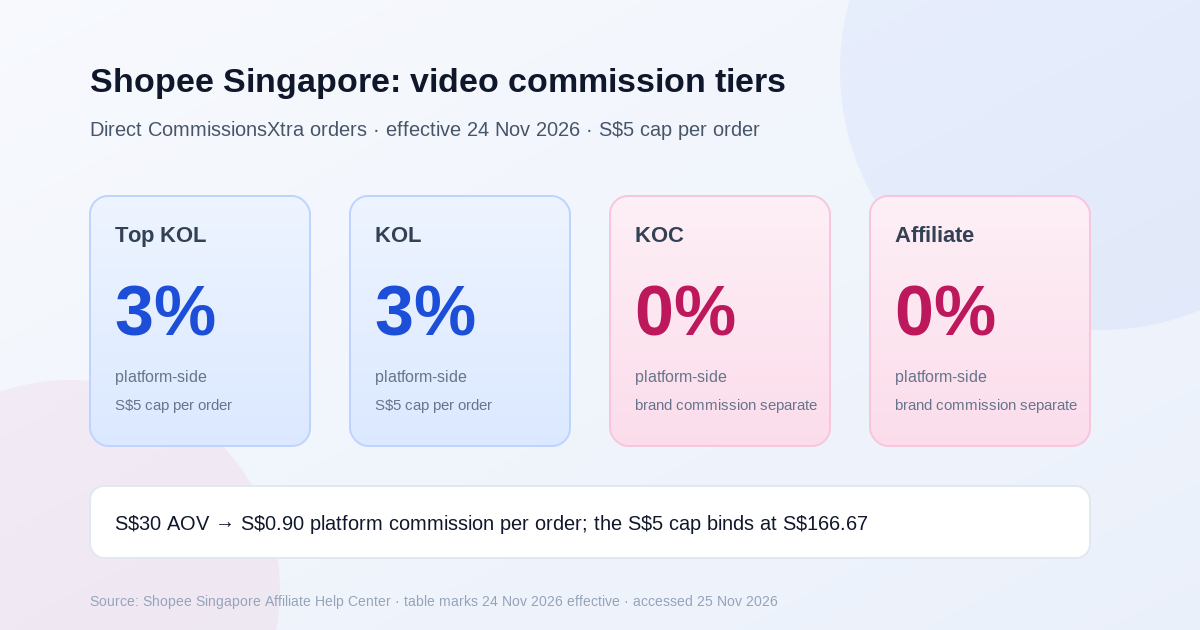
If you run Shopee Video campaigns with KOC or ordinary affiliate creators in Singapore, the real decision is which of your orders sit in the 0% cohort, how much platform commission you lose per order, and whether to top up brand commission. Shopee Singapore's affiliate help centre now lists Shopee Video direct CommissionsXtra orders at 3% for Top KOL/KOL and 0% for KOC/Affiliate, both capped at S$5 per order; two other official pages in the same help centre still show 5% or split the rate by AMS/non-AMS product. This article treats the dated commission table as the primary change record and uses the other pages only to mark the evidence boundary, not as independent confirmation.
1. What changed, for which tiers, and from when
From 24 November 2026, the Shopee Singapore affiliate help centre's Commissions Structure (W.e.f. 2 January 2026) marks Shopee Video direct CommissionsXtra orders at 3% for Top KOL and KOL, and 0% for KOC and Affiliate, both capped at S$5 per order. The page tags the 0% cells [UPDATED!] and adds "*With effect from 24th Nov 2026". It does not show a publication date, say who was notified, or preserve the previous KOC/Affiliate rate.
Reading the table as "Shopee Video commission is now zero" misses two qualifiers. First, the 0% sits only in the KOC and Affiliate columns; Top KOL and KOL are listed at 3%. Second, the row covers Direct CommissionsXtra orders only; non-CommissionsXtra orders are not in that row. The page also does not say whether the 0% is permanent, a temporary subsidy change, or limited to certain products or creators.
| Channel | Order type | Top KOL | KOL | KOC | Affiliate |
|---|---|---|---|---|---|
| Shopee Video | Direct CommissionsXtra | 3% | 3% | 0%* | 0%* |
| Shopee Live | Direct CommissionsXtra | 10% | 10% | 10% | 10% |
| Social Media | Direct CommissionsXtra | 7% | 6% | 6% | 5% |
| Social Media | Direct Non-CommissionsXtra | Up to 4% | 3% | 3% | 2% |
| Brand Commissions | Direct CommissionsXtra | Up to 40% (uncapped) | — | — | — |
| Brand Commissions | Indirect CommissionsXtra | Up to 12% (uncapped) | — | — | — |
Shopee Video, Shopee Live and Social Media Shopee Commissions are all capped at S$5 per order; Brand Commissions are uncapped. *The 0% applies from 24 November 2026.
The table is an affiliate-facing help page, not a seller contract. The rate, CommissionsXtra settings and settlement rules a seller sees in the seller centre may differ; verify in the Affiliate Portal or contract before putting 0% into a budget.
Two other official pages in the same help centre give different numbers: the Introduction to SAP still lists Shopee Video at 5% across all tiers, while the Creator Levelling page describes video commission by product type — AMS Products 3%, Non-AMS Products 0% — across Lv0–Lv2. None of the three pages explains how they relate.
2. Mechanism: platform commission, brand commission and the S$5 cap
Shopee Commissions are platform-side; their rates are set by Shopee; Brand Commissions (CommissionsXtra) are set by the seller; the 0% changes the platform-side part, not brand commission. The table adds the two into Total Commissions (up to 50%): platform commission up to 10%, brand commission up to 40%. If a seller wants KOC/affiliate creators to keep the same take-home pay, the seller has to fill the gap with brand commission.
A Direct Order is a purchase from the same shop after a customer clicks an affiliate link; an Indirect Order is a purchase from a different shop. Brand commission is capped at 40% on direct orders and 12% on indirect orders (30% of the seller-set rate). A "3 percentage point top-up" therefore applies to direct orders; indirect orders need a different calculation and have a lower ceiling.
The S$5 per-order cap makes the loss regressive. At 3%, a S$30 order loses min(0.90, 5) = S$0.90; a S$80 order loses min(2.40, 5) = S$2.40; the cap binds at S$166.67; above that, the effective rate falls as AOV rises (S$300 loses S$5, or 1.67%). Low-AOV orders lose a larger share; high-AOV orders have their absolute loss capped.
For a seller, the direct effect is that KOC/affiliate creators earn 0 platform video commission unless Shopee runs a separate campaign; without a seller-funded brand commission, their video income is only the brand-commission part. Whether to top up, and by how much, depends on the incremental contribution of video orders, not on the 0% headline.
3. Evidence boundary: why three official pages disagree
This article treats the dated commission table (191914) as the primary change record; the other two official pages mark the evidence boundary and are not independent confirmation. The differences could reflect different programmes or product eligibility (AMS vs non-AMS), stale values left by different update cycles, or pages aimed at different roles (affiliates vs sellers). Without a Shopee announcement or seller-centre confirmation, there is no basis for choosing one explanation.
The equivalent Malaysia help page still lists Shopee Video at 3% (L2), last updated 25 September 2026. That is a different market; it neither proves nor disproves the Singapore 0%. The Singapore rate also cannot be extended to Indonesia, the Philippines, Thailand, Vietnam or Taiwan.
Three data sets are missing: creators' income mix (platform vs brand commission), video order volume and conversion, and creator activity or churn after 0%. Without them, any claim that "creators will leave" or "video is dead" is an assumption.
4. Recomputable analysis: two seller scenarios
The order volumes, AOV, contribution and incremental share below are hypothetical examples, not Shopee data or NWi measurements; the only page-derived numbers are the rates, the S$5 cap and the effective date. Formulas: platform commission per order = min(rate × AOV, S$5); monthly top-up cost = orders × loss per order; break-even incremental orders = top-up cost ÷ contribution per order.
Scenario A: 1,000 KOC/affiliate video orders at S$30 AOV (hypothetical)
Assume 1,000 Shopee Video direct CommissionsXtra orders a month, all from KOC/affiliate creators, AOV S$30, brand commission 10%, an assumed removed platform commission of 3%, contribution of S$6 per order, and 15% incremental orders; ignore returns, taxes and ads.
At 3% and the S$5 cap, platform commission per order = min(30 × 3%, 5) = S$0.90, so the monthly loss is 1,000 × 0.90 = S$900. To restore creator earnings with 3 percentage points of brand commission, the monthly cost is also S$900. Incremental contribution = 150 × 6 = S$900, exactly break-even.
If a four-week test shows an incremental order share of 15% or more, the top-up does not lose money; below 15%, do not top up — let video commission fall or move the budget to Live.
Scenario B: 300 video orders, 60% KOC/affiliate, S$120 AOV (hypothetical)
Assume 300 video direct CommissionsXtra orders a month: 180 from KOC/affiliate and 120 from Top KOL/KOL; AOV S$120, contribution S$20 per order, and 10% of the KOC/affiliate orders incremental; ignore returns, taxes and ads.
KOC/affiliate loss per order = min(120 × 3%, 5) = S$3.60, so the monthly loss is 180 × 3.60 = S$648. Top KOL/KOL are listed at 3% and are not counted. A 10% incremental share = 18 orders × 20 = S$360, below S$648; break-even requires 648 ÷ 20 = 32.4, or at least 33 incremental orders (18.3% of 180).
Do not top up the full 3 percentage points; test 1 percentage point (S$216 a month) or move the budget to Live, and stop the top-up if the four-week incremental total is below 33 orders.
Sensitivity: at S$200 AOV, 3% hits the S$5 cap, so the loss per order rises from S$3.60 to S$5 but falls from 3.0% to 2.5% of AOV; at S$20 AOV, the loss is only S$0.60, still 3% of AOV. Whether a top-up pays depends on contribution per incremental order, not on the loss ratio.
5. Counter-cases and alternative explanations
Creators may already earn most of their income from brand commission; the 3% platform payment may be a small bonus, so 0% may not cause churn. Second, video may be upper-funnel while the seller measures it with last-click attribution; the channel then looks worse than it is, and cutting it may reduce new-customer acquisition. Third, Shopee Live's platform commission is 10% (S$5 cap) and is set by Shopee; if Live converts better or costs less per creator, moving budget to Live may be cheaper than topping up video.
Fourth, the 0% may cover only some products or creators (for example, non-AMS products or specific tiers), so the affected order share may be much lower than "all video orders". Fifth, a seller with no KOC/affiliate video orders is not directly affected; it should watch whether the 3% for Top KOL/KOL changes, and the Live/social rates.
6. Action plan: verify the portal first, then run a four-week test
This week, do three things. First, export at least 90 days of affiliate orders and group them by creator tier (Top KOL/KOL/KOC/Affiliate), AMS/CommissionsXtra status, direct/indirect order, AOV, platform commission per order and brand commission. Second, verify the actual rate in the Affiliate Portal or contract. Third, split KOC/affiliate video creators into a test group and a control group. Then run a four-week capped test: add only 1–3 percentage points of brand commission to the test group, capped at "loss per order × orders", not the full 3 points at once. Compare incremental orders and contribution between the test and control groups each week. Stop if incremental contribution is below the top-up cost; move budget to Live if Live's cost per incremental order is lower; if creator activity does not change, the 0% is not changing behaviour and no top-up is needed.
Do not reprice products or cut the entire video channel from the 0% headline. Confirm the affected cohort first, then decide with incremental data; for most sellers, the first step is verification, not a price change.
7. Limitations and uncertainties
Five unknowns could change the conclusion: the scope of the 0% (KOC/Affiliate only, or other tiers/products); the previous KOC/Affiliate rate (the page does not preserve it, and the 3% used here is an assumption); the rate applied to orders placed before 24 November but settled after; creators' income mix and the incrementality of video orders; and whether the 0% is permanent, temporary or a test. Recompute with the portal rate, order-level data and four-week test results.
This article discusses the public wording of Shopee Singapore's affiliate commission page. It does not mean NWi provides live commission, creator data or settlement services for Shopee Singapore; the applicable rate, product eligibility and settlement are governed by Shopee's seller centre, contract and latest notices.
Method and disclosure
Data basis: the Shopee Video rates, creator tiers, S$5 cap and 24 November 2026 effective date come from the Shopee Singapore affiliate help centre commission table (accessed 25 November 2026); the SAP introduction and Creator Levelling pages from the same help centre are used only to compare wording; the Malaysia page is used only to mark the market boundary. Order volumes, AOV, contribution and incremental shares are hypothetical examples, not Shopee data or NWi measurements.
The original increment is to split "Shopee Video commission is zero" into three layers — which creator tier, which order/product type, and the per-order loss after the S$5 cap — and then use incremental-order break-even to decide whether to top up brand commission.
This article was prepared with the assistance of an automated research workflow and is based on the public sources listed at the end; it has not been reviewed by a human editor.
To put platform, shop, product and creator orders into one verification table, see [NWi CrossborderGo](/product/) for global overview, shop/product research and custom markets; for selection and operations tools, see [NWi Operations](/products/zhiying/); for data access, see [MCP](/mcp/); for a demo, see [Demo and enquiry](/demo/). The [Cross-border Agent](/page/agent.html)'s creator advisor currently covers VN/ID/MY and its review insights are limited to selected brands, so do not apply a Singapore conclusion directly. For the platform analysis framework, see [Shopee Data Analysis](/article/nwi-2026-1118-shopee-data-analysis.html); for profit accounting, see [the five-step subtraction](/article/nwi-2026-1118-profit-calculation.html).
Reference sources
- 1. Shopee Singapore Affiliate Help Center, "Commissions Structure (W.e.f. 2 January 2026)" (primary: rates, tiers, S$5 cap and the 24 November 2026 effective date): view original, accessed 25 November 2026.
- 2. Shopee Singapore Help Center, "Introduction to Shopee Affiliate Program (SAP)" (primary page, wording comparison: still lists Shopee Video at 5%): view original, accessed 25 November 2026.
- 3. Shopee Singapore Help Center, "Guidelines on Creator Levelling as a Shopee Video & Live Creator" (primary page, wording comparison: AMS 3%, non-AMS 0%): view original, accessed 25 November 2026.
- 4. Shopee Malaysia Help Center, "How to Understand Shopee Live & Shopee Video Commission Rates" (market-boundary comparison: L2 3%, last updated 25 September 2026): view original, accessed 25 November 2026.
- Note: sources 2, 3 and 4 are used only to compare wording or mark the market boundary; they are not independent confirmation of the Singapore change.