
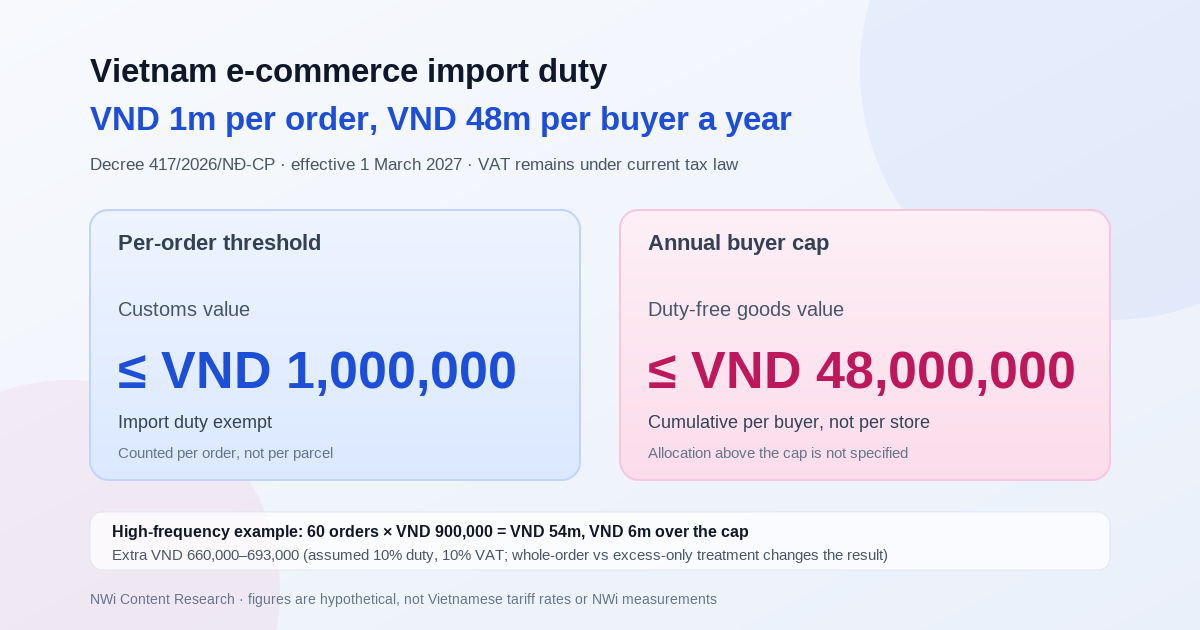
If you sell cross-border parcels on Shopee, Lazada or TikTok Shop Vietnam, the decision from 1 March 2027 is not a simple 'duty-free under VND 1 million' headline: it depends on the customs value per order, the same buyer's annual duty-free total, and who files the Vietnamese customs declaration. Decree 417/2026/NĐ-CP (signed on 20 November 2026 and published on 23 November) exempts imports through e-commerce platforms from import duty when the customs value is VND 1,000,000 or less per order, but caps each organisation or individual buyer's duty-free goods at VND 48,000,000 a year. The decree also says VAT and other taxes remain under current tax law, so 'duty-free' is not 'tax-free'.
1. What the decree changes: a per-order threshold, an annual cap and two channels
Start with the legal text. Article 12(1) exempts imported goods through e-commerce platforms from import duty when the customs value is VND 1,000,000 or less per order; the same clause immediately caps the exemption at VND 48,000,000 of goods per organisation or individual buyer per year. Article 12(2) sends VAT and other taxes back to current tax law; Article 12(3) says e-commerce imports sent by postal or express delivery follow this Article and no longer follow Decree 134/2016/NĐ-CP (as amended by Decrees 18/2021/NĐ-CP and 182/2025/NĐ-CP). Article 30 sets the effective date at 1 March 2027.
That means VND 1 million is the per-order threshold and VND 48 million is the per-buyer annual ceiling; both must be met. A buyer who places 12 orders of VND 900,000 a year spends VND 10.8 million and stays within the cap. A buyer who places 60 orders of VND 900,000 spends VND 54 million, exceeding the annual cap by VND 6 million. The decree does not state whether the whole over-cap order loses the exemption or only the excess is taxed; that is an implementation question to confirm with customs or the platform before you rely on it.
The second change is channel-specific. Before the decree, Vietnam had a low-value exemption for postal and express imports: Article 29(2) of Decree 134/2016/NĐ-CP exempted imported goods sent by postal or express delivery from import duty when the customs value was VND 1 million or less, or the tax payable was VND 100,000 or less; if either threshold was exceeded, the whole shipment paid duty. Non-postal, non-express e-commerce imports (for example, platform-owned logistics or border-warehouse direct dispatch) did not qualify for that low-value exemption and followed general import rules. The new decree brings 'imports through e-commerce platforms' under Article 12: duty-free up to VND 1 million per order, capped at VND 48 million per buyer per year; postal and express channels no longer follow the old Decree 134 rule.
One detail easily lost in headlines: the old rule had two alternative thresholds, 'value of VND 1 million or less' and 'tax payable of VND 100,000 or less'. Article 12(1) of the new decree only states the VND 1 million customs-value threshold; it does not carry the VND 100,000 tax alternative into the text. For a low-duty product whose order value is slightly above VND 1 million, that could mean an order that was exempt under the old rule is no longer exempt. Because the decree has no transitional clause, treat this as an implementation question to confirm with customs, not as a settled tax increase.
| Channel / order | Before 1 March 2027 | From 1 March 2027 | Main impact |
|---|---|---|---|
| Postal/express, ≤ VND 1m per order | Import duty exempt under Article 29 of Decree 134/2016; VAT under current law | Import duty exempt, but counted against the VND 48m annual buyer cap | High-frequency buyers may hit the cap; the per-order value threshold is broadly unchanged |
| E-commerce platform import, not postal/express, ≤ VND 1m per order | Not eligible for the low-value postal/express exemption; general import rules | Import duty exempt, counted against the annual cap | Some direct parcels gain the exemption, but order data and identity checks are required |
| Order > VND 1m | General tax rules; postal/express goods with tax payable of VND 100,000 or less could still be duty-exempt under the old rule | General rules; Article 12 keeps only the VND 1m per-order value threshold | More data and declaration requirements; whether the old tax alternative survives is unconfirmed |
| Local warehouse / general trade import | Import duty and VAT under general trade rules | The e-commerce low-value exemption does not apply; general trade rules | The exemption is not a local-warehouse subsidy |
2. The mechanism: order data, identity checks and who declares
The decree does more than change a tax line; it turns the e-commerce import declaration into a data process. Article 4 lists the customs declarant: the e-commerce platform owner, a customs agent, a transport enterprise, a bonded-warehouse enterprise, or a postal/international express enterprise. If the platform owner is a foreign trader without a presence in Vietnam, it must use a Vietnamese customs agent or authorise a postal/international express enterprise in Vietnam to handle the customs procedure.
Article 18 requires the platform owner or its authorised provider to send order information to the e-commerce customs data system before the transport arrives in Vietnam; the system checks it and returns an acceptance number within 30 minutes; order information can be corrected before declaration; and the system cancels the order information after three months if no goods are actually exported or imported. Article 19 requires transport enterprises to provide transport information. Article 7 requires the system to verify the declarant, seller and buyer identity, connect to the National Population Database, business-registration and tax databases, and track duty-free imports by organisation and individual.
This explains why 'price ≤ VND 1 million' is not the only condition. If the buyer's identity does not match the National Population Database, if the order information does not match the transport information, or if the goods are not Group 1, the system may refuse registration or route the case to manual processing. Group 1 covers goods that do not require licences or conditions, are not subject to specialised inspection, and are not subject to anti-dumping, countervailing or safeguard measures; everything else is Group 2 and follows the general customs system. For goods that require a licence or quarantine, even an order below VND 1 million should not be read as 'licence-free' or 'inspection-free'; Article 11(2) sets exceptions to the conditions and specialised-inspection exemption for duty-free goods.
The other key is the declarant. A cross-border seller is usually not the Vietnamese customs declarant; the platform, customs agent or logistics provider is. But the declaration is built from order data, and liability follows the chain: Article 29 assigns responsibilities to the platform, transport enterprise, declarant, buyer and seller; a false declaration can lead to a supplementary declaration, additional tax, administrative penalties or, if there are signs of a crime, an investigation. The seller's job is to keep the product name, HS code, origin, quantity, weight and declared value consistent with the order, and to write into the contract who declares and who bears additional tax and penalties.
3. Worked analysis: three buyer scenarios
All numbers below are hypothetical examples, not Vietnam's customs tariff and not NWi measurements. The only inputs from the public text are 'VND 1 million per order', 'VND 48 million per buyer per year' and 'VAT under current law'; the 10% duty, 10% VAT, contribution rates, return freight and payment fees are examples. Replace them with your own data to recompute.
Scenario A: a low-frequency buyer, 12 orders × VND 900,000 (hypothetical)
Assume one buyer places 12 orders a year at VND 900,000 customs value each, for VND 10.8 million in total; import duty is 10%, VAT is 10%, all orders are within the annual cap, and freight, insurance, excise tax and platform fees are ignored.
Each order is exempt from import duty; VAT is VND 900,000 × 10% = VND 90,000, or VND 1.08 million for the year. If the order lost the exemption, duty would be VND 90,000 and VAT would be (VND 900,000 + VND 90,000) × 10% = VND 99,000, for VND 189,000 in total, or VND 99,000 more than the exempt case — 11% of the goods value.
This buyer's annual total is VND 10.8 million, leaving VND 37.2 million of the VND 48 million cap, so no duty-driven repricing is needed; still check that the platform settlement does not treat 'duty-free' as 'VAT-free', and keep each order's declaration number and tax amount.
Scenario B: a high-frequency buyer, 60 orders × VND 900,000 (hypothetical)
Assume the same buyer places 60 orders a year at VND 900,000 each, for VND 54 million, exceeding the annual cap by VND 6 million; import duty is 10%, VAT is 10%, contribution margins are 20% and 8%, and other costs are ignored.
If the quota is used in order sequence and the whole order loses the exemption once the cap is crossed, the last seven orders (VND 6.3 million) are affected and the extra duty plus VAT is 7 × VND 99,000 = VND 693,000; if only the VND 6 million excess is taxed, the extra amount is about VND 660,000. At the upper bound, that is 1.28% of the buyer's annual GMV; at a 20% contribution margin it is 6.42% of contribution, and at 8% it is 16.04%.
For this buyer, a buffer of up to 1.5% of GMV (VND 810,000) covers the upper bound; beyond that, pass the cost to the buyer, cap the order value or steer the buyer to local stock, and do not make order splitting the main strategy.
| Assumed duty rate | Extra tax on the VND 6m excess (10% VAT) | Calculation |
|---|---|---|
| 0% | VND 0 | VND 6m × 0% × 1.1 |
| 5% | VND 330,000 | VND 6m × 5% × 1.1 |
| 10% | VND 660,000 | VND 6m × 10% × 1.1 |
| 20% | VND 1,320,000 | VND 6m × 20% × 1.1 |
Scenario C: splitting one VND 1.2 million order into two VND 600,000 orders (hypothetical)
Assume one genuine order has a customs value of VND 1.2 million and is split into two separate VND 600,000 orders; import duty is 10%, VAT is 10%, the second order adds VND 60,000 of freight and a 2% payment/processing fee on VND 600,000 (VND 12,000), and other costs are ignored.
Without splitting, duty is VND 120,000 and VAT is (VND 1.2 million + VND 120,000) × 10% = VND 132,000, for VND 252,000 in total. If two VND 600,000 orders both stay within the annual quota, each pays VND 60,000 of VAT, or VND 120,000 in total: VND 132,000 less tax, but VND 72,000 more in freight and payment fees, for a net saving of VND 60,000, or 5% of the goods value. If the buyer's annual quota is already exhausted, both VND 600,000 orders pay duty, the total tax is still VND 252,000, and the extra VND 72,000 turns the split into a VND 72,000 net loss.
Splitting has a positive return only when three conditions hold at the same time: two genuine independent orders, the buyer still has annual quota, and the added freight and payment fees are below VND 132,000; splitting one VND 1.2 million order into two parcels is not two orders, because the decree counts orders, not parcels, and the system matches order data with transport data.
4. Counter-cases: three situations that look like they need a change but may not
The first case is a low-ticket, low-repeat buyer. Under the old rules, postal or express orders of VND 1 million or less were already exempt from import duty; the new decree keeps the VND 1 million per-order value threshold, adds the VND 48 million annual total, and does not carry over the 'tax payable of VND 100,000 or less' alternative. A buyer who places only a few orders a year and stays below VND 48 million sees no change in the duty result; what changes is the data and identity requirement, not the duty bill.
The second case is non-postal, non-express e-commerce imports. Under the old rules these goods did not qualify for the low-value exemption and followed general import rules, paying duty and VAT; the new decree gives them a duty exemption of up to VND 1 million per order, still subject to the annual cap. For that channel, the new rule may be a reduction, not an increase. Treating 'Vietnam ends the low-value exemption' as a universal conclusion mixes the two channels.
The third case is local stock. A local warehouse imports under general trade, pays duty and VAT at import (VAT is usually creditable), and does not use the e-commerce low-value annual cap. The new decree gives local stock no extra subsidy; it clarifies the cross-border direct-parcel duty exemption and adds an annual ceiling. Whether local stock is cheaper depends on delivery speed, return rates, inventory turnover and capital tied up, not on this duty line alone. Treating 'move to local stock' as the answer for everyone will produce the wrong calculation.
There is also an alternative explanation: the decree's main purpose may be traceability rather than a tax increase. Article 7 requires the system to track duty-free imports by organisation and individual, Article 18 requires order data before transport arrives, and Article 29 allocates data-accuracy responsibility across the platform, logistics, declarant, buyer and seller. For compliant sellers, this raises the cost of 'grey' parcels; for sellers that rely on under-declaration, order splitting or incomplete identity data, the real cost increase is the compliance risk.
5. Action plan and stop conditions: a checklist before and after 1 March 2027
From now to 31 December 2026, do three things. First, group SKUs by customs value (example bands; adjust them to your price range): ≤ VND 1 million, VND 1–1.2 million, VND 1.2–2 million and > VND 2 million; pay special attention to bundles and multi-item sets near VND 1 million, because duty is assessed on the order's customs value, not the unit price. Second, pull the last 12 months of buyer-level annual value: median, 90th percentile and the share of buyers above VND 48 million; you can see only your own platform orders, not the buyer's purchases elsewhere, so this is a lower bound. Third, confirm in writing with each platform and logistics provider: who is the declarant, who sends the order data, how duty and VAT are listed in settlement, how the annual cap is accumulated, and whether returns and refunds reduce the quota.
By 31 January 2027, update the landed-cost model: separate duty, VAT, customs fees and a 'quota-risk buffer'; for SKUs at or below VND 1 million, test bundles or pricing that preserve gross margin; for SKUs above VND 1 million, do not assume the exemption. For high-frequency buyers, set a maximum absorption per order (example: 1.5% of GMV); beyond that, pass the cost through or cap the order value.
After 1 March 2027, reconcile the first four to eight weeks of settlement: record the order number, declaration number, customs value, HS code, duty, VAT, customs fee and settlement date for each order; separate 'duty', 'VAT' and 'fee' instead of looking at one total deduction. If an order of VND 1 million or less is charged duty while the buyer is still under the cap, use the order number and Article 12 to escalate to the platform or logistics provider. If the buyer is over the cap, apply the absorption limit you set in advance.
If a platform still cannot confirm the declarant and settlement treatment in writing by 31 January 2027, pause price changes and SKU expansion based on this decree; if a buyer cohort's absorbed duty and VAT exceed 2% of GMV for two consecutive months, stop absorbing and pass it through or cap the order; if orders of VND 1 million or less are charged duty and two billing cycles pass without resolution, move the SKU to a channel with a clearer declaration treatment or to local stock; if the buyer's quota is exhausted and the buyer refuses the pass-through, limit the order value or offer a local-stock option rather than splitting the order.
| Field | Definition | Use |
|---|---|---|
| Order number / declaration number | One-to-one link between the platform order and the customs declaration | Anchor for reconciliation and escalation |
| Customs value | Goods value + freight + insurance (CIF) | Test whether the order is ≤ VND 1m |
| HS code / origin | Product classification and origin | Duty rate and trade-remedy exposure |
| Duty / VAT | Separate lines in settlement | Distinguish duty exemption from VAT |
| Buyer's annual duty-free value | Platform/customs visibility | Test proximity to the VND 48m cap |
| Returns and refunds | Whether they reduce the annual quota | Not specified in the decree; confirm |
| Declarant | Platform / customs agent / logistics | Liability chain if data is wrong |
6. Unknowns and limitations
Six unknowns are most likely to change the conclusion. First, the decree does not state how the VND 48 million annual cap is allocated when an order crosses the threshold: whether the whole order loses the exemption or only the excess is taxed. Second, the decree does not state whether returns and refunds reduce the annual quota, or at what point they do so. Third, implementing guidance and data fields have not been published; as of 25 November 2026, we have read the decree text and official summaries, but not an operational instruction from the General Department of Customs. Fourth, VAT rates can be 5%, 10% or zero depending on the goods, with an 8% reduced rate for some goods in specific periods; the 10% used here is illustrative. Fifth, the seller cannot see the buyer's annual total on other platforms; the VND 48 million cap is buyer-level and, under the decree's system design, should accumulate across platforms, so the seller's own orders are only a lower bound. Sixth, the decree's scope depends on the definition of 'e-commerce platform' and 'platform owner' in other Vietnamese laws; whether foreign platforms implement on the same timetable will depend on their notices.
There is also an evidence boundary: this article read the official Government Portal summary, the Government decree catalogue page and LuatVietnam's full-text reproduction, and cross-checked VOV and Dân trí; the signed PDF is a 31-page scan and its body text could not be fully extracted in this review. For Articles 4, 7, 18 and 29, the details rely on LuatVietnam's full-text reproduction; for the Article 12 tax core, the official portal and VOV quotations are the basis. If the General Department of Customs publishes implementing guidance, that guidance should prevail.
This article does not predict enforcement intensity and does not turn 'duty-free' into 'VAT-free'. Treat it as a decision framework, not tax advice; confirm the classification, rates and declaration obligations with Vietnamese customs, the platform's Seller Center and your customs broker in writing.
7. Method and disclosure
Data basis: the signing date (20 November 2026), publication date (23 November 2026), effective date (1 March 2027), the VND 1 million per-order import-duty exemption, the VND 48 million annual buyer cap, the treatment of VAT and other taxes under current tax law, Article 4 declarants, Article 7 identity verification and tracking, Article 11 specialised-inspection exemptions, Article 18 order-data timing and Article 29 responsibilities come from the Vietnam Government Portal (baochinhphu.vn) report of 23 November 2026, the Government decree catalogue page (chinhphu.vn) and LuatVietnam's full-text reproduction; the old rule (postal/express goods of VND 1 million or less, or tax payable of VND 100,000 or less, exempt from import duty) comes from Article 29(2) of Decree 134/2016/NĐ-CP and the National Public Service Portal Q&A; the end of the VAT exemption for low-value express imports from 18 February 2025 comes from the Government Portal report on Decision 01/2025/QĐ-TTg; VOV and Dân trí are used only to cross-check the policy summary and the old-rule context. The 10% duty, 10% VAT, 12/60 orders, VND 900,000 order value, 20%/8% contribution margins, VND 60,000 second-order freight, 2% payment fee, 1.5% absorption buffer and 2% stop threshold are hypothetical examples, not Vietnamese tariff rates or NWi measurements.
The original increment is to split the 'VND 1 million duty-free' headline into five variables — the order-level threshold, the buyer-level annual cap, channel differences, the declaration data chain and the settlement fields — and to recompute three scenarios (low-frequency, high-frequency and split orders), instead of translating a policy headline into a single 'tax increase' or 'tax-free' conclusion.
This article was prepared with the assistance of an automated research workflow, based on the public sources listed at the end, and has not been manually reviewed.
Where the tools fit: NWi CrossborderGo lets you review markets, platforms, categories, brands, stores and products, including Vietnam, to assess price bands, competitive density and category opportunity; the exact sites, historical range and fields depend on the contract and account authorisation, and it does not file customs declarations or calculate your tax payable. To connect platform back-office or customs data to your own analysis workflow, see MCP data access; client compatibility, fields and permissions depend on the actual integration. To model your own category and buyer mix, request a walkthrough at /demo/. The Cross-border Agent can support expert research on Vietnam market entry, but review insights are limited to selected brands, the beauty innovation advisor is limited to beauty, and the creator advisor currently covers Vietnam, Indonesia and Malaysia; in NWi Operations, market numbers are third-party estimates.
8. Sources
- 1. Vietnam Government Portal, 'Thủ tục hải quan và chính sách thuế đối với hàng hóa xuất, nhập khẩu qua nền tảng thương mại điện tử' (primary: signing and publication dates, VND 1 million per-order import-duty exemption, VND 48 million annual buyer cap, VAT under current law, Group 1/Group 2 goods, declaration procedure): view source, published 2026-11-23, accessed 2026-11-25.
- 2. Vietnam Government decree catalogue, 'Nghị định số 417/2026/NĐ-CP' (primary: document number, signed 2026-11-20, effective 2027-03-01, signed PDF link): view source, accessed 2026-11-25.
- 3. LuatVietnam, 'Nghị định 417/2026/NĐ-CP quản lý hải quan hàng hóa xuất nhập khẩu thương mại điện tử' (legal database full-text reproduction: Article 4 declarants, Article 7 identity verification and tracking, Article 18 order-data timing, Article 29 responsibilities, Article 30 effective date): view source, page updated 2026-11-25, accessed 2026-11-25.
- 4. VOV, 'Siết quy định hải quan và thuế với hàng thương mại điện tử' (independent media: cross-check of the VND 1 million per-order threshold, VND 48 million annual cap, Group 1/Group 2 goods and declaration timing): view source, published 2026-11-23, accessed 2026-11-25.
- 5. Dân trí, 'Hàng nhập khẩu mua online không quá 1 triệu đồng được miễn thuế nhập khẩu từ tháng 3/2027' (independent media: under the old rules, postal/express goods of VND 1 million or less were duty-exempt but still subject to VAT; non-postal e-commerce imports were not eligible for the old low-value exemption): view source, published 2026-11-23, accessed 2026-11-25.
- 6. Vietnam Government Portal, 'Ngừng miễn thuế hàng nhập khẩu dưới 1 triệu đồng gửi qua chuyển phát nhanh' (primary: Decision 01/2025/QĐ-TTg repealed Decision 78/2010/QĐ-TTg from 2025-02-18, ending the VAT exemption for low-value express imports): view source, published 2025-01-03, accessed 2026-11-25.
- 7. National Public Service Portal, 'Điều kiện miễn thuế đối với hàng hóa gửi qua dịch vụ chuyển phát nhanh' (primary: Article 29(2) of Decree 134/2016/NĐ-CP, postal/express goods of VND 1 million or less, or tax payable of VND 100,000 or less, exempt from import duty; above either threshold the whole shipment pays duty): view source, page does not state a publication date, accessed 2026-11-25.
- Note: sources 1, 2, 6 and 7 are Vietnamese government or public-service primary materials; source 3 is a legal-database full-text reproduction used for procedural articles; sources 4 and 5 are independent media used only to cross-check the policy summary and the old-rule context. This article does not use any competitor data vendor's text, estimates, charts, screenshots or API output; all hypothetical numbers are labelled as examples.