
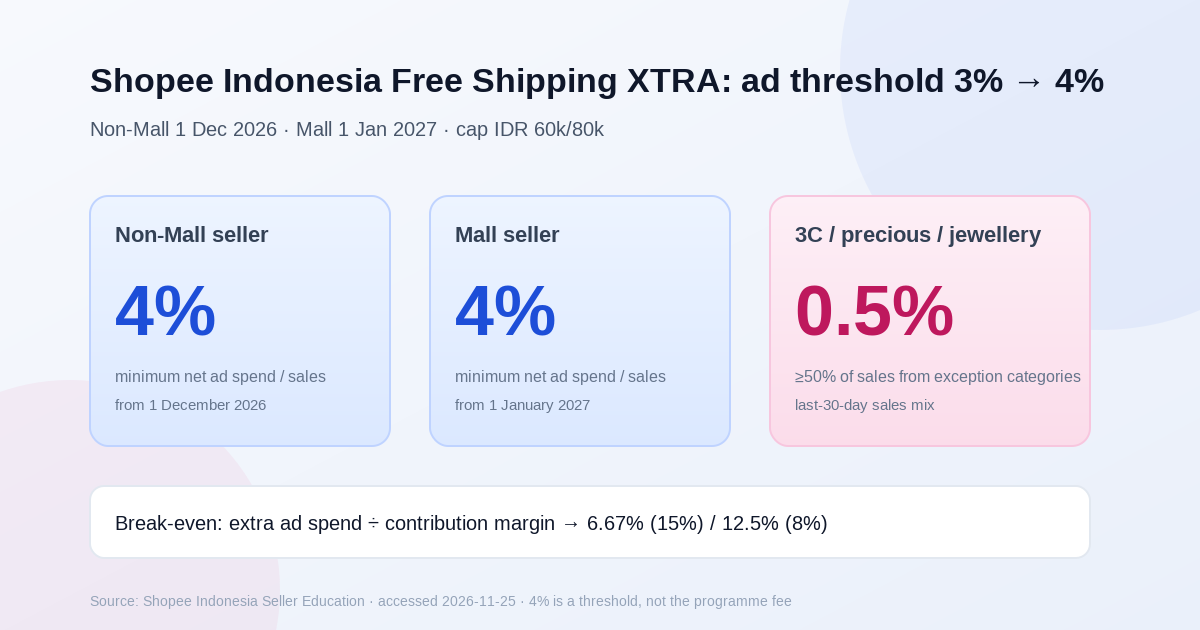
If you use Free Shipping XTRA on Shopee Indonesia, the minimum net ad spend for non-Mall sellers rises from 3% to 4% of sales on 1 December 2026; Mall sellers follow on 1 January 2027. The point is not that the rate rose by one percentage point. The 4% is a threshold for the ad-user programme fee, not the programme fee itself; the extra 1% of ad spend has to generate enough incremental sales to pay back the contribution it consumes. This article works through three scenarios, then lists the five data sets to pull, the actions and the stop conditions before 1 December.
1. The 4% is a threshold, not a fee: unpack the rule first
Shopee Indonesia's seller education page states that the minimum net ad spend for the Free Shipping XTRA 'ad-user special offer' rises from 3% to 4% of sales. Non-Shopee Mall sellers apply it from 1 December 2026; Shopee Mall sellers from 1 January 2027. The per-item programme fee cap also rises: regular-size items from IDR 40,000 to IDR 60,000, and special-size items from IDR 60,000 to IDR 80,000.
If at least 50% of a seller's sales in the last 30 days come from phones, tablets, desktops, laptops, monitors, precious metals or fine jewellery, the minimum net ad spend is 0.5%, not 4%. The exception is based on the sales mix, not on a '3C seller' label; check the 30-day category share in the dashboard, not the store tag.
The second common misread: 4% is an ad-spend threshold, not the programme fee. The official page also changes the Free Shipping XTRA programme fee table by category; some category fees may fall and some may rise, and the per-item cap changes at the same time. Reading the headline as 'Shopee Indonesia adds a flat 4%' will produce the wrong number. The right order is: your category's programme fee, then whether the 4% threshold binds, then the per-item cap.
| Item | Before | After | Effective/applicability |
|---|---|---|---|
| Minimum net ad spend (non-Mall) | 3% of sales | 4% of sales | 1 December 2026 |
| Minimum net ad spend (Mall) | 3% of sales | 4% of sales | 1 January 2027 |
| Per-item programme fee cap (regular size) | IDR 40,000 | IDR 60,000 | With the new rate |
| Per-item programme fee cap (special size) | IDR 60,000 | IDR 80,000 | With the new rate |
| 3C/precious metals/jewellery, ≥50% of sales | 0.5% | 0.5% | Based on the last-30-day sales mix |
| Programme fee rate itself | Category table | Category table, some up and some down | Seller Center is authoritative |
The 'before' column reflects how the official page describes this change. The full category-level programme fee table is not in the public summary, so sellers must use the Seller Center fee table. This article does not treat 4% as the fee, and does not ignore the possibility that some category fees fall.
2. Mechanism: why the extra 1% of ad spend changes unit contribution
Net ad spend is the seller's ad spend over the last 30 days, net of grants, rebates or ROAS-protection credits; the official page compares it with sales to produce a ratio. Below the threshold, the seller does not get the ad-user programme fee, or pays a higher programme/standard fee — confirm the exact treatment in Seller Center. Treating 4% as 'an extra 4% tax' is wrong: the money is still spent on ads, but it moves from 'discretionary' to 'must spend to the threshold'.
For a seller already at 4% or above, there is no incremental ad spend. For a seller at 3%, the increment is 1% of sales. That 1% is not free: it buys ad traffic, but it also reduces contribution. The decision has to compare the extra ad spend with the incremental sales it generates and the conversion lift from the free-shipping badge.
The formula: extra ad spend = (4% − current net ad-spend ratio) × sales; break-even incremental sales = extra ad spend ÷ contribution margin. Contribution margin here is the marginal contribution after product cost, platform commission, fulfilment, payment and after-sales, before fixed costs; use your own settlement data, not an industry average.
The per-item cap is the second constraint: programme fee = min(category rate × item price, per-item cap). High-priced items hit the cap sooner, so the 4% threshold and the fee cap must be calculated separately; low-priced items may be squeezed by fixed costs, making the extra ad spend harder to recover.
The same formula scales with the gap: if the current ratio is 2%, the increment is 2%, and the break-even sales at a 15% contribution margin double to 13.33%. 'How far am I from 4%' matters more than the 4% headline itself.
3. Three scenarios: how much incremental sales the extra 1% must buy
Scenario A: IDR 1 billion monthly sales, 15% contribution margin, current ad spend 3%. Assume IDR 1 billion of monthly sales, a current net ad-spend ratio of 3%, a 15% contribution margin, and an extra ad spend equal to the one-percentage-point gap from 3% to 4%; the badge's conversion lift is unknown. Calculation: extra ad spend = 1% × IDR 1 billion = IDR 10 million; break-even incremental sales = IDR 10 million ÷ 15% = IDR 66.67 million, or 6.67% of current sales. Result: the badge must lift monthly sales by at least 6.67% for the extra 1% of ad spend not to erode contribution. Decision: measure the badge's incremental sales in a controlled test before 1 December; if the lift is below 6.67%, do not raise ad spend to 4% just to keep the badge — compare the programme-fee change, cut inefficient ads or leave the programme.
Scenario B: IDR 300 million monthly sales, 8% contribution margin, current ad spend 3%. Assume IDR 300 million of monthly sales, a current net ad-spend ratio of 3%, an 8% contribution margin, and an extra ad spend of 1% of sales; other conditions unchanged. Calculation: extra ad spend = IDR 300 million × 1% = IDR 3 million; break-even incremental sales = IDR 3 million ÷ 8% = IDR 37.5 million, or 12.5% of current sales. Result: a low-margin seller needs a 12.5% sales lift to break even, which the badge alone is unlikely to deliver. Decision: recalculate by SKU, not at store average; if the badge's lift is below 12.5%, leaving the programme or moving the ad budget to proven SKUs is better value than chasing the 4% threshold.
Scenario C: a 3C/precious-metals/jewellery seller with more than 50% of sales from exception categories. Assume at least 50% of the last 30 days' sales come from phones, tablets, desktops, laptops, monitors, precious metals or fine jewellery, the seller's ad spend is already above 0.5%, and the per-item cap still applies by regular/special size. Calculation: the applicable minimum net ad spend is 0.5%, not 4%; against the old 3% threshold, this seller has no incremental ad spend, and the 0.5% exception does not make it spend more. Result: the 4% headline does not apply to this seller's ad threshold, but the programme-fee rate and per-item cap changes still affect unit contribution. Decision: do not raise ad spend to 4% because of the headline; first verify that the 30-day category share really reaches 50%, then check the programme fee and cap, and do not treat the exception as a store-wide waiver.
| Scenario | Monthly sales | Contribution margin | Extra ad spend | Break-even incremental sales | Share of current sales |
|---|---|---|---|---|---|
| A | IDR 1 billion | 15% | IDR 10 million | IDR 66.67 million | 6.67% |
| B | IDR 300 million | 8% | IDR 3 million | IDR 37.5 million | 12.5% |
| C | Seller-specific | — | 0 (already above 0.5%) | — | — |
Scenarios A and B are hypothetical examples, not platform averages; the point of C is not 'no cost' but 'do not use the wrong threshold'. If a C-type seller does not actually meet the 50% sales-mix test, or the programme fee rises, it must rerun the A/B method instead of treating the '3C exception' as a blanket waiver.
4. Counter-cases and evidence boundary: who is unaffected, and where the headline misleads
Counter-case one: a seller already at or above 4% has no incremental ad spend; treating 4% as 'everyone pays 1% more' overstates the impact.
Counter-case two: a 3C/precious-metals/jewellery seller that meets the 50% sales-mix test faces a 0.5% threshold, not 4%; but '3C seller' is not the same as 'exception seller' — check the last 30 days' sales mix.
Counter-case three: the programme fee table also changes, and some category fees may fall; reading only the 4% headline can miss the offset. Conversely, do not assume every category is unchanged because some fall.
Evidence boundary: the official page gives the 4% threshold, the 0.5% exception, the per-item cap and the effective dates, but it does not publish the badge's average conversion lift, the seller's net-ad-spend distribution, price elasticity or the full category fee table. The 15% and 8% contribution margins and the 3% current ad ratio in this article are hypothetical examples, not platform averages or NWi measurements. Replace them with your own 30-day net ad spend, sales, category mix and settlement data.
There is also a measurement issue: net ad spend usually excludes grants, rebates and ROAS-protection credits; confirm the definition in Seller Center. If you count grants in the numerator, you may overstate the ratio and conclude you have already reached 4%. Sales may be gross or net of tax and refunds; this article uses the Seller Center definition and makes no tax adjustment.
5. Actions and stop conditions: five data sets to pull before 1 December
First: the last 30 days of net ad spend and sales, at store and SKU level; confirm the numerator and denominator definitions before calculating the ratio. Second: contribution margin by category/SKU, after product cost, platform commission, fulfilment, payment, after-sales and returns; do not substitute gross margin. Third: the last 30 days' share of sales from the exception categories (phones, tablets, desktops, laptops, monitors, precious metals, fine jewellery), to test the 50% condition. Fourth: the current Free Shipping XTRA programme fee and per-item cap, by regular/special size and category. Fifth: the badge's incremental sales or conversion lift, ideally from a controlled test; without one, compare the same SKU before and after the badge and record seasonality and campaign effects.
Action order: first calculate contribution with no ad change and only the programme-fee change; then calculate contribution at 4% ad spend with 0%/3%/6% badge lift; finally calculate contribution from leaving the programme and moving the ad budget to proven SKUs. If all three are worse than the exit case, do not add ad spend just to keep the badge.
Stop conditions: if the badge's incremental sales are below the break-even line (6.67% in Scenario A, 12.5% in Scenario B) and the programme-fee change does not offset it, stop adding ad spend; if contribution under the 4% route stays below the exit route for two consecutive weeks, stop; if you do not meet the 0.5% exception but budget as if you do, correct it immediately; if the Seller Center fee table differs from the public summary cited here, use Seller Center and pause the decision.
Fields to watch: net ad spend, sales, ad-attributed sales, badge-order share, programme-fee deductions, per-item cap triggers, and contribution after refunds/returns. Review the first week after 1 December, and again for Mall sellers after 1 January; do not wait until 12.12 is over.
If you want to put net ad spend, category mix, contribution margin and badge orders into one reproducible model, see the Shopee data analysis platform and the cross-border data analytics product; for a custom analysis using your own store data, use the demo and inquiry page.
6. Limitations and next steps
Limitation one: the official page is in Indonesian and the programme fee table is category-specific; the public summary does not give every category's number. This article can confirm the threshold, exception, cap and dates, but cannot tell you your category's rate.
Limitation two: there is no public benchmark for the badge's conversion lift; the 6.67% and 12.5% figures are break-even lines, not forecasts. If your current ad ratio is 3%, measure the badge's incremental sales first, then decide whether to go to 4%.
Limitation three: 4% is a minimum net ad spend, not a budget ceiling; once you meet it, you can concentrate spend on high-contribution SKUs instead of spreading it evenly. This article does not describe 4% as a flat platform fee, and does not describe the 0.5% exception as automatic for all 3C sellers.
The article's original contribution is to separate the 4% threshold from the programme fee, convert the headline into a break-even incremental-sales hurdle by contribution margin, and put the 0.5% exception and the per-item cap into the same decision, rather than repeating that the ad threshold rose from 3% to 4%.
Data basis: Shopee Indonesia's seller education page states that the minimum net ad spend for the Free Shipping XTRA ad-user special offer rises from 3% to 4% of sales, effective 1 December 2026 for non-Shopee Mall sellers and 1 January 2027 for Shopee Mall sellers; the per-item programme fee cap rises from IDR 40,000/60,000 to IDR 60,000/80,000; sellers with at least 50% of the last 30 days' sales from phones, tablets, desktops, laptops, monitors, precious metals or fine jewellery have a 0.5% minimum net ad spend. The 4% is an ad-spend threshold, not the programme fee; the programme fee table also changes, and some category fees may fall. Ennews's 20 November 2026 report is used to cross-check the threshold, dates, caps and exception; AMZ123's 19 November 2026 09:32 report is used to cross-check the 3%→4% change. The monthly sales, contribution margins, current ad ratios, incremental sales and break-even lines in this article are hypothetical examples, not platform rates, platform averages or NWi measurements.
This article was prepared with the assistance of an automated research workflow, based on the public sources listed at the end, and was not manually reviewed.
Next steps: complete SKU-level data collection and the controlled test before 1 December; check programme-fee deductions and badge-order share in the first week after 1 December; Mall sellers should rerun the same model after 1 January 2027. If the Seller Center fee table conflicts with the public summary, use Seller Center and keep this article as a method record.
7. Sources and access notes
The main sources are two Shopee Indonesia seller education pages: one sets out the 4% threshold, effective dates, per-item cap and programme-fee change; the other sets out the 0.5% exception. Both pages are JS/login interfaces on public access; the text was read from the search-indexed full-text excerpt and cross-checked against independent reports by Ennews and AMZ123. Sellers should use the latest fee table in Seller Center.
- seller.shopee.co.id/edu/article/273... — Shopee Indonesia Seller Education, Free Shipping XTRA programme fee update, accessed 25 November 2026.
- seller.shopee.co.id/edu/article/273... — Shopee Indonesia Seller Education, 0.5% exception for 3C/jewellery-heavy sellers, accessed 25 November 2026.
- ennews.com/news-149104.htm... — Ennews, Shopee Indonesia raises the Free Shipping XTRA ad-fee threshold, 20 November 2026.
- amz123.com/kx/iqFLRLJq — AMZ123, Shopee Indonesia raises the net ad-spend threshold to 4%, 19 November 2026 09:32.