
If you sell to US customers and your store can sit outside the United States, the question after 23 November 2026 is not whether to embrace AI traffic. It is an order-level arithmetic question: ChatGPT agentic checkout is on by default, so do you keep it, turn it off, or keep it with a different measurement routine? Three numbers have to be established: how much higher the agent return rate is than your baseline, what each extra return costs, and whether these orders would have happened on your own checkout anyway. This article starts from what Shopify's own pages establish, adds an independent payment-provider analysis for the counter-case, then gives two decision frames and a 30-day reconciliation sheet.
The event first. In its 23 November 2026 changelog, Shopify renamed Direct checkout to agentic checkout across all AI channels and made it available for ChatGPT. Orders still appear in the Shopify admin and are managed as usual. For eligible stores, agentic checkout is enabled by default when Manage for me or Automatically enable new channels is on; existing opt-outs still apply, and settings on other channels do not change.
Eligibility is decided at both store and channel level: the store must sell to customers in the United States (the store itself can be based outside the US), products must be eligible for Shopify Catalog, the merchant must accept the Agentic Storefronts Supplemental Terms, and Terms of service, Privacy policy and Return and refund policy must be completed in the admin. B2B-only products are not supported for agentic storefronts, and products on OpenAI's prohibited list do not appear in ChatGPT product discovery.
The switch is under Sales channels → Agentic → Channels → ChatGPT. If the setting shows Manage for me, switch to Manual first. But the scope of turning it off is narrower than many assume: it stops AI agents from completing checkout with agentic tools such as UCP and WebMCP. It does not affect purchases through the Shop skill or the Shop App for ChatGPT, and it might not prevent an agent from completing a purchase on your own online store checkout. Product discovery also continues.
Mechanism: the attribution is in your admin, the checkout may not be your theme
Shopify Catalog supplies product data to AI channels. When eligible, ChatGPT's agent can complete some purchases with tools such as UCP or WebMCP. For orders placed through AI channels, the merchant keeps the customer relationship and post-purchase experience, and the order appears in the admin with channel or referrer attribution. That sentence is the foundation of this article: the reconcilable unit is the order record, not a session, not a pixel, and not how much traffic AI brought.
The checkout is not necessarily the one you configured in your theme. Clause 4 of the supplemental terms says a Participating Channel may customise Shopify Checkout to match its interface and may override customisations made through the Checkout Branding API. Your configured shipping and delivery options, marketing opt-in, abandoned checkouts, and payment methods or wallets “may not be the same” on the channel's interface. The clause puts the judgement on the merchant: if those configurations are required for the business, consider disabling that channel.
Read the data boundary at the same time. Shopify's help page says an AI channel receives product data and, when an order is placed in that channel, order details such as the customer's name, email address, phone number and physical address. It does not receive your full order history, orders from other sales channels, or your general customer database. The channel sees this order, not the whole customer.
Fees are a second unresolved item. The ChatGPT help page says there are no fees associated with selling in ChatGPT and that you pay only standard payment processing fees. Clause 6.1 of the supplemental terms nevertheless reserves the right to assess a fee on transactions for certain Participating Channels, set out in the Shopify admin and charged in addition to subscription, transaction and other fees. If a transaction is cancelled or refunded, the Agentic Storefronts fee is refunded, but Shopify Payments transaction fees are not. The two texts are not reconciled, so this article does not treat “no fees” as a permanent conclusion.
Evidence boundary: four things that can be verified, four that cannot
Four things can be verified: the default state and its triggers (Manage for me or automatically enabling new channels); eligibility and exclusions (US customers, store may be abroad, Shopify Catalog, policy pages, B2B-only and OpenAI-prohibited products); the scope of deactivation (UCP/WebMCP are blocked, Shop skill and Shop App are not, and other checkout paths may still complete); and the presence of channel or referrer attribution together with the conflicting fee language.
Four things cannot be verified. First, agent order volume, conversion, return rate and channel fee: none of them appears in Shopify's public pages. Second, whether ChatGPT checkout fires Google Analytics or custom pixels: the ChatGPT help page does not say. Third, the agent share of traffic: payment provider Adyen notes that many agents do not consistently identify themselves, that fingerprints change frequently, and that virtual-card BINs are only an indirect estimate. Fourth, whether agent orders are incremental or replace orders that would have happened on your own store.
The pixel point is especially easy to misuse. Shopify's Google AI Mode and Gemini page is explicit: Google Analytics and custom pixels do not fire in that agentic checkout, which fires only server-to-server pixels (started, completed). The same page lists subscription-only products, bundles, customisable products and B2B-only products as unsupported, and says some checkout blocks may not display. But that is a sentence-by-sentence statement for the Google channel. The ChatGPT page has no equivalent. Treat the Google finding as a prompt to verify in your own admin, not as a fact about ChatGPT.
One compliance detail is easy to miss: product descriptions must include relevant legal disclosures in the first 6,000 characters. The agent channel reads product data, not your customer-service scripts; a missing disclosure shows up first in returns and disputes, not in a dashboard.
Separate two kinds of contribution: absolute and incremental
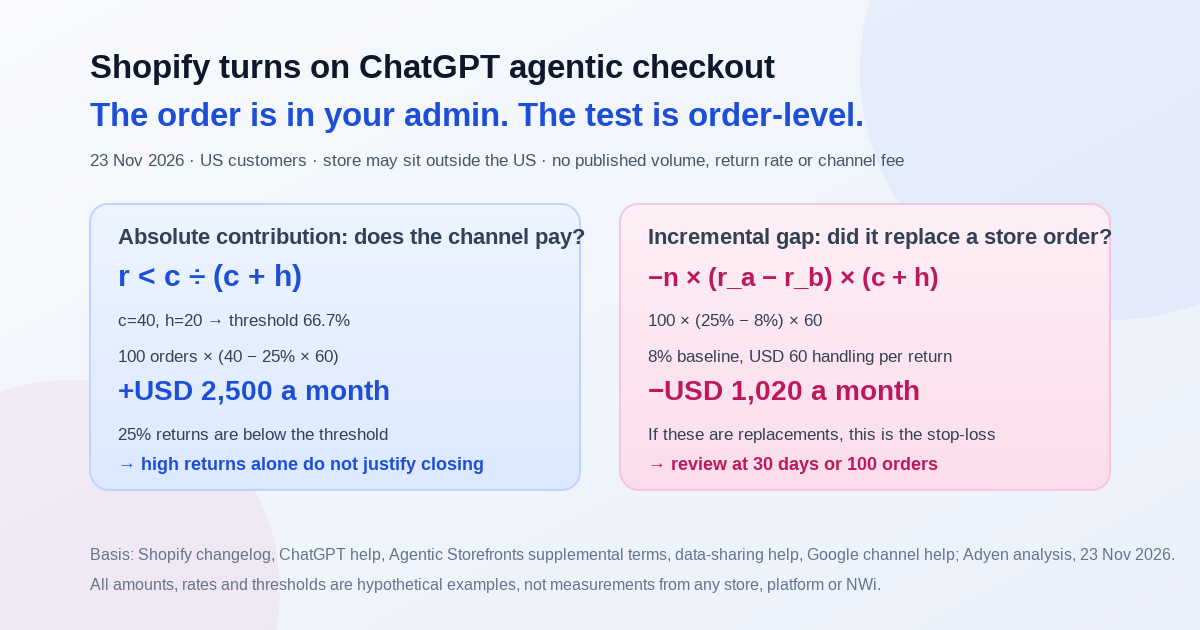
Let n be agent orders, c the pre-return contribution per kept order, h the handling cost per return (return shipping, inspection, markdown), r_a the agent return rate, and r_b the baseline return rate for the same SKUs and channel. Absolute contribution = n × [c − r_a × (c + h)]. The gap to the baseline = −n × (r_a − r_b) × (c + h).
Absolute contribution stays positive while r_a is less than c ÷ (c + h), which is the same as 1 ÷ (1 + h ÷ c). The threshold depends only on the ratio of return handling cost to unit contribution, not on order volume. With c=12 and h=6 the threshold is 66.7%; with h=10 it falls to 54.5%; when h equals c it is 50%.
| h ÷ c | threshold r* | reading |
|---|---|---|
| 0.25 | 80.0% | handling is light; even a high agent return rate can stay positive |
| 0.50 | 66.7% | handling is half the unit contribution |
| 0.75 | 57.1% | handling is three quarters of the unit contribution |
| 1.00 | 50.0% | handling equals contribution; above half returns the channel loses money |
The two frames can give opposite answers, which is the point of this article. Absolute contribution asks whether the channel makes money on its own. Incremental contribution asks whether these orders would have happened on your own store otherwise. If agent orders are incremental, the channel adds contribution whenever r_a is below the threshold, and the gap to the baseline is not a reason to close. If agent orders are replacements, every order carries a cost of (r_a − r_b) × (c + h), and only then does the gap decide.
Incrementality is hard to establish and no single signal is reliable. Weak signals include the share of new email addresses among agent orders, whether on-site orders for the same SKUs fall at the same time, and whether agent orders concentrate in SKUs that already sell well. All are clues: a new email may belong to an existing customer, an on-site decline may come from seasonality or ads, and concentration may simply reflect product discovery. Do not conclude from one signal.
Three scenarios: from 1% to 10%, when is action worth it?
All three scenarios are hypothetical examples, not measurements from any store, platform or NWi. Figures are in US dollars and exclude advertising, taxes and foreign exchange. The store takes 1,000 orders a month; AOV and contribution are set in the table.
| Item | Scenario A | Scenario B | Scenario C |
|---|---|---|---|
| Agent order share | 1% | 5% | 10% |
| Agent orders n | 10 | 50 | 100 |
| AOV (USD) | 60 | 60 | 200 |
| Pre-return contribution c (USD/order) | 12 | 12 | 40 |
| Return handling h (USD/return) | 6 | 6 | 20 |
| Agent return rate r_a | 10% | 15% | 25% |
| Baseline return rate r_b | 8% | 8% | 8% |
| Absolute contribution (USD/month) | 102 | 465 | 2,500 |
| Baseline comparison (USD/month) | 105.6 | 528 | 3,520 |
| Gap (USD/month) | −3.6 | −63 | −1,020 |
| Excess cost per 100 orders (USD) | 36 | 126 | 1,020 |
| Threshold r* = c ÷ (c + h) | 66.7% | 66.7% | 66.7% |
Scenario A: 1% agent share, check the cost of reconciliation first
Scenario A assumes 1,000 monthly orders, a 1% agent share (10 orders), AOV USD 60, pre-return contribution c = USD 12, return handling h = USD 6, an agent return rate of 10% and a baseline of 8%.
10 × 12 = USD 120; one return costs 1 × (12 + 6) = USD 18; net contribution is USD 102. The baseline is 10 × (12 − 8% × 18) = USD 105.6, so the gap is −USD 3.6 a month.
At this size the excess cost is below the cost of manual reconciliation: keep the default if the export can be automated; if the team can only see pixels, turn it off until order-level channel attribution exists.
Scenario B: 5% agent share, the gap starts to cover an information fix
Scenario B assumes 1,000 monthly orders, a 5% agent share (50 orders), AOV USD 60, c = USD 12, h = USD 6, an agent return rate of 15% and a baseline of 8%.
50 × 12 = USD 600; 7.5 returns × 18 = USD 135; net contribution is USD 465. The baseline is 4 returns × 18 = USD 72, or USD 528, so the gap is −USD 63 a month.
The gap already covers one small fix to size or material information: fix the information and restrict high-return SKUs first, then consider closing only if the agent return rate stays above twice the baseline for two consecutive months.
Scenario C: 10% agent share and high AOV, the stop-loss test
Scenario C assumes 1,000 monthly orders, a 10% agent share (100 orders), AOV USD 200, c = USD 40, h = USD 20, an agent return rate of 25% and a baseline of 8%.
100 × 40 = USD 4,000; 25 returns × 60 = USD 1,500; net contribution is USD 2,500 (12.5%). The baseline is 8 returns × 60 = USD 480, or USD 3,520 (17.6%), so the gap is −USD 1,020 a month.
At 25% the agent return rate is still below the 66.7% absolute threshold, so high returns alone do not justify closing. If these orders replace on-site orders, the −USD 1,020 a month is the stop-loss basis: close the high-return categories first, then reassess the store.
Recomputation check: A is 10 × (12 − 0.10 × 18) = USD 102; B is 50 × (12 − 0.15 × 18) = USD 465; C is 100 × (40 − 0.25 × 60) = USD 2,500. All three match the table.
Reconciliation cost belongs in the same calculation. If manual reconciliation costs R a month, a manual process pays only when n × (r_a − r_b) × (c + h) is greater than R. Scenario A's excess cost is USD 3.6 a month. At USD 50 an hour for four hours a month (R = 200), break-even needs 556 agent orders a month. At 10 orders, a manual process is not worth building; automate the export or sample-check instead.
Scenario C has a counter-intuitive result: with a 25% return rate the absolute contribution is still positive at USD 2,500, because the threshold is 66.7%. Looking only at high returns would wrongly conclude that the channel must be closed. If these orders are replacements, the −USD 1,020 gap is the real problem. That is why the two frames must be separated before deciding.
Action list: a 30-day or 100-order reconciliation
- Record the current state: Sales channels → Agentic → Channels → ChatGPT, noting Manage for me or Manual, the Catalog access and Agentic checkout switches, and the review date.
- Export the last 90 days of orders with at least: order number, order date, channel/referrer, new or returning customer, AOV, discount, shipping paid, refund date and amount, return reason, payment processing fee, return handling cost and contribution.
- Build three ledgers: orders (channel attribution), returns (reason and lag) and contribution (fees and handling), aligned by order number.
- Calculate r_b from the same SKUs and channel. Do not substitute a store-wide average unless the SKU mix is close.
- Calculate r_a, the threshold c ÷ (c + h) and the excess cost; write the result on one page with every assumption.
- Sample 10 agent orders and check the checkout details: shipping options, marketing opt-in, abandoned checkout and payment methods against the on-site checkout. Clause 4 allows the channel to override these configurations.
- Review at 30 days or 100 agent orders, whichever comes first. If the return window is longer than 30 days, extend the observation to 60 days so the return rate is not read before returns arrive.
- If you decide to close, turn off Agentic checkout in the ChatGPT settings and confirm the behaviour of Shop skill, Shop App and other checkout paths still matches expectations.
Stop conditions: r_a at or above the threshold for two consecutive observation windows, or excess cost above 10% of monthly contribution, or a sample check that finds policy, consent or shipping promises differ from the on-site checkout and cannot be fixed. When triggered, restrict high-return SKUs first, then consider closing the whole store.
If you also run marketplace stores and want market-side data (category, brand, price band) placed next to your own order-contribution ledger, review the platform and site coverage of [NWi CrossborderGo](/product/); to turn your own export fields and return definitions into a repeatable reconciliation routine, contact us through [request a demo](/demo/). The method does not depend on any specific tool and can be run from a Shopify admin export alone.
Counter-cases and alternative explanations
- Default-on does not equal growth: Shopify's public pages publish no agent order volume, so a default cannot be read as a traffic dividend.
- Turning it off does not mean no agent orders: Shop skill, Shop App and other checkout paths may still complete purchases, and product discovery continues.
- Fees may not be the main risk: the help page says no extra fees, while the supplemental terms reserve channel fees; returns, attribution and after-sales are harder.
- Few agent orders may mean agents were blocked: Adyen notes that CDNs, CAPTCHAs and fraud rules can turn away legitimate agents, so a low count is not proof of low demand.
- A low return rate may mean returns have not arrived yet: a 30-day window is too short for categories with long return cycles.
- Before-and-after comparisons around peak season are unreliable: Black Friday and Cyber Monday seasonality and ad pacing move both on-site and agent orders, so read the channel mix rather than the total.
- A new email is not necessarily a new customer: an existing customer may use another address, or the agent may fill in different contact details.
Unknowns and limitations
This article had no access to any Shopify admin and uses no NWi measurement of Shopify. The public coverage of NWi CrossborderGo is defined by coverage.json and the product pages. The method here is transferable, but it is not a product claim that NWi covers Shopify.
All amounts, rates and thresholds are hypothetical examples; figures are in US dollars and exclude advertising, taxes, foreign exchange and other platform fees; return handling covers return shipping, inspection and markdown, not customer-service time.
ChatGPT checkout pixel behaviour, agent order share, channel fees and return distribution are not public; the sentence-by-sentence Google channel finding cannot be transferred. The completeness of order-level attribution is also unknown, and agents that do not identify themselves may leave gaps.
The 30-day or 100-order review point is an operational suggestion, not a statistical significance threshold; with a small sample the return rate will swing widely, so read an interval rather than a point estimate.
Original analytical contribution
This article adds three things. First, it splits keep-or-close into absolute and incremental contribution and gives the closed-form threshold r* = c ÷ (c + h): the threshold depends only on the ratio of return handling cost to unit contribution, not on order volume.
Second, three scenarios show that a high return rate does not equal a closure: Scenario C has a 25% agent return rate and still contributes USD 2,500 per 100 orders in absolute terms. What decides is whether those orders replaced on-site orders, at a replacement cost of (r_a − r_b) × (c + h) per order.
Third, reconciliation cost is part of the decision: a manual process pays only when the excess cost exceeds the cost of reconciliation. At a 2 percentage point return-rate gap, c=12 and h=6, break-even needs about 556 agent orders a month to cover USD 50 an hour for four hours (R=200). That threshold decides the next action more than the question of whether to do AI channels at all.
Sources
- 1. Shopify Changelog, “Manage agentic checkout for ChatGPT” (primary, 23 Nov 2026; renaming, ChatGPT availability, default condition and switch path): read the original, accessed 25 November 2026.
- 2. Shopify Help, “Selling on ChatGPT” (primary, living page; eligibility, exclusions, fee wording, Shop skill and Shop App exception): read the original, accessed 25 November 2026.
- 3. Shopify Help, “Shopify agentic storefronts” (primary, living page; channel scope, order attribution, customer relationship): read the original, accessed 25 November 2026.
- 4. Shopify, “Agentic Storefronts Supplemental Terms of Service” (primary, updated 6 October 2026; clause 4 on checkout customisation, clause 6.1 on fees): read the original, accessed 25 November 2026.
- 5. Shopify Help, “Data sharing and privacy for selling with agentic storefronts” (primary, living page; order fields visible to AI channels and what is not): read the original, accessed 25 November 2026.
- 6. Shopify Help, “Selling on Google AI Mode and Gemini” (primary, living page; used only for the Google channel pixel and unsupported-feature evidence, not transferred to ChatGPT): read the original, accessed 25 November 2026.
- 7. Adyen, “How to be agentic-ready this peak season” (independent payment-provider analysis, 23 November 2026; agent identification, virtual-card BINs, false declines and manual review): read the original, accessed 25 November 2026.
Basis: the Shopify changelog of 23 November 2026 for the renaming, ChatGPT availability, default condition and switch path; the ChatGPT help page for eligibility, exclusions, fee wording and the Shop skill/Shop App exception; the agentic storefronts help page for order attribution and channel scope; clauses 4 and 6.1 of the supplemental terms (updated 6 October 2026) for checkout customisation and fee reservation; the data-sharing page for the order fields visible to AI channels; the Google AI Mode and Gemini help page only for the channel-specific finding that pixels do not fire and only server-to-server events are sent, not transferred to ChatGPT; and Adyen's 23 November 2026 analysis for the counter-case on agent identification and false declines. Order volume, AOV, contribution, return rates, handling cost, reconciliation cost and thresholds in this article are hypothetical examples, not measurements from any store, platform or NWi.
This article was prepared with the assistance of an automated research workflow, based on the public sources listed at the end, and has not been reviewed by a human. It is not platform, payment, tax or legal advice; eligibility, fees, pixel behaviour and compliance obligations for agentic checkout should be confirmed in your Shopify admin, with your payment provider and under applicable law.