
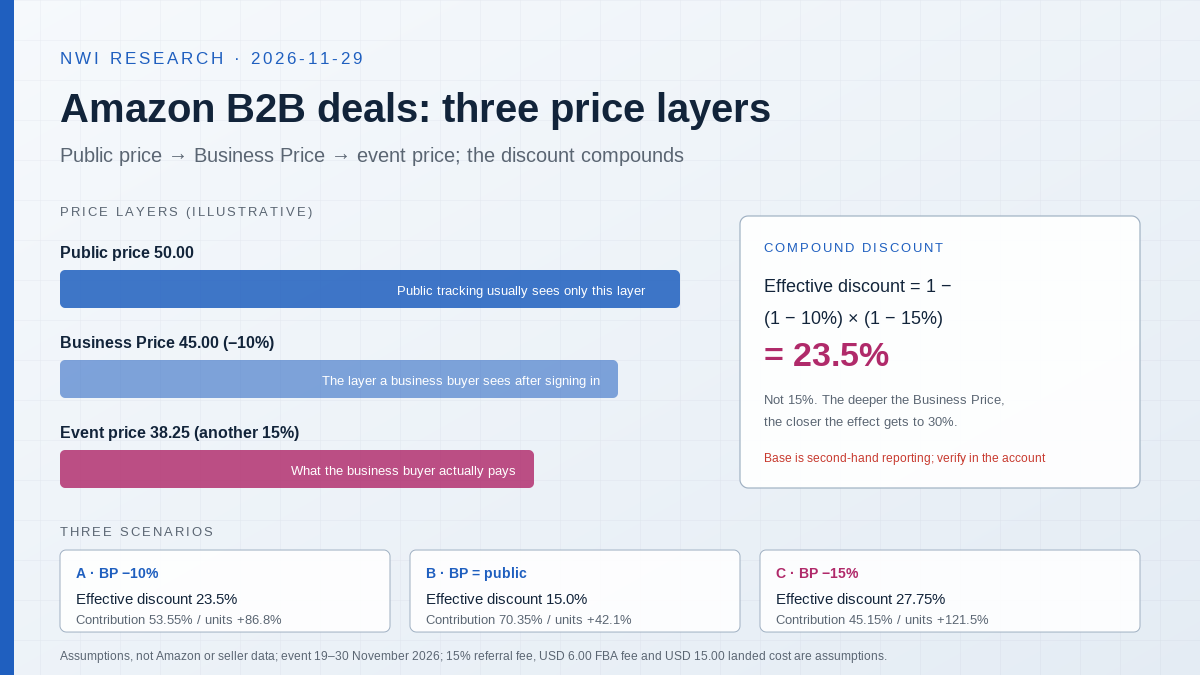
The real decision is whether, before the event closes on 30 November, to rebuild the B2B price benchmark from the Business Price in your own account or to keep using public prices for competitor price bands and treat the business discount as another channel. If you sell office, cleaning, safety or maintenance products on Amazon US and a competitor's public listing price has not moved while its business buyers may be getting a Business Price and a further 15% on top, that is the choice in front of you on 29 November 2026.
This is not simply whether to match “a 15% deal”. Business Price is already a separate layer. If the event discount is calculated on that layer, the business buyer's effective discount is higher than 15%, while public price tracking usually records only what a logged-out visitor sees. Mixing the layers distorts price bands, price floors and contribution.
This article is for three groups: brands and distributors already selling on Amazon Business with a Business Price set; operations teams using public listing prices to build competitor price bands; and sellers preparing to join Business Deals at the next high-velocity event. Categories with no business demand, such as pure consumer gifts, are outside the core scope.
1. The event: what Amazon confirmed and what it did not
Amazon's Seller Forums account News_Amazon announced that from 31 August 2026 sellers could create Business Deals; on 23 September 2026, the Selling Partner Blog announced it again. The two official notices agree on the following: the feature covers the US, Canada, UK, Germany, France, Italy, Spain, Japan, Mexico and Australia; discounts run from one hour to 30 days and can be a fixed price or a percentage; products need a 3.5+ star rating, new condition and pricing and seller-performance requirements; the minimum is 10% for regular deals and 15% for high-velocity events such as Prime Big Deal Days, Black Friday and Cyber Monday; only products with an existing Business Price are eligible; and the entry point is the Price Discounts tool in Seller Central, with All Business Customers selected as the audience.
Amazon's Black Friday page confirms the buyer side: Black Friday Week and Cyber Monday run from 19 to 30 November, and Amazon Business offers business customers deals of up to 50%. That “up to 50%” is a promotional ceiling, not a seller requirement and not an average across products.
| Item | Confirmed by Amazon or reported | Boundary |
|---|---|---|
| Event window | 19–30 November 2026; business-only deals up to 50% | Up to 50% is a promotional ceiling, not a seller threshold or average |
| Launch | 31 August 2026; one hour to 30 days; fixed price or percentage | A promotion tool, not a standing rule |
| Markets | US, CA, UK, DE, FR, IT, ES, JP, MX, AU | Whether a site or account shows All Business Customers still needs an account check |
| Eligibility | 3.5+ stars, new condition, pricing and performance rules; products with an existing Business Price only | A SKU without a Business Price is not eligible |
| Minimum discount | 10% regular, 15% high-velocity events | The official posts do not state the discount base |
| Discount base | Not stated on the official public pages | DSG's 27 November report says it is calculated from the Business Price, attributed to a third party's review of Amazon's notice |
| Price visibility | Not stated by Amazon | Whether logged-in business prices are visible to logged-out visitors or third-party monitors is unknown |
| Customer base | Seller post: 11 million registered business organisations; program page: 8 million organisations served, excluding emerging markets | Different measures; not the same addressable demand pool |
| Fees | 23 September blog subheading: no additional fees; seller post: enhanced visibility at no extra cost until 31 December | The report DSG cites says whether a separate deal fee applies was not clarified; prefer the official statement and check the account |
| Sales | Not published | No event sales, participation, business-order share or actual transaction prices |
Two numbers in that table are easy to merge. The seller post says “over 11 million registered business organisations”; the Amazon Business program page says “8 million organisations served globally, excluding emerging markets”, alongside USD 35 billion in annualized sales and 97 Fortune 100 companies. The first is a registration count, the second a served-organisation count, and the page does not state the period in the same block. Treating 11 million as your addressable business buyers overstates demand.
There is also a fee conflict. The 23 September official blog's subheading says “with no additional fees”, and the seller post says enhanced visibility is “at no additional cost until 31 December 2026”; the report DSG cites says Amazon did not clarify whether sellers pay a separate fee to run a deal. On evidence priority, take Amazon's own public statement first; if a fee appears in your account, use the Seller Central bill, and do not turn a second-hand “unclear” into “a fee is charged”.
2. Mechanism: why 15% is not 15%
The discount base DSG reports makes Business Price a separate price layer for Amazon Business customers; Business Deals are open only to products that already have a Business Price, and the event discount sits on top of that layer, so the buyer's effective discount has to be calculated with a two-layer formula.
Sellers can set a static business price in the Business Price column on Manage Inventory or use Automate Pricing rules; the Amazon Business page also says business pricing can be synchronized with retail prices. Business Price is therefore not a temporary event price but a layer that exists every day; the event adds a limited-time discount on top.
If the base is indeed the Business Price, the effective discount is 1 − (1 − Business Price discount) × (1 − event discount). A Business Price 10% below public plus a 15% event discount is 23.5%, not 15%; a Business Price 15% below public plus 15% is 27.75%.
That is where “public price tracking may miss a layer” comes from: logged-out visitors and most public price series see the first layer; business buyers who sign in see the second, and during the event may see a third. Mixing three layers into one price band, when the monitor cannot see the business price, overstates a competitor's B2B price and overstates your own price floor.
But the claim has to stay conditional: Amazon has not publicly said whether logged-in business prices are visible to logged-out visitors or third-party price monitoring. If a monitor can capture the business price, the layer is not missing; if it cannot, the public series may be one layer short. Treat it as a risk to verify, not as an established industry fact.
3. Evidence boundary: what can enter a decision
Amazon's public seller announcement confirms the event, the ten markets, the 10% and 15% minimums and the existing-Business-Price rule, but it does not state the discount base or say whether logged-in business prices are visible to third-party price monitoring.
- Official confirmation also covers the one-hour to 30-day duration, fixed-price or percentage formats, the 3.5-star and new-condition rules, the Price Discounts entry point, the All Business Customers audience, 11 million registered organisations, and no extra cost for enhanced visibility until 31 December 2026.
- The official posts do not state the discount base. DSG's 27 November report says “Amazon calculates the discount from that account price” and attributes that sentence to a third party's review of Amazon's seller notice; it is second-hand reporting, not a verbatim Amazon public statement.
- The official posts do not publish event sales, seller participation, business-order share, actual transaction prices, refunds or repeat rates, and do not say whether business prices are visible to logged-out visitors, third-party price monitoring or comparison services.
- “Up to 50%” is a buyer-facing ceiling; it cannot be used to infer a seller's minimum discount or an average discount.
- One reply on the Seller Forums post says the UK Promotions page shows only All Customers and Prime Customers, with no All Business Customers; that is one seller's anecdote, not platform confirmation, and not representative of all accounts.
- DSG says the deadline to submit deals for the holiday event was 20 October; that means new submissions for this event were likely closed by 29 November, and the realistic action in the remaining time is to review, keep or stop an existing deal. The deadline is also second-hand and should be checked in the account.
- The Seller Central Help Hub page for Business Deals (GQKDQB4UCAUABYVC) did not return readable article text in this environment, so this article relies only on the public forum post, official blog, program page, Black Friday page and DSG report.
4. Counter-cases: when the layer does not exist
The counter-case is a seller with no Business Price, or one whose Business Price already equals the public price: the first is ineligible, and the second gives business buyers a single-layer 15% discount, not a compounded 23.5%.
- The competitor has no Business Price: the public price remains a valid benchmark, and there is no B2B layer to invent.
- Business prices are visible to monitoring: the public series already includes the layer, so the issue is data lag and login state, not a missing layer.
- The category has no business demand: office, cleaning, safety and maintenance are more likely to have B2B demand; pure consumer gift categories may see little effect.
- Contribution falls below the floor and repeat purchases cannot recover it: even a real discount should not be run.
- The site or account does not show All Business Customers: the feature is not live there, so fix eligibility before changing prices.
- Business and consumer orders cannot be separated: you cannot tell incremental volume from cannibalisation, so fix the data before widening the discount.
5. The arithmetic: three scenarios
Common assumptions: public price USD 50.00; referral fee 15%; FBA fee USD 6.00; landed cost USD 15.00; no ads, returns, storage, inbound placement or B2B volume referral-fee difference. The Amazon Business page says business volume purchases may qualify for lower referral fees; this article does not include that benefit, so the contribution figures below are conservative, actual contribution may be slightly higher and the required increase slightly lower. All prices and costs are assumptions, not Amazon or seller data.
Scenario A: Business Price 10% below public, event discount 15%
Assumptions: public price USD 50.00, Business Price USD 45.00, event discount 15%; referral fee 15%, FBA fee USD 6.00, landed cost USD 15.00; no ads, returns, storage or B2B volume referral-fee difference.
Result: event price = 45.00 × 0.85 = USD 38.25; effective discount = 1 − 38.25 ÷ 50 = 23.5%; unit contribution = 38.25 − 5.74 − 6.00 − 15.00 = USD 11.51, or 53.55% of the USD 21.50 public-price contribution; holding that contribution requires 86.8% more units.
Decision: if business repeat purchases and units per order cannot lift volume by more than eight-tenths, do not roll the deal across the catalogue; test high-repeat SKUs for one to two days at most.
Scenario B: Business Price equals public price, event discount 15%
Assumptions: public price and Business Price both USD 50.00, event discount 15%; referral fee 15%, FBA fee USD 6.00, landed cost USD 15.00; no ads, returns or storage.
Result: event price = 50.00 × 0.85 = USD 42.50; effective discount = 15.0%; unit contribution = 42.50 − 6.38 − 6.00 − 15.00 = USD 15.13, or 70.35% of the public-price contribution; holding that contribution requires 42.1% more units.
Decision: without a separate business price or evidence of business repeat demand, keep using public prices for the band and do not claim a 23.5% B2B discount.
Scenario C: Business Price 15% below public, event discount 15%
Assumptions: public price USD 50.00, Business Price USD 42.50, event discount 15%; referral fee 15%, FBA fee USD 6.00, landed cost USD 15.00; no ads, returns or storage.
Result: event price = 42.50 × 0.85 = USD 36.125; effective discount = 1 − 36.125 ÷ 50 = 27.75%; unit contribution = 36.125 − 5.42 − 6.00 − 15.00 = USD 9.71, or 45.15% of the public-price contribution; holding that contribution requires 121.5% more units.
Decision: the deeper the Business Price, the closer the compounded event discount gets to 30%; run it only where business customers repeat, returns are low and B2B orders can be separated, otherwise narrow the Business Price first.
| Scenario | Business Price | Event price | Effective discount off public | Contribution / public contribution | Unit increase to hold contribution |
|---|---|---|---|---|---|
| A | 45.00 | 38.25 | 23.5% | 53.55% | +86.8% |
| B | 50.00 | 42.50 | 15.0% | 70.35% | +42.1% |
| C | 42.50 | 36.125 | 27.75% | 45.15% | +121.5% |
The three scenarios produce effective discounts of 23.5%, 15.0% and 27.75%, contribution ratios of 53.55%, 70.35% and 45.15% of the public-price contribution, and required unit increases of 86.8%, 42.1% and 121.5% to hold that contribution.
Three notes on the arithmetic. First, ratios use unrounded contribution values and are then shown to two decimals, so 11.51 × units will not reproduce exactly 53.55%. Second, the referral fee is charged on the transaction price, so a lower event price also lowers the absolute referral fee; that is why contribution does not fall in proportion to the discount. Third, if a business volume order qualifies for a lower referral fee, actual contribution is higher and the required increase is lower than the table shows; do not treat the table as a worst case, only as a conservative case that leaves the benefit out.
The price-band effect can also be quantified: a public monitor sees USD 50.00, while the business buyer pays USD 38.25 in Scenario A, a gap of USD 11.75; in Scenario C the gap is USD 13.875. In these three scenarios, a competitor band built on public prices overstates the B2B price by 23.5% to 27.75%; conversely, if you set your Business Price off the public price, you may sit above the competitor's actual B2B transaction price.
6. Action and stop conditions: what the remaining time allows
Before the event closes, check whether the Promotions page offers the All Business Customers audience, list the SKUs that already have a Business Price, and recompute contribution at the event price; if contribution falls below the floor and business repeat purchases cannot recover it, stop or narrow the deal to high-repeat SKUs, then fold the B2B layer into the monthly price-band review.
The event ends on 30 November. The realistic action in the remaining time is not “sign up again” but reviewing the existing deal and the existing Business Price. Work in this order:
- Check whether Promotions shows All Business Customers. If the audience is absent, the feature is not live for that site or account; stop and do not reprice first.
- Export every SKU with a Business Price and separate the SKUs without one; the latter are not in this event and should not enter the B2B band.
- Compute three prices for each SKU: public price, Business Price and event price; use the compounding formula, not a flat 15%.
- Recompute unit contribution at the event price and compare it with the public-price contribution; list business-order share, units per order, repeat purchases and returns separately, not as total orders.
- If an existing deal stays above the contribution floor and business repeat purchases can recover it, keep it; if it falls below and cannot recover, stop it or narrow it to high-repeat SKUs. Do not continue just because the deal was already submitted.
- DSG reports that the submission deadline for this holiday event was 20 October; if you did not submit by then, you likely cannot join this event on 29 November. Confirm in the account before planning around “signing up today”.
- After the event, keep Business Price and the event price in the monthly price-band review; keep public market data as the public layer and the B2B layer in a separate column, not one unannotated curve.
Stop conditions: no Business Price; no All Business Customers audience; no verifiable business demand; event contribution below the floor with no repeat or unit recovery; business orders cannot be separated from consumer orders; or price visibility, MFN or wholesale contract terms are not confirmed in writing. If any one holds, stop first rather than “run it and see”.
The post-event review template is simple: two price columns, one public layer and one B2B layer; three metrics, units or volume, transaction price and contribution; one note saying whether the B2B layer came from the account or from an assumption. The next high-velocity event then does not require guessing again.
7. Limitations and unknowns
This is a Black Friday and Cyber Monday promotion, not a standing rule; the discount base comes from second-hand reporting, Amazon had published no event sales, seller participation, business-order share or actual transaction prices as of 29 November 2026, and every fee, cost and unit figure here is an assumption.
- Whether business prices are visible to logged-out visitors, third-party price monitoring or comparison services is unknown; if they are, the public series may already include the layer.
- There are no event sales, seller participation, business-order share, actual transaction prices, refunds or repeat rates, so the true return cannot be calculated.
- The missing UK audience is one Seller Forums reply, an anecdote rather than platform confirmation.
- The referral fee, FBA fee, landed cost, price and unit figures are assumptions; ads, returns, storage, inbound placement and B2B volume referral-fee differences are excluded, so actual contribution will differ.
- This article did not measure Chinese or English search demand and does not use any competitor data supplier's estimate as evidence; it is an event-driven decision analysis, not search-demand validation.
- NWi CrossborderGo's public-market data do not include Seller Central Business Price, B2B-only deal prices, business-buyer identity, settlement prices or seller profit; it provides public-market estimates and price bands only.
8. What this means for selection and data decisions
The selection lesson is not “every category needs B2B”; it is “before building a price band, ask whether the category has business demand and whether competitors carry a separate Business Price”. Office, cleaning, safety and maintenance are more likely to see business purchasing; consumer gifts and fashion may have a thin B2B layer. Public price bands remain useful for selection, but the B2B layer is a correction that has to be verified separately.
The data lesson is about definition: a public-market price band is an estimate built from transaction prices, not the list price and not the price a business buyer sees after signing in. It is useful for category demand, price-band distribution and brand concentration, but it is not a B2B quote or a profit statement. Separating the public layer from the B2B layer lets a team compare categories on public data without dropping the business discount.
Within activated modules, NWi CrossborderGo provides category, brand, store and product data for Amazon sites including the US, Europe and Japan, covering sales, units, ASP, brand share and price bands; public-market data are updated monthly, usually between the 10th and 15th of each month for the prior month, and the available sites, history and fields depend on the contract. It supports category size, price bands and competitive position on the public layer; its public-market data do not include Business Price, B2B-only deal prices, business-buyer identity, settlement prices or seller profit, which have to be checked separately in Seller Central and the finance data.
To see Amazon category, price-band and competitive position, start with Amazon data analysis; to put several marketplaces into one set of definitions, see NWi CrossborderGo; to check whether your platform mix, sites and fields can be connected, describe them in a demo request. Product capabilities, site coverage and fields depend on the modules activated and the contract.
9. Method and disclosure
Data basis: on 29 November 2026 this article reopened and checked five public sources: the Amazon Seller Forums News_Amazon announcement that Business Deals would start on 31 August 2026, the Amazon Selling Partner Blog post of 23 September 2026, the Amazon Business program page, Amazon's About Amazon Black Friday page published on 9 November 2026 and updated on 19 November 2026, and the Distribution Strategy Group report by Mark Brohan published on 27 November 2026. The forum post and the official blog confirm the ten markets, the one-hour to 30-day duration, the 10% and 15% minimums, the 3.5-star and new-condition rules, eligibility limited to products with an existing Business Price, 11 million registered organisations and no extra cost for enhanced visibility until 31 December 2026. The program page confirms that Business Price is a separate layer, that it can be set in the Business Price column or through Automate Pricing, that business pricing can be synchronized with retail prices, that business volume purchases may qualify for lower referral fees, and it gives 8 million organisations served excluding emerging markets, USD 35 billion in annualized sales and 97 Fortune 100 companies. The Black Friday page confirms the 19–30 November window and business-only deals of up to 50%. DSG reports the 19–30 November event, a discount calculated from the Business Price, a 20 October submission deadline, and no published sales figures, and attributes the calculation base to a third party's review of Amazon's seller notice. The Seller Central Help Hub page for Business Deals (GQKDQB4UCAUABYVC) did not return readable article text in this environment and is not treated as a read source. Calculation basis: effective discount = 1 − (1 − Business Price discount) × (1 − event discount); Scenario A is 1 − 38.25 ÷ 50 = 23.5%, Scenario B is 1 − 42.50 ÷ 50 = 15.0%, Scenario C is 1 − 36.125 ÷ 50 = 27.75%; contribution = event price − referral fee − FBA fee − landed cost, giving 38.25 − 5.7375 − 6 − 15 = 11.5125 in A, 42.50 − 6.375 − 6 − 15 = 15.125 in B and 36.125 − 5.41875 − 6 − 15 = 9.70625 in C; public-price contribution is 50 − 7.5 − 6 − 15 = 21.50; contribution ratios are 11.5125 ÷ 21.50 = 53.55%, 15.125 ÷ 21.50 = 70.35% and 9.70625 ÷ 21.50 = 45.15%; required unit increases are 21.50 ÷ 11.5125 − 1 = 86.8%, 21.50 ÷ 15.125 − 1 = 42.1% and 21.50 ÷ 9.70625 − 1 = 121.5%. All prices, fees, costs and unit figures are labelled assumptions, not measurements by Amazon, DSG, NWi or any seller; ads, returns, storage, inbound placement and B2B volume referral-fee differences are excluded. Product boundary: within activated modules, NWi CrossborderGo covers Amazon sites including the US, Europe and Japan and provides public-market estimates for sales, units, ASP, brand share and price bands, updated monthly (usually between the 10th and 15th of each month for the prior month), with available sites, history and fields depending on the contract; its public-market data do not include Business Price, B2B-only deal prices, business-buyer identity, settlement prices or seller profit.
This article was prepared with automated research assistance from the public sources listed at the end and has not been reviewed by a human. It does not invent customer data, expert review, sales uplift, ranking outcomes or platform endorsement. It is not financial, pricing, legal or platform-operations advice; Business Price, event eligibility, fees, price visibility, MFN or wholesale contract terms should be based on the current Seller Central pages, account bills, contracts and finance or legal advice. The referral fee, FBA fee, landed cost and unit figures are assumptions and must not be used directly in a quote or budget.
Sources
- Amazon Seller Forums, News_Amazon, announcement effective 31 August 2026, Create exclusive deal for Amazon Business customers: launch on 31 August 2026, ten markets, one hour to 30 days, 10%/15% minimums, 3.5 stars and new condition, existing Business Price only, 11 million registered organisations, no extra cost for enhanced visibility until 31 December 2026; accessed 29 November 2026.
- Amazon Selling Partner Blog, 23 September 2026, Create exclusive deals for Amazon Business customers: subheading states “with no additional fees”; ten markets, 10%/15%, 3.5 stars, new condition, 11 million organisations; accessed 29 November 2026.
- Amazon Business program page, Expand your reach to business customers: Business Price column, Automate Pricing, business pricing synchronized with retail prices, 8 million organisations served excluding emerging markets, USD 35 billion annualized sales, 97 Fortune 100 companies, lower referral fees on larger purchases; accessed 29 November 2026.
- Amazon About Amazon, published 9 November 2026 and updated 19 November 2026, Black Friday and Cyber Monday 2026 is here: 19–30 November window; Amazon Business deals exclusive to business customers up to 50%; accessed 29 November 2026.
- Distribution Strategy Group, Mark Brohan, 27 November 2026, Amazon Business Adds Business-Only Seller Deals to Black Friday and Cyber Monday: 19–30 November event; discount calculated from the Business Price (attributed to a third party's review); 10%/15%; holiday deal submission deadline 20 October; no sales figures; price-monitoring visibility not clarified; accessed 29 November 2026.
10. Conclusion
Three sentences. First, Amazon opened Business Deals to business buyers in ten markets from 19 to 30 November 2026, and the official posts confirm the 10% and 15% minimums and the existing-Business-Price rule but do not state the discount base. Second, if the base is the Business Price, a Business Price 10% below public plus a 15% event discount equals a 23.5% compounded discount off public, cutting contribution to 53.55% of the public-price level and requiring 86.8% more units to hold it; the deeper the Business Price, the closer the compounded effect gets to 30%. Third, before the event closes, check the audience and the existing deal, recompute contribution at the event price, stop or narrow anything below the floor, and fold the B2B layer into the monthly price-band review instead of merging it into one public curve.
The contribution is to separate public price, Business Price and event price into three layers, give the compounding formula and contribution thresholds at three Business Price depths, and keep “15%”, “up to 50%” and “11 million business organisations” from being read as the same number.