
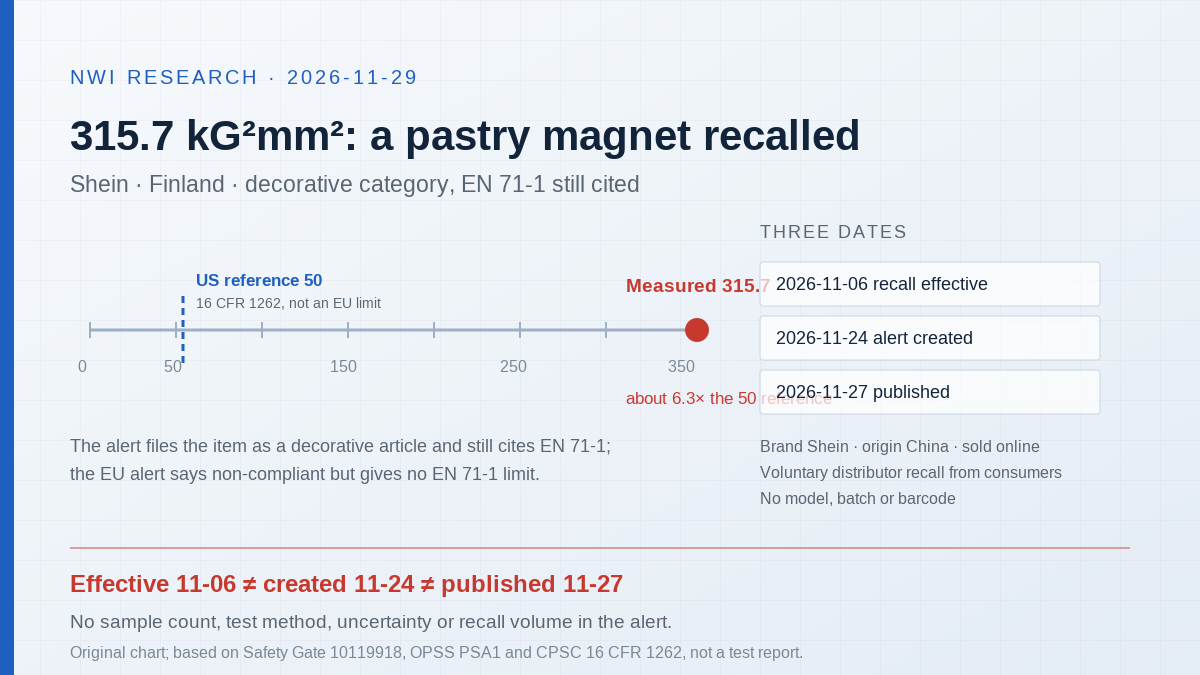
The decision is whether a food-shaped fridge magnet sold as decorative should be tested against a toy-standard magnetic flux limit, and whether to stop selling before a regulator asks. On 27 November 2026 the EU Safety Gate published Finnish alert SR/03507/26: a 3D simulation cake magnet sold by Shein, shaped like a square cherry pastry and containing a magnet, was recalled from consumers. The record states a measured magnetic flux of up to 315.7 kG²mm² and says the product does not comply with the General Product Safety Regulation (GPSR) or EN 71-1. The measure is a voluntary distributor recall effective 6 November 2026. For sellers of home decor, fridge magnets, gifts and food-shaped small items, this is not someone else's recall; it is a classification and evidence check.
1. What the alert says, and what it does not
Start with the fields that can be checked. Everything in the table below comes from the Safety Gate record; the gaps are listed after it.
| Field | Alert record |
|---|---|
| Reference | SR/03507/26 |
| Notifying country | Finland |
| Product | 3D simulation cake magnet; square cherry pastry shape with a magnet |
| Category | DECORATIVE_ARTICLES |
| Brand / origin | Shein / China |
| Sold online | Yes |
| Risk | Choking, injuries; measured magnetic flux up to 315.7 kG²mm² |
| Legal basis | Non-compliant with the GPSR and with EN 71-1 |
| Measure | Recall from consumers; voluntary; distributor; effective 2026-11-06 |
| Identifiers | No model, batch or barcode |
Keep the dates apart. The alert was created on 24 November 2026 and published on 27 November, but the measure took effect on 6 November. Finland's Safety and Chemicals Agency, Tukes, had already announced the recall of two Shein products through Vaarallisettuotteet.fi on 19 November, and Shein stopped selling and began collecting the products after Tukes contacted it. The EU alert is a publication event, not the start of the recall. Treating 27 November as the start would miss the weeks in which units were already with consumers.
The record gives no model, batch or barcode, no sales volume, no selling period, no sample count, no test method or measurement uncertainty, and no listing or store identifier; the online-trader field reads Other / Shein. That means it cannot tell you whether the stock in your warehouse is the same item. You can only compare the description and the three photos. Anyone who turns this alert into a blanket claim that all food-shaped magnets are illegal has gone beyond the evidence.
2. The mechanism: food imitation plus a small magnet
Two risks sit on top of each other. The first is food imitation: the color, form and shape make the item easy to mistake for food, so a young child may bite it or put it in the mouth and choke. The second is the magnet: if a small magnet is swallowed, two or more can attract each other across the intestinal wall, causing blockage or perforation. The risk is not that the magnet is strong on its own: the pastry shape invites a child to mouth it, the small magnet is swallowed, and two or more magnets attract across tissue, risking blockage or perforation.
The flux index describes how strongly a magnet is attracted to another magnet. It is the square of the magnetic flux density multiplied by the pole area, so a higher-grade magnet or a larger pole area raises the number. The alert gives one result, a measured maximum of 315.7 kG²mm². It does not give the method, the number of samples, the uncertainty, or whether the value refers to a single magnet or the whole item.
The part sellers should notice is that the alert classifies the product as a decorative article and still cites EN 71-1. The category label did not automatically remove the product from the toy standard. The UK OPSS alert PSA1 of 5 April 2022 lists fridge magnets among magnetic products and says the acceptable maximum magnetic flux index for toys is set in EN 71; OPSS recommends applying that level to any product where magnets may be ingested by a child, not only to toys. That precedent is not EU law, but it shows the assessment path: check whether the magnet is accessible and whether a child could swallow it, then look at what the product is called.
For scale, use a cross-standard reference. The US CPSC final rule 16 CFR 1262 sets a flux index of less than 50 kG²mm² for loose or separable magnets that fit entirely within the small parts cylinder, measured by the ASTM F963 method, with toys exempt. 315.7÷50=6.314, about 6.3 times. This is the US magnet-product figure, not the legal limit in EN 71-1; the EU alert only says the product does not comply with EN 71-1 and gives no limit. Use it as an order-of-magnitude reference, not as the EU enforcement threshold.
3. Evidence boundaries: what 315.7, the dates and Shein can prove
The alert gives no model, batch or barcode, no sample count, test method or uncertainty; 315.7 proves the sampled item, not every unit in your warehouse. It supports the judgment that this sample is well above a common toy magnet benchmark, not the claim that every unit of the SKU, or every similar product, fails; nor does the alert say whether other colors, packs or magnet batches of the same design also failed.
Separate the brand from the operator. The brand is Shein, the economic operator in the measure is a distributor, and the online-trader field reads Other / Shein. That supports the statement that the product was sold through Shein, but it does not establish whether Shein was the manufacturer, importer or marketplace, and it does not turn a distributor's voluntary recall into a platform penalty. Collapsing the three layers into a claim that Shein was fined is inaccurate and misdirects the supplier follow-up.
Separate recall from injury. The risk description is a probability judgment and the measure is a voluntary recall; the record reports no accident or injury. That does not lower the risk, but it sets the strength of the evidence: the regulator judged the risk unacceptable, not that someone was hurt, and not that every unit will fail. A voluntary recall is also not a clean bill of health; the refunds, delistings and stock write-offs are real.
Finally, the alert does not explain why a decorative article was assessed under EN 71-1. A reasonable explanation is that the food shape plus an accessible magnet creates a child-ingestion path, but that is analysis, not the alert's text. The triage table and test advice later in this article are operating judgments inside that evidence boundary, not legal advice.
4. Counter-cases: when a decorative argument can work, and when it cannot
The counter-case is a magnet fully enclosed and not separable in an adult homeware product with no child appeal; that argument can work, but only with a risk-assessment file, not a not-a-toy line in a listing. A file at least needs structural evidence that the magnet is inaccessible, an abuse test showing it stays inaccessible, a description of the target user and selling context, packaging warnings, and a report that names the clause and the measured value.
Four arguments fail. First, it is a fridge magnet, not a toy: the OPSS precedent lists fridge magnets among magnetic products, and a category name is not an exemption. Second, the listing says 14+: an age label has to match the product's function, size and appearance; an inflated label can highlight the conflict with child-appeal features. Third, the supplier sent a CE certificate: a certificate without clauses, without a measured flux value and without covering this SKU does not prove the magnet is safe. Fourth, add a warning label: a warning cannot make a swallowable magnet unswallowable and cannot replace a structural or material fix.
Keep one alternative explanation open: this recall may have been triggered by the combination of food shape and magnet, not by the magnet alone. A strong magnet in a product that does not look like food and is clearly aimed at adults could be assessed differently. Conversely, a weak magnet in a highly realistic food shape could still be handled for choking risk. Test and fix the two risks separately; do not package them under one decorative label.
5. Two costed scenarios: test three or all twelve, and how many units repay a recall
The two scenarios turn whether to test and whether to recall into arithmetic. Every price, hour, retail price, cost and volume is an assumption; replace them with your own numbers. The conclusions hold only while the assumptions do.
Scenario A: twelve SKUs, test three strong-magnet lines or all twelve
Assumptions: the range has twelve food-shaped magnet SKUs, three with neodymium magnets and nine with ferrite; each test costs 280 euros (180 lab, 30 sample, 70 admin), and a one-hour documentation screen per SKU costs 35 euros; one recall costs 11,600 euros as in Scenario B; platform fees, ads and refunds are excluded.
Result: testing three strong-magnet SKUs costs 3×280+12×35=840+420=1,260 euros; testing all twelve costs 12×280=3,360 euros; against an 11,600-euro recall, the break-even probabilities are 1,260÷11,600=10.9% and 3,360÷11,600=29.0%.
Decision: if you put the chance that at least one of the three strong-magnet SKUs fails above 10.9%, test three; if you put the chance that at least one of twelve fails above 29.0%, test all twelve; below both thresholds, fix documentation and warnings before scaling.
Scenario B: how many units must one recall sell to repay
Assumptions: the SKU sells at 12 euros with a 4-euro unit cost, 300 units sold and 900 in stock; a recall refunds the full 12 euros, pays 6 euros return shipping and 4 euros handling per unit, scraps stock at 4 euros a unit, and uses 40 admin hours at 35 euros; platform fines, legal fees, complaints and brand damage are excluded.
Result: refunds 300×12=3,600, return shipping 300×6=1,800, handling 300×4=1,200, stock write-off 900×4=3,600 and admin 40×35=1,400 total 11,600 euros; the recall costs 11,600÷300=38.67 euros per unit sold; at 12−4=8 euros contribution, it takes 11,600÷8=1,450 units to repay, while selling all 1,200 units contributes only 1,200×8=9,600 euros.
Decision: if the SKU cannot reach 1,450 lifetime units, one recall costs more than the entire batch contributes; without flux and accessibility evidence, not listing the strong-magnet line is cheaper than recalling it later.
Under the assumptions, testing three strong-magnet SKUs costs 3×280+12×35=1,260 euros, 10.9% of one 11,600-euro recall; testing all twelve costs 3,360 euros, or 29.0%. Both scenarios are hypothetical, not measurements by Shein, the Finnish authorities, any seller or NWi. The 280 euros per test, 35 euros an hour, 12-euro retail price, 4-euro cost, 6-euro return shipping, 4-euro handling, 300 units sold and 900 in stock can all be replaced. The 10.9% and 29.0% figures are operating thresholds, not statistical significance tests; they exist to make you stop and calculate before scaling, not to prove that a SKU will fail.
6. Action and stop conditions: a 48-hour triage
Within 48 hours, export every food-shaped decorative SKU with a magnet, tag it by magnet grade, separability, small-parts fit and an EN 71-1 report with clauses and measured values, then choose delist, test or file. If any of the four cannot be answered, treat the SKU as unverified, not as probably fine.
- Fields: SKU, magnet grade and dimensions, whether the magnet is separable, whether it fits entirely in the small parts cylinder, the report's clauses and measured flux, age label, packaging warnings, marketplace, units sold, stock, retail price and unit contribution.
- Supplier: request the BOM and magnet specification, and a report that names the EN 71-1 clause and the measured value; a CE certificate or declaration of conformity without values counts as not provided.
- Sampling: sample current stock, not a golden sample; split samples by color, pack and magnet batch within the same SKU.
- Stop-sell triggers: no report or unknown flux; a separable magnet that fits the small parts cylinder; a realistic food shape a child may mouth; a platform or authority inquiry; a measured value above the threshold you adopt.
- Recall triggers: confirmed accessible magnet above the threshold, sold in the EU or EEA, with a child-ingestion path; or an authority order or platform removal.
- Do not: relabel and keep selling; use one SKU's report to cover the whole magnet family; treat decorative as a get-out word; describe a distributor's recall as a platform penalty.
Write the stop conditions down. If the report proves the magnet is fully enclosed, stays inaccessible after abuse testing and the product has no child-appeal features, file it and keep selling. If it only proves the magnet is strong but cannot come out, that is not enough; fix the structure or material. If the fix still cannot prove inaccessibility, delist. A workable timetable is: day 1 export the list, day 2 send the supplier questionnaire, day 7 send the high-risk SKUs for testing, day 14 decide delist, fix or file.
7. What it means for cross-border sellers: classification evidence beats the word decorative
The alert does not change whether magnetic products can be sold. It changes what you need to prove that your product is not the high-risk combination. Many teams used the category, the listing title and the word decorative as the test; regulators now look at whether the magnet is accessible, what its flux is, and whether a child would treat it as food. All three can be answered with documents and tests before listing, without waiting for a recall.
For a data team, market data can decide whether a category is worth entering, but it cannot replace compliance evidence. Within the modules enabled for an account, NWi CrossborderGo provides market-side sales, price bands and brand, store and product research by platform, country, category and time range; it can help size a food-shaped home-decor category, its price bands and substitute concentration. It does not test magnetic flux or decide whether a product is a toy, and the available sites, history and fields depend on the account authorization and contract. Related entry points: [NWi CrossborderGo](/product/), [request a demo](/demo/).
If a team wants supplier questionnaires, test reports, platform rules and recall costs in one research workflow, NWi Cross-border Agent can help break down the question, organize the evidence and draft a conclusion for review; its consumer and review insight applies to selected brands, its product-innovation advisor focuses on beauty, and its creator-marketing advisor currently lists Vietnam, Indonesia and Malaysia only, so do not describe it as full-brand, full-category or market-wide coverage. MCP data access also depends on actual integration and permissions; a menu entry does not prove a connection. Related entry points: [Cross-border Agent](/page/agent.html), [MCP data access](/mcp/).
The original contribution is turning decorative from a disclaimer into an evidence table: is the magnet accessible, what is its flux, can a child mistake it for food; if any answer is missing, do not keep selling.
This article has no Shein sales, stock, test report or recall volume, and no EU court or Commission ruling on whether a decorative magnet is a toy; every cost figure is an assumption, not a benchmark.
8. Method and sources
Data basis: on 29 November 2026 this article reopened the JSON record of EU Safety Gate alert 10119918 (SR/03507/26) and checked the creation date of 24 November 2026, the publication date of 27 November 2026, the measure's entry into force on 6 November 2026, the DECORATIVE_ARTICLES category, the Shein brand, China as country of origin, online sale, the distributor's voluntary recall from consumers, and the measured magnetic flux of up to 315.7 kG²mm² in the risk description. On the same day it read MTV Uutiset's 19 November 2026 report on Tukes publishing two Shein recalls through Vaarallisettuotteet.fi and Shein stopping sales and collecting the products after Tukes contacted it. For the regulatory precedent it read the UK OPSS PSA1 alert of 5 April 2022, which lists fridge magnets among magnetic products and recommends applying EN 71's magnetic flux level where a child may ingest a magnet. For the numerical reference it read the US CPSC final rule of 21 September 2022 (16 CFR 1262), which sets a flux index limit of 50 kG²mm² for magnet products, measured by the ASTM F963 method, with toys exempt. Calculations: Scenario A, 3×280+12×35=1,260, 12×280=3,360, 1,260÷11,600=10.9%, 3,360÷11,600=29.0%; Scenario B, 300×12=3,600, 300×6=1,800, 300×4=1,200, 900×4=3,600, 40×35=1,400, total 11,600, 11,600÷300=38.67, 12−4=8, 11,600÷8=1,450, 1,200×8=9,600. Test prices, sample costs, labor, retail price, unit cost, return handling, stock and units sold are labeled assumptions, not measurements by Shein, the Finnish authorities, any seller or NWi.
This article was prepared with automated research assistance from the public sources listed at the end and has not been reviewed by a human editor; it does not invent customer data, expert review, platform testing or ranking results. It is not legal, compliance, platform-operations or advertising advice; whether a product is a toy, whether its magnetic flux passes, and whether it should be recalled depend on current EU and target-market law, an accredited laboratory report, platform rules and the competent authority's answer. Public-source analysis is not a market-wide test report.
- European Commission — Safety Gate, 2026-11-27 (created 2026-11-24), Safety Gate alert SR/03507/26: 3D simulation cake magnet: Finnish notification, Shein brand, China origin, decorative category, measured 315.7 kG²mm², GPSR and EN 71-1, distributor's voluntary recall from consumers, effective 2026-11-06.
- MTV Uutiset, 2026-11-19, Tukes varoittaa kahdesta Sheinin tuotteesta – poistettava heti käytöstä: Tukes published two Shein recalls through Vaarallisettuotteet.fi, the pastry magnet's magnetic part can cause choking and internal-organ injury, and Shein voluntarily stopped selling and began collecting products after Tukes contacted it.
- Office for Product Safety and Standards (UK), 2022-04-05 (publication), Product Safety Alert: Small, High-Powered Magnetic Products (PSA1): lists fridge magnets among magnetic products, states that EN 71 sets the toy magnetic flux level and recommends applying it to any product where a child may ingest a magnet.
- U.S. Consumer Product Safety Commission, 2022-09-21, Safety Standard for Magnets (16 CFR 1262): loose or separable magnets that fit the small parts cylinder must have a flux index below 50 kG²mm², measured by ASTM F963, with toys exempt.