
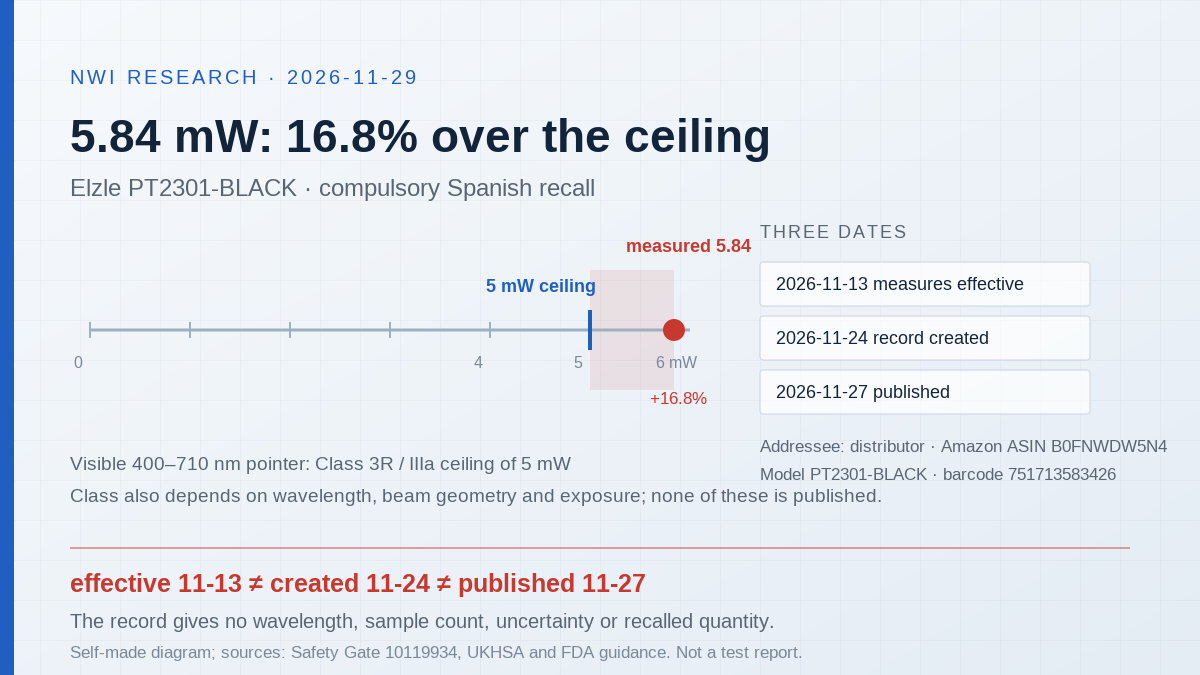
The real decision is whether to run a per-model EN 60825-1 power and label review first, or to delist every laser pointer and presenter after the Spanish alert. The alert was published on 27 November 2026, but the three compulsory measures took effect on 13 November 2026; for the named Amazon ASIN B0FNWDW5N4 this is not about to happen - it already did.
1. What the record says: one model, one ASIN, three dates
EU Safety Gate record SR/03497/26 was notified by Spain, published on 27 November 2026, created on 24 November and not corrected since. The product name is "100M remote control distance. Laser presenter", the version name is "Laser pointer", and it is described as a laser pointer with a remote control in a white cardboard box. Origin: China. Sold online: yes.
| Field | Record |
|---|---|
| Product / version | 100M remote control distance. Laser presenter / Laser pointer (with remote control) |
| Notifying country / reference | Spain / SR/03497/26 |
| Created / published | 2026-11-24 / 2026-11-27 |
| Brand / model | Elzle / PT2301-BLACK |
| Batch / barcode | not provided / 751713583426 |
| Sold online / listing identifier | yes / Amazon ASIN B0FNWDW5N4 |
| Addressee / measure type | distributor / compulsory (recall, withdrawal, consumer warning) |
| Effective date | 2026-11-13 |
| Measured value / legal basis | up to 5.84 mW / GPSR and EN 60825-1 |
| Risk type | damage to sight |
Read the three dates separately: the measures took effect on 13 November 2026, the record was created on 24 November, and it was published on 27 November. Fourteen days separate the effective date from publication, so a seller who starts checking only when the alert appears has already missed the most dangerous window. The measures are not a request to fix something: recall from consumers, withdrawal from market and consumer warning are compulsory and simultaneous.
The addressee matters more than the hazard wording. The record names the distributor, not the manufacturer. For a seller that buys from a brand or importer and lists under its own marketplace account, this is more direct than manufacturer liability: you may be the party ordered to recall and withdraw.
The record gives one online listing identifier, Amazon ASIN B0FNWDW5N4, but does not say whether that listing is still live or what the marketplace did. An alert is an authority record, not proof of platform action; conversely, a live listing does not mean the alert does not apply.
2. What 5.84 mW against 5 mW actually means
5.84 mW matters because the visible-band Class 3R ceiling is 5 mW, and the 16.8% overshoot is enough to put a pointer designed at the ceiling on the wrong side of the limit.
UKHSA's laser safety advice describes Class 3R as having "a maximum output power of 5 mW" and warns that direct intrabeam viewing can injure the eye; the same page notes that BS EN 60825-1 sets out eight laser classes. US FDA guidance for pointer manufacturers is more explicit: pointers promoted for pointing and demonstration are limited to Class IIIa, which means 5 mW in the visible 400-710 nm range, and pointers "may not exceed the accessible emission limits of CDRH Class IIIa or IEC Class 3R".
Against 5 mW, 5.84 / 5.00 = 1.168, or 16.8% above. That is not an order-of-magnitude failure; it is a marginal one. The same design with slightly lower output or better consistency could sit inside the limit - and, in the other direction, ordinary batch variation can push a compliant design outside it.
Class is not decided by power alone. Wavelength, beam diameter and divergence, and exposure duration all affect the accessible emission limit; the alert publishes none of these and no measurement uncertainty. The 5.84 mW figure therefore shows non-compliance under the measurement conditions used, not the product's declared class, and it does not prove the device is Class 3R.
If unit-to-unit power varies with a 5% coefficient of variation, keeping 99% of units below 5 mW requires a design target no higher than 5 x (1 - 2.326 x 0.05) = 4.42 mW. At 10% variation the same formula gives 5 x (1 - 2.326 x 0.10) = 3.84 mW. Both numbers are conditional calculations, not this product's design values and not an EN 60825-1 requirement; they show that a product designed at the ceiling has almost no room for batch variation.
Near the limit, uncertainty also decides the answer. A 5.84 mW reading with +/-10% (k = 2) spans 5.26-6.42 mW, still above 5 mW; but a 5.20 mW reading spans 4.68-5.72 mW, straddling the limit. In that case the laboratory's uncertainty statement and decision rule decide whether the unit passes, and a point estimate below 5 mW is not enough.
3. Evidence boundary: what one alert can and cannot prove
The alert gives one measured maximum and two legal bases, but no test report, sample count, wavelength, beam diameter or measurement uncertainty, so it cannot prove every batch of the same model exceeds the limit.
- It proves that this model, PT2301-BLACK, was measured at up to 5.84 mW by the authority and judged non-compliant with the GPSR and EN 60825-1, and that the measures are already effective and addressed to the distributor.
- It does not prove that other models, batches, colours or stores selling the same model are affected; there is no batch number and no comparison across batches.
- It does not prove the marketplace removed everything. There is one online identifier, an Amazon ASIN, with no platform-action statement and no recalled quantity.
- It does not prove an industry-wide problem. A single record cannot be used to estimate a non-compliance rate for the category.
To test whether this is a dense cluster, on 29 November 2026 I sampled Safety Gate public notification ids 10119820-10119999 through the API: 71 valid notifications were published between 20 and 27 November 2026, and exactly one was in the laser pointer category, this SR/03497/26. That is an id-range sample, not a full census, and it cannot be used to estimate a failure rate; it only shows that laser alerts were not dense in this window, which argues against shutting down the whole category.
4. Scenario A: four laser SKUs, test first or wait for the marketplace to act
Scenario A: four laser SKUs, test first or wait for the marketplace to act
Assumptions: each of four laser SKUs gets one EN 60825-1 power and class assessment plus label review at EUR 350, so EUR 1,400 in total; the named model has 300 units in stock and 200 sold, at EUR 4.10 landed cost per unit and EUR 6.00 net handling cost per sold unit; the other three SKUs hold 900 units and 600 sold; commissions, ads, penalties and lost traffic are excluded.
Result: testing costs EUR 1,400. If one SKU fails, the failure costs 300 x EUR 4.10 + 200 x EUR 6.00 = EUR 1,230 + EUR 1,200 = EUR 2,430, so the total is EUR 3,830. Waiting for the marketplace and handling all four SKUs costs 1,200 x EUR 4.10 + 800 x EUR 6.00 = EUR 4,920 + EUR 4,800 = EUR 9,720, a difference of EUR 5,890.
Decision: isolate the named model and ASIN, run the power and label review per model, and resume only when the report covers the batch on sale and leaves measured headroom. The EUR 1,400 buys a reduction from EUR 9,720 of passive exposure to EUR 3,830, provided the report can be tied to the batch.
5. Scenario B: a 60-unit trial batch should not pay for full certification
Scenario B: a 60-unit trial batch should not pay for full certification
Assumptions: a new product sells as a 60-unit trial at EUR 4.10 landed cost and EUR 12.90 retail; a full EN 60825-1 assessment plus label review costs EUR 350 per model; stopping the trial without testing writes off 60 x EUR 4.10 = EUR 246 of inventory.
Result: EUR 350 / EUR 246 = 1.42, so the test fee is 1.42 times the inventory exposure; with only 60 units sold and no other channel stock, paying for full certification costs more than stopping the trial.
Decision: compute exposure as stock x landed cost + sold units x net handling cost before choosing how many models to test; when exposure is clearly below the test fee, stop selling and request the supplier's report, and when exposure is far above it, test first and isolate.
This is not an argument against testing; it is an argument against running every SKU through the same process. A trial batch exists to validate demand and supply, not to absorb full certification cost, while a lead SKU with large exposure makes a EUR 350 test fee small next to EUR 9,720 of passive handling. Compute exposure first, then choose how many models to test; that is closer to the real decision than testing everything or testing nothing.
6. Counter-cases: not every laser product should stop
The counter-case is not about being less careful; it is about not turning a compulsory recall of one ASIN into a shutdown of an entire laser category.
- Counter-case one: treating all laser products as one class. UKHSA describes Class 1 as safe in normal use and Class 2 as safe for short exposure in 400-700 nm; enclosed laser printers, some barcode scanners and presentation pointers have different limits and use contexts.
- Counter-case two: using a "Class 2, below 1 mW" label as proof. UKHSA lists higher-than-stated output, additional invisible wavelengths and incorrect labelling as common problems, with the typical example of a pointer marked Class 2 (or below 1 mW) that measures as Class 3B. A label is a declaration, not a measurement.
- Counter-case three: assuming a new label fixes it. The OPSS report of October 2023 on three high-powered pointers sold via Amazon found Class 3 or 4 products whose labels and manuals were both incorrect, and the marketplace removed the listings. A label can be changed; power cannot be changed by relabelling.
- Counter-case four: applying the UK finding directly to the EU. The OPSS report rests on the UK General Product Safety Regulations 2005, while the Spanish record cites the GPSR and EN 60825-1; the direction is the same but the law, penalties and procedure are not.
- Counter-case five: assuming other stores or variants are safe because the alert names one ASIN. The traceability keys are model and barcode, not store; the same model on another site needs its own check, and "not my store" is not an exclusion.
7. Action list and stop conditions
- Build a laser SKU log: model, barcode/ASIN, declared power and class, wavelength, supplier, stock and sold units, price and contribution; flag PT2301-BLACK and B0FNWDW5N4 separately.
- Ask the supplier for three things: an EN 60825-1 report tied to the batch on sale (with wavelength, power, class, uncertainty and sample count), label and manual photos, and compliance files for batteries and remotes.
- Audit the label: class marking, wavelength, maximum output and warnings must match the report; products with child-appealing designs need the stricter treatment, and BS EN 50689:2021, as cited by UKHSA, limits child-appealing consumer lasers to Class 1.
- Isolate before testing: stop the named model and ASIN first, then rank the remaining SKUs by exposure and test the highest-contribution models whose declared power sits closest to 5 mW.
- Record the decision: which models were tested, report dates, batches covered, conclusions and the resume date; without batch traceability, widen the scope to the same supplier and model.
Isolate the named model and ASIN first, then ask the supplier for an EN 60825-1 report and label photos per model, and resume only when the report covers the batch on sale with measured headroom.
Stop conditions: a measured value above the applicable limit with no effective remedy, a report that does not cover the batch on sale, a label that contradicts the report, an unconfirmed wavelength or class, or a supplier that refuses to provide a test report. Any one of these means the product does not go back on sale.
8. Unknowns and limits
- The alert does not publish wavelength, beam parameters, sample count, test method, measurement uncertainty or recalled quantity.
- The 5 mW figure is the visible-band (400-710 nm) pointer ceiling; other wavelengths and pulsed conditions have different limits and cannot be handled with a single 5 mW rule.
- The id-range sample covers only part of the notifications published between 20 and 27 November 2026, is not a full census and cannot be used to estimate a category failure rate.
- The UK OPSS report and the US FDA guidance are regulatory material from other jurisdictions, used only to explain limits and common failure modes; they are not EU legal conclusions.
- This article is not legal, testing, compliance or platform-operations advice; whether a specific product is affected and whether to stop, recall or retest should be confirmed with the latest Safety Gate record, the EN 60825-1 text, an accredited laboratory, counsel and the competent authority.
This article did not measure laser power and has no seller inventory, sales or platform-action data; the alert omits recalled quantities, the test method and measurement uncertainty.
9. The analytics increment: rank exposure before choosing what to test
The usual mistake with an alert like this is to treat one ASIN as the whole category, or to treat one ASIN as somebody else's problem. A more useful order is to use platform, site, category, brand/store and product data to find which laser SKUs carry the largest stock and sold-unit exposure and which price bands contribute most, then set testing and isolation priorities. Data cannot replace a test, but it can put a limited testing budget on the SKUs most likely to fail and most expensive to stop.
Within enabled modules, NWi CrossborderGo provides platform, site, category, brand/store and product data to estimate category size, price bands and SKU sales exposure (monthly Amazon EU and other site data, with available sites, history and fields depending on account authorization and the contract). It does not measure laser power, issue EN 60825-1 reports, trace batches, confirm listing status or execute recalls.
- See category size, price bands and SKU exposure on your own sites: book a demo.
- See the platforms and fields covered: NWi CrossborderGo.
- Amazon category and product analysis: Amazon data analysis.
The original increment is splitting the 5.84 mW reading into three layers - the limit, batch variation and measurement uncertainty - and using test cost against inventory exposure to decide which models to test first.
10. Method and sources
Data basis: on 29 November 2026 this article reopened EU Safety Gate notification 10119934 (SR/03497/26) and checked the notifying country (Spain), publication date (27 November 2026), creation date (24 November 2026), brand Elzle, model PT2301-BLACK, barcode 751713583426, the absence of a batch number, origin (China), the online listing identifier (Amazon ASIN B0FNWDW5N4), the three compulsory measures (recall from consumers, withdrawal from market, consumer warning) and their 13 November 2026 effective date, that the measures are addressed to the distributor, and the risk type (damage to sight). It also reopened the UKHSA laser safety advice page (first published 8 August 2014, public update 18 March 2025), the UK OPSS product safety report of 5 October 2023 on high-powered laser pointers and the US FDA guidance for laser pointer manufacturers. Calculations: 5.84 / 5.00 = 1.168, or 16.8% above; design margin at one-sided 99% (z = 2.326) equals 5 x (1 - 2.326 x 0.05) = 4.42 mW at 5% variation and 5 x (1 - 2.326 x 0.10) = 3.84 mW at 10%; under +/-10% uncertainty (k = 2), 5.84 mW spans 5.26-6.42 mW and a 5.20 mW reading spans 4.68-5.72 mW; Scenario A uses 4 x EUR 350 = EUR 1,400, failure handling 300 x EUR 4.10 + 200 x EUR 6.00 = EUR 1,230 + EUR 1,200 = EUR 2,430, total EUR 3,830, handling all four 1,200 x EUR 4.10 + 800 x EUR 6.00 = EUR 4,920 + EUR 4,800 = EUR 9,720, difference EUR 5,890; Scenario B uses 60 x EUR 4.10 = EUR 246 and EUR 350 / EUR 246 = 1.42. All inventory, cost, test-fee, handling and unit figures are labelled assumptions, not measurements from Safety Gate, UKHSA, OPSS, the FDA or any seller. The id-range sample 10119820-10119999 is a sample, not a full Safety Gate census. Product scope: NWi CrossborderGo provides platform, site, category, brand/store and product data within enabled modules to estimate laser category size, price bands and SKU sales exposure; it does not measure laser power, issue EN 60825-1 reports, trace batches, confirm listing status or execute recalls, and available sites, history and fields depend on account authorization and the contract.
This article was prepared with automated research assistance from the public sources listed at the end and has not been human-reviewed; it does not invent customer data, expert review, test results, platform action or ranking outcomes. It is not legal, compliance, product-safety or platform-operations advice. Whether a specific product is affected, whether to stop selling, recall or retest, which market applies, and how to engage an authority or platform should be confirmed with the latest Safety Gate record, the EN 60825-1 text, an accredited testing laboratory, counsel and the competent authority. Analysis of public material is not a whole-market test report.
- European Commission - Safety Gate, 27 November 2026, alert 10119934 (SR/03497/26): Elzle PT2301-BLACK laser presenter measured at up to 5.84 mW, non-compliant with the GPSR and EN 60825-1; compulsory recall from consumers, withdrawal from market and consumer warning effective 13 November 2026, addressed to the distributor; Amazon ASIN B0FNWDW5N4; origin China.
- UKHSA, Laser radiation: safety advice (first published 8 August 2014, public update 18 March 2025): Class 3R maximum output power 5 mW; common problems include higher-than-stated output, additional invisible wavelengths and incorrect labelling; BS EN 50689:2021 allows Class 1, Class 2 and a subgroup of Class 3R, with child-appealing consumer lasers limited to Class 1.
- UK OPSS, 5 October 2023, Product Safety Report: High Powered Laser Pointers sold via Amazon: three ASINs, Class 3 or 4 products, incorrect labels and manuals, listings removed by the marketplace; legal basis the UK General Product Safety Regulations 2005.
- US FDA, Important Information for Laser Pointer Manufacturers: pointers limited to Class IIIa, 5 mW in the visible 400-710 nm range, and may not exceed the accessible emission limits of CDRH Class IIIa or IEC Class 3R.