
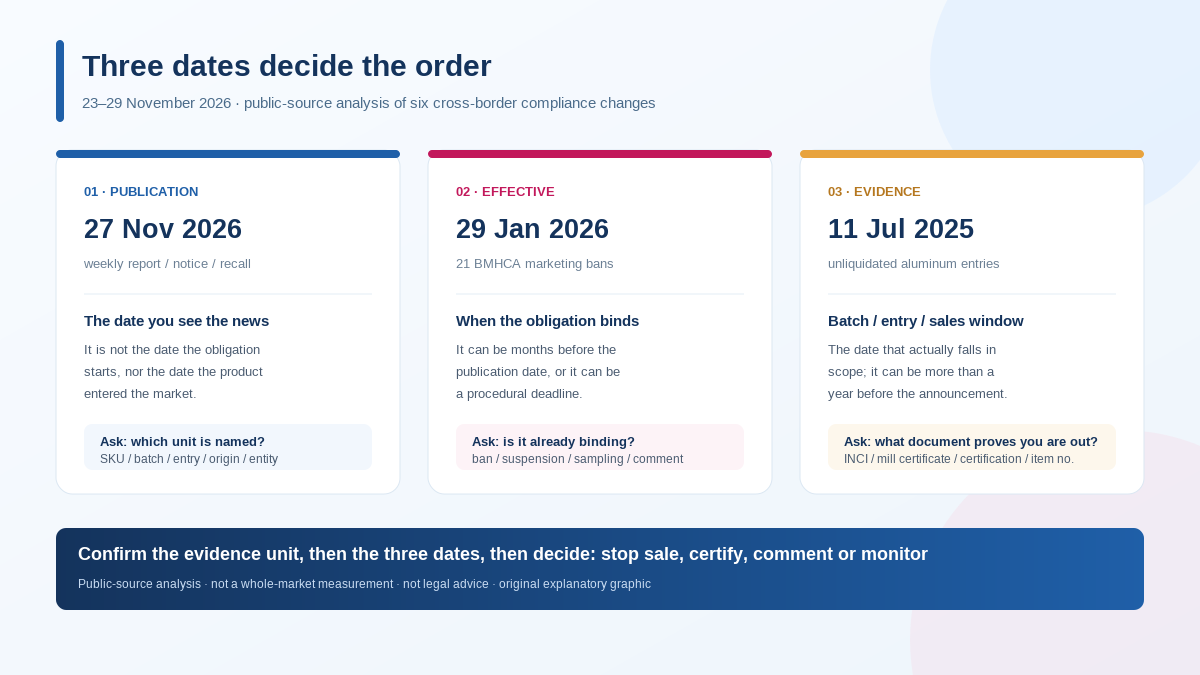
If you sell cosmetics, lighting, children's products, mattresses or aluminum containers in the EU, the UK or the US, this week can look like six unrelated headlines. They point to one decision. The decision this week is whether to react headline by headline, or to map SKUs, batches, customs entries and origin against three dates: publication, effective and evidence. The answer is not which headline is bigger; it is which date already binds, which unit is named, and which document can prove you are outside the scope.
This analysis covers public material from 23 to 29 November 2026 (Monday to Sunday; cutoff 08:30 Asia/Shanghai on 29 November). It selects six changes with official primary documents and a date or scope that is easy to misread. It is not a whole-market measurement report or legal advice.
1. What changed this week: six changes, five evidence units
Start with the overview table. "Evidence unit" means the level of material needed to prove whether you are in scope; it is not the listing status in a platform back end, and it is not a brand name.
| Change | Publication | Effective/procedural date | Evidence unit | What it does not prove |
|---|---|---|---|---|
| EU Safety Gate week 47 BMHCA cosmetics | 27 Nov 2026 report | 21 bans on 29 Jan 2026; 3 destructions on 16 Nov; 1 recall on 5 Nov | SKU/INCI/batch | Not 25 new violations, and not a brand-wide breach |
| EU mattress anti-dumping initiation | 27 Nov 2026 Official Journal | Importer sampling 4 Dec; scope comments 7 Dec; initiation comments 3 Jan 2027; no duty yet | Importer/entry/product definition | 4 December is not a registration or duty date |
| US aluminum-container circumvention | Public inspection 27 Nov; published 30 Nov | Vietnam/Thailand final applicable 30 Nov, suspension from 11 Jul 2025; UAE preliminary from 10 Feb 2026 | Entry/foil origin/certification | Not all aluminum containers, and not all origins |
| UK OPSS Christmas lighting (two cases) | 27 Nov 2026 | Border rejection/recall, immediate | Model/barcode/plug/battery compartment | The two cases rely on different regulations and are not one defect |
| UK OPSS children's products (two cases) | 27 Nov 2026 | Recall, immediate | Barcode/item number/hair component/neck opening | The Tesco notice gives no standard clause or afterflame seconds; do not invent a threshold |
| US CPSC adult bed rails (two cases) | 25 Nov 2026 | Recall, immediate | Model/batch | Both say no incidents reported; that does not cover all bed rails |
These six are not a ranking of importance. They were selected because an official primary document can be checked, the dates are easy to misread, and there is a clear seller action. Changes supported only by media retellings or competitor estimates were not included.
2. The three dates: publication, effective and evidence
The three dates are publication, effective and evidence: publication is when the document is made public, effective is when the obligation or procedural right starts to bind, and evidence is the batch, entry or sales window that actually falls in scope.
Take BMHCA. The Safety Gate week 47 report has a report_date of 27 November 2026 and contains 110 notifications, of which 25 are BMHCA cosmetic notifications. Twenty-one marketing bans took effect on 29 January 2026, three destructions on 16 November 2026 and one recall on 5 November 2026. The 25 publication dates run from 18 to 25 November, all before the report date. The report is therefore not a new rule; it is a batch publication of measures that had already taken effect or been applied.
Take aluminum containers. The Vietnam and Thailand final determinations are published and applicable on 30 November 2026, but suspension of liquidation for unliquidated entries starts on 11 July 2025, the date the circumvention inquiry began. The UAE determination is preliminary, with suspension from 10 February 2026. The finals also state that they no longer apply retroactive suspension before initiation, but that does not mean there is no past exposure: entries on or after 11 July 2025 remain in scope.
Take mattresses. The 27 November 2026 notice is only an initiation. Unrelated importers have seven days to submit sampling information (4 December), product-scope comments are due in ten days (7 December), and comments on the initiation itself are due in 37 days (3 January 2027). Provisional measures follow the basic regulation's timetable; there is no duty today. Calling 4 December a "registration effective date" is misleading: the notice says a registration regulation will be published in due time, not that registration happened on 4 December.
Take OPSS and CPSC. The publication date is the date the recall or border rejection becomes public, but the product entered the market during an earlier sales window. The two CPSC recalls dated 25 November cover products sold on Amazon.com from December 2025 to October 2026 and from March to July 2026; the OPSS Next sleep-bag recall names 22 item numbers, and the Tesco wig recall names one barcode. The publication date is neither the sales date nor the production date.
3. The evidence unit: a listing is not enough, and neither is a brand
Across the six changes, there are at least five evidence units: formula/INCI, model/batch, barcode/item number, customs entry/origin, and legal entity/importer. A platform listing and a brand name are usually not the unit named by the authority.
| Evidence unit | This week's example | What it can prove | What it cannot prove |
|---|---|---|---|
| Formula/INCI | 25 BMHCA cosmetic alerts | That formula contains a prohibited substance and the ban is already effective | That every other formula under the brand also contains it |
| Model/batch | CPSC HOMEAL Model 317 / Batch BG-202501129-001; Easymake HC030-3 | That model/batch is recalled | That every other model under the brand is recalled |
| Barcode/item number | Tesco wig barcode 5063445972016; 22 Next sleep-bag item numbers | That barcode/item number is recalled | That every similar product is unsafe |
| Customs entry/origin | Vietnam/Thailand aluminum finals; UAE preliminary | Whether that entry can be certified and whether liquidation is suspended | That the country of assembly is the country of origin |
| Legal entity/importer | Mattress initiation's unrelated-importer sampling | That importer must submit sampling information | That 4 December is a registration effective date |
This table explains why "delist the brand" is often insufficient: one BMHCA brand may have several formulas; one aluminum product may be treated differently depending on the origin of the foil; CPSC names a model/batch; and the Tesco wig notice does not even give the standard clause or afterflame seconds. The reverse is also true: a notice that names one model does not make every SKU under the brand a recalled product.
An official notice can prove that the named model, batch or entry is in scope, but it cannot prove that every other SKU, batch or origin under the same brand is also non-compliant.
4. Conflicting evidence: where the official documents diverge
The first conflict is publication versus effective date. The BMHCA report was published on 27 November, but 21 bans had already taken effect on 29 January. If you read only the report date, you think there is time; if you read only the effective date, you think it is old news. The correct reading is that the measures already bind, but the product-level records have only now been published together.
The counter-example is the aluminum container: the same finished product made in Vietnam may avoid the cash deposit if it uses non-Chinese foil and completes the importer and exporter certifications; but the same product using Chinese foil may still be treated under the China order rates, even when the country of assembly is different.
The second conflict is the same product under different national procedures. For Vietnam and Thailand, the aluminum determination is final, applicable on 30 November 2026, with suspension from 11 July 2025. For the UAE, it is preliminary, applicable on 30 November 2026, with suspension from 10 February 2026, and UAE producers/exporters are not currently eligible to certify. Copying the Vietnam template to the UAE would overstate the chance of a zero deposit.
The third conflict is procedural deadline versus substantive obligation. In the mattress notice, 4 December is the deadline for unrelated-importer sampling information and 7 December is the product-scope comment deadline; the notice says the registration regulation will be published separately. Treating a procedural deadline as "already registered" or "already taxed" turns a possible retroactive risk into a certainty that the document does not support.
The fourth conflict is notice detail versus evidence gap. The Tesco wig recall says the product does not meet the required flammability safety standards but gives no standard clause, afterflame seconds or specific failing component. A missing detail does not mean lower risk, and it does not license you to invent a threshold; ask the authority or the supplier instead of filling the gap with a guess.
The fifth conflict is recall volume versus incident evidence. The two CPSC recalls dated 25 November cover 8,396 units and both say "No incidents reported". "No incidents reported" means no report had been received at the time of the notice; it does not mean the product is risk-free, and it does not mean every other batch of the same model is safe. Nor should 8,396 units be read as the number of people injured.
5. Scenario A: an aluminum entry without certification
Assumptions: 20,000 aluminum containers at a declared value of EUR 0.40 each, or EUR 8,000 in total; no importer or exporter certification and no mill certificate for the aluminum foil; China-wide AD rate of 287.80% and all-others CVD rate of 317.85%; port charges, broker fees, exchange rates and final liquidation differences are excluded.
Scenario A uses 20,000 aluminum containers at a declared value of EUR 0.40 each, or EUR 8,000 in total; without certification, the AD deposit is EUR 8,000 × 287.80% = EUR 23,024 and the CVD deposit is EUR 8,000 × 317.85% = EUR 25,428, for a total of EUR 48,452, or 605.65% of the declared value.
Result: AD deposit = EUR 8,000 × 2.878 = EUR 23,024; CVD deposit = EUR 8,000 × 3.1785 = EUR 25,428; total EUR 48,452, or 605.65% of the declared value; if the certification is complete and the foil is not Chinese-origin, the cash deposit for that entry can be zero, but the documents can still be verified.
Decision: do not ship before obtaining the mill certificate and the importer/exporter certifications; if foil origin cannot be proven, switch to non-Chinese foil or price the 605.65% deposit into the landed cost before quoting.
This scenario calculates the cash deposit, not the final duty. The deposit is collected at an estimated rate; final liquidation, administrative review and company-specific rates can change the result. If the certification is complete and the foil is not Chinese-origin, the cash deposit for that entry can be zero, but the importer/exporter certifications, commercial invoice, bill of lading, mill certificate and production records still have to be submitted and can be verified. The UAE preliminary determination does not currently allow UAE producers/exporters to certify, so the Vietnam/Thailand path cannot be copied directly.
6. Scenario B: a cosmetics set with five BMHCA-positive SKUs
Assumptions: all five SKUs list BMHCA in INCI; 250 units per SKU at a cost of EUR 14 per unit and a retail price of EUR 39 per unit; testing costs EUR 300–700 per SKU; three SKUs can be reformulated or relabeled and resold, two must be written off; platform fees, returns, recall logistics and units already sold are excluded.
Result: inventory cost = 5 × 250 × 14 = EUR 17,500; testing = 5 × 300–5 × 700 = EUR 1,500–3,500; three resellable SKUs = 3 × 250 × 14 = EUR 10,500; two written-off SKUs = 2 × 250 × 14 = EUR 7,000; the stop-first resolution cost = EUR 8,500–10,500; if all five SKUs are confirmed prohibited, the full EUR 17,500 inventory is unsellable.
Decision: stop sales as soon as INCI matches, use testing to verify the batch and pursue supplier recovery, not as a precondition for continued sales; measure the returns/recall exposure on units already sold separately.
Testing here verifies whether the batch matches the label and supports supplier recovery; it does not turn a prohibited substance into a permitted one. The 21 bans took effect on 29 January 2026. If sales continued after that date, the exposure is not limited to current inventory; it also includes returns or recalls of units already sold, which this scenario does not calculate.
7. Action list and stop conditions
Turn the six changes into a seven-day action table, in this order: stop selling the SKUs confirmed in scope, then collect the documents, then decide whether to certify, comment or keep monitoring. Do not reverse the order.
Stop selling the SKUs that are confirmed in scope first, then collect formula versions, INCI, batches, models, customs entries, proof of aluminum-foil origin and importer/exporter certifications; do not wait for test results before delisting, and do not use test results to overturn a legal prohibition.
- Build a register with one row per change and columns for publication date, effective/procedural date, evidence date, evidence unit, document, owner and status.
- Map by evidence unit: formula/INCI for cosmetics; model/barcode/plug/battery compartment for lighting; item number/component for children's products; importer/entry/product definition for mattresses; entry/foil origin/certification for aluminum.
- Stop sales first where a hit is confirmed: BMHCA in INCI, a model/batch/barcode named by OPSS or CPSC, or an aluminum entry that cannot prove non-Chinese foil.
- Collect verifiable documents: formula sheet, test reports, mill certificate, commercial invoice, bill of lading, production records, importer/exporter certifications, GCC where applicable, and product-label and packaging photos.
- Set T-14/T-7/T-1 reminders for 4 December, 7 December, 3 January 2027 and 6 January 2027 (for old entries covered by the UAE preliminary); name a backup owner for each date.
- When a notice lacks technical detail, confirm in writing with the authority or supplier; do not add a standard clause, afterflame time or test threshold yourself.
Write down the stop conditions too: if the official document does not name your model, batch or origin, do not treat it as a recall; but if you cannot prove you are outside the scope, do not keep shipping. Stop shipping aluminum products when foil origin cannot be proven; stop selling cosmetics when INCI contains BMHCA; if the mattress scope is unclear, file a scope comment by 7 December or seek professional advice; when a notice such as the Tesco wig recall lacks detail, take the conservative stop-sale action first and verify afterwards.
8. Limitations: this is not a whole-market measurement
This is a public-source analysis, not an NWi whole-market measurement, and it has no seller inventory, sales, testing or customs-entry data; every scenario figure is an assumption and cannot be treated as an actual loss, actual duty or actual recall cost.
The data also has boundaries: the 25 BMHCA alerts were selected from the risk text by BMHCA or its chemical name, and the weekly report may be updated; OPSS and CPSC notices cover only the named products and cannot be turned into an overall defect rate for a product category; the aluminum documents were read from the 27 November public-inspection version before formal publication on 30 November; the mattress provisional-measure timetable follows the basic regulation and there is no duty today. Every scenario figure is an assumption, not an actual loss for NWi or a seller.
Product boundaries: [NWi CrossborderGo](/product/) provides global overview, industry, brand/store/product and custom-market research to size the affected categories, brands and price bands; it does not read OPSS, CPSC or Safety Gate notices, and it is not a recall or compliance database. [NWi Cross-border Agent](/page/agent.html) can help turn official documents into research questions; its review insights cover selected brands, its beauty-innovation advisor focuses on beauty, and its creator advisor currently covers Vietnam, Indonesia and Malaysia, not every brand or market. [NWi Operations](/products/zhiying/) supports selection and operations tracking, with market figures that are third-party estimates. [MCP](/mcp/) is the data-access discussion, with client compatibility, fields and permissions confirmed during integration. To align categories, sites, batch fields and report scope, use [request a demo](/demo/).
9. Verifiable checks for next week
If the three-date model is useful, next week should produce the following falsifiable signals. If they do not appear, the model needs revision.
- 4 December: the mattress unrelated-importer sampling deadline. Check whether the Commission separately publishes a registration regulation and whether it gives a registration start date. If not, registration remains a forward-looking risk, not an effective duty.
- 4 December: the Safety Gate week 48 report. Count, on the same basis, the share of cosmetic alerts whose measure effective date is earlier than the report date. The week 47 baseline is 25/25; if week 48 falls below 50%, the publication-lag pattern is weakening.
- 7 December: the mattress product-scope comment deadline. Check whether the definition of the "core providing the principal support function" is clarified or narrowed. If narrowed, remap SKUs and CN codes.
- 4–11 December: whether OPSS or CPSC publishes more recalls in the same product families, and whether the new notices name a model/batch/item number or only a brand. If only a brand, the evidence burden shifts to supplier documents.
- By 31 December: how CBP handles certified aluminum entries. Check whether complete certifications are accepted and whether liquidation is still suspended. If complete documents are still challenged, the real threshold is higher than the notice text.
The one-sentence falsifiable hypothesis: if next week's notices continue to show an effective date or an evidence window earlier than the publication date, the three-date ordering has explanatory power; if every new notice has publication date = effective date and names only a brand, the model needs revision.
10. Conclusion
The six changes do not share a villain or a hero, but they share an order of judgment: confirm the evidence unit, then the three dates, and only then decide whether to stop sales, certify, comment or keep monitoring. A headline tells you what happened; it does not tell you which date already binds, which unit is named, or which document can prove you are outside the scope.
The contribution is not a repeat of six headlines but a separation of publication, effective and evidence dates, plus a reusable order of judgment: confirm the evidence unit, then the date, and only then decide whether to stop sales, certify, comment or keep monitoring.
Coverage window: 23–29 November 2026, 00:00–08:30 Asia/Shanghai. This analysis uses only publicly accessible official primary documents: the EU Safety Gate 2026-W47 weekly report XML (report_date 27/11/2026; 110 notifications, parsed line by line into 25 BMHCA cosmetic notifications and their measure dates), the European Commission's mattress anti-dumping notice C/2026/6281 (27 November 2026), US Federal Register documents 2026-24184, 2026-24176 and 2026-24175 on aluminum container circumvention (published 30 November 2026; on public inspection 27 November), four UK OPSS product-safety notices dated 27 November 2026, and two US CPSC recall notices dated 25 November 2026. Counts are computed from the original documents; every scenario figure is an explicitly labeled assumption and is recalculated in the text. No seller data, platform back-end data, competitor data or third-party estimates were used. The Federal Register documents were read from the public-inspection version before formal publication on 30 November.
This analysis was prepared with automated research assistance from the public sources listed at the end and was not reviewed by a human expert. It does not invent customer data, expert review, test results, platform decisions or ranking outcomes. It is not legal, compliance, trade-remedy, tax or product-safety advice. Whether a product is in scope, whether it must be stopped, recalled or certified, which market applies, and how to engage an authority depend on the latest official texts, accredited testing, counsel and the competent authority. Public-source analysis is not a whole-market measurement report.
Sources
- European Commission – Safety Gate, 27 November 2026, Safety Gate weekly report 2026-W47 (XML): report_date 27/11/2026; 110 notifications, including 25 BMHCA cosmetics; 21 bans effective 29 January 2026, 3 destructions effective 16 November 2026 and 1 recall effective 5 November 2026; downloaded and parsed on 29 November 2026.
- European Commission, 27 November 2026, Notice of initiation C/2026/6281 (mattresses): 11 EU producers lodged the complaint on 16 October; investigation period 1 July 2025–30 June 2026; unrelated-importer sampling within 7 days, scope comments within 10 days, initiation comments within 37 days; provisional measures no later than 7 or 8 months; registration regulation to be published separately; read on 29 November 2026.
- U.S. Federal Register / International Trade Administration, public inspection 27 November 2026, published 30 November 2026, Vietnam final circumvention determination: Vietnam-completed aluminum containers using Chinese foil are found to circumvent; applicable 30 November 2026; suspension from 11 July 2025; without certification, AD 287.80% plus CVD 317.85%; public-inspection version read on 29 November 2026.
- U.S. Federal Register / International Trade Administration, public inspection 27 November 2026, published 30 November 2026, Thailand final circumvention determination: Thailand-completed aluminum containers using Chinese foil are found to circumvent; applicable 30 November 2026; suspension from 11 July 2025; without certification, AD 287.80% plus CVD 317.85%; public-inspection version read on 29 November 2026.
- U.S. Federal Register / International Trade Administration, public inspection 27 November 2026, published 30 November 2026, UAE preliminary circumvention determination: UAE-completed aluminum containers using Chinese foil are preliminarily found to circumvent; applicable 30 November 2026; suspension from 10 February 2026; certification documents for entries from 10 February to 7 December 2026 due no later than 6 January 2027; UAE producers/exporters are not currently eligible to certify; public-inspection version read on 29 November 2026.
- Office for Product Safety and Standards, 27 November 2026, WHSCwp Light String Garland (2611-0048): button-battery compartment not adequately secured and easily accessible; does not meet the Toys (Safety) Regulations 2011; import rejected at the border; Amazon identifiers X0020L80HZ, FBA15M74G978U000002 & 1; SKU P1-B2; read on 29 November 2026.
- Office for Product Safety and Standards, 27 November 2026, Hobbycraft LED Curtain Lights (2611-0148): plug face does not conform to BS 1363, cannot make a secure connection and has no fuse; does not meet the Electrical Equipment (Safety) Regulations 2016 or the Plugs & Sockets etc. (Safety) Regulations 1994; withdrawn and recalled by Hobbycraft; product number 6844361000, barcode 5050687910371; read on 29 November 2026.
- Office for Product Safety and Standards, 27 November 2026, Tesco Witch Hat with Hair Assortment (2611-0192): does not meet the required flammability safety standards; does not meet the Toys (Safety) Regulations 2011; recalled by Tesco; barcode 5063445972016; the notice does not give the standard clause, afterflame seconds or specific failing component; read on 29 November 2026.
- Office for Product Safety and Standards, 27 November 2026, Next Baby Sleep Bags (2611-0216): neck opening too large, so an infant's head could pass through and slip inside; does not meet the General Product Safety Regulations 2005; recalled from end users by Next; 22 item numbers in the 2.5 TOG removable-sleeve range; read on 29 November 2026.
- U.S. Consumer Product Safety Commission, 25 November 2026, HOMEAL Portable Bed Rails (27-104): about 3,897 Model 317 units, batch BG-202501129-001; sold on Amazon.com from December 2025 through October 2026 for about USD 48; refund; no incidents reported; read on 29 November 2026.
- U.S. Consumer Product Safety Commission, 25 November 2026, Easymake Bed Rails (27-106): about 4,499 Model HC030-3 units; sold on Amazon.com from March through July 2026 for about USD 60; missing required hazard warning labels; refund; no incidents reported; read on 29 November 2026.