
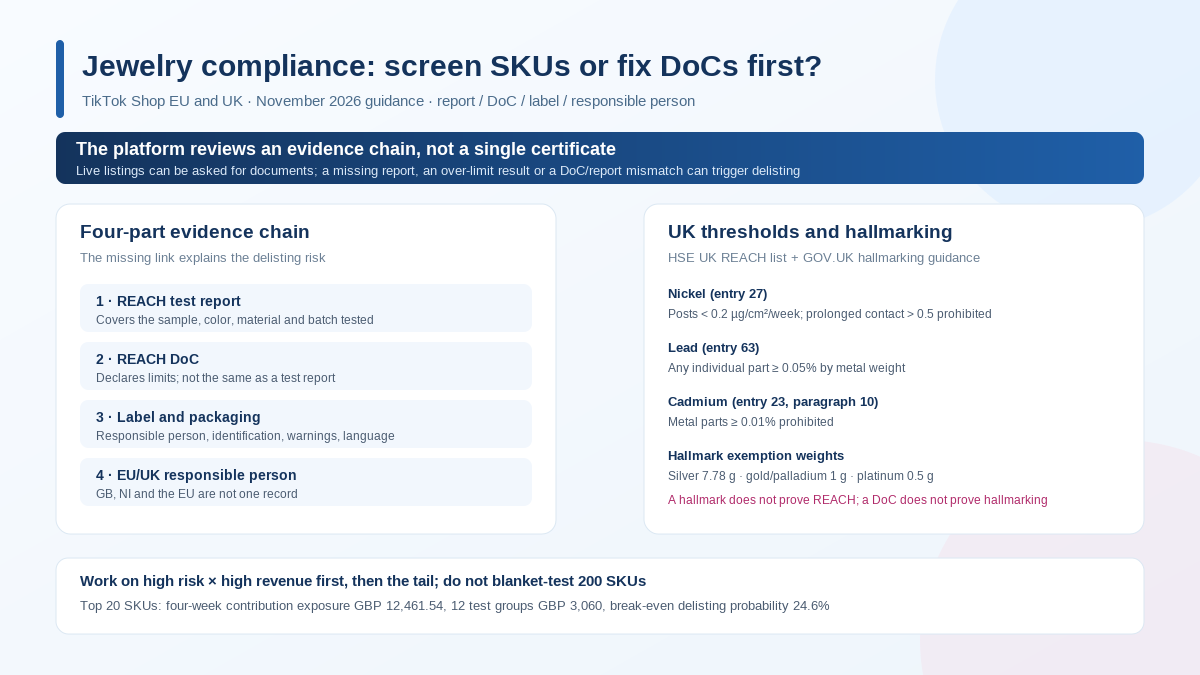
If you sell jewelry or accessories on TikTok Shop in the EU or UK, the question raised by the platform's November 2026 guidance is not “do I need REACH?” but “do the DoC and test report I already have cover this SKU's material, color, age group and market?” The guide says new listings must submit qualification documents and live listings can also be asked for them; its Chinese edition lists four existing-product delisting triggers: a missing report, a report that does not meet review requirements, a limit exceedance, and a DoC that is inconsistent with the test report. Whether to fix documents first or screen SKUs first depends on which evidence gap you treat as the real risk.
The real decision is whether to screen existing EU and UK jewelry SKUs by material, age group and market, suspend the high-risk ones and fix their evidence first, or to submit REACH DoCs and test reports for every SKU first; the two sequences carry different costs and exposure.
The platform asks for a four-part evidence chain, not one certificate
The guide covers jewelry and accessories sellers on TikTok Shop in the EU and UK. It requires sellers to submit relevant qualification documents for platform review when a product is listed; for products already on sale, the platform can also ask for them. The core documents named in the guide are a REACH declaration of conformity (REACH DoC) and applicable REACH test reports. Where the product is not placed on the market by a UK entity, the platform also requires a UK responsible person's full contact details to appear on the physical packaging or label; Northern Ireland continues to follow EU rules. The guide also says labeling must be complete before dispatch or the shipment may be rejected. The current Seller Center page controls the exact list.
A REACH DoC is a written declaration from the manufacturer or the EU/UK responsible person confirming that restricted chemical substances in the product are within the safe limits set by REACH (Regulation (EC) No 1907/2006) and UK REACH. It is not the test report itself: the DoC is a declaration, and the test report is the evidence behind it. The platform lists a DoC that is inconsistent with the test report as one of the existing-product delisting triggers, which means it reviews consistency, not just whether a document exists.
| Document | What it proves | What it does not prove |
|---|---|---|
| REACH DoC | The manufacturer or responsible person declares restricted substances are within limits | Without a test report, it does not prove a specific batch was tested |
| REACH test report | The result for the sample tested under a specific method | Does not automatically cover other colors, materials, sizes or batches |
| Label and packaging images | Responsible person, identification and warnings are marked | Does not prove chemical compliance |
| EU/UK responsible-person details | An entity the authority can contact | Does not replace testing, a DoC or a hallmark |
The guide paragraphs reviewed for this article do not publish a pass threshold for each material, a test method, an approved laboratory list, or a promise that every SKU will be sampled. It gives document categories and delisting triggers, not a certificate. A seller therefore cannot treat “I uploaded a DoC” as a compliance conclusion, or “the platform has not contacted me” as a safety signal.
Three hard UK REACH thresholds
The platform guide covers the EU and UK together, but the legal thresholds must be read separately. The UK REACH restrictions list is maintained by HSE and applies in Great Britain; the entries closest to jewelry and accessories are 23, 27 and 63. The table below restates only the entry text and does not treat UK thresholds as EU thresholds.
| Entry | Substance | Threshold or condition | Scope | Key text |
|---|---|---|---|---|
| 27 | Nickel | Release below 0.2 micrograms per square centimeter per week for post assemblies; above 0.5 for parts in direct and prolonged skin contact is prohibited | Earrings, necklaces, bracelets, anklets, rings, watch cases and straps, rivets and zippers on garments | A non-nickel coating must also keep release at or below 0.5 for at least two years |
| 63 | Lead | 0.05% or more by weight in any individual part | Jewelry and imitation jewelry, hair accessories, including bracelets, necklaces, rings, piercing jewelry, watches, brooches and cufflinks | “Any individual part” includes the materials and components; the entry has exemptions for crystal glass and inaccessible watch parts |
| 23(10) | Cadmium | 0.01% or more by weight of the metal in metal beads, jewelry-making components and metal parts of jewelry, imitation jewelry and hair accessories | Bracelets, necklaces, rings, piercing jewelry, watches, brooches and cufflinks | The entry also covers cadmium in plastics; this article uses only paragraph 10 for metal parts |
These thresholds are concentrations or release rates, not material names. Stainless steel, alloys, coatings, solder, clasps and chains can all trigger them; “hypoallergenic” is a marketing word, not a test result. Nickel is especially about release: a stainless-steel ear post still fails if release exceeds 0.2 micrograms per square centimeter per week; other parts in prolonged skin contact use the 0.5 limit; a part with a non-nickel coating must also show that the coating keeps release at or below 0.5 for at least two years of normal use.
Precious metal has a separate UK hallmarking layer. GOV.UK gives exemption weights of 7.78 g for silver, 1 g for gold and palladium, and 0.5 g for platinum; precious-metal items below those weights generally do not need a compulsory hallmark, while items above them do. Since 1 January 2021, Great Britain no longer recognizes equivalent EU hallmarks; Northern Ireland continues to recognize them; new stock entering the GB market needs a UK hallmark or a Common Control Mark (CCM), while exports to the EU need a mark recognized by the destination country. Online retailers must also display the hallmark information prominently on the product page (the Dealer's Notice).
Hallmarking and REACH are two lines. Hallmarking covers precious-metal fineness, the sponsor's mark and the assay office mark; it does not cover nickel release, lead or cadmium. REACH covers chemical restrictions; it does not cover precious-metal fineness. Passing one is not passing the other, which is why “we have a UK hallmark” cannot answer the platform's document review.
Screen SKUs first: four questions decide the rule
Break “compliance” into four checkable questions: market (GB, NI or the EU), material (precious metal, base metal, plastic, leather, coating), age group (children or adults), and contact (piercing, prolonged skin contact or occasional contact). Different answers trigger different rules and evidence. An adult silver ring and a child's plastic hair clip cannot share one report or one label set; a responsible person can cover both, but the record must match the market.
A simple risk score sets priority. High risk is children's plus piercing or prolonged skin contact, plus an uncoated base metal and no report. Next is precious metal above the exemption weight without a hallmark. High commercial exposure is the top 20% of revenue. Low risk is a stable long-tail SKU with a report, a DoC, a complete label and a responsible person. Work on high risk times high exposure first, then high risk times low exposure, and only then the low-risk tail.
| Priority | Typical profile | Do first |
|---|---|---|
| P1 | Children's, piercing or prolonged skin contact, no report | Suspend or pause listing; obtain the report and DoC; check labels and the responsible person |
| P2 | Top revenue, missing report or report does not cover a color/material | Audit documents first, then test by material group |
| P3 | Precious metal above the exemption weight, no UK hallmark | Hallmark, reprice or delist; do not start with a chemical report |
| P4 | Report, DoC, label and responsible person complete, long tail | Spot-check consistency and batches; do not blanket-test |
Testing all 200 SKUs at once is rarely the right first move. Tests are grouped by material, color and component; the more groups, the faster the cost exceeds the contribution of the tail, and a report covers only the sample submitted, not every batch. Use a document audit and supplier declarations to remove SKUs that clearly have evidence, then decide which groups to test.
The mechanism is an evidence chain: material decides which restriction applies, age group decides whether children's rules stack on top, market decides whether EU or UK documents are needed, a report covers only the sample tested, and a DoC only declares limits; a missing link can satisfy a delisting trigger.
Scenario A: 200 SKUs, where the testing budget goes first
Scenario A: 200 live SKUs, GBP 600,000 annual revenue, top 20 SKUs at 60% of revenue
Assumptions: 200 live SKUs, GBP 600,000 annual revenue, 45% gross margin; the top 20 SKUs contribute 60% of revenue and the 180-SKU tail contributes 40%; the four-week delisting exposure runs at the same annual rate; each test group costs GBP 255 (GBP 180 test + GBP 45 courier + GBP 30 admin), with 12 groups for the top and 30 for the tail; no substitution sales, platform grace period or partial delisting.
Result: top annual contribution = 600,000 × 60% × 45% = GBP 162,000; four-week exposure = 162,000 × 4 ÷ 52 = GBP 12,461.54; top testing = 12 × 255 = GBP 3,060; break-even delisting probability = 3,060 ÷ 12,461.54 = 24.6%. Tail annual contribution = 600,000 × 40% × 45% = GBP 108,000; four-week exposure = 108,000 × 4 ÷ 52 = GBP 8,307.69; tail testing = 30 × 255 = GBP 7,650; break-even probability = 7,650 ÷ 8,307.69 = 92.1%.
Decision: test the top 20 SKUs and the high-risk children's or piercing SKUs first; do not test the whole tail at once; use reports and supplier declarations to remove SKUs with clear evidence, then test only the high-risk groups. If the delisting probability is below 24.6%, the top group can also fix documents first and postpone testing.
The reverse also matters: if a delisting removes one SKU rather than the whole group, the top exposure must be recalculated from that SKU's contribution; if the platform only asks for documents and does not suspend sales, the four-week exposure does not exist. The calculation answers “is it worth testing first,” not “will the platform delist.”
Split 200 SKUs into the top 20 and the 180-SKU tail: the top group's four-week contribution exposure is GBP 12,461.54, 12 test groups cost GBP 3,060, and the break-even delisting probability is 24.6%; the tail's four-week exposure is GBP 8,307.69, 30 groups cost GBP 7,650, and the break-even probability is 92.1%.
Scenario B: thin-margin precious metal and hallmarking
Scenario B: hallmarking, 1,000 silver chains and 300 platinum rings above the exemption weights
Assumptions: 1,000 silver earrings at 2.1 g, 1,000 silver chains at 9.5 g, 500 gold pendants at 0.8 g and 300 platinum rings at 0.6 g; the silver exemption is 7.78 g, gold/palladium 1 g and platinum 0.5 g; each hallmark costs an assumed GBP 1.10 including the UK assay office fee and logistics; unit contribution is GBP 3.20 for earrings, GBP 8.00 for chains, GBP 5.50 for pendants and GBP 22.00 for rings; no returns or discounts.
Result: the 2.1 g silver earrings and 0.8 g gold pendants are below the exemption weights and do not need a compulsory hallmark (REACH still applies); the 9.5 g silver chains and 0.6 g platinum rings are above the exemption weights and do need one. Chain hallmarking = 1,000 × 1.10 = GBP 1,100; contribution = 1,000 × 8.00 = GBP 8,000; hallmarking is 13.75% and contribution after the hallmark is GBP 6,900. Platinum ring hallmarking = 300 × 1.10 = GBP 330; contribution = 300 × 22.00 = GBP 6,600; hallmarking is 5.0% and contribution after the hallmark is GBP 6,270. If a silver chain's unit contribution is only GBP 0.90, the GBP 1.10 hallmark is already above it and unit net contribution is −GBP 0.20.
Decision: hallmark precious-metal SKUs above the exemption weights before dispatch; delist or reprice SKUs whose unit contribution is below the hallmark fee (including logistics); do not treat “silver,” “gold plated” or “hypoallergenic” as a reason to skip hallmarking or REACH.
Hallmarking is a legal requirement, not an option; the calculation only asks whether the SKU is still worth selling. If the hallmark fee (including logistics) exceeds unit contribution, the right move is to delist or reprice, not to skip the mark. Assay office fees vary by office, metal, weight and volume; GBP 1.10 is an assumption in this article.
Counter-cases and evidence boundaries
A counter-case is a stainless-steel earring with no precious metal and no hallmarking duty that still fails if nickel release exceeds 0.5 micrograms per square centimeter per week; conversely, a UK-hallmarked silver item does not automatically prove nickel, lead or cadmium compliance.
A second counter-case is “one report covers every color.” A test report covers the sample submitted; a new color, material, coating, clasp or supplier can take the report out of scope. The platform lists a report that does not meet review requirements as a delisting trigger, so the seller must check the sample description, color list, material list and batch records, not just the conclusion on the first page.
A third counter-case is “CE or UKCA is enough.” CE and UKCA are conformity marks for specific product categories, not a general jewelry pass, and they do not replace a REACH DoC or a precious-metal hallmark. If children's jewelry is also a toy, toy-safety rules can stack on top. The seller must first establish which regulatory scope the product falls into, then decide which document is needed.
A fourth counter-case is “UK only, so the EU does not matter.” The UK and EU are two market regimes; Northern Ireland continues to recognize EU hallmarks, and a UK responsible person is not the same as an EU responsible person. A UK-only seller may not need an EU responsible person, but it cannot move a UK document into Northern Ireland or the EU unchanged. A seller with no EU or UK sales is outside the guide's scope, although the platform may still apply destination-country rules.
The platform guide proves the document categories and delisting triggers, the HSE list proves the UK thresholds, and GOV.UK proves the hallmarking weights and the GB/NI split; none of them proves a specific SKU's test result, the platform's review probability or the EU thresholds.
Platform rules and law are also different. The platform guide is TikTok Shop's review requirement; it can be stricter than the law and can ask for documents on its own standard. Legal duties come from REACH, general product-safety rules and hallmarking law, as applicable in each market. “Submit a DoC” does not mean the law requires only a piece of paper; not being sampled does not make a product lawful. Conversely, legal compliance does not guarantee platform approval, because the platform also reviews document consistency, label images and responsible-person details.
Action list and stop conditions
- Build the table: for each SKU record market (GB, NI, EU), material, precious-metal weight, coating, age group, contact, revenue share, current report, DoC, label and responsible-person details.
- Map the rules: precious metal above the exemption weight goes to hallmarking; piercing or prolonged skin contact goes to nickel; all jewelry and hair accessories go to lead and cadmium; children's products may also trigger toy or other children's rules.
- Audit the report: check that the sample description covers the material, color, size and component, and that the standard version, method, laboratory, report date and batch are stated. A report that says “pass” without a sample description is treated as not covering the SKU.
- Check the DoC: the manufacturer or responsible person, product identifiers, restricted substances and report number must match the test report. If the DoC and report disagree, stop and fix the documents before relisting.
- Check the label: the responsible person's name, address and contact details, identification, warnings and language must appear on the packaging or label; the product page must show the hallmark information required by GOV.UK.
- Set priority: P1 suspends or pauses listing; P2 audits then tests; P3 hallmarks or reprices; P4 spot-checks and does not blanket-test.
- Relist only when the report covers the current SKU, the DoC matches the report, the label and responsible person are complete, and any required hallmark is done.
The sequence is to build a SKU × market × material × age × contact table, rank by high risk × high revenue, ask suppliers for the report and DoC and check the sample description, colors, sizes, standard version and responsible-person details, and only then decide whether to test, relabel, delist or relist.
- Stop condition one: the report is missing, the sample description does not cover the current color or material, or the DoC and report disagree — stop selling until both are fixed and rechecked.
- Stop condition two: nickel, lead or cadmium results reach or exceed the applicable threshold — do not solve it with a new label, a new image or a warning; change the material, process or supplier first.
- Stop condition three: precious metal is above the exemption weight but has no UK hallmark or CCM — do not ship to GB; hallmark it or use another compliant route.
- Stop condition four: unit contribution is below the hallmark fee (including logistics), or below the amortized test cost — delist or reprice; do not keep a loss-making SKU to make the catalog look complete.
- Stop condition five: the platform, regulator or competent authority issues a new applicable requirement — follow the latest text; the thresholds and dates in this article do not replace an updated rule.
Do not treat “CE/UKCA,” “a DoC” or “a test report” as a single pass. The platform reviews the chain: what the product is, which market it sells into, which restriction applies, which report covers it, whether the DoC matches the report, and whether the label and responsible person are in place. A missing link can turn “compliant” into “the file looks complete.”
What this means for product selection and data
The product-selection effect is not “the EU and UK are closed to jewelry”; it is “jewelry that cannot prove the material, age group and market fit cannot be sold.” Compliance evidence belongs in SKU admission, not in after-sales repair. For data work, the platform guide and the HSE list are risk signals, not sales signals: they show which materials, age groups and markets are more likely to fail, but they do not show how much a SKU sold or whether the platform will delist it.
Within activated modules, NWi CrossborderGo provides category, brand, store and product data for TikTok Shop and other marketplaces, including sales, units, ASP, brand share and price bands; prior-month data is updated between the 10th and 15th of each month; sites, history and fields depend on the contract. It can help size the EU/UK jewelry category, its price bands and brand concentration, and decide which price bands and high-risk SKUs to audit first. It does not provide product testing, REACH DoCs, responsible-person services, platform qualification decisions or legal advice. Data can rank risk; it cannot prove a SKU is safe.
To size the TikTok Shop UK jewelry category, its price bands and brand concentration, see NWi CrossborderGo; to break the data down by site, category and brand, book a demo; to see how NWi Operations supports SKU checks, see NWi Operations. Product capabilities, site coverage and fields depend on the modules activated and the contract.
Method and disclosure
Data basis: on 29 November 2026 this article re-checked TikTok Shop Academy's EU and UK jewelry and accessories compliance guidance updated in November 2026 (the Chinese page on 20 November and the English page on 16 November; the pages are region-scoped, so this round captured direct paragraphs through the research search channel and limits platform claims to those paragraphs). It also read the Health and Safety Executive (HSE) UK REACH restrictions list (page updated 2 September 2025; the list file includes entries 23 cadmium, 27 nickel and 63 lead), GOV.UK's guidance on hallmarking compliance (updated 9 December 2021), GOV.UK's guidance on hallmarking requirements and the EU (published 25 October 2019), and OPSS product safety advice for businesses (updated 21 July 2026). Platform dates, markets, document types and existing-product delisting triggers follow the guide; HSE thresholds, scope and exemptions follow the entry text; GOV.UK exemption weights, the GB/NI split and the online Dealer's Notice requirement follow the guidance. Calculation basis: Scenario A uses 200 live SKUs, GBP 600,000 annual revenue, a 45% gross margin, the top 20 SKUs at 60% of revenue, a four-week delisting exposure, GBP 255 per test group (GBP 180 test + GBP 45 courier + GBP 30 admin), 12 groups for the top and 30 for the tail. Scenario B uses 1,000 silver earrings at 2.1 g, 1,000 silver chains at 9.5 g, 500 gold pendants at 0.8 g, 300 platinum rings at 0.6 g, an assumed GBP 1.10 hallmark per item and unit contributions of GBP 3.20, 8.00, 5.50 and 22.00. All quantities, prices, margins, test fees, hallmarking fees, contributions and probabilities are labeled assumptions, not measurements by TikTok Shop, HSE, GOV.UK, NWi or any seller. Product basis: within activated modules, NWi CrossborderGo provides category, brand, store and product data for TikTok Shop and other marketplaces, including sales, units, ASP, brand share and price bands; prior-month data is updated between the 10th and 15th of each month; sites, history and fields depend on the contract. It does not provide product testing, REACH DoCs, responsible-person services, platform qualification decisions or legal advice.
This article was prepared with automated research assistance and is based on the public sources listed at the end; it was not reviewed by a human expert. It does not invent customer data, expert review, sales, test results, platform review outcomes or ranking effects. It is not legal, compliance, product-safety or marketplace-operations advice; whether a product complies, whether it needs a REACH DoC or test report, which market rule applies, and how to label a responsible person or a precious-metal hallmark should be confirmed against the latest platform rules, the full regulations and standards, an accredited testing body, the competent authority and the actual product.
This article has no seller SKU list, stock, sales, test reports or marketplace back-end data, and it did not read the full EU REACH or GPSR text; test fees, hallmarking fees, gross margin, contribution and delisting probabilities are labeled assumptions.
Conclusion
Put the platform guide, the UK REACH list and the hallmarking rules together, and the practical conclusion is three sentences. First, screen SKUs by market, material, age group and contact before asking every SKU for the same document. Second, the report, DoC, label and responsible person are a four-part evidence chain, and any missing link can trigger delisting of a live product. Third, precious-metal hallmarking and chemical restrictions are separate lines: a hallmark does not prove REACH compliance, and a DoC does not prove hallmarking is done.
The contribution is threefold: splitting the platform document check into the report, DoC, label and responsible-person chain; using head and tail break-even probabilities to decide what to test first; and separating UK hallmarking weights from REACH chemical thresholds so a hallmark is not mistaken for chemical compliance.
Sources
- TikTok Shop Academy, updated 16 November 2026, Compliance Guidance for Listing Jewelry & Accessories Products: the EU/UK jewelry and accessories guide; new listings submit qualification documents, live listings can be asked for them, the REACH DoC definition, the UK responsible person and labeling requirements; read on 29 November 2026.
- TikTok Shop Academy (cross-border seller learning center), updated 20 November 2026, Jewelry and Accessories Compliance Guide: the Chinese edition of the guide; existing-product delisting triggers include a missing report, a report that does not meet review requirements, a limit exceedance, and a DoC that is inconsistent with the test report; read on 29 November 2026.
- Health and Safety Executive, page updated 2 September 2025, List of restrictions applicable under UK REACH: thresholds, scope and exemptions in entries 23 cadmium, 27 nickel and 63 lead; downloaded and read entry by entry on 29 November 2026.
- Health and Safety Executive, Restrictions under REACH: official landing page and source of the restrictions list; read on 29 November 2026.
- British Hallmarking Council / GOV.UK, updated 9 December 2021, Hallmarking: how businesses can comply with the law: the Dealer's Notice and the online display requirement; read on 29 November 2026.
- British Hallmarking Council / GOV.UK, published 25 October 2019, Hallmarking requirements and the EU: exemption weights of 7.78 g for silver, 1 g for gold/palladium and 0.5 g for platinum; GB stopped recognizing EU hallmarks on 1 January 2021 while NI continues to; new GB stock needs a UK hallmark or CCM; read on 29 November 2026.
- Office for Product Safety and Standards / GOV.UK, updated 21 July 2026, Product safety advice for businesses: safety and labeling duties for consumer products made, imported, distributed or sold in the UK, corrective action and legal risk; read on 29 November 2026.