
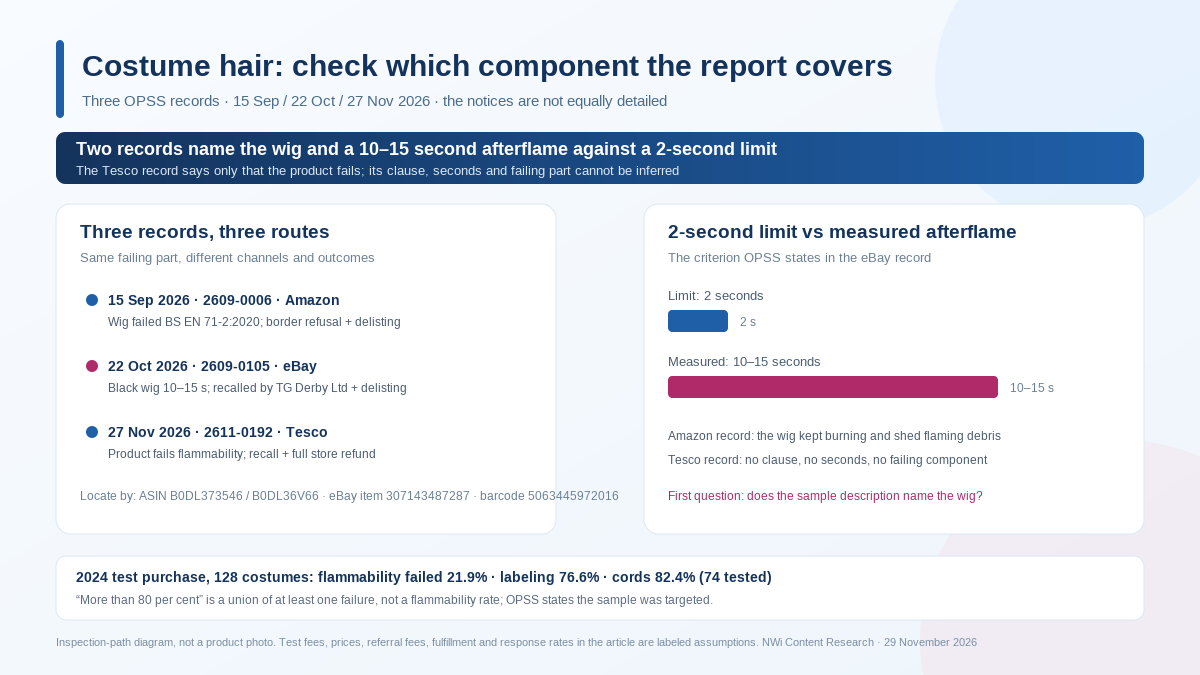
If you sell children's dress-up costumes or hair pieces in the UK, the three OPSS records from September to November 2026 ask a narrower question than whether the hair can catch fire: which component does your test report actually cover? Two records name the wig as the failing part; the eBay record gives the measured afterflame and the 2-second limit. The Tesco record says only that the product does not meet the flammability requirements, with no clause and no number. That difference decides whether you suspend, retest or recall.
If you sell children's dress-up costumes in the UK, the real decision is whether the existing test report covers the wig or headpiece, and, where it does not, whether to suspend and retest or treat the stock as a recall.
1. Three records, three enforcement routes
| Date and type | PSD | Product and channel | Identifiers | Hazard | Legal basis | Corrective action |
|---|---|---|---|---|---|---|
| 15 September 2026 product safety report | 2609-0006 | AOOWU mermaid princess dress with a red wig and jewelry; Amazon | Model 4351929; size 120; ASINs B0DL373546 and B0DL36V66; identifiers X0025UI06N, FBA15LRSSNN7U000003 and X0025UI0LX; China | The wig failed BS EN 71-2:2020; it continued to burn well beyond the permitted period and shed flaming debris | Toys (Safety) Regulations 2011 | Import rejected at the border; Amazon removed the listing |
| 22 October 2026, updated 5 November 2026, recall | 2609-0105 | Wednesday Addams costume with a black dress, tights, belt and black plaited wig; eBay | eBay item 307143487287; country of origin unknown | The black wig failed BS EN 71-2 and burnt for 10 to 15 seconds after the flame was removed against a 2-second maximum; some documentation and markings were absent | Toys (Safety) Regulations 2011 | Recalled by TG Derby Ltd; eBay removed the listing |
| 27 November 2026 recall | 2611-0192 | Tesco kids witch hat with hair in various colors; Tesco | Barcode 5063445972016; China | Does not meet the required flammability safety standards and may ignite quickly near a naked flame; no clause, afterflame seconds or failing component given | Toys (Safety) Regulations 2011 | Recalled by Tesco; full refund at any store |
The corrective actions differ. The September Amazon case was a border refusal plus a marketplace removal, so the goods never entered the UK market. The October eBay case was an end-user recall by TG Derby Ltd, with the listing removed at the same time. The November Tesco case was a retailer recall with a full refund at any store. For a seller, those are three different routes: a border refusal has to be fixed before customs clearance, a marketplace removal has to be handled through the listing notice, and a retail recall requires contacting buyers who already own the product.
The records also differ in detail. The eBay notice states the test criterion and the measured result: no more than 2 seconds of afterflame, against 10 to 15 seconds. The Amazon notice names BS EN 71-2:2020 and records flaming debris. The Tesco notice says only that the product does not meet the flammability requirements, with no clause, no seconds and no failing component. The first two cannot be projected onto the third, and a short notice does not mean the issue was only the hat fabric.
2. Why hair is a separate risk point
BS EN 71-2 is the toy flammability standard. The limit stated in the eBay case is 2 seconds of afterflame once the ignition source is removed; the wig burnt for 10 to 15 seconds. That is not a marginal overshoot. The hair is at head height, next to the face and neck, and a material that keeps flaming and sheds debris can ignite nearby clothing, furnishings and materials; the Amazon notice records flaming debris falling from the product.
The mechanism is component-level: the wig ships with the costume but can be sourced from a separate trim supplier, so a report that describes only the dress fabric has never measured the hair that sits beside the face and neck. This does not prove that the reports in these three cases missed the wig, because the notices do not disclose report scope. It does mean a seller has to confirm coverage through the sample description, not through the sentence “we have an EN 71 report”.
The second layer is documentation and marking. The eBay notice states that some required documentation and markings were absent. A product can perform correctly and still be stopped at a test purchase or a marketplace review because the label, warnings, manufacturer or importer details, or batch identifier are incomplete. In the 2024 test purchase, 98 of 128 items failed labeling, more than three times the 28 that failed flammability, and that gap deserves its own look.
3. Decomposing the “more than 80 per cent” headline
OPSS published the results of a June 2024 test purchase of 128 Halloween costumes for children under seven on 22 October 2024, corrected on 7 November 2024. The headline says more than 80 per cent failed basic safety tests, but the table contains three checks with different denominators.
| Check | Tested | Pass | Fail | Inconclusive | Failure share |
|---|---|---|---|---|---|
| BS EN 71-2:2020 flammability | 128 | 98 | 28 | 2 | 28 ÷ 128 = 21.9% |
| BS EN 14682:2014 cords | 74 | 13 | 61 | 0 | 61 ÷ 74 = 82.4% |
| Labeling | 128 | 30 | 98 | 0 | 98 ÷ 128 = 76.6% |
Decomposing the 2024 sample: 28 of 128 costumes failed flammability (21.9%), 98 of 128 failed labeling (76.6%), and 61 of 74 failed the cord check; the headline “more than 80 per cent” is a union of at least one failure and cannot be read as eight in ten costumes being flammable.
The union can be recomputed. More than 80 per cent means at least 103 items failed at least one check, because 128 × 80% = 102.4. Labeling alone accounts for 98, so at least five failures must come from flammability or cords. The union cannot exceed (98 + 28) ÷ 128 = 98.4%, because two items were inconclusive and not all 128 can have failed. In other words, the sample supports “more than eight in ten costumes failed at least one check”, not “more than eight in ten costumes were flammable”.
OPSS attached its own caveat: the products were selected for low price, poor reviews and apparent low quality, so the exercise was targeted, not representative of all products sold online, and not a national estimate of non-compliance. The 21.9% is therefore not a market base rate, and neither is the 80%. What is useful to a seller is the structure: labeling covers 98 of the 128 items (76.6%), the widest single failure in this sample, and can often be corrected in the documents and markings, while flammability is the most serious and can only be excluded with a component-level test.
4. What the records do not prove
The three records prove dates, product identifiers, hazard descriptions, legal bases and corrective actions, but not sales, injury counts, the testing laboratory, the scope of any report, or whether the matching dress passed or failed. They give no unit volumes, stock levels, sample counts or test-method details, and they do not say whether the wig came from the same factory as the dress or from a separate supplier.
All three records come from OPSS. They are three enforcement outputs from one regulator, not independent confirmation by three institutions. They show that this failure keeps being found, not how often it occurs. The 2024 test purchase is a different sample, period and product scope; it helps explain the structure of the checks but cannot be combined with the three cases into a time series.
The statutory layer was also unavailable. On 29 November 2026, repeated requests to legislation.gov.uk pages and to the EUR-Lex directive page returned HTTP 202 with an empty body. Legal statements here therefore follow OPSS wording only; no clause is interpreted independently, and EU rules are not presented as UK obligations. The Tesco notice and PDF give neither a clause nor afterflame seconds, and this article does not fill that gap.
One boundary runs the other way: not appearing in an OPSS notice does not mean compliance. Enforcement comes from test purchases, complaints and marketplace referrals and does not reach every seller. Conversely, one appearance does not mean every product from the same brand is defective. A list is unreliable evidence in both directions.
5. Counter-cases and alternative explanations
A counter-case is a wig made from flame-retardant fiber with a component-level report covering the current colorways and lots, complete marking and traceability; it should not be delisted merely because these three records exist. A dress-only product with no headwear is outside this failure mode, although other flammability and labeling rules still apply. The judgment has to land on a component, a colorway, a batch and a report, not on the category “costume”.
An alternative explanation is that the 2024 sample failed labeling far more often than flammability, which means many products are stopped for paperwork before material performance is even reached. A seller can have a compliant wig and still be stopped for a missing importer address, batch number or warning; another can have perfect labels and an untested wig. The two lines have to be checked separately rather than covered by one “compliant” conclusion.
A third explanation is batch variation. A SKU that changes fiber supplier, dyeing or finish can change its burning behavior, and a report covers the sample submitted, not later production. The notices do not disclose batch or material-change records, so this article does not infer a cause; it treats batch and fiber as fields the seller must confirm with the supplier.
6. Two reproducible scenarios
Every number below is an assumption, used to show the arithmetic. None is a measurement by OPSS, Tesco, eBay, Amazon, TG Derby Ltd, AOOWU, NWi or any seller. Replace the test fee, price, referral fee, fulfillment cost, response rate and pass probability with your own.
Scenario A: 2,400 wig-inclusive costumes in a UK warehouse, not yet listed
Assumptions: landed cost GBP 4.20 per unit, retail GBP 16.99, 15% referral fee and GBP 2.60 fulfillment per unit; one component flammability sample per colorway across three colorways, at GBP 260 testing plus GBP 120 courier plus GBP 90 admin, or GBP 470 per colorway and GBP 1,410 in total; disposal GBP 0.35 per unit; the full 2,400 units sell within four weeks.
Result: contribution per unit = 16.99 × 0.85 − 4.20 − 2.60 = GBP 7.6415, or GBP 18,339.60 for 2,400 units and GBP 16,929.60 after the test fee; scrapping now = −2,400 × 4.20 − 2,400 × 0.35 = −GBP 10,920; testing and then scrapping on failure = −GBP 12,330; the break-even pass probability against scrapping now = 1,410 ÷ (16,929.60 + 12,330) = 4.8%.
Decision: test before listing unless you believe the pass probability is below 4.8%, in which case scrap now; keep the stock off sale during testing, and do not substitute a warning label or a new photo for a component test. The test fee of GBP 1,410 is 7.7% of the batch's gross contribution of GBP 18,339.60, while a wrong judgment risks at least the entire landed cost.
Scenario B: 1,100 sold and 1,300 in stock, deciding between recall and retest
Assumptions: 1,100 sold and 1,300 on hand; landed cost GBP 4.20, retail GBP 16.99, 15% referral fee and GBP 2.60 fulfillment; 30% recall response; GBP 16.99 refund plus GBP 3.20 return logistics plus GBP 0.80 handling, or GBP 20.99 per responding buyer; GBP 1,500 fixed communications and legal cost; retesting GBP 1,410, ten working days, 24% of the remaining 42 selling days, with sales suspended during testing.
Result: recall now and scrap the stock = 1,100 × 30% × 20.99 + 1,500 + 1,300 × 4.20 + 1,300 × 0.35 = 330 × 20.99 + 1,500 + 5,460 + 455 = GBP 14,341.70; test first, and if it passes sell 76% of the planned stock = 1,300 × 7.6415 × 0.76 − 1,410 = GBP 6,139.80; if it fails = −1,410 − 8,426.70 − 5,915 = −GBP 15,751.70; against −GBP 14,341.70 for recalling now, the break-even pass probability = 1,410 ÷ (6,139.80 + 15,751.70) = 6.4%.
Decision: retest first if the pass probability is above 6.4%, and recall now if it is below; suspend sales during testing, and if the test fails, notify buyers and recall the sold units under OPSS and marketplace requirements.
Change the response rate from 20% to 45% and the immediate recall cost rises from GBP 12,032.80 to GBP 17,805.05, while the pass branch of GBP 6,139.80 does not move. The higher the response rate, the more valuable it is to establish the facts before recalling. Conversely, if the supplier has already admitted that the wig was never tested, the pass probability is close to zero and recalling now is cheaper.
7. Action list and stop conditions
- Build the table: list every live, in-transit and warehouse SKU by barcode 5063445972016, eBay item 307143487287, ASINs B0DL373546 and B0DL36V66, model 4351929, size 120 and FBA shipment FBA15LRSSNN7U000003, together with the same supplier and batch.
- Audit the report: ask for the original test report and check whether the sample description names the wig or headpiece, the colorway, the size, the fiber content, the standard version (BS EN 71-2:2020), the laboratory, the report date and its validity. A report that covers only the dress fabric, one color or one size counts as not covering the rest.
- Marking and documents: check the UKCA or CE mark and the applicable transition rules, the manufacturer and importer name and UK address, the batch or model, the age grading and warnings, the instructions and the declaration of conformity against the OPSS guidance; keep the technical file and declaration for 10 years as the guidance states.
- Channel response: goods refused at the border cannot enter, so fix testing and documents before discussing clearance; for a removed listing, read the reason and appeal window in the notice and do not relist under a new ASIN; for a retail recall, contact buyers, refund or replace and record the response rate as stated in the notice.
- Stop conditions: the report does not cover the wig, the fiber content is unknown, the same identifier appears in a new notice, the marketplace has removed the listing, or returns and reviews cluster around burning, melting or smoke. Any one of these means suspend sales and quarantine the stock.
- Relisting conditions: a component-level test covering the current color and batch passes, marking and documents are complete, the batch is traceable, and no new notice names the same identifier.
- Fields to watch: PSD number, notice date, barcode, ASIN or eBay item, hazard type, legal basis, corrective action, marketplace notice and appeal window, customs detention, return reasons, and the supplier's report scope and fiber content.
- Stop rule: if the batch or report cannot be confirmed, retesting still fails, or the supplier refuses a component test, stop selling and scrap or destroy the stock. If you switch to a version without the wig, assess it as a new product for marking, testing and listing; do not simply remove the wig from the photo.
The sequence is to list every live and in-transit SKU by barcode, ASIN, eBay item and batch, then check whether the report's sample description covers the wig, its colorways and its sizes, and only then choose the border, marketplace or retail recall route.
The order matters: build the table, audit the report, then decide whether to suspend or relist. Do not start with “will the marketplace take it down”, because a takedown is an outcome, not compliance evidence, and do not start with “has anyone else been caught”, because test purchases do not reach every seller.
8. What this means for product selection and data
The implication for product selection is not that costumes cannot be sold in the UK. It is that a costume whose headpiece cannot be shown to comply cannot be sold. Compliant products still have demand, but compliance evidence has to be part of SKU admission rather than an after-sales repair. For data work, an OPSS record is a risk signal, not a sales signal: it shows which component, channel and marking tend to fail, not how many units an ASIN sold.
NWi CrossborderGo provides Amazon US, Europe and Japan category, brand, store and product data, including sales, units, ASP, brand share and price bands, updated monthly between the 10th and 15th for the prior month; specific sites, history and fields depend on the contract. It can help size the UK children's costume category and its price bands and brand concentration, which is useful for deciding which price bands and wig-inclusive SKUs to audit first. It does not provide product-safety testing, recall status, EN 71-2 compliance conclusions or marketplace penalty data. Data can rank risk; it cannot prove a SKU is safe.
To size the UK children's costume category, its price bands and brand concentration first, see NWi CrossborderGo; to break the data down by site, category and brand, contact us through Request a demo; to see how the operations tools support SKU triage, see NWi Operations. Product capability, site coverage and fields depend on the modules enabled and the contract.
9. Method and notes
Data basis: on 29 November 2026 this article re-read three OPSS records and their official PDFs on GOV.UK: the AOOWU Mermaid Princess Dress product safety report (PSD 2609-0006) of 15 September 2026, the Wednesday Addams Costume recall (PSD 2609-0105) published on 22 October 2026 and updated on 5 November 2026, and the Tesco Witch Hat with Hair Assortment recall (PSD 2611-0192) of 27 November 2026. It also read the OPSS Halloween costume test-purchase notice published on 22 October 2024 and corrected on 7 November 2024, and the OPSS guidance Toys (Safety) Regulations 2011: Great Britain, updated on 24 March 2025. Dates, product identifiers, barcodes, ASINs, country of origin, hazard descriptions, legal bases, corrective actions and notifiers are recorded as published; clause numbers, afterflame seconds, sales, injury counts and testing laboratories that the notices do not give are not supplied here. Calculation basis: the flammability failure rate is 28 ÷ 128 = 21.9%; the labeling failure rate is 98 ÷ 128 = 76.6%; the cord failure rate is 61 ÷ 74 = 82.4%; “more than 80 per cent” means at least 103 of 128 failed at least one check (128 × 80% = 102.4), and because 98 already failed labeling, at least five other failures fall outside the labeling set; the union ceiling is (98 + 28) ÷ 128 = 98.4% because two items were inconclusive. Scenario A uses 2,400 units, landed cost GBP 4.20 per unit, retail GBP 16.99, a 15% referral fee, GBP 2.60 fulfillment per unit, one sample per colorway across three colorways, GBP 260 testing plus GBP 120 courier plus GBP 90 admin per colorway, GBP 0.35 disposal per unit and a four-week sell-through. Scenario B uses 1,100 sold, 1,300 on hand, a 30% recall response, GBP 20.99 per responding buyer (GBP 16.99 refund + GBP 3.20 return logistics + GBP 0.80 handling), GBP 1,500 fixed communications and legal cost, GBP 1,410 retesting, ten working days, 42 remaining selling days and suspended sales during testing. All quantities, prices, referral fees, fulfillment costs, test fees, response rates and pass probabilities are labeled assumptions, not measurements by OPSS, Tesco, eBay, Amazon, TG Derby Ltd, AOOWU, NWi or any seller. Product basis: NWi CrossborderGo provides Amazon US, Europe and Japan category, brand, store and product data, including sales, units, ASP, brand share and price bands, updated monthly between the 10th and 15th for the prior month; specific sites, history and fields depend on the contract. It does not provide product-safety testing, recall status, EN 71-2 compliance conclusions or marketplace penalty data.
This article was prepared with automated research assistance and is based on the public sources listed at the end; it was not reviewed by a human expert. It does not invent customer data, expert review, sales, injury cases, test results, ranking effects or platform endorsements. It is not legal, compliance, product-safety or marketplace-operations advice; whether a product complies, whether a wig or headpiece needs BS EN 71-2 testing, and the applicable test methods and recall scope should be confirmed against the latest OPSS notices, the full regulations and standards, an accredited testing body, marketplace rules and the actual product.
This article has no seller SKU list, stock, sales, test reports or marketplace back-end data, and it did not read the full text of the Toys (Safety) Regulations 2011 or BS EN 71-2; test fees, prices, fees, fulfillment and recall response rates are labeled assumptions.
10. Conclusion
Put the three cases together and three sentences do most of the work. First, check whether the report covers the wig or headpiece; a report on the dress fabric is not a substitute. Second, a border refusal, a marketplace removal and a retail recall are different actions with different sequences, but all of them require you to locate the batch by barcode, ASIN or item number. Third, decide between retesting and recall with a pass probability and a recall cost, not with what happened to someone else or with the fact that you have a CE mark.
The contribution is threefold: locating the failing part in the wig or headpiece rather than the whole costume, splitting the 2024 “80 per cent” into three denominators and showing flammability at 21.9%, and turning “retest or recall” into two break-even probabilities.
Sources
- Office for Product Safety and Standards, 15 September 2026, Product Safety Report: AOOWU Mermaid Princess Dress sold via Amazon (2609-0006): ASINs B0DL373546 and B0DL36V66; model 4351929; size 120; the wig failed BS EN 71-2:2020, burnt well beyond the limit and shed flaming debris; border refusal; Amazon removed the listing; read on 29 November 2026.
- Office for Product Safety and Standards, 22 October 2026 (updated 5 November 2026), Product Recall: Wednesday Addams Costume sold via eBay (2609-0105): eBay item 307143487287; the black wig burnt for 10 to 15 seconds after the flame was removed against a 2-second maximum; documentation and markings absent; recalled by TG Derby Ltd; read on 29 November 2026.
- Office for Product Safety and Standards, 27 November 2026, Product Recall: Tesco Witch Hat with Hair Assortment (2611-0192): barcode 5063445972016; China; does not meet the flammability requirements; recalled by Tesco with a full refund; no clause or afterflame seconds given; read on 29 November 2026.
- Office for Product Safety and Standards, 27 November 2026, Tesco Kids Witch Hat with Hair Assortment official PDF: risk type Fire and Burns; counterfeit status No; online marketplace N/A; other fields match the HTML notice; read on 29 November 2026.
- Office for Product Safety and Standards, 22 October 2024 (updated 7 November 2024), OPSS issues children’s Halloween costume warning: 128 costumes for under-sevens tested in June 2024; 28 failed flammability and 2 were inconclusive; 61 failed the cord check; 98 failed labeling; OPSS states the sample is targeted and not representative; read on 29 November 2026.
- Office for Product Safety and Standards, 1 January 2021 (updated 24 March 2025), Toys (Safety) Regulations 2011: Great Britain: safety assessment, conformity assessment, 10-year retention of the technical file and declaration of conformity; importer checks and marking duties; Northern Ireland is covered separately; read on 29 November 2026.