
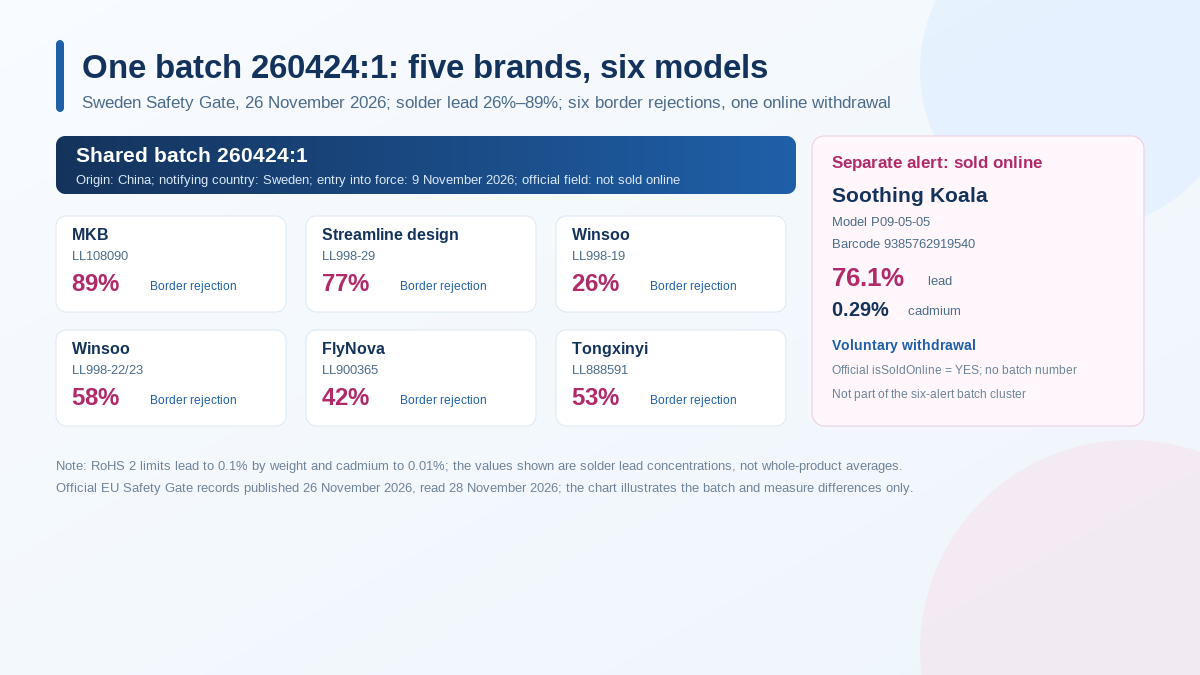
For an EU seller of low-price electric toys, the decision after Sweden's 26 November 2026 Safety Gate alerts is whether to delist by brand, screen stock by batch and barcode, or first request RoHS and solder test reports from suppliers. The first fact in the official record is that six electric-toy alerts cover five brands and six models, all sharing batch 260424:1, with solder lead maxima of 26%–89%, all rejected at the Swedish border, and all marked as not sold online. The seventh alert is different: the Soothing Koala electric plush had lead up to 76.1% and cadmium up to 0.29%, was sold online and was voluntarily withdrawn. Mixing the two cases produces opposite actions: the first six require batch and supplier checks, while the seventh requires an immediate stop and withdrawal.
What Sweden published on 26 November: seven alerts, five brands, one shared batch
The EU Safety Gate published seven Swedish electric-toy alerts on 26 November 2026. The first six cover electric toy cars, a flying spinner and a toy game console from MKB, Streamline design, Winsoo (two models), FlyNova and Tongxinyi: five brands and six models sharing batch 260424:1, with solder lead up to 89%, 77%, 26%, 58%, 42% and 53% respectively. All six were found non-compliant with the RoHS 2 Directive, and the measure is import rejected at the border (compulsory, importer), with entry into force on 9 November 2026. The seventh alert is the Soothing Koala electric plush, model P09-05-05, barcode 9385762919540, with solder lead up to 76.1% and cadmium up to 0.29%; the measure is a voluntary withdrawal from the market, entry into force on 2 November 2026, and the record says it was sold online. All seven records name China as the country of origin and Sweden as the notifying country.
| Brand | Model | Barcode | Solder lead (up to) | Measure |
|---|---|---|---|---|
| MKB | LL108090 | 2026031019642 | 89% | Border rejection (compulsory) |
| Streamline design | LL998-29 | 2026031019680 | 77% | Border rejection (compulsory) |
| Winsoo | LL998-19 | 2026031019635 | 26% | Border rejection (compulsory) |
| Winsoo | LL998-22/23 | 2026031019697 | 58% | Border rejection (compulsory) |
| FlyNova | LL900365 | 2026031019918 | 42% | Border rejection (compulsory) |
| Tongxinyi | LL888591 | 2026031019581 | 53% | Border rejection (compulsory) |
The six rows in Table 1 share batch 260424:1. Their barcodes differ, so the batch is not the barcode: it is a production or material identifier. The official records do not explain how 260424:1 was assigned, and they do not say the six models came from one factory; they only show that the notified goods share this batch number.
| Product | Model | Barcode | Lead / cadmium (up to) | Measure | Sold online |
|---|---|---|---|---|---|
| Soothing Koala | P09-05-05 | 9385762919540 | 76.1% / 0.29% | Voluntary withdrawal | Yes |
Table 2 is the seventh alert, not part of the six-alert cluster: it has no batch number, it has a model and barcode, the official field says it was sold online, and the measure is a voluntary withdrawal rather than a border rejection. Merging it into “seven models stopped at the border” would misstate the record and mislead online sellers about what to do.
The mechanism: why one batch spans five brands, and why border rejection is not a recall
Six electric-toy alerts cover five brands and six models that share batch 260424:1, with solder lead maxima of 26%–89%; all six were rejected at the Swedish border. A seventh alert, the Soothing Koala electric plush, had lead up to 76.1% and cadmium up to 0.29%, was sold online and was voluntarily withdrawn.
Safety Gate is the EU rapid alert system for dangerous non-food products. The Swedish cluster is not primarily “a brand problem”; it is “one batch, 260424:1, with high lead in the solder across different brands and models”. A batch number is normally assigned by the manufacturer or importer to identify a production run, a process or a lot of material. When five brands and six models share one batch number, the most reasonable hypothesis is a shared production batch or a shared solder/component source. But the official records do not name a factory, a supplier, a solder composition or an address, so “same batch equals same factory” is a hypothesis to verify with supplier documents, not an established fact.
The RoHS 2 Directive restricts certain hazardous substances in electrical and electronic equipment; the European Commission page lists lead, cadmium, mercury, hexavalent chromium, PBB, PBDE and four phthalates. The UK government's RoHS guidance states a maximum of 0.1% lead and 0.01% cadmium by weight in homogeneous materials. Solder is a homogeneous material, and 26%–89% lead is far above the 0.1% limit; that is why the alerts say “excessive concentration”, not “trace”. The alert reports the solder measurement, not the lead content of the whole product, and it does not prove that every unit of the same model is non-compliant.
Border rejection and voluntary withdrawal are different measures. The first six alerts use “import rejected at border”, a compulsory measure addressed to the importer, with entry into force on 9 November 2026; the goods were stopped before entering the EU market, and the official field also says they were not sold online. The seventh alert, Soothing Koala, uses “product withdrawal from market”, a voluntary measure, with entry into force on 2 November 2026, and the official field says it was sold online. Calling the first six a “recall” or “already delisted in Europe” is inaccurate; calling the seventh a “border rejection” is also inaccurate.
If your toy cars are unrelated to these five brands and your batch is not 260424:1, the six border rejections do not by themselves prove your SKU is risky; equally, a supplier that cannot document the batch means “no match” is not proof of safety.
Evidence boundary: what the official records do and do not prove
The official records prove the model, barcode, batch, measured values, measure and entry-into-force date; they do not prove sales, stock, injuries, factory identity, supplier relationships, platform coverage or whether other batches are equally non-compliant.
The “not sold online” field needs a second caveat. It describes whether the notified consignment was sold through an online channel; it does not mean the model was never sold online, and it does not mean other goods from the same batch did not enter another member state or another channel. For the first six alerts, the official record says the goods were stopped at the border, so an EU online seller's chance of holding that exact consignment is lower; but other goods from the same production batch may have entered through another importer, port or country, which only the supplier's batch-flow records can confirm.
The official records also do not give a non-compliance rate or name the platforms involved. They are individual alerts, not a market-wide inspection report; seven alerts are not the EU toy market's overall defect rate, and the country of origin is not itself the risk. For a seller, the useful reading is narrower: batch, model and barcode are fields that can be checked against the SKU table and supplier documents.
The arithmetic: batch-first screening versus brand-wide screening
The three scenarios below label every cost as an assumption. They illustrate the order of decisions, not a measurement by a seller, platform, laboratory or the EU. Replace the assumptions with your own numbers; the formulas stay the same.
Scenario A: 40 SKUs, batch/barcode screening versus brand-wide screening (assumed)
40 live electric-toy SKUs; six match batch 260424:1 or its barcodes; twelve belong to the same brand/model family but the batch is unknown; mapping and document review take 20 minutes per SKU; one RoHS/solder test costs €300 per SKU; if one high-risk SKU is missed, assume 500 units × €15 = €7,500 in refunds and delisting losses; platform fees, logistics and brand damage are excluded.
Batch/barcode screening: 6 × €300 = €1,800 and 6 × 20 minutes = 2 hours. Brand-wide screening: 12 × €300 = €3,600 and 12 × 20 minutes = 4 hours. Brand-wide screening costs €1,800 more; it is worth it in expected cost only if the estimated chance that the extra six contain at least one high-risk SKU exceeds €1,800/€7,500 = 24%.
Start with batch and barcode mapping; expand to the brand/model family only if the estimated chance of finding an extra high-risk SKU exceeds 24%, or the supplier cannot provide batch records. Do not delist every SKU of a named brand by default.
Scenario B: one SKU confirmed in batch 260424:1, stop and test versus keep selling (assumed)
One SKU is confirmed in batch 260424:1; 1,000 units in stock; €4 contribution per unit; 20 units sold per day; the test costs €300 and takes seven days; stopping for seven days loses 20 × 7 × €4 = €560; if selling continues and the goods are rejected or recalled, assume €8,000 in logistics, refunds and disposal; penalties, platform suspension and reputation are excluded.
The stop-and-test cost is €300 + €560 = €860. The expected cost of continuing is the enforcement probability × €8,000. The break-even probability is €860/€8,000 = 10.75%.
If your estimated enforcement probability is above 10.75%, stop and test; below 10.75%, still verify the batch documents and prepare traceability, because “low probability” is not evidence that nothing will happen. Resume only with a batch-specific RoHS report and a passing independent test.
Scenario C: the online-sold Soothing Koala model, withdraw versus keep selling (assumed)
One live SKU matches the Soothing Koala model P09-05-05 or barcode 9385762919540; 500 units in stock; €6 contribution per unit; 10 units sold per day; withdrawal and disposal cost €2,000; clearing takes 14 days; stopping for 14 days loses 10 × 14 × €6 = €840; if selling continues and a withdrawal or refund is required, assume €6,000 in costs; penalties and reputation are excluded.
The voluntary withdrawal cost is €2,000 + €840 = €2,840. The break-even probability for continuing is €2,840/€6,000 = 47.3%.
The official record says this product was sold online and was voluntarily withdrawn, so the risk should not be treated as low; if the model or barcode matches, stop selling, withdraw, retain samples, and ask the supplier for the batch and test records.
On the stated assumptions, batch screening six SKUs costs €1,800 and brand-wide screening twelve SKUs costs €3,600; the extra €1,800 is worth it only if the estimated chance that the extra six contain at least one high-risk SKU exceeds €1,800/€7,500 = 24%.
Actions and stop conditions: which SKUs to stop, ask about, or leave alone
Split SKUs into four groups by model, barcode and batch: confirmed match, same family but unknown batch, the online-withdrawn model, and no match; stop and test confirmed matches, request batch reports for the same family, and keep no-match SKUs selling with a quarterly scan.
- Confirmed match with batch 260424:1 or one of the first six models/barcodes: stop selling, quarantine the stock, ask the supplier for the batch-specific RoHS report, solder composition and component source, and send a sample for XRF/solder testing; do not reorder until the result is in.
- Same brand or model family but unknown batch: do not delist automatically; request the supplier's batch-flow records and the batch-specific test report; if the supplier cannot provide them, use the 24% threshold in Scenario A to decide whether to sample and test.
- Match with the Soothing Koala model P09-05-05 or barcode 9385762919540: stop selling and withdraw immediately, retain samples and batch records, and follow Scenario C.
- No model, barcode or batch match: keep selling, but add the seven alerts' models, barcodes and batch to a quarterly compliance scan; recheck if the supplier changes solder or component sources.
Stop conditions: resume when the supplier provides a batch-specific RoHS report and an independent test passes; keep the stop if the supplier cannot document the batch or the test fails; if the cost of stopping exceeds the SKU's annual contribution, consider exiting the low-margin SKU rather than testing indefinitely. When resuming, put the report, test date, sample photos and batch record in one SKU file, and trigger a new review when the supplier changes material or factory.
Do not: read “not sold online” as “no risk”; use a RoHS certificate without a batch number as batch proof; claim “same batch equals same factory” without official or laboratory evidence; or describe the seven alerts as an “industry-wide recall”.
Limitations and the fields to watch next
This article has no seller stock, sales, supplier contracts or test reports; every cost, probability and loss figure is an assumption; the official records do not publish the factory, solder source, sales volume or non-compliance rate.
The contribution is to turn “one batch” into seven official records, separate six border rejections from one online voluntary withdrawal, and use the 24% and 10.75% break-even points to set a batch-first screening order.
Fields to watch next: the supplier's batch number, production date and solder supplier; whether the RoHS report names the model, batch, homogeneous material and test method; whether there is EN 62321-series or equivalent lead/cadmium testing; whether a platform sends a compliance request; whether Safety Gate/ICSMS updates the same batch; and whether Sweden or the EU publishes a follow-up measure.
Product boundary: NWi CrossborderGo provides EU market, category, brand, store, product and price-band research by account or contract; it does not provide recall lists, batch traceability, test reports, customs detention data or supplier audits, and it does not replace legal or compliance advice. Market data can size the exposure of a price band or category, but it cannot prove whether a specific SKU is in batch 260424:1.
If you need to align category and price-band exposure with your SKU list, see NWi CrossborderGo for the global overview and category research, or request a demo to discuss your markets, categories and account access; the batch and test judgement still depends on supplier and laboratory records.
Method and disclosure
Data basis: on 28 November 2026 I read the seven Swedish Safety Gate records published on 26 November 2026 under references SR/03481/26, SR/03482/26, SR/03487/26, SR/03490/26, SR/03491/26, SR/03492/26 and SR/03493/26. The official detail pages are JavaScript applications that returned only a shell; I read the same official records through the public API endpoint (path public/api/notification/ plus the alert ID, with language=en), covering brand, model, barcode, batch, risk description, legal provision, measure category and type, entry into force, country of origin and whether the product was sold online. The RoHS 2 legal basis comes from the European Commission's RoHS page; the 0.1% lead and 0.01% cadmium values come from the UK government's RoHS guidance, which restates the same thresholds. Calculation basis: the SKU counts, stock, contribution, test fee, stop days and enforcement loss in the scenarios are labelled assumptions; test cost = SKUs × test fee, lost contribution = daily units × stop days × unit contribution, and break-even probability = stop cost ÷ enforcement loss. Platform fees, logistics, tax, penalties, reputation and exchange rates are excluded. Product basis: NWi CrossborderGo provides EU market, category, brand, store, product and price-band research by account or contract; it does not provide recall lists, batch traceability, test reports, customs detention data, supplier audits or legal advice.
This article was prepared with automated research assistance from the public sources listed at the end and was not human-reviewed; it does not invent customer data, expert review, recall execution, sales effects, ranking outcomes or platform endorsement. It is not legal, compliance, financial or operational advice; verify the alert status, batch, test method, platform requirements and enforcement position with the EU Safety Gate, the competent authority, supplier documents, laboratory reports and professional advice.
Sources
- Safety Gate SR/03482/26: MKB Smoke effect Shaking Racer
- Safety Gate SR/03481/26: Streamline design Rally car series
- Safety Gate SR/03493/26: Winsoo Kart racing
- Safety Gate SR/03492/26: Winsoo Dinosaurs speed car
- Safety Gate SR/03491/26: FlyNova Flying spinner
- Safety Gate SR/03490/26: Tongxinyi Toy cat
- Safety Gate SR/03487/26: Soothing Koala
- European Commission RoHS Directive page
- UK government RoHS compliance guidance
Accessed 28 November 2026. The official detail pages are JavaScript applications; the records cited here were read from the same official records through their public API output, and the alert references and fields match the page records.