
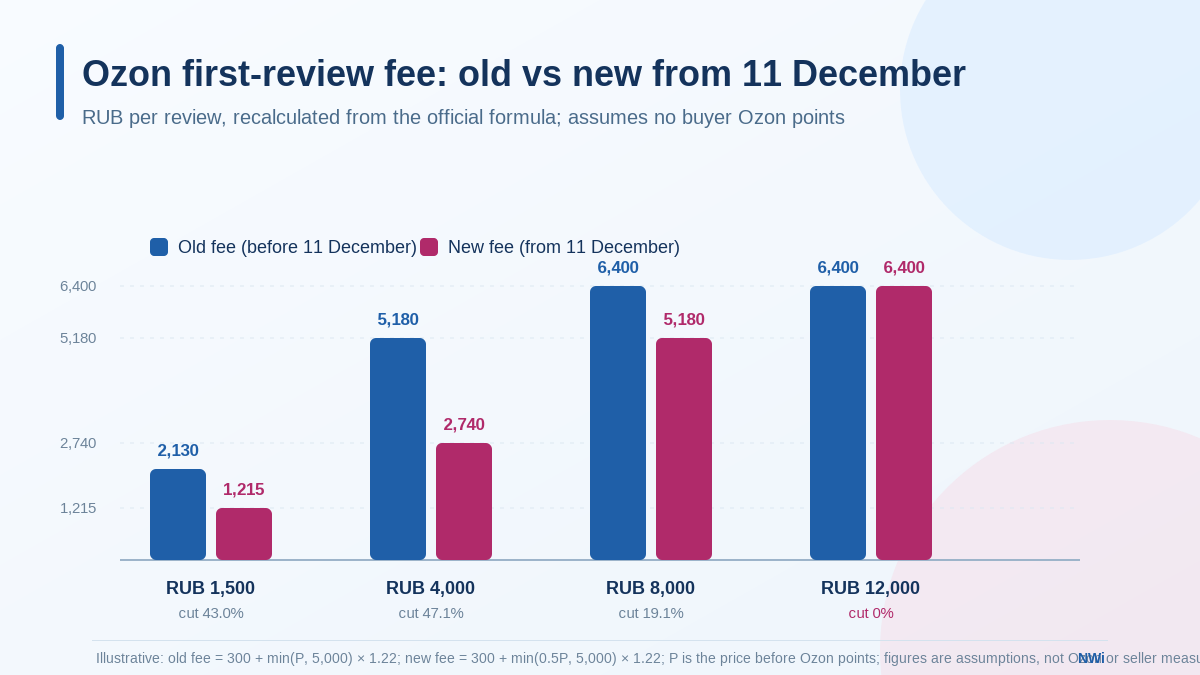
For an Ozon Russia seller preparing December launches, the real decision is which SKUs should wait until 11 December for the lower first-review fee, which should launch before it, and which should not use the tool even after the cut. The answer depends on four fields: the price before Ozon points, contribution margin, the planned launch date, and whether the review must already be live before 11 December. On 25 November Ozon said that from 11 December the first-review tool will credit top authors with 50% of the product price in points instead of 100%, set the fee at RUB 300 plus 50% of the price before points (capped at RUB 5,000) times 1.22, and delay both the fee debit and the points credit until 16 days after publication. Ozon says the cost of attracting one review will fall by almost half, but the published formula does not cut every price equally: below RUB 5,000 the fee roughly halves, between RUB 5,000 and RUB 10,000 the saving tapers, and at RUB 10,000 or above the cap leaves the fee unchanged.
1. What the 25 November notice changes: fee, cap and settlement
Ozon published the notice on 25 November 2026 and made the changes effective on 11 December 2026. First, author points fall from 100% to 50% of the product price, and the fee becomes RUB 300 plus 50% of the price before Ozon points (capped at RUB 5,000) times 1.22; Ozon says this will make the cost of attracting one review almost half. Second, the default timing for both the fee debit and the points credit moves to 16 days after publication; under the old rules most points were credited soon after publication, while the fee was already delayed 16 days in some reliability checks. The reason is that some authors collected points and then returned the product.
| Item | Before 11 December 2026 (old) | From 11 December 2026 (new) |
|---|---|---|
| Author points | 100% of the product price (old formula P + B, capped at RUB 5,000) | 50% of the product price before Ozon points (capped at RUB 5,000) |
| Service fee | 300 + min(P + B, 5,000) × 1.22 | 300 + min(0.5 × P, 5,000) × 1.22 |
| Settlement | Mostly soon after publication; some reliability checks after 16 days | Fee debit and points credit 16 days after publication |
| Qualifying review | Published, video and at least five characters of text, five stars, non-anonymous | Same conditions; eligibility and product scope depend on Seller Center |
P is the buyer-facing price before Ozon points; B is the Ozon points the buyer used. Every scenario in this article assumes B = 0. The RUB 300 fixed fee includes VAT; 1.22 is the coefficient in the notice, not an interpretation of the statutory VAT rate. The old formula comes from section 2.28 of the Ozon tariff page effective 1 December 2026; the new formula comes from the 25 November notice. Both charge only for qualifying reviews.
The same notice contains two secondary updates: from 11 December Ozon may give discounts on the Review Management subscription and the Brand Promotion tool, but "may" is not a guarantee; from 15 December External Promotion adds TikTok and Dzen as publication platforms. Neither changes the first-review fee formula, and this article does not treat either as a discount or traffic the seller already has.
2. Mechanism: why low-price SKUs get the largest cut and high-price SKUs may get none
Ozon calculates author points and the service fee from the product price: the old formula was RUB 300 plus the price (capped at RUB 5,000) times 1.22; the new formula cuts points from 100% to 50% and settles the fee and points 16 days after publication. The key is the two caps: the old formula caps the product price at RUB 5,000, and the new formula caps the "50% of price" amount at RUB 5,000. The old cap binds at a price of RUB 5,000; the new cap binds at RUB 10,000, because 0.5 × 10,000 = 5,000. Below RUB 5,000 the variable part halves; between RUB 5,000 and RUB 10,000 the old fee is already capped while the new fee is still rising, so the saving tapers; at RUB 10,000 and above both formulas hit the same cap, so the fee does not fall at all.
Putting the formula into four price points: at RUB 1,500 the old fee is 300 + 1,500 × 1.22 = RUB 2,130 and the new fee is 300 + 750 × 1.22 = RUB 1,215, a saving of RUB 915; at RUB 4,000 the old fee is 300 + 4,000 × 1.22 = RUB 5,180 and the new fee is 300 + 2,000 × 1.22 = RUB 2,740, a saving of RUB 2,440; at RUB 8,000 the old fee is 300 + 5,000 × 1.22 = RUB 6,400 and the new fee is 300 + 4,000 × 1.22 = RUB 5,180, a saving of RUB 1,220; at RUB 12,000 both the old and new fee are 300 + 5,000 × 1.22 = RUB 6,400, a saving of zero.
| Price P (RUB) | Old fee (RUB) | New fee (RUB) | Saving per review (RUB) | Cut | New fee as % of price | Break-even units at 30% margin |
|---|---|---|---|---|---|---|
| 1,500 | 2,130 | 1,215 | 915 | 43.0% | 81.0% | 2.7 |
| 4,000 | 5,180 | 2,740 | 2,440 | 47.1% | 68.5% | 2.3 |
| 8,000 | 6,400 | 5,180 | 1,220 | 19.1% | 64.8% | 2.2 |
| 10,000 | 6,400 | 6,400 | 0 | 0% | 64.0% | 2.1 |
| 12,000 | 6,400 | 6,400 | 0 | 0% | 53.3% | 1.8 |
"Break-even units" = fee per review ÷ contribution per unit. At a 30% contribution margin, a RUB 1,500 SKU contributes RUB 450 per unit, so 1,215 ÷ 450 = 2.7 units; a RUB 4,000 SKU contributes RUB 1,200, so 2,740 ÷ 1,200 = 2.3 units; a RUB 8,000 SKU contributes RUB 2,400, so 5,180 ÷ 2,400 = 2.2 units; a RUB 12,000 SKU contributes RUB 3,600, so 6,400 ÷ 3,600 = 1.8 units. This is not a sales forecast; it is the threshold a review must clear to avoid losing money on the fee. Actual conversion can be higher or lower.
For a SKU priced at RUB 4,000, the old fee is 300 plus 4,000 times 1.22 = RUB 5,180, and the new fee is 300 plus 2,000 times 1.22 = RUB 2,740, a saving of RUB 2,440 per review. The example also shows that "almost half price" mainly describes the variable part. The RUB 300 fixed fee does not fall, so the total fee falls by less than 50%; the lower the price, the larger the fixed fee's share and the smaller the total cut.
3. Evidence boundary: what the official pages prove and do not prove
The official notice and tariff page prove the formula, dates and cap, but they do not prove the sales a review generates, author supply, category eligibility or platform enforcement. The four readable Ozon documents give: the 25 November notice's 11 December effective date, 50% points, fee formula, RUB 5,000 cap and 16-day settlement; section 2.28's old formula, RUB 5,000 points cap and no-refund clause; the knowledge-base page's conditions (published, video, at least five characters of text, five stars, non-anonymous) and the 30-day pin limit without a subscription; and the 30 June launch notice's minimum of three reviews per product.
All four sources are Ozon publications, not four independent organisations, so this is not independent confirmation. The article also has no seller data on review conversion, author supply, category eligibility, actual debits, return rates or campaign budgets. The pages read here do not state how many sellers the change affects, how review volume will change, or whether a review will produce sales or ranking. The article does not estimate those unknowns.
Direct access to seller.ozon.ru and seller-edu.ozon.ru returned a redirect loop to webfetch and an anti-bot challenge to curl; the body text was read through the search backend's full-text extraction, and each source record marks readBackend=websearch-full-text. That limitation does not change the formula or dates, but it means the article does not have a direct HTTP 200 body read. Readers should confirm against the current Ozon Seller Center pages.
4. Three worked scenarios: which SKUs wait and which do not
The three scenarios use the same formula; the prices, review counts and 30% contribution margin are assumptions, not measurements by Ozon, NWi or any seller. First calculate the old and new fee per review, then multiply by the number of reviews; finally divide the fee per review by contribution per unit to get the break-even units.
| Scenario | Key assumptions | Result | Decision |
|---|---|---|---|
| A | Three SKUs at 1,500 / 4,000 / 8,000; five reviews each | Old 68,550; new 45,675; saving 22,875 (33.4%) | Wait until after 11 December if possible; if not, compare the extra 22,875 with the campaign contribution |
| B | 12,000; ten reviews; 30% margin | Old and new both 64,000; saving 0; 1.8 units per review, at least 18 units for ten | Do not delay for the cut; buy only if incremental units exceed 18 or the launch needs reviews |
| C | 1,500; twenty reviews; 30% margin | Old 42,600; new 24,300; saving 18,300 (43.0%); 2.7 units per review, 54 units for twenty | Even after the cut it may not pay; test organic or the RUB 250 accelerated review first |
Scenario A: three SKUs, five reviews each
Assume SKUs priced at RUB 1,500, 4,000 and 8,000, five reviews each, no Ozon points used by buyers, and no returns or ads; illustrative only. The old fee totals RUB 68,550 and the new fee RUB 45,675, a saving of RUB 22,875 or 33.4%; the new fee per review is RUB 1,215, 2,740 and 5,180 for the three SKUs. If all three launches can wait until after 11 December, wait; if a launch must go live between 1 and 10 December, compare the extra RUB 22,875 with the campaign contribution.
Scenario B: a RUB 12,000 SKU, ten reviews
Assume a RUB 12,000 price, ten reviews, no Ozon points used by buyers, and a 30% contribution margin, or RUB 3,600 per unit; illustrative only. The old and new fee are both RUB 6,400 per review, or RUB 64,000 for ten, a 0% cut; each review costs 1.78 units of contribution, so ten reviews need at least 18 incremental units to break even. Do not delay this SKU for the fee cut; buy only if the review generates more than 18 incremental units or the launch window requires reviews.
Scenario C: a RUB 1,500 SKU, twenty reviews
Assume a RUB 1,500 price, twenty reviews, no Ozon points used by buyers, and a 30% contribution margin, or RUB 450 per unit; illustrative only. The old fee is RUB 42,600 and the new fee RUB 24,300, a saving of RUB 18,300 or 43.0%; the new fee is still 81% of the price, each review costs 2.7 units of contribution, and twenty reviews need 54 incremental units to break even. Even after the cut, this price point may not be worth it; test organic reviews or the RUB 250 accelerated review first, and stop if the review does not produce 54 incremental units.
Together, the decision order is not "buy because the fee fell". First check whether the price is below RUB 5,000 (largest cut), then RUB 5,000–10,000 (tapering), then RUB 10,000+ (no cut); then use contribution margin to estimate the break-even units per review, and the launch date to decide whether the SKU can wait until 11 December.
5. Counter-cases and alternative explanations: a cut is not a reason to buy, and 16 days is not only cash flow
The counter-case is a SKU priced at RUB 10,000 or more: both the old and new formulas hit the RUB 5,000 cap, so the fee does not fall at all; for a low-price SKU, the fee can still exceed contribution margin even after the cut. This does not mean a high-price SKU should not use reviews; it means waiting for the cut has no fee rationale for that SKU. If the launch needs reviews, decide on review value and the launch window, not on the headline.
The second counter-case is a low-price SKU. At RUB 1,500 the new fee is RUB 1,215, still 81% of the price; even at a 30% margin, each review needs 2.7 units of contribution to break even. The cut lowers the fee from RUB 2,130 to RUB 1,215 but does not change the structure in which the review fee can exceed the contribution from one unit. For that SKU, organic reviews, the accelerated-review tool (section 2.27 lists a RUB 250 fixed fee) or no paid review may be a better fit; the accelerated tool does not provide the same five-star top-author video, so compare the format, not only the price.
The third counter-case is five-star selection. The tool charges only for five-star, non-anonymous reviews with video and text, so the reviews it collects are a selected sample of positive reviews, not a random sample of buyer satisfaction. The knowledge-base page also says that without a subscription each review is pinned for at most 30 calendar days and the next review replaces it; if the pin period is shorter than the launch window, the review's visible value is lower than it looks.
The fourth counter-case is the 16-day settlement. The notice says the delay is meant to prevent points-then-return; the tariff page separately says the fee is not refunded if the review is edited or deleted after publication, or the product is returned. The official notice does not spell out how the two rules interact or whether a return within 16 days means no fee at all; sellers should confirm the actual debit in Seller Center and should not read the 16-day delay as "return equals free".
The fifth counter-case is the other discounts. The notice says Ozon "may" give discounts on Review Management and Brand Promotion, but does not promise every seller will get one; do not put an uncertain discount into the budget. The financing effect of the 16-day delay can also be calculated: twenty reviews at RUB 2,000 cost RUB 30,400 at the new fee; at an assumed 20% annual cost of capital for 16 days, the interest is about RUB 267, or 0.9% of the fee. The larger effect is more likely on author supply and review timing than on financing.
The compliance boundary: use only the platform's permitted review tools, do not buy fake reviews, and do not require or induce positive reviews. The tool itself charges only for five-star reviews, so sellers should keep "rating" and "representativeness" separate and should not treat selected positive reviews as proof of product quality.
6. Action list and stop conditions
The action order is to group SKUs by price, contribution margin and launch date; wait until after 11 December where possible; for launches that cannot wait, compare the extra fee with the campaign contribution; after launch, record the publication date and the actual debit on day 16.
- Build a table: SKU, price before Ozon points, category, current review count and rating, last-30-day orders, contribution per unit, planned launch date, planned review count, and whether the seller has Review Management or Premium Pro.
- Calculate: old fee = 300 + min(P, 5,000) × 1.22; new fee = 300 + min(0.5P, 5,000) × 1.22; calculate per review and in total; mark each SKU as below RUB 5,000, RUB 5,000–10,000 or RUB 10,000+.
- Time it: if the launch can wait until after 11 December, wait; if it must go live between 1 and 10 December, compare the extra old-minus-new fee with the campaign contribution.
- Check eligibility: confirm the product is available in the tool, the minimum of three reviews per product, the 30-day pin limit, the current subscription and the actual debit rules in Seller Center.
- Record after launch: publication date, expected debit date on day 16, actual debit, points credited, review status (published / pending / rejected), pin start and end, returns and incremental orders.
Stop conditions: the price is RUB 10,000+ and the only reason to wait is the fee cut; the fee per review exceeds a contribution-margin ceiling you set (for example 20%–30%, an illustrative threshold, not a platform rule); the review cannot stay pinned long enough for the launch window; author supply or review quality falls and reviews stop qualifying; a low-price SKU's fee still exceeds contribution per unit; or the eligibility, debit or refund rules in Seller Center differ from the notice. If any applies, stop adding budget and go back to the formula and Seller Center.
Fields to watch: SKU, price, category, current review count and rating, last-30-day orders, contribution per unit, planned launch date, review count, old/new fee, publication date, debit date, actual debit, points, review status, pin days, return rate and incremental orders.
7. Limitations and unknowns
This article has no seller data on review conversion, author supply, category eligibility, actual debits or returns; every price, margin and review count is a labelled assumption, not a measurement by Ozon, NWi or any seller.
The specific unknowns are the order uplift from a review, author willingness to accept orders after the 16-day delay, category eligibility and moderation differences, how the 16-day return and no-refund rules actually interact, whether Ozon changes the formula or cap later, and the seller's actual cost of capital and campaign budget. The article does not estimate search volume, CPC, difficulty, conversion or customer data; every scenario can be recalculated from the formula, but it is not the seller's actual cost or return.
8. What it means for selection and data judgment
The original increment is to split the headline "almost half price" into the fixed fee, the 50% variable and the RUB 5,000 cap, show that the cut is zero above RUB 10,000, and give a break-even unit count per review based on contribution margin. The change does not alter the fundamental question of whether a review produces orders; it changes the cost curve of the review. For a December launch, group SKUs by price and contribution margin first, then decide which are worth waiting for, which are worth buying early, and which should use a cheaper review tool or no paid review.
To put Ozon Russia category, price band and brand concentration back into market data, see NWi CrossborderGo; for data by site, category and brand, contact us through Request a demo; for the cross-border data definitions, see Cross-border data. Product capabilities, site coverage and fields depend on the activated modules and the contract.
9. Method and disclosure
Data basis: on 28 November 2026 this article re-read Ozon's 25 November 2026 notice "Lower first-review fee and other updates", sections 2.27 and 2.28 of the Ozon Seller Education "Full list of commissions and tariffs", the first-review knowledge-base page, and the 30 June 2026 launch notice. The notice says that from 11 December 2026 author points fall from 100% to 50% of the product price, the fee is RUB 300 plus 50% of the price before Ozon points (capped at RUB 5,000) times 1.22, and both the fee debit and the points credit are delayed until 16 days after the review is published. The tariff page gives the old formula S + (P + B) × (1 + VAT rate), with S = RUB 300 and author points capped at RUB 5,000; it also says the fee is not refunded if the review is edited or deleted after publication, or the product is returned. The knowledge-base page says the fee is charged only for published, non-anonymous five-star reviews with video and at least five characters of text, and that without a subscription each review is pinned for at most 30 calendar days. The launch notice sets a minimum of three reviews per product. Calculations: old fee = 300 + min(P, 5,000) × 1.22; new fee = 300 + min(0.5P, 5,000) × 1.22; all examples assume the buyer uses no Ozon points (B = 0). The 1.22 is the published coefficient, not an interpretation of the statutory VAT rate. All prices, margins and review counts are labelled assumptions. Product scope: NWi CrossborderGo provides Ozon Russia sales, units, ASP and brand share, updated monthly and by contract; it does not provide review fees, author supply, campaign budgets, seller billing, real-time inventory or the sales uplift from a review.
This article was prepared with automated research assistance from the public sources listed at the end and has not been manually reviewed; it does not invent client data, expert review, review outcomes, sales uplift, ranking results or platform endorsement. It is not financial, tax, accounting or marketplace-operations advice; the fee, eligibility, debit, refund, review rules and campaign budget should be confirmed against Ozon Seller Center, the contract and professional advice.
- Ozon Seller, 25 November 2026, Lower first-review fee and other updates: from 11 December, 50% points, fee formula, RUB 5,000 cap, 16-day settlement; read on 28 November 2026.
- Ozon Seller Education, undated, Full list of commissions and tariffs: section 2.28 old formula and no-refund clause; section 2.27 RUB 250 accelerated-review rate; sections 2.27/2.28 effective 1 December 2026; read on 28 November 2026.
- Ozon Seller Education, undated, What is first-review collection: qualifying conditions, five-star video and text, non-anonymous, 30-day pin without a subscription; read on 28 November 2026.
- Ozon Seller, 30 June 2026, First-review collection: get five-star video reviews from top authors: at least three reviews per product, five-star video and text conditions; read on 28 November 2026.