
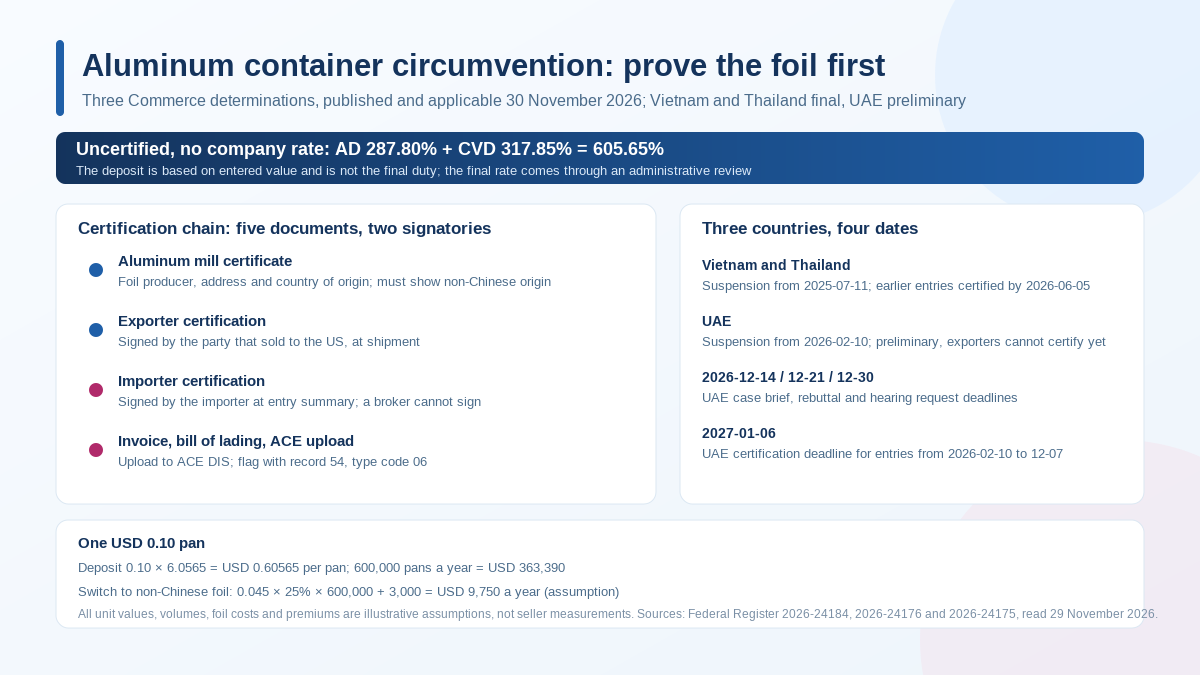
If you import aluminum foil pans from Vietnam, Thailand or the UAE, the real decision is whether this shipment can prove non-Chinese foil and avoid a deposit, or whether you accept the China-rate deposit and reprice, pass it through or leave the US market. If the shipment cannot prove that, US Customs and Border Protection collects deposits at the China order rates: 287.80% antidumping plus 317.85% countervailing, or 605.65% of entered value.
On a USD 0.10 pan, 605.65% is about USD 0.61 per unit, six times the FOB price. It is a deposit, not a final duty, but it consumes cash first, and unliquidated imports from 11 July 2025 (Vietnam and Thailand) or 10 February 2026 (the UAE) are in scope.
1. What happened on 30 November: three determinations, three countries, one certification threshold
The US Department of Commerce signed three determinations on 23 November 2026, filed them on 27 November, and published them on 30 November, when they became applicable. Vietnam and Thailand received final affirmative circumvention determinations; the UAE received a preliminary affirmative determination. All three rely on section 781(b) of the Tariff Act of 1930 and 19 CFR 351.226 to bring aluminum containers finished in a third country from Chinese foil, then exported to the United States, within the scope of the China orders of 8 May 2025 (preliminarily for the UAE).
For Vietnam and Thailand, liquidation is suspended for unliquidated entries from 11 July 2025, the date the inquiry was initiated. For the UAE, it starts on 10 February 2026. The final determinations dropped the retroactive suspension of entries before the initiation date, so imports before 11 July 2025 are outside this suspension.
| Country | Determination | Suspension start | Certification deadline | ACE third-country case numbers |
|---|---|---|---|---|
| Vietnam | Final affirmative | 11 July 2025 | Earlier entries 5 June 2026; later entries at shipment and entry summary | A-552-170 / C-552-171 |
| Thailand | Final affirmative | 11 July 2025 | Earlier entries 5 June 2026; later entries at shipment and entry summary | A-549-170 / C-549-171 |
| UAE | Preliminary affirmative | 10 February 2026 | 6 January 2027 (entries from 10 February to 7 December 2026) | A-520-170 / C-520-171 |
The scope covers disposable aluminum containers, pans, trays and lids made primarily from flat-rolled aluminum. They are currently classified mainly under HTSUS 7615.10.7125 and may also appear under 7612.90.1090, 7615.10.3015 and other lines. The notice excludes aluminum casks, drums, cans, boxes, cups and bottles under 7612.90, but an in-scope pan is not excluded merely because its foil thickness puts it under 7612.90.5000. Changing the code is not the way out; the product definition controls.
Keep the rates separate. The 287.80% rate is the China-wide antidumping cash-deposit rate; the 317.85% rate is the all-others countervailing rate; together they are 605.65%. The notice says companies with their own company-specific rates under the China orders use those rates, and everyone else uses the two rates above. It does not explain how a third-country producer maps to a Chinese company rate, so you cannot simply assume the 193.90% company rate applies.
2. Mechanism: why third-country processing still falls under the China orders
Section 781(b) lets Commerce include goods completed or assembled in a third country within an existing order when the goods are of the same class or kind, are made in the third country from merchandise subject to the order or produced in the order country, the third-country process is minor or insignificant, the order-country input is a significant share of the value exported to the United States, and Commerce finds action appropriate to prevent evasion.
The key fact here is not “the factory is in Vietnam”. It is “the foil is Chinese”. All three determinations describe the inquiry merchandise as aluminum containers assembled and completed in Vietnam, Thailand or the UAE using Chinese-origin aluminum foil and then exported to the United States. The three determinations separate “finished in a third country” from “made with Chinese foil”: the foil origin and the certification decide the treatment, not the location of the factory.
The deposit mechanism: Commerce directs CBP to suspend liquidation of unliquidated entries and collect a cash deposit at the applicable rate. The deposit is not the final duty. The final assessment is set in an administrative review based on the company’s data and cooperation, although a non-cooperating company can keep an adverse-facts rate. Treating 605.65% as the final bill overstates it; treating it as money that will never be collected understates the cash problem. The determinations set deposit rates and certification rules; they are not a final duty, an import volume or a ruling on any individual seller, and the final assessment comes through an administrative review.
Certification is the main way to avoid the deposit. The importer and the exporter both certify that the goods were not made with Chinese foil, or used an input other than foil, and submit the commercial invoice, bill of lading and aluminum mill certificate. A false or incomplete file can lead to a de facto finding that the entries are in scope, suspension, deposits, and removal from the certification process.
Who signs: the importer signs the importer certification, and a broker cannot sign for it. The exporter certification is signed by the party that sold to the United States. At entry, the importer uploads both certifications and the documents to the Document Imaging System in ACE and flags certified entries with record 54, AD/CVD certification designation, type code 06. Keep the file until the later of five years after the last entry and three years after any related US litigation ends.
3. Who is exposed: importers, exporters and product boundaries
The first group is brands and sellers that use their own US entity as importer of record. The deposit lands on their entry, the broker is only an agent, and they must sign the certification. The second group uses a third-party importer or a DDP forwarder. The duty bill is not in their name, but the contract passes the cost back; confirm whether the counterparty will sign the importer certification and can obtain the mill certificate and entry records. The third group is Vietnamese, Thai and UAE factories making goods for US brands. The exporter certification must come from the party that sold to the United States, so a factory that will not sign leaves its customer without the zero-deposit path.
| Product | Assessment | Basis |
|---|---|---|
| Disposable aluminum pans, trays, containers and lids | In scope | Core scope description |
| Aluminum foil rolls or sheets | Outside this inquiry | Input, not a container |
| Aluminum cans, cups, bottles, boxes under 7612.90 | Expressly excluded | Order exclusion |
| Paper container with an aluminum lid | Only the aluminum lid is in scope | Notice limits coverage to the lid |
| An in-scope pan entered under 7612.90.5000 | Not automatically excluded | Thickness classification does not change the product definition |
Two boundaries are easy to miss. First, lids imported on their own are covered; when a lid arrives with a paper container, only the aluminum lid is in scope. Second, embossing, printing, coating and decoration do not remove a pan from scope, and neither does a non-stick coating.
Not every factory in Vietnam, Thailand or the UAE uses Chinese foil. In Vietnam and Thailand, a factory using local, Indian, Korean or other non-Chinese foil can use the certification path if it can produce the mill certificate and a complete document set; UAE exporters cannot certify yet, as the next section explains. Conversely, using Chinese foil and moving only the last step to a third country does not make the goods safe just because the last step is offshore.
4. The certification path: what to file, who signs, and when
The file has five parts: the importer certification, the exporter certification, the commercial invoice, the bill of lading and the aluminum mill certificate. The mill certificate should identify the foil producer, its address and the country of origin; the invoice, bill of lading, production records and purchase orders tie the shipment to that foil. The importer also keeps a copy of the exporter certification.
There are three timing rules. For Vietnam and Thailand, entries from 11 July 2025 through 6 May 2026 had to be certified and uploaded by 5 June 2026. If that was not done and the entries were filed as non-AD/CVD, the importer should already have filed a post-summary correction converting them to AD/CVD and paid the deposit. For entries after 6 May 2026, the exporter certifies at shipment and the importer at entry summary. For the UAE, entries from 10 February to 7 December 2026 may certify until 6 January 2027.
The UAE has a crucial difference. The notice says UAE producers and exporters are not currently eligible to participate in the certification regime. A company can request a certification review, typically within an administrative review. That means even a UAE factory using non-Chinese foil cannot currently provide the exporter certification, so the importer cannot complete the file and the zero-deposit path is effectively unavailable. The notice also says certified UAE entries remain subject to suspension of liquidation, with a zero deposit, while certified Vietnam and Thailand entries avoid suspension and deposit altogether. This is the most easily missed difference among the three determinations.
Comment windows for the UAE, computed from 30 November publication: case briefs are due 14 days after publication, on 14 December 2026; rebuttals seven days later, on 21 December; hearing requests within 30 days, on 30 December. Vietnam and Thailand are final determinations, so comments do not change this suspension; the route for a challenge is an administrative review or litigation, not another round of preliminary comments.
- Pull every entry since 11 July 2025 (Vietnam and Thailand) or 10 February 2026 (the UAE), grouped by HTS line, entered value, importer, exporter and liquidation status.
- For each entry, mark whether liquidation is suspended, whether a post-summary correction was filed, whether certifications were uploaded, and whether the mill certificate shows non-Chinese origin.
- Confirm who the importer of record is; if it is a third party, establish who bears the deposit and any retroactive assessment under the contract.
- Have the exporter sign its certification with the mill certificate attached; a broker cannot sign the importer certification.
- Stop quoting zero deposit for any SKU where the mill certificate cannot be obtained.
5. The arithmetic: three scenarios and one foil-switch rule
Formula: deposit per unit = entered value × 6.0565; annual deposit = units × deposit per unit; annual foil-switch cost = units × foil cost per unit × premium + certification administration. The unit values, volumes, foil costs and premiums below are assumptions, not Commerce, CBP or seller measurements. Freight, taxes other than duty, marketplace fees, returns and exchange rates are excluded.
Scenario A: Vietnam factory, Chinese foil, no certification
Assume an entered value of USD 0.10 per pan, 600,000 pans a year, foil at USD 0.045 per pan (45% of FOB), a 25% premium for non-Chinese foil, and USD 3,000 a year of certification administration; freight, marketplace fees and returns are excluded.
The deposit is USD 0.60565 per pan and USD 363,390 a year; assuming 200,000 pans in a 40-foot high-cube container, each container carries USD 121,130; switching to non-Chinese foil costs 0.045 × 25% × 600,000 + 3,000 = USD 9,750 a year, about 1/37 of the deposit.
If you can obtain the mill certificate and the exporter will sign, switching foil costs far less than paying the deposit; if you cannot, reprice at 605.65% and exit any SKU whose contribution turns negative rather than gambling on liquidation.
Scenario B: UAE route, exporter cannot certify
Assume an entered value of USD 0.12 per pan, 150,000 pans imported after 10 February 2026, foil at USD 0.05 per pan, and a 25% non-Chinese foil premium; freight and marketplace fees are excluded.
The deposit is USD 0.72678 per pan, or USD 109,017 for 150,000 pans; even with non-Chinese foil, UAE exporters cannot currently sign the certification, so the zero-deposit path is unavailable and switching foil does not change the deposit.
Do not treat the UAE as a “move the factory and you are safe” option; file an evidence-based comment by 14 December or place new orders where the exporter can certify, and reserve cash for goods already shipped.
Scenario C: exporter confirmed at a company rate (assumption)
Assume an exporter is confirmed at the 193.90% company-specific AD rate, with CVD still at 317.85%, for 511.75% in total; entered value is USD 0.10 per pan and volume is 600,000 pans a year; the mapping is an assumption because the notice does not explain how third-country producers qualify.
The deposit is USD 0.51175 per pan and USD 307,050 a year, USD 56,340 less than the China-wide rate; the gap comes from 93.90 percentage points of AD rate and is not an automatic entitlement.
Confirm the entity mapping with Commerce or trade counsel before putting the difference into a quote; if you cannot confirm it, budget at 605.65%.
| Scenario | Entered value per unit (USD) | Deposit rate | Deposit per unit (USD) | Units a year | Annual deposit (USD) |
|---|---|---|---|---|---|
| A Vietnam, Chinese foil, no certification | 0.10 | 605.65% | 0.60565 | 600,000 | 363,390 |
| B UAE, exporter cannot certify | 0.12 | 605.65% | 0.72678 | 150,000 | 109,017 |
| C Assumed company rate | 0.10 | 511.75% | 0.51175 | 600,000 | 307,050 |
Scenario A carries a USD 0.60565 deposit per pan and USD 363,390 a year, while switching to non-Chinese foil costs USD 9,750 a year, about 1/37 of the deposit; scenario B’s 150,000 pans carry USD 109,017.
Decision rule: compare the deposit per unit with the per-unit premium for certifiable non-Chinese foil plus certification administration divided by units. Because the deposit is about six times FOB and foil is usually only part of FOB, switching foil is cheaper as long as the premium is below about 1,346% (before administration). Spread the USD 3,000 certification cost in, and the break-even premium is about 1,335%. The real constraint is not money; it is whether you can obtain the mill certificate, whether the exporter will sign, and whether the file survives verification.
Sensitivity: at entered values of USD 0.06, 0.10 and 0.20, the deposit per unit is USD 0.36339, 0.60565 and 1.2113. Low-price SKUs carry a smaller absolute deposit but still six times FOB; high-price SKUs carry more absolute cash pressure. Do not calculate duty from the retail price: duty is based on entered value, while marketplace fees are based on selling price.
6. Counter-cases: when not to switch foil or exit
The counter-case is a Vietnamese or Thai factory using non-Chinese foil that can certify: its entries are not suspended and carry no deposit, so this is not a blanket ban on third-country processing.
Boundary one: the product is out of scope. Foil rolls, aluminum cans, cups, bottles and boxes, and the paper part of a paper container with an aluminum lid are outside this inquiry. If the product is genuinely excluded, the duty discussion does not apply, but confirm the HTS line and the product definition rather than relying on a supplier saying “it is not a pan”.
Boundary two: the entry predates 11 July 2025. The final determinations dropped the retroactive suspension of entries before the initiation date, so those entries are outside this round. If the goods themselves are Chinese-origin they may still fall under the China orders, so an early entry date is not a blanket exemption.
Boundary three: the exporter has a company rate. If it is confirmed at the 193.90% AD rate, the total is 511.75%, not 605.65%, a difference of 93.90 percentage points. The notice does not say how third-country entities map to a company rate, so confirm it first rather than applying it yourself.
Boundary four: the UAE finding may change. It is preliminary, and comments or a hearing could change the scope, the rate treatment or the certification arrangement. Do not treat it as permanent, but do not expect it to change before your next shipment either.
Boundary five: the final assessment may be lower than the deposit. The deposit is prepaid; an administrative review sets the final rate from the company’s actual data and cooperation. A cooperating company with complete records may end up below the deposit and recover the excess, but the refund waits for the review and liquidation, so the cash pressure is real.
Boundary six: certification can cost more than it saves. At a few thousand units a year with thin contribution, administration, legal fees and internal time can exceed the deposit saved, and exiting the SKU or moving it to a non-US market may be the better decision.
7. Action list, observation fields and stop conditions
Split imports into a certified and an uncertified quoting path, confirm who the importer of record is and whether the exporter can sign, then set 30 November, 14 December and 6 January 2027 as the three triggers.
Sequence: first, from now to 30 November, pull the entry data, mark liquidation and certification status, confirm the importer of record, and flag every SKU without a mill certificate. Second, from 30 November, quote new imports on two paths, certified and uncertified; reserve cash at 605.65% for the uncertified path and do not sign annual prices on a zero-deposit assumption. Third, by 14 December, file an evidence-based case brief if you use the UAE and have the evidence; rebut by 21 December; decide on a hearing request by 30 December. Fourth, by 6 January 2027, check the certification status of UAE entries from 10 February to 7 December 2026, but note that exporters cannot currently sign, so prioritize a supply-chain change. Fifth, keep mill certificates, invoices, bills of lading and production records by entry for the legal retention period.
Observation fields: ACE entry and liquidation status; record 54 type 06; whether a post-summary correction was filed; third-country case numbers A-552-170/C-552-171, A-549-170/C-549-171 and A-520-170/C-520-171; CBP CSMS implementation messages; the start of an administrative review; the UAE final determination and comment outcome; the foil producer and country of origin on the mill certificate; and the deposit rate on CBP Form 7501.
Stop conditions: the mill certificate cannot be obtained or shows Chinese origin, so stop the certification path and reprice at the full deposit or exit; the product is confirmed in writing as excluded, so stop treating it as in scope; the UAE final determination narrows or removes the finding, so reassess; an administrative review sets a final rate below your contribution buffer, so you can resume; or the supply chain completes a non-Chinese foil switch and passes verification, so run the new path.
Three things not to do: do not change only the HS code; do not let a broker sign the importer certification; and do not quote zero deposit for a SKU when the mill certificate cannot be obtained.
8. Limits and unknowns
This article has no import volumes for the three countries, no count of affected sellers, no company-level entry values and no final review rates; every scenario number is an assumption.
The determinations do not publish a list of third-country producers, the mapping to company rates, details of CBP implementation instructions or an administrative review schedule. Those will appear in ACE, CBP CSMS and later Commerce documents.
The UAE is preliminary, so scope, rate treatment and certification arrangements may change. Vietnam and Thailand are final, but administrative reviews, litigation or scope rulings can still change the picture.
This article does not assess other third countries, such as India, Malaysia or Mexico, where Chinese foil might be used. The China orders apply to Chinese-origin goods; whether third-country processing is circumvention depends on the facts and on whether a new inquiry is opened, and cannot be inferred by analogy.
Product boundary: NWi CrossborderGo provides global overview, industry, brand and shop research, product research and custom market analysis, which can compare US price bands, category density and alternative markets. Available sites, history and fields depend on the account and contract. It does not read entry summaries, manage origin or mill certificates, or provide circumvention rates, tariff classification, importer-of-record filing or legal advice.
9. Method and disclosure
The contribution is to turn the three determinations into three executable tests: is there a non-Chinese foil certificate, who is the importer, and is the deposit cheaper or dearer than switching foil.
Method: on 29 November 2026 I read the full pre-publication Federal Register texts of 2026-24184 (Vietnam final), 2026-24176 (Thailand final) and 2026-24175 (UAE preliminary) through the Federal Register full-text endpoint. All three were signed on 23 November 2026, filed at 8:45 am on 27 November and published and made applicable on 30 November 2026. I also read the China orders of 8 May 2025 (90 FR 19467) for the 287.80%, 193.90% and 317.85% rates and the scope, and 19 CFR 351.226 for the suspension and retroactivity rules. Arithmetic: total deposit rate = 287.80% + 317.85% = 605.65%; deposit per unit = entered value × 6.0565; annual deposit = units × deposit per unit; annual foil-switch cost = units × foil cost per unit × premium + certification administration; break-even premium = deposit per unit ÷ foil cost per unit (before administration), and (deposit per unit − administration per unit) ÷ foil cost per unit after including USD 3,000. Scenario A: 0.10 × 6.0565 = USD 0.60565; 600,000 × 0.60565 = USD 363,390; 200,000 × 0.60565 = USD 121,130; 0.045 × 25% × 600,000 + 3,000 = USD 9,750; 363,390 ÷ 9,750 = 37.3. Scenario B: 0.12 × 6.0565 = USD 0.72678; 150,000 × 0.72678 = USD 109,017. Scenario C: 0.10 × 5.1175 = USD 0.51175; 600,000 × 0.51175 = USD 307,050; difference USD 56,340. Sensitivity: 0.06 × 6.0565 = 0.36339 and 0.20 × 6.0565 = 1.2113. All entered values, volumes, foil costs, premiums, administration costs and the scenario C company-rate mapping are labeled assumptions, not Commerce, CBP, marketplace or seller measurements. Product boundary: NWi CrossborderGo provides global overview, industry analysis, brand and shop research, product research and custom market analysis; available sites, history and fields depend on the account and contract, and it does not read entry summaries or mill certificates, or provide circumvention rates, tariff classification, origin determinations or legal advice.
This article was prepared with automated research assistance from the public sources listed at the end and has not been reviewed by a human expert. It does not invent customer data, expert review, duty outcomes, sales effects, ranking results or platform endorsement. It is not legal, trade-remedy, customs or tax advice; questions about product scope, tariff classification, origin, certification files, deposits or participation in a case should go to the Federal Register, CBP implementation instructions, a customs broker, trade counsel or the relevant authority.
If you need to map US category size, price bands and competitive density before deciding which SKUs still contribute under a duty assumption, see the global overview, industry, brand and shop research and product research modules in NWi CrossborderGo; available sites, history and fields depend on the account and contract. To review your own sites and data scope, book a demo. If your team wants public rules, marketplace data and internal SKU records in one research workflow, look at the expert research process in the NWi Cross-border Agent; its output still needs human review and does not replace a broker, trade counsel or compliance advice.
Sources
- Federal Register: Vietnam final affirmative circumvention determination (2026-24184, signed 23 November, filed 27 November, published 30 November 2026)
- Federal Register: Thailand final affirmative circumvention determination (2026-24176)
- Federal Register: UAE preliminary affirmative circumvention determination (2026-24175)
- Federal Register: China antidumping and countervailing duty orders on disposable aluminum containers, pans, trays and lids (90 FR 19467, 8 May 2025)
- 19 CFR 351.226: circumvention inquiries and suspension of liquidation (eCFR, point-in-time 1 November 2026)
Accessed 29 November 2026. The three determinations were filed on 27 November and published on 30 November; this article reads the Federal Register pre-publication full text (documents 2026-24184, 2026-24176 and 2026-24175) and checks rates, scope and suspension rules against the 2025 orders and 19 CFR 351.226.