
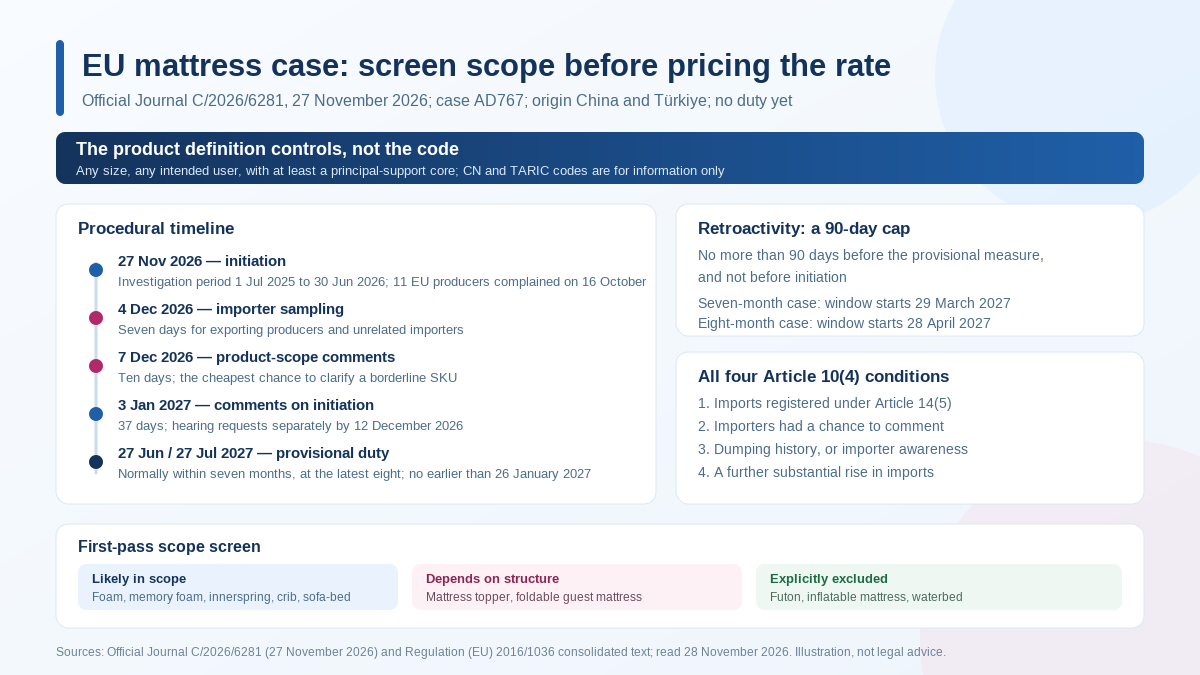
If you sell mattresses in the EU that are sourced from China or Türkiye, the question after 27 November 2026 is not whether the EU will add a duty. It is three narrower questions: does your SKU fall inside the product definition, are you the importer of record, and will you file anything before the 4 and 7 December deadlines? An initiation is not a duty: the notice publishes no rate, no margin figure and no import volume. What changes cash flow is the chain from registration to provisional duty to retroactive collection, and that chain has a 90-day cap and four conditions that must all be met.
The 27 November notice: scope, codes and key dates
The European Commission opened an anti-dumping investigation into mattresses originating in China and Türkiye in Official Journal C/2026/6281 on 27 November 2026. The TRON form and case links in the notice identify the case as AD767. The complaint was lodged by 11 EU producers on 16 October, and the Commission considered the evidence sufficient to initiate under Article 5(9) of the basic Regulation.
The product definition covers mattresses of any dimensions, size or intended user, made from an assembly of materials that includes at least a core providing the principal support function. The core may be innersprings, rubber, cellular plastics or other materials, and the mattress may add upholstery and ticking. Futon mattresses, inflatable mattresses and waterbeds are explicitly excluded.
The codes named are ex 9404 21 10, ex 9404 21 90, ex 9404 29 10 and ex 9404 29 90, with TARIC codes 9404 21 10 90, 9404 21 90 90, 9404 29 10 90 and 9404 29 90 90. The notice also says the CN and TARIC codes are given for information only, that the Section 2 product definition controls the scope, and that classification may change. That sentence sets the screening order: check structure first, codes second.
The investigation period is 1 July 2025 to 30 June 2026, and the injury trend is examined from 1 January 2023 to the end of that period. The Commission is therefore looking at import volumes, prices and EU industry performance from January 2023 to June 2026, not at today's price.
| Item | Time limit | Date | Notice reference |
|---|---|---|---|
| Exporting producer sampling information | 7 days | 4 December 2026 | 5.3.1(a) |
| Unrelated importer sampling information | 7 days | 4 December 2026 | 5.3.3 |
| Product-scope comments | 10 days | 7 December 2026 | Section 2 |
| Hearing request on initiation | 15 days | 12 December 2026 | 5.2, 5.7 |
| China inputs and representative-country comments | 15 days | 12 December 2026 | 5.3.2 |
| Comments on the complaint and initiation | 37 days | 3 January 2027 | 5.2 |
| China cost and price factual information | 65 days | 31 January 2027 | 5.3.2 |
| Other provisional-stage information | 70 days | 5 February 2027 | Section 7 |
| Comments on other parties' submissions | Day 75 | 10 February 2027 | Section 8 |
| Earliest provisional duty | 60 days | 26 January 2027 | Article 7(1) |
| Provisional duty usual/latest | 7/8 months | 27 June/27 July 2027 | Section 6 |
| Investigation usual/latest | 12/14 months | 27 November 2027/27 January 2028 | Section 6 |
The table counts calendar days from 27 November 2026. Extensions are possible in exceptional cases, but questionnaire replies are normally extended by no more than three days and in principle not more than seven, while other submissions are normally extended by up to three days. An extension must be justified; it is not an automatic right. The TRON system and the Official Journal control the actual deadline.
The notice publishes no dumping margin, duty rate or import volume. It calls the margins for China and Türkiye significant. The 10%, 20% and 30% rates in this article are assumptions, not official figures and not a forecast of the final rate.
From registration to retroactive collection: four gates
Section 5.9 says the Commission intends to instruct customs authorities to register imports of Chinese and Turkish mattresses at an early stage, which may lead to retroactive collection of definitive duties, and that the registration regulation will be published in due time. At the time of this review the registration regulation had not been published, so the start date is unknown.
Registration only records imports in the customs ledger. The Commission can collect definitive duties retroactively on registered imports only when all four Article 10(4) conditions are met, and never more than 90 days before the provisional measure applies.
The baseline in Article 10(1) is that provisional measures and definitive duties apply only to products entering free circulation after the measure takes effect. Article 10(4) provides the exception, and it requires all four conditions: the imports were registered under Article 14(5); importers had an opportunity to comment; there is a history of dumping over an extended period, or the importer knew or should have known of the dumping and the injury alleged or found; and, on top of the injurious import level, there is a further substantial rise in imports which, given its timing, volume and other circumstances, is likely to seriously undermine the remedial effect of the definitive duty.
The second gate is the time cap. Article 10(4) allows retroactive collection on imports entered no more than 90 days before the provisional measure applies, and not before the initiation date. Applying the notice timetable: if provisional duties land at seven months (27 June 2027), the 90-day window starts on 29 March 2027; at the eight-month ceiling (27 July 2027), it starts on 28 April 2027. Imports from December 2026 to March 2027 fall outside that window when duties arrive at seven or eight months. If they come earlier (the earliest is 26 January 2027), the window moves earlier but never before the initiation date.
The third gate is whether a measure actually lands. Article 7(1) allows provisional duties no earlier than 60 days after initiation (26 January 2027), normally within seven months and in any event within eight. The Commission discloses the planned rates four weeks before imposition and gives three working days to comment on the accuracy of the calculations. If it decides not to impose provisional duties but to continue, it issues an information document. Definitive duties also pass the Union interest test, and Article 9(3) requires immediate termination where the margin is below 2% of the export price.
The fourth gate is the level. Article 7(2) caps a provisional duty at the dumping margin and requires a lower duty where that is enough to remove the injury. Section 4.2 of the notice says the complainants provided evidence of raw material distortions for polyether polyols in China, which they say account for [20-30]% of production cost and are subject to withdrawal of the export VAT refund, and that the Commission will assess under Article 7(2a) whether a duty below the margin would remove the injury. For China, normal value is not based on domestic prices: it is constructed under the Article 2(6a) significant-distortions method, and the complainants propose Mexico as the representative country. The significant margin therefore comes from a constructed normal value, and the final rate also depends on the sampled companies, the representative country and the injury margin.
Cooperation status also sets the rate tier. Sampled exporting producers complete the full questionnaire; cooperating producers that agree to be sampled but are not selected get a duty no higher than the weighted average margin of the sample, excluding zero, de minimis and Article 18 margins; non-cooperating companies are assessed on facts available, which may be less favorable. An importer that does not file sampling information does not directly change the rate tier applied to the goods, but it loses the chance to be sampled, to comment and to access the case file.
Who is exposed: screen by product definition, not by code alone
The decision is whether to screen SKUs against the product definition and file by 4 or 7 December, or to change suppliers, origin or prices first. The answer depends on whether the product falls inside the scope, who is the importer of record, and whether the 90-day retroactivity window covers goods already in transit.
The duty falls on the customs declaration, and the legal debtor is the importer of record, not necessarily the brand or the store operator. An EU company importing, an EU distributor importing, a service provider clearing before FBA receipt and a logistics provider clearing DDP on direct-to-consumer shipments put the cash and the final cost in different places. Start with the Incoterms, the EORI number and 12 months of customs entries, not with the retail price.
The scope description has three elements: it is a mattress rather than an accessory, it is an assembly of materials, and it has at least a core providing the principal support function. That supports a first-pass screen.
| Product type | First-pass view | Reason |
|---|---|---|
| Roll-packed foam or memory-foam mattress | Likely in scope | Cellular-plastic core counts as an other-material core |
| Innerspring mattress, including pocket springs | Likely in scope | Innerspring core |
| Crib or child-bed mattress | Likely in scope | Any intended user; no age exception |
| Replaceable sofa-bed mattress sold separately | Possibly in scope | Has a support core and is sold as a mattress |
| Mattress topper | Possibly out of scope | Usually does not provide the principal support; document the structure |
| Futon mattress | Explicitly excluded | Section 2 of the notice |
| Inflatable mattress | Explicitly excluded | Section 2 of the notice |
| Waterbed | Explicitly excluded | Section 2 of the notice |
| Bed frame, headboard, bedding | Out of scope | Not a mattress |
This is a screen, not a ruling. The topper is the easiest place to get it wrong: a comfort layer laid on an existing mattress usually has no core providing the principal support and may fall outside, while a thick memory-foam pad or a foldable guest mattress that supports on its own may be treated as a mattress. The test is structure, thickness, intended use and the product page, not whether the title contains the word mattress. The product-scope deadline is 7 December 2026, only 10 days away; where the boundary is unclear and the volume is material, that is the cheapest chance to clarify.
Then layer by exposure. A brand whose EU entity is the importer carries the duty on its own declaration and the retroactive risk on its own books. A brand selling through an EU distributor sees the duty land on the distributor first, but DAP or DDP terms, annual price talks and rebates pass it back. A marketplace seller that outsources clearance should confirm whether the provider declares in its own name, whose name is on the duty bill, and whether the import records are available.
There is also a reverse risk. Article 10(4)(d) treats a further substantial rise in imports, on top of the injurious level, as one condition for retroactive collection. Read structurally, a rush of volume after initiation and before provisional measures could supply exactly that evidence. This is not a statement by the Commission but a risk inferred from the text: front-loading does not necessarily reduce exposure and may raise the chance of retroactive collection. Decide on real demand, warehousing cost and cash flow instead.
Evidence boundary: what the notice does not say
The notice says the Commission found enough evidence to open an investigation. It does not find dumping or injury, and it publishes no margin figure, no duty rate and no import volume. The notice repeatedly uses claim and allegation language for the complainants' case.
The notice does not publish the dumping margin, an expected rate, Chinese or Turkish export volumes to the EU, the size of the EU market, the complainants' market share or the sampled companies. Significant is a qualitative description; converting it into a percentage has no basis in the notice.
The notice says the complainants relied on a third-party market-intelligence price comparison for polyether polyols and on a [20-30]% cost share. Those are allegations in the complaint, and the bracketed range shows the precise figure sits in the confidential version. This article treats them as the complainants' claim and does not use that vendor's data.
The notice writes 16 October without a year. This article infers 16 October 2026 from the 27 November 2026 publication date. The inference is reasonable, but the notice itself does not repeat the year.
The registration regulation is not yet published, so the start date, whether the registration scope matches the investigation scope, and whether goods in transit are covered are all unknown. Whether the four Article 10(4) conditions hold will be decided at the definitive stage; retroactive collection cannot be determined now.
The arithmetic: three exposures and one scope-comment break-even
The three scenarios are assumptions, not measurements by the Commission, customs or a seller. Currency is the euro, and only the duty line is counted; import VAT, freight, warehousing, marketplace commission, advertising, returns and exchange rates are excluded. Formulas: duty per unit = declared value x assumed rate; duty as a share of contribution = duty per unit / contribution per unit; 90-day window exposure = units in the window x duty per unit; break-even volume loss = duty per unit / contribution per unit. Full-year figures use the same rate for 12 months only as an order of magnitude; provisional duties may cover fewer months.
Scenario A: roll-packed foam mattress, EU entity is the importer
Assume a declared value of EUR 52 per unit, a contribution of EUR 21 per unit, 36,000 units imported a year, an assumed provisional rate of 20%, 9,000 units inside the 90-day window, and the EU entity declaring and paying the duty itself. Import VAT, freight, marketplace fees and returns are excluded.
The duty is EUR 10.40 per unit, or 49.5% of the EUR 21 contribution; the 90-day retroactive exposure is EUR 93,600 and the full-year figure at the same rate is EUR 374,400. If the whole duty is passed through, the break-even volume loss is 49.5%.
If expected volume loss after a EUR 10.40 price rise is below 49.5%, pass the duty through; if it is higher, renegotiate FOB and pack volume, or exit the low-contribution SKU.
Scenario B: innerspring mattress, the EU distributor is the importer
Assume a declared value of EUR 140 per unit, distributor gross margin of EUR 48 per unit, seller gross margin of EUR 40 per unit, 12,000 units a year, an assumed 20% rate, 3,000 units in the 90-day window, and a DAP contract where the distributor declares.
The duty is EUR 28.00 per unit, or 20% of declared value and 58.3% of the distributor's EUR 48 margin; the 90-day exposure is EUR 84,000 and the full-year figure is EUR 336,000. If the two sides split it evenly, the seller concedes EUR 14 per unit, or 10% of declared value and 35% of its own margin.
Do not build 2027 prices on a no-duty assumption. Write a trigger clause that shares the published rate and sets how retroactive collection is settled.
Scenario C: mattress topper, decide first whether to comment on scope
Assume 20,000 units a year, a declared value of EUR 18 per unit, a contribution of EUR 7 per unit, an assumed 20% rate, and a scope-comment cost of EUR 6,000 for an external adviser plus 80 internal hours at EUR 60, or EUR 10,800.
The duty is EUR 3.60 per unit, or 51.4% of the EUR 7 contribution, and the full-year figure is EUR 72,000; if the product is held in scope, the 90-day exposure on 5,000 units is EUR 18,000. The scope-comment cost equals 15% of the annual duty.
If you judge the chance of a clear exclusion to be above 15%, filing costs less in expectation than not filing; below 15%, prepare the structural file and wait for the registration regulation or the sample list.
| Scenario | Declared value/unit (EUR) | Assumed rate | Duty/unit (EUR) | Contribution/unit (EUR) | Share of contribution | 90-day window exposure (EUR) | Full-year (EUR) |
|---|---|---|---|---|---|---|---|
| A Roll-packed foam | 52 | 20% | 10.40 | 21.00 | 49.5% | 93,600 | 374,400 |
| B Innerspring | 140 | 20% | 28.00 | 48.00 | 58.3% | 84,000 | 336,000 |
| C Mattress topper | 18 | 20% | 3.60 | 7.00 | 51.4% | 18,000 | 72,000 |
In Scenario A the duty is 52 times 20%, or EUR 10.40 per unit, which is 49.5% of a EUR 21 contribution, and the 90-day window exposure on 9,000 units is EUR 93,600. In Scenario C the scope-comment cost of EUR 10,800 equals 15% of an assumed annual duty of EUR 72,000.
Sensitivity: at a 10% rate, Scenario A falls from EUR 10.40 to EUR 5.20 and from 49.5% to 24.8% of contribution; at 30% it rises to EUR 15.60, or 74.3%. Scenario B at 30% pays EUR 42.00, or 87.5% of the distributor margin; Scenario C at 10% pays EUR 1.80, or 25.7% of contribution. The rate tier matters more than whether a case exists, and the rate waits on sampling and the injury margin.
The decision order: first check whether contribution after absorbing the duty stays above your minimum; then check whether the volume loss after passing it through stays below break-even; if neither works, discuss FOB, pack weight, a new supplier or exit. Do not set a retail price and back out the duty, because marketplace commission is charged on the selling price while the duty is charged on the declared value.
Counter-cases: when not to reprice or reroute
The counter-case: the Commission may decide at the provisional stage not to impose duties, or may terminate at the final stage because injury or Union interest is not established; registration alone does not guarantee a duty.
Counter-case two: registration is not retroactivity. All four Article 10(4) conditions are required. If the Commission does not find a further substantial rise, or importers had no chance to comment, retroactive collection lacks a basis. A seller importing at a normal pace should not treat possible retroactivity as certain.
Counter-case three: the product may be out of scope. Futons, inflatable mattresses and waterbeds are explicitly excluded; toppers, frames and bedding depend on structure. If the product is excluded, the duty discussion does not apply, but watch whether the registration scope is drafted more broadly.
Counter-case four: you may not be the debtor. If an EU distributor or logistics provider is the importer of record, the duty bill is not in your name, but the cost returns through price, rebates or contract terms. Ignoring the contract because it looks like someone else's problem can leave you accepting the full cost at the annual review.
Counter-case five: demand elasticity may matter more than the rate. With strong differentiation and repeat purchase, passing through EUR 28 may cost little volume; in a commoditized, price-compared category it may cost more than 58.3%. This article has no elasticity data, so it cannot conclude that raising prices is always better or absorbing is always worse.
Counter-case six: changing origin is not automatically faster. Moving orders to a third country requires origin rules, capacity checks and compliance files; re-routing through a third country without changing origin raises separate anti-circumvention questions. This article does not judge the feasibility of specific alternative origins.
Action list, observation fields and stop conditions
Split SKUs into in-scope, borderline and clearly excluded groups, confirm the importer of record and EORI number, then use 4 December, 7 December, 3 January 2027 and the provisional pre-disclosure as four action triggers.
Step one, now to 4 December: confirm the importer of record and EORI, and pull 12 months of import entries by CN code, declared value, origin and importer. If you are an unrelated importer with material volume, file the Annex sampling information by 4 December.
Step two, by 7 December: document the structure of borderline SKUs and decide whether to comment on product scope. The test is not whether the title says mattress but whether a core provides the principal support.
Step three, by 12 December and 3 January 2027: if you need a hearing, or have substantive points on initiation, injury, causation or Union interest, file by those dates. Saying that you would prefer no duty is not an evidenced submission.
Step four, by 31 January 2027: if you buy from China and hold verifiable public information on costs, inputs or a representative country, you can file factual information under Section 5.3.2; such submissions must rely on readily available public sources.
Step five, ongoing: watch four fields: whether the registration regulation is published and its start date; the importer and exporting-producer sample lists; the rates in the provisional pre-disclosure; and the Article 10(4)(c) and (d) findings on dumping history and a further substantial rise. A change in any one of them is enough to change purchasing and pricing.
Stop conditions: the registration regulation clearly excludes your product; the Commission terminates the case or reaches a negative final finding; the final rate is below your contribution buffer; an alternative supply plan has passed origin, compliance and quality checks; or you decide to exit the SKU or market. When any of these holds, stop buying against the worst case.
Three things not to do: do not skip the 4 December filing to save a little work now; do not assume everything is in scope and raise all prices without a structural file; and do not treat an initiation as an imposed duty when renegotiating annual prices with a distributor.
Limits and unknowns
This article has no duty rate, dumping margin, import volume, EU market size or complainant market-share data, and it did not read the confidential complaint or the TRON case file; every percentage scenario is an assumption.
The effect of a scope comment depends on the quality of the evidence filed, and this article cannot predict whether the Commission will accept it.
Dates are counted in calendar days without EU public holidays, granted extensions or procedural changes; TRON and the Official Journal control the actual deadline.
This article does not assess specific alternative origins, origin rules, anti-circumvention, import VAT, quotas, free-trade agreements or exchange rates, and it does not model second-order effects from marketplace commission, FBA fees or return-rate changes.
Product boundary: NWi CrossborderGo provides global overview, industry analysis, brand and store research, product research and custom market analysis that can help size an EU category, map price bands and gauge competition when estimating pass-through room. Available sites, history and fields depend on account authorization and contract. It does not read the Official Journal or the TRON case file and does not provide anti-dumping rates, customs classification, import registration, origin rulings or legal advice.
Method and disclosure
The contribution is to turn an initiation into three executable judgments: whether the product is inside the definition, who is the importer of record, and how the 90-day window and four conditions work. Three reproducible scenarios convert a rate assumption into duty per unit, contribution share and window exposure.
Data basis: on 28 November 2026 I reopened and read the notice of initiation in Official Journal C/2026/6281 (27 November 2026) through the EU Publications Office Cellar XHTML representation. The EUR-Lex HTML entry returned an access-protection page and was not used as a reading source. Scope, codes, investigation period, deadlines, registration intent and the provisional-measure ceiling come from that notice. The legal mechanics were checked against the consolidated text of Regulation (EU) 2016/1036 as at 8 June 2018: Article 7(1) on 60 days to seven or eight months, Article 7(2) on the lesser duty rule, Article 7(2a) on raw material distortions, Article 9(3) on the 2% de minimis margin, Article 10(1) and 10(4) on retroactivity, and Article 18 on non-cooperation. Dates are calendar days from 27 November 2026: 7 days is 4 December 2026, 10 days is 7 December, 15 days is 12 December, 37 days is 3 January 2027, 65 days is 31 January, 70 days is 5 February and 75 days is 10 February; seven months is 27 June 2027, eight months is 27 July 2027, 12 months is 27 November 2027 and 14 months is 27 January 2028. The 90-day windows start on 29 March 2027 and 28 April 2027 respectively. Calculation basis: duty per unit = declared value x assumed rate; duty as a share of contribution = duty per unit / contribution per unit; 90-day window exposure = units in the window x duty per unit; break-even volume loss = duty per unit / contribution per unit; scope-comment cost = 6,000 + 80 x 60 = EUR 10,800, which is 15% of an assumed annual duty of EUR 72,000. Scenario A: 52 x 20% = EUR 10.40, 10.40 / 21 = 49.5%, 9,000 x 10.40 = EUR 93,600. Scenario B: 140 x 20% = EUR 28.00, 28 / 48 = 58.3%, 3,000 x 28 = EUR 84,000. Scenario C: 18 x 20% = EUR 3.60, 3.60 / 7 = 51.4%, 20,000 x 3.60 = EUR 72,000. All declared values, contributions, volumes, window units, rates and costs are labeled assumptions, not measurements by the Commission, customs, a marketplace or a seller. Product basis: NWi CrossborderGo provides global overview, industry analysis, brand and store research, product research and custom market analysis; available sites, history and fields depend on account authorization and contract. It does not read the Official Journal or the TRON case file and does not provide anti-dumping rates, customs classification, import registration, origin rulings or legal advice.
This article was prepared with automated research assistance and analyzes the public sources listed at the end. It was not reviewed by a human expert. It does not invent customer data, expert review, duty outcomes, sales effects, ranking results or marketplace endorsement. Nothing here is legal, trade-remedy, tax, customs or investment advice. Questions about product scope, customs classification, origin, import registration, duty rates or participation in the case should be checked against the Official Journal, the TRON case file, a customs broker, a trade lawyer or the competent authority.
If you need to size the EU category, map price bands and gauge competitive density before estimating pass-through room under a duty assumption, see the global overview, industry, brand and store and product research modules in NWi CrossborderGo; available sites, history and fields depend on account authorization and contract. To run a demonstration on your own sites and data scope, request a demo. If your team wants to put public rules, marketplace data and internal SKU records into one research workflow, see how the NWi Cross-border Agent structures expert research; its output still needs human review and does not replace a customs broker, trade lawyer or compliance advice.
Sources
- Official Journal C/2026/6281, notice of initiation of an anti-dumping proceeding concerning mattresses from China and Türkiye (27 November 2026, read via the EU Publications Office Cellar)
- Regulation (EU) 2016/1036, consolidated text as at 8 June 2018: Article 7 provisional measures, Article 9(3) 2% threshold, Article 10 retroactivity, Article 14(5) registration, Article 18 non-cooperation
- European Commission TRON case page: AD767 (caseId 2925)
- EUR-Lex entry for the same notice (HTML body is access-protected; this article read the Cellar representation)
Accessed 28 November 2026. The EUR-Lex HTML entry returned an access-protection page, so the body was read from the same Official Journal file through the EU Publications Office Cellar. The TRON case page is a JavaScript application used only to confirm the case number and official entry point; no data was taken from it.