
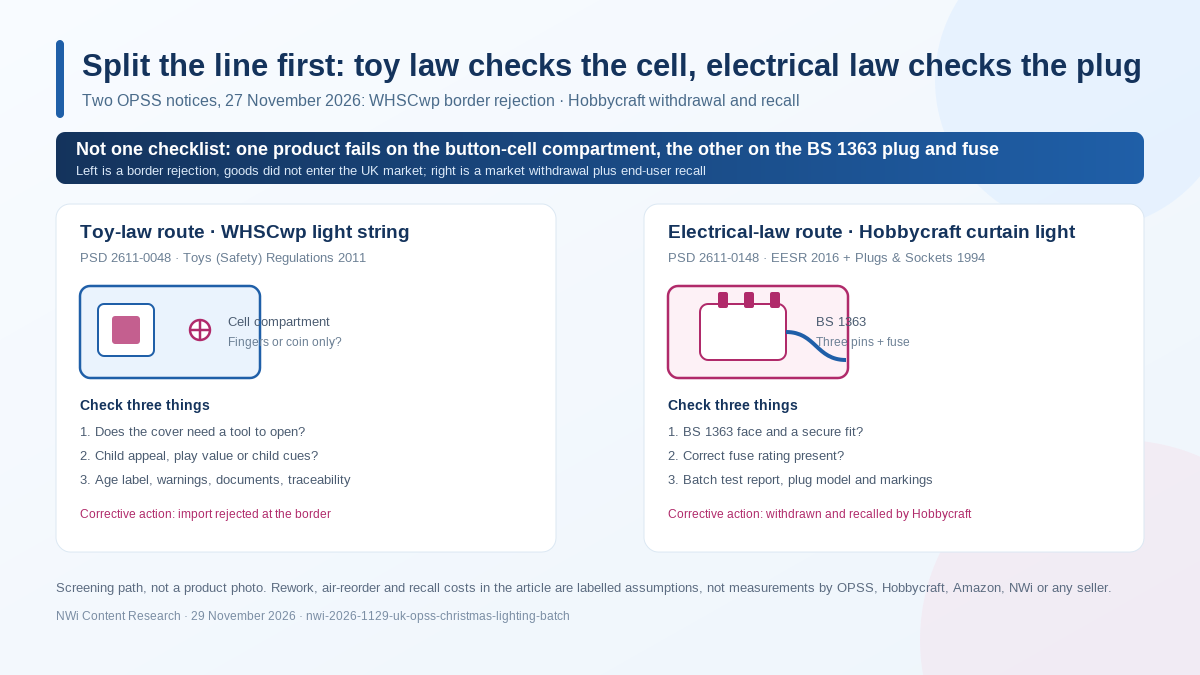
If you sell Christmas light strings, curtain lights or battery-powered decorations in the UK, the decision after 27 November 2026 is not simply that OPSS published two more notices. It is whether each SKU should be screened first under toy law or electrical law, and then whether to rework it, air-reorder it, recall it or scrap it.
1. Two notices, two legal routes and two enforcement actions
Start with the facts. On 27 November 2026, OPSS published a product safety report for the WHSCwp Light String Garland (PSD 2611-0048). The notice lists the product type as "Lighting equipment - Rope/String Lights", the brand WHSCwp, Amazon product identifiers X0020L80HZ and FBA15M74G978U000002 & 1, SKU P1-B2 and China as the country of origin. The hazard is that the button-cell compartment is not adequately secured and is easily accessible, so the cells may be put in the mouth and swallowed, causing chemical burns to the gastrointestinal tract. The notice also says documentation and marking need improvement. The legal basis is the Toys (Safety) Regulations 2011, the corrective action is that the import was rejected at the border, and the notifier is Local Authority Trading Standards.
On the same day, OPSS published a recall for the Hobbycraft Create & Celebrate Warm White LED Curtain Lights (PSD 2611-0148). The product is a string of 3m x 2m curtain lights in a white box, product number 6844361000, barcode 5050687910371, country of origin China. The hazard is that the plug face does not conform to BS 1363 and cannot make a secure connection to the socket, so the user may touch the live and neutral pins; the plug also has no fuse, so it may overheat and/or explode under fault conditions. The legal basis is the Electrical Equipment (Safety) Regulations 2016 and the Plugs & Sockets etc. (Safety) Regulations 1994. Hobbycraft withdrew the product from the market and recalled it, and consumers are advised to stop using it immediately and return it to a Hobbycraft store for a full refund.
| Date | Notice / PSD | Product and identifiers | Hazard | Legal basis | Corrective action | First seller check |
|---|---|---|---|---|---|---|
| 2026-11-27 | WHSCwp light string 2611-0048 | Small light string with battery pack; Amazon X0020L80HZ, FBA15M74G978U000002 & 1; SKU P1-B2; China | Button-cell compartment not adequately secured and easily accessible; swallowing can cause chemical burns; documentation and marking also need improvement | Toys (Safety) Regulations 2011 | Import rejected at the border | Check whether the compartment needs a tool to open; then check child-product design and labelling |
| 2026-11-27 | Hobbycraft LED curtain lights 2611-0148 | 3m x 2m curtain lights in a white box; product 6844361000; barcode 5050687910371; China | Plug face does not conform to BS 1363, cannot connect securely, live pins may be touched; no fuse, so overheating or explosion under fault conditions | Electrical Equipment (Safety) Regulations 2016; Plugs & Sockets etc. (Safety) Regulations 1994 | Withdrawn and recalled by Hobbycraft; full refund | Check for a BS 1363 three-pin plug, a fuse and a secure fit |
The enforcement actions differ. WHSCwp was a border rejection, so that shipment did not enter the UK market. Hobbycraft was a market withdrawal plus a recall from end users, so some units may already be in consumers' hands. That difference decides what the seller does first: the border case must be fixed in the inbound and customs process, while the recall case requires contacting buyers and handling returns and remaining stock.
2. Why a light string can be treated as a toy
The easy mistake with WHSCwp is to see only a festive light string while OPSS applied the Toys (Safety) Regulations 2011. The notice does not explain the classification and gives no age label, packaging or test report, so we cannot invent a reason for OPSS. What can be confirmed is that OPSS treated an easily accessible button-cell compartment as a specific failure under toy law and also required improvements to documentation and marking.
The mechanism runs through two different compliance chains. A light that is aimed at children or has play value must have a button-cell compartment that a child cannot easily open, or the cell may be swallowed and cause chemical burns. A mains-powered light must have a plug that conforms to BS 1363, connects securely to the socket and contains a fuse, or the user may touch live pins or the plug may overheat under fault conditions.
The button-cell mechanism is not complicated. A child may remove the cell and put it in the mouth; in the moist oesophagus the cell creates a current and can cause severe chemical burns within a short time. Even without full swallowing, the nose or ear canal can be injured. The OPSS notice gives no battery model, size or injury case, so we cannot quantify the probability; but whether the compartment needs a tool and whether a child can open it with a coin or fingers are physical facts a seller can check directly.
3. Why a BS 1363 plug is a separate risk
The second case has a different mechanism. BS 1363 is the UK three-pin plug standard; the point is not that the plug can enter a socket, but that the plug face, pin insulation and earth structure form a secure and safe connection. OPSS says the plug face does not conform to BS 1363, cannot make a secure connection, and may allow the user to touch the live and neutral pins; the plug also has no fuse. The missing fuse is not a missing accessory but a missing safety function: a fuse cuts the circuit under fault current, and a missing or non-conforming fuse can let the plug overheat or explode.
The defect may not be visible in a product photo. A plug can have three pins and look British while its face thickness, pin length, insulation or fuse holder is non-conforming; a conversion or universal plug may also bypass BS 1363. Sellers should not rely on the words "UK plug" or on a supplier's CE/UKCA declaration; they need the plug model, fuse rating, plug-face drawing and batch test report.
4. Evidence boundary
The two notices prove the dates, product identifiers, hazard types, legal bases and corrective actions. They do not prove sales, inventory, injuries, test methods or the scope of marketplace removals; both notices come from OPSS, so they are two enforcement cases from one publisher, not cross-confirmation by two independent institutions.
There is also a source boundary: this run tried to open Hobbycraft's recall page, but Cloudflare blocked it, so the retailer's own recall instructions were not read. The description of the Hobbycraft recall therefore relies only on the OPSS notice; the retailer's refund process, recall volume and timetable are not presented as verified facts. Both notices come from OPSS, the same publisher, so they are two distinct enforcement cases, not cross-confirmation by two independent institutions or two mutually validating statistical sources.
5. Countercase: not every Christmas light needs to be delisted
The countercase is a light string sold strictly as adult decoration, with a button-cell compartment that needs a screwdriver and complete documentation and warnings: it may fall outside toy law. A curtain light with a BS 1363 three-pin plug, the correct fuse and a passing batch test should not be delisted merely because Hobbycraft recalled its product.
Another alternative explanation is that the Hobbycraft recall may cover only one batch or one supplier, not every Chinese-made curtain light; the WHSCwp border rejection may cover only that shipment, not every product under the brand. Sellers should define the scope by batch, barcode, model and test report, not by broad labels such as "made in China" or "Christmas lights".
6. Two reproducible scenarios
Both sets of numbers below are assumptions used to show the calculation; they are not measurements by OPSS, Hobbycraft, Amazon, NWi or any seller. Replace the exchange rate, price, test fee, response rate and rework cost with your own figures.
Scenario A: 12,000 button-cell light strings are refused at the border
Assumptions: FOB USD 2.05 per string; freight and insurance USD 0.50; duty 3.7% of FOB; GBP 1 = USD 1.27; rework adds a screwed battery compartment, documentation and testing at USD 0.55 per unit plus USD 0.15 diversion freight, with a fixed test cost of USD 2,800; the reworked batch sells 45% at GBP 12.99 and 55% at GBP 7.99; referral fee 15%; fulfilment GBP 3.20 per unit.
Result: landed cost = (2.05 + 0.50 + 2.05 x 3.7%) / 1.27 = GBP 2.0676 per string, or GBP 24,811 in total; rework costs GBP 8,819, so the reworked total cost is GBP 33,630; revenue is GBP 122,880, fees are GBP 56,832 and contribution is GBP 32,418. Air reordering costs GBP 39,299 and, at 55% full price and 45% markdown, yields GBP 128,880 revenue, GBP 57,732 fees and GBP 31,849 contribution, a difference of GBP 569.
Decision: use rework if it can be completed before the selling window; treat air freight as the variable, with a break-even at USD 1.74 per string (air reorder wins below that, rework wins above it); scrapping recovers GBP 1,890 and loses GBP 22,921, so it is only the floor if neither option can reach the season.
Scenario B: 6,000 curtain lights are already in a UK warehouse with a non-BS 1363 plug
Assumptions: landed cost GBP 4.10 per unit; retail GBP 18.99; 4,200 sold and 1,800 remaining; recall response 35%; refund GBP 18.99 plus return logistics GBP 3.50 and handling GBP 0.90, or GBP 23.39 per unit; fixed communications and legal cost GBP 3,500; reworking the remaining stock costs GBP 1.30 per plug, GBP 1,800 for retesting and GBP 0.40 per unit for repacking.
Result: a full recall plus disposal of the remaining stock costs 4,200 x 35% x 23.39 + 3,500 + 1,800 x 4.10 = GBP 45,263. Recalling the sold units and reworking the remaining stock costs 34,383 + 3,500 + 4,860 = GBP 42,743, which is GBP 2,520 less.
Decision: the sold units must be recalled; reworking the remaining stock is a separate GBP 2,520 decision, not a reason to delay the recall; if retesting does not accept the rework, treat it as a full recall.
Take Scenario A: 12,000 strings are refused at the border. Landed cost is GBP 24,811; rework costs GBP 8,819, and selling the reworked batch at 45% full price and 55% markdown yields GBP 32,418 contribution. Air reordering costs GBP 39,299 and, at 55% full price and 45% markdown, yields GBP 31,849, a difference of GBP 569; the break-even air freight is USD 1.74 per string.
Moving the response rate from 20% to 50% raises the full-recall cost from GBP 30,528 to GBP 59,999, but "recall the sold units and rework the remaining stock" stays GBP 2,520 cheaper. Do not use the possibility of reworking remaining stock as a reason to delay the recall. The real saving happens earlier: if the plug problem is found before listing, replacing the plug, retesting and repacking all 6,000 units costs GBP 12,000, which is GBP 33,263 less than the after-sale recall.
7. Action checklist
The order is: first build a table of every UK live and inbound light string and curtain light by SKU, ASIN or FBA shipment ID, barcode, supplier and batch; then split the table into a toy-law line (child appeal or button cells) and an electrical line (mains power and BS 1363 plug); finally apply the stop-sale, rework, recall and scrap conditions batch by batch.
- Build the table: list every UK live and inbound Christmas light string, curtain light and battery-powered decoration by SKU, ASIN or FBA shipment ID, barcode, supplier, batch and stock location; start with the WHSCwp identifiers X0020L80HZ, FBA15M74G978U000002 & 1 and SKU P1-B2, and the Hobbycraft product 6844361000 / barcode 5050687910371.
- Split the lines: if the product is aimed at children, has play value or uses button cells, check the battery compartment (tool needed? coin or finger access?), warnings, age labelling, documentation and traceability under toy law; if it is mains-powered, check the BS 1363 plug, fuse, plug face, pin insulation, secure fit and batch test report.
- Stop-sale triggers: the compartment opens without a tool; the plug is not BS 1363, has no fuse or does not fit securely; the supplier cannot provide a batch test report; OPSS adds the same model or barcode; the marketplace removes the listing; or returns cluster around "shock" or "battery". If any applies, stop sale and quarantine the stock.
- Rework conditions: the defect is local and verifiable (for example, a new battery-compartment cover or a replacement plug), there is independent testing and updated documentation and marking, and the fix can be traced to the specific batch; retest before relisting and do not substitute a report for a sister batch.
- Recall conditions: the product is already sold and the defect may cause chemical burns or electric shock, or a regulator or marketplace requires a recall; notify buyers, refund or replace, and record the response rate under the OPSS notice and marketplace rules; do not merely delist the listing without contacting buyers.
- Observation fields: OPSS PSD number, notice date, product, barcode and ASIN, hazard type, legal basis and corrective action; marketplace removal notices, customs holds or border rejections, return reasons, "battery", "plug" or "spark" in reviews; the supplier's batch test report and fuse rating.
- Stop conditions: if the batch cannot be identified, a compliant test cannot be obtained, or the rework still cannot meet BS 1363 or toy law, stop selling and scrap or destroy the stock; do not use a conversion plug, tape, a seal or a warning card as a substitute for a structural fix.
The order matters: build the table, split the lines, then stop, rework or recall. Do not start with "will the marketplace remove it?", because a marketplace removal is an outcome, not compliance evidence.
8. What this means for product selection and data
The selection implication is not "Christmas lights cannot be sold"; it is "lights whose structure and batch compliance cannot be evidenced cannot be sold". Compliant products still have demand, but sellers need compliance evidence as part of SKU admission, not as after-sale repair. For data work, the OPSS notices are a risk signal, not a sales signal: they show which structures, markings and price bands are more likely to be stopped at the border or by a marketplace, but they do not show how many units an ASIN sold.
NWi CrossborderGo provides Amazon US, Europe and Japan category, brand, store and product data, including sales, units, ASP, brand share and price bands, updated monthly; the UK is in the Europe site group, and specific sites, history and fields depend on the contract. It can help size the Christmas-lighting category, price bands and brand concentration, and therefore which SKUs and price bands to check first; it cannot provide product-safety testing, recall status, BS 1363 or toy-law compliance conclusions, or marketplace penalty data. Data can rank risk, not prove that a SKU is safe.
To size the UK Christmas-lighting category, price bands and brand concentration first, see NWi CrossborderGo; to break the data down by site, category and brand, contact us through the demo page; to see how the operations tool supports SKU checks, see NWi Operations. Product capabilities, site coverage and fields depend on the modules and contract.
9. Method and disclosure
Data basis: on 29 November 2026 this article re-read two OPSS notices and their linked official PDFs on GOV.UK: the WHSCwp light string garland product safety report (PSD 2611-0048) and the Hobbycraft LED curtain lights recall (PSD 2611-0148), both published on 27 November 2026. It also read the OPSS consumer guidance "Stay safe this Christmas" published on 26 November 2026. Dates, product identifiers, barcodes, country of origin, hazard types, legal bases, corrective actions and notifiers are recorded as published; the PDFs add the risk types (Burns, Chemical; Electric shock and fire) and the online-marketplace field (Amazon; N/A). Calculation basis: Scenario A uses 12,000 strings, FOB USD 2.05, freight and insurance USD 0.50, duty at 3.7% of FOB, GBP 1 = USD 1.27, rework at USD 0.55 per unit plus USD 0.15 diversion freight, a fixed test cost of USD 2,800, retail GBP 12.99, markdown GBP 7.99, 15% referral, GBP 3.20 fulfilment per unit, a 45% full-price/55% markdown split after rework and a 55% full-price/45% markdown split for air reordering. Scenario B uses 6,000 units, landed cost GBP 4.10, retail GBP 18.99, 4,200 sold, 1,800 remaining, a 35% recall response, GBP 18.99 refund plus GBP 3.50 return logistics and GBP 0.90 handling, GBP 3,500 fixed cost, and rework of the remaining stock at GBP 1.30 per plug plus GBP 1,800 retesting and GBP 0.40 per unit repacking. All quantities, prices, exchange rates, test fees, response rates and rework costs are labelled assumptions, not measurements by OPSS, Hobbycraft, Amazon, NWi or any seller. Product basis: NWi CrossborderGo provides Amazon US, Europe and Japan category, brand, store and product data, including sales, units, ASP, brand share and price bands, updated monthly; the UK is in the Europe site group, and specific sites, history and fields depend on the contract. It does not provide product-safety testing, recall status, BS 1363 or toy-law compliance conclusions, or marketplace penalty data.
This article was prepared with automated research assistance and is based on the public sources listed at the end; it was not reviewed by a human expert. It does not invent customer data, expert review, recall volumes, test results, injury cases, ranking effects or platform endorsements. It is not legal, compliance, product-safety or marketplace-operations advice; whether a product complies, whether a battery compartment is acceptable, whether a plug meets BS 1363, and the applicable test methods and recall scope should be confirmed against the latest OPSS notices, the full regulations and standards, an accredited testing body, marketplace rules and the actual product.
This article has no seller SKU list, inventory, sales, test reports or marketplace back-end data, and it did not read the full text of BS 1363, EN 60598, EN 62115 or the Toys (Safety) Regulations 2011; the volumes, prices, exchange rate, test fees, response rate and rework costs in both scenarios are labelled assumptions.
10. Conclusion
Put the two cases together and the practical conclusion is three sentences. First, split the SKUs by "aimed at children or uses button cells" and "mains-powered or BS 1363 plug", not by one checklist. Second, a border rejection and a recall are different enforcement actions: the first must be fixed before the inbound shipment and customs, the second requires contacting buyers and handling remaining stock. Third, choose rework, air reorder, recall or scrap by batch cost and the remaining selling window, not by what happened to another seller or by the presence of a CE mark.
The contribution is not a retelling of two OPSS notices. It places the toy-law button-cell compartment and the electrical-law BS 1363 plug and fuse in one triage table, then uses batch-level rework, air-reorder, recall and scrap costs to answer which line to check first and how to dispose of the batch before the season ends.
Sources
- Office for Product Safety and Standards, 27 November 2026, Product Safety Report: WHSCwp Light String Garland (2611-0048): Amazon identifiers X0020L80HZ, FBA15M74G978U000002 & 1; SKU P1-B2; button-cell compartment not adequately secured and easily accessible; does not meet the Toys (Safety) Regulations 2011; import rejected at the border; read on 29 November 2026.
- Office for Product Safety and Standards, 27 November 2026, WHSCwp Light String Garland official PDF: risk type Burns, Chemical; online marketplace Amazon; other fields match the HTML notice; read on 29 November 2026.
- Office for Product Safety and Standards, 27 November 2026, Product Recall: Hobbycraft Create & Celebrate Warm White LED Curtain Lights (2611-0148): product number 6844361000; barcode 5050687910371; plug face does not conform to BS 1363, no fuse; does not meet the Electrical Equipment (Safety) Regulations 2016 or the Plugs & Sockets etc. (Safety) Regulations 1994; withdrawn and recalled by Hobbycraft; read on 29 November 2026.
- Office for Product Safety and Standards, 27 November 2026, Hobbycraft LED Curtain Lights official PDF: risk type Electric shock and fire; online marketplace N/A; other fields match the HTML notice; read on 29 November 2026.
- Office for Product Safety and Standards, 26 November 2026, Stay safe this Christmas: advises checking Christmas lights and decorations, not using damaged electrical products and checking recalls before buying or using; consumer advice, not a new legal obligation; read on 29 November 2026.