
The decision is where to put limited optimization time: on your own videos or on the creator videos the system routes to your backend, given a cap of five keywords and 20 product links per video — and whether a platform-stated 91% same-product accuracy is good enough to skip a manual mismatch audit. TikTok Shop's US Seller University page for Post-view Search shows an update dated 27 November 2026. It is not a new search-ad product but an operations workspace that connects searches made after viewing a video to the seller backend; a page update is not the same as a feature launch.
1. Separate what changed on 27 November from what did not
The official page now carries “Updated at 11/27/2026” and knowledge_id 2548295378323252. Compared with the 15 October 2026 version (knowledge_id 4183278685275956), the earlier page already documented the Post-view Search workspace, five keywords and 20 product links per video, the My/Creator/Top views, comments on seller-owned videos and T+1 activation. The new version adds a platform-stated 91% same-product recognition accuracy, a waiver of extra CPS commission on non-shoppable videos, a non-shoppable-first default, a 20-video batch limit and a 10-video recommendation-batch limit, plus a UNICE case study. TikTok publishes no changelog, and the screenshots show date ranges reaching back to early October 2026, so the accurate description is “the official guide has a new version dated 27 November”, not “the feature launched on 27 November”.
| Item | What the 27 November page says | What the page does not say |
|---|---|---|
| Keywords and products | Up to five keywords and 20 product links per video | Whether a keyword will actually appear, or where |
| Comments | Eligible seller-owned videos only, up to 500 characters; creator videos cannot be commented on | The effect on click-through; no independent measurement is given |
| Batch limits | Up to 20 videos per batch; up to 10 per recommendation batch | Batch edits replace existing settings; the page warns but gives no rollback |
| Activation | T+1; keywords must pass system review | Review duration, rejection reasons or appeal path |
| Recognition | A stated 91% same-product recognition accuracy | Sample, period, definition, mismatch handling |
| Ordering | Non-shoppable videos are filtered first in the workspace by default | Whether this affects organic reach or search ranking |
| Commission | No extra CPS commission for optimizing non-shoppable videos | How commission works on shoppable videos |
| Market | United States | Whether the UK, EU or other markets are covered |
The page also contradicts itself in two places: one entry point says Products > Search Optimization and another says Marketing > Search Optimization; one passage gives a query length of 2–4 English words and another gives 2–6. This is not a rule conflict an outside reader can reconcile. Use the entry point that actually appears in your Seller Center, and start with the narrower 2–4 word form, which reduces review ambiguity and is easier to align with the main product shown in the video.
2. Mechanism: five fields from a view to a search order
Post-view Search describes searches people make after a video sparks their interest: a viewer may tap a suggested term below the video, open a search entry above the comments, tap a search-linked phrase in a comment, or type a new query. This is different from a search that begins with a fully formed shopping plan. The need is created by the content first; search then helps the viewer identify the item, compare options and find a purchase path.
Seller Center splits the work into three views. My videos contains videos published by the seller account; the seller can add keywords, link products and write a comment. Creator videos contains creator or third-party videos that the system has matched and routed to the seller backend; the seller can add keywords and product links but cannot comment, because TikTok says a seller cannot speak on behalf of a creator. Top videos is a research view for content that performs strongly in the category; it is not an editing workspace.
| Field | What the page defines | What you use it to judge |
|---|---|---|
| Video impressions | How often the video was shown | Whether the video was seen, though not whether it worked |
| Search volume | Related searches made after viewers watched | Whether the content created search, not just views |
| Search product impressions | Times products appeared in those search results | Whether search connected to a product |
| Search orders | Orders credited to the post-view search journey | Which videos are worth configuring further |
| Search GMV | Sales value credited to that journey | Commercial value, subject to returns and attribution |
What the seller submits are relevance signals: up to five keywords and up to 20 product links, plus a 500-character comment and pin on eligible seller-owned videos. The system identifies products in videos, decides whether to route a video to the seller backend, decides whether a keyword is shown and where, and decides how orders are attributed. The page says seller inputs do not guarantee that a term or product will appear, or that it will receive a fixed placement; keywords must pass review, and unrelated products or keywords are filtered out.
Put the five fields together and the mechanism is not “add keywords and sales rise”. A video first creates search, the query connects to a product, the product is clicked and ordered, and the order is credited to that video. If any link breaks, configuration does not become a result. Post-view Search turns searches made after viewing into five fields — video impressions, search volume, search product impressions, search orders and Search GMV — and seller inputs are relevance signals, not ranking orders.
3. Evidence boundary: what 91%, the case study and T+1 can and cannot prove
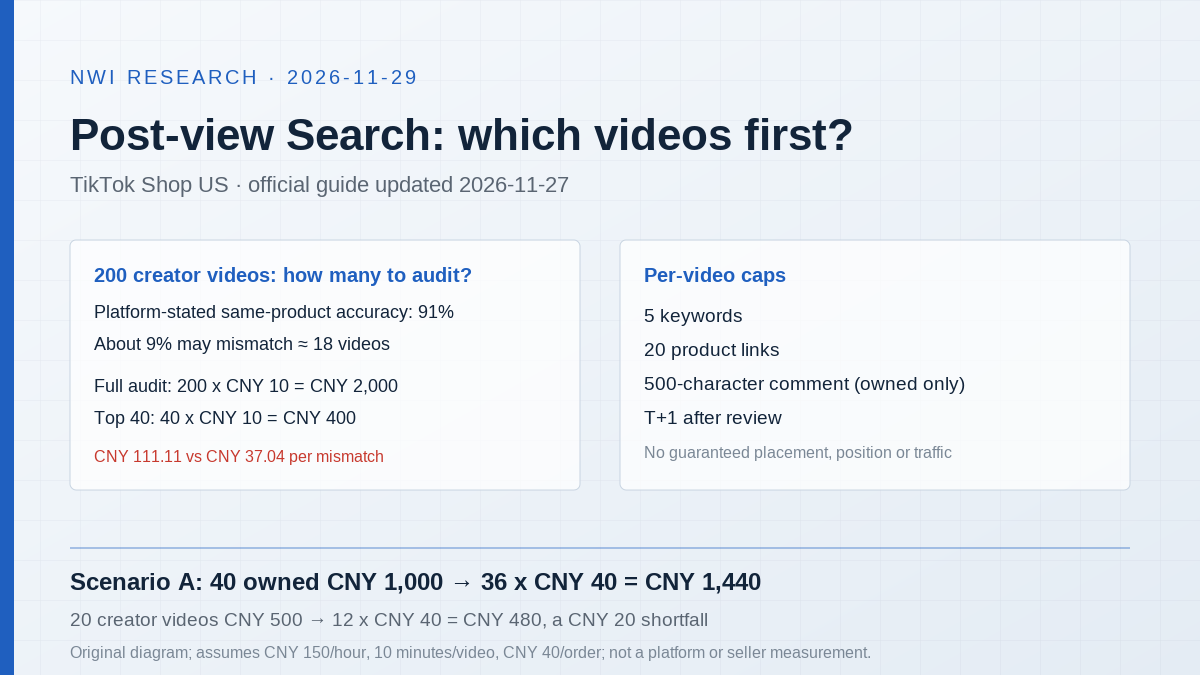
The 91% is the most misread number in the page. It is the platform's own statement — “Current same-product recognition accuracy is 91%” — but the page gives no sample size, period, tested categories, definition of a mismatch or treatment of the remaining 9%. It is at best a system-level prior, not the accuracy for your shop, category or batch of creator videos. On 200 routed videos, 9% is about 18 possible mismatches; that is a reason to plan an audit, not a promise of an outcome.
The UNICE case study is also often used as proof of effect. According to PPC Land's quotation of the official page, the period was 28 October to 2 November 2026, with 160 videos, of which 117 showed submitted keywords (73.1%), 23,060 keyword impressions, and “30%+ observed growth” in search orders and Search GMV. The page gives no comparison period, no absolute order count and no method, and the case footer says “observed-period results only; not a causal lift claim or performance guarantee”. It shows that TikTok is willing to feature the case; it does not show that copying it will produce 30% growth.
Four more limits matter. First, TikTok has not published the attribution window, whether search orders include assisted orders, or whether the same order can appear in another report. Second, the page is explicitly for the United States; availability in the UK or EU is unconfirmed. Third, the module may not be visible to every US seller; the page says to contact the account manager if it is missing. Fourth, there is no launch date, and the screenshots show date ranges before 27 November. The 91% is a platform figure with no published sample, period, definition or mismatch handling, and a page update is not a feature launch; 27 November must not be written as the first day the feature existed.
This article therefore does not answer “does the feature work?” It answers “what should your shop test first, with which fields, and when should it stop?” That is more useful than repeating a feature list, and it respects the evidence boundary the page leaves.
4. Counter-case: which shops should not start with Post-view Search
- Counter-case 1: most sales come from shoppable videos. Non-shoppable-first is a platform default, not a ranking promise for your shop; if viewers can already reach the product from a shoppable video, fixing listing conversion may matter more than adding keywords.
- Counter-case 2: the product is unclear in creator videos or is not the main product. The system routes by product recognition; if it cannot identify the product, no new optimizable video appears and extra slots do not help.
- Counter-case 3: a niche category, many SKUs or many near-identical items. A 91% system-level figure may be worse in practice; wrong links can be removed in review, wasting slots and sending viewers to the wrong product.
- Counter-case 4: no keyword surfaces after review. Treating “60 videos configured” as a result overstates the effect; the page only says T+1, not that a term will be shown.
- Counter-case 5: a before-and-after comparison during Black Friday and Cyber Monday. Search demand is moving on its own; order growth may be seasonal rather than caused by configuration, and without a control group attribution is not credible.
- Counter-case 6: the team cannot maintain an audit. Batch edits replace existing settings, so mistakes scale; build a video-product-keyword log before scaling.
The counter-case is not that the feature is useless; it is that shops whose sales come from shoppable videos, whose products are unclear in creator videos, or whose teams keep no control group can mistake configured videos for results. A safer order is to start with videos that show a clear product, already have search exposure and can be left in a control group, then decide whether to extend to the whole shop.
5. Two reproducible scenarios: which videos first, and how much to audit
The real decision is where to put limited human time — on your own videos or on the creator videos the system routes to your backend — under a cap of five keywords and 20 product links per video, and whether a stated 91% same-product accuracy is good enough to skip a manual audit. The two scenarios below turn that into arithmetic; every assumption can be replaced with your own hours, contribution and mismatch cost.
Scenario A: start with 40 owned videos or 20 creator videos
Assumptions: 60 optimizable videos, 40 owned and 20 from creators; 10 minutes per video at CNY 150 per hour, or CNY 25 per video; CNY 40 contribution per search order; the owned videos are assumed to produce 36 orders and the creator videos 12; platform commission, ads, refunds and review removals are excluded.
Result: configuring all 60 costs 60 x CNY 25 = CNY 1,500; the 40 owned videos cost CNY 1,000 and return 36 x CNY 40 = CNY 1,440, leaving CNY 440; the 20 creator videos cost CNY 500 and return 12 x CNY 40 = CNY 480, a shortfall of CNY 20. The CNY 1,000 owned-video tranche pays back under the assumed orders; the creator tranche needs at least CNY 500 / CNY 40 = 12.5, or 13 orders, to cover labor.
Decision: use the 40 owned videos first to test whether keywords surface and produce search orders; expand to creator videos only if the 20 creator videos produce at least 13 search orders in two weeks; otherwise fix the product display and links in the videos instead of adding more configurations.
Scenario B: with 200 creator videos and 91%, audit all or the top 40?
Assumptions: 200 creator videos are routed; at the platform's 9% mismatch rate, 200 x 9% = 18 may be mismatched; a manual check takes 4 minutes per video at CNY 150 per hour, or CNY 10 per video; the top 40 by search exposure are assumed to cover 60% of mismatches, about 10.8; refunds, customer complaints and platform penalties from a wrong link are excluded.
Result: a full audit costs 200 x CNY 10 = CNY 2,000, or CNY 2,000 / 18 = CNY 111.11 per mismatch found; a top-40 audit costs 40 x CNY 10 = CNY 400, or CNY 400 / 10.8 = CNY 37.04 per mismatch found. If one mismatch costs less than CNY 37, even the sample is not worth it; between CNY 37 and CNY 111, start with the top 40; above CNY 111, a full audit may be justified.
Decision: write down the cost of one mismatch — review and removal of a wrong link, customer complaints, refunds and reshipment — before choosing the audit depth; if the first 20 videos show two or more clear mismatches, pause batch configuration, extend to the top 40–60 and raise it with TikTok or the account manager instead of scaling.
Both scenarios are assumption-based arithmetic, not a measurement by TikTok, any seller or NWi; the CNY 150 hourly rate, CNY 40 contribution, 10 minutes per configuration, 4 minutes per audit and 60% coverage can all be replaced. The two-in-20 trigger is an operational pause, not a statistical significance test; its job is to make you look before scaling, not to prove the platform wrong.
The original contribution is to turn 91% from a promotional number into an audit-budget rule: 200 videos imply about 18 mismatches, a full audit costs CNY 2,000 and a top-40 audit costs CNY 400, giving CNY 111.11 and CNY 37.04 per mismatch found.
6. Action and stop rules: a triage sheet
- Export the five video-level fields — Video impressions, Search volume, Search product impressions, Search orders and Search GMV — and rank by Search orders and Search GMV, not by views.
- Start with non-shoppable videos in which the product is clear; submit up to five keywords and up to 20 product links that match the main product. Prefer “brand + product term” or “attribute + product term”; avoid broad brand, category, holiday and scenario terms. The page gives both 2–4 and 2–6 words; start with 2–4.
- Seller-owned videos can carry a 500-character comment and a pin; creator videos cannot be commented on, so do not promise creators you will speak for them, and do not treat comments as a creator-video input.
- Keep a log: video ID, main product, up to five keywords, up to 20 links, submission date, T+1 visibility, review removals, mismatch flag, Search orders and Search GMV. Without the log, batch edits create untraceable changes.
- Leave a group of unconfigured videos as a control for two weeks; during Black Friday and Cyber Monday, do not attribute search-order growth to configuration without that control.
Export the five video-level fields, rank by Search orders and Search GMV, start with non-shoppable videos that show the product clearly, then check visibility and review on day 7 and orders, GMV and the control group on day 14 before scaling.
Stop if a keyword has not surfaced for seven days, a product link is removed in review, the video's main product does not match the shop's product, the first 20 videos show two or more clear mismatches, the 20 creator videos produce fewer than 13 search orders in two weeks at CNY 40 contribution, the platform changes the rules, or there is no control group. Any one of these is a reason to pause expansion and fix the product, video or link rather than add more configurations.
When to act: check on day 7 and day 14. On day 7, look at keyword visibility, link removals and review blocks. On day 14, compare Search orders, Search GMV and the control group. If there is still no difference on day 14, stop expanding and move the time back to listings, product display in videos and price bands; do not treat “more videos configured” as progress.
7. What this means for cross-border sellers: the bottleneck is audit time, not keywords
The update does not change whether a seller can add keywords; it changes the competition from “who posts more videos” to “who can match video, query and product”. The cap is five keywords and 20 product links, so the scarce input is human review time: deciding which videos are worth configuring, which links are wrong and which orders can be attributed. Creator videos are supply you do not control, and the 91% is a prior, not a verdict on your shop.
For a data team, the division of labor is: use market-side data to judge whether a category, brand, shop or creator is worth following; use Seller Center's video-level post-view data to judge whether your configuration worked. One cannot replace the other. Within enabled modules, NWi CrossborderGo provides TikTok Shop US, Southeast Asia and UK market-side sales, units, ASP, creator GMV and price-band data on a monthly update; it does not have seller-side, video-level post-view search-term, search-order or Search GMV data from Seller Center, and has not verified access to the Post-view Search API. Start with the [TikTok Shop data-analysis page](/platforms/tiktok-shop/) for the market-side scope, then use the [product page](/product/) for CrossborderGo's module boundaries, or [request a demo](/demo/) to check your own sites and fields.
If the team wants to put platform rules, creator videos, product links and search orders into one research process, the Cross-border Agent can help break down the question, organize evidence and produce conclusions for review. Its consumer and review insights are limited to selected brands, its product-innovation advisor focuses on beauty, and its creator-marketing advisor currently lists Vietnam, Indonesia and Malaysia only; it must not be described as covering every brand, category or market. MCP data access is also subject to actual integration and permissions; a menu entry is not a successful connection. Entry points: [Cross-border Agent](/page/agent.html), [MCP data access](/mcp/) and [NWi Operations](/products/zhiying/).
NWi does not hold seller-side video-level post-view data from Seller Center and has not verified the Post-view Search API; the 91%, attribution window and search-order definition can only be treated as platform statements.
8. Method and sources
Data basis: on 29 November 2026 this article rechecked the TikTok Shop US Seller University Post-view Search page (knowledge_id 2548295378323252, marked Updated at 11/27/2026) against the 15 October 2026 version (knowledge_id 4183278685275956). Direct HTTPS access timed out in this environment, so the text was cross-checked against the search-index full-text excerpts retained by the 29 November radar, PPC Land's independent report of 28 November 2026 and EasyTikTok's full-text reproduction of 27 November 2026; the 91%, CPS waiver, non-shoppable-first default and batch limits agree across those three channels. The article also read the TikTok Shop US Search Insights page (13 July 2026) to confirm the post-view search data entry point. Calculations: Scenario A uses 60 x CNY 25 = CNY 1,500, 40 x CNY 25 = CNY 1,000, 36 x CNY 40 = CNY 1,440, 12 x CNY 40 = CNY 480 and CNY 500 / CNY 40 = 12.5; Scenario B uses 200 x 9% = 18, 200 x CNY 10 = CNY 2,000, CNY 2,000 / 18 = CNY 111.11, 40 x CNY 10 = CNY 400, 40 videos covering 60% of mismatches or about 10.8, and CNY 400 / 10.8 = CNY 37.04. All video counts, hours, labor costs, contribution per order, mismatch rates and coverage shares are labelled assumptions, not measurements by TikTok, any seller or NWi. Product scope: within enabled modules, NWi CrossborderGo provides TikTok Shop US, Southeast Asia and UK market-side sales, units, ASP, creator GMV and price-band data on a monthly update; it does not have seller-side, video-level post-view search-term, search-order or Search GMV data from Seller Center, and has not verified access to the Post-view Search API. Sites, history, fields and attribution remain subject to account authorization and contract.
This article was prepared with automated research assistance from the public sources listed at the end and has not been human-reviewed; it does not invent customer data, expert review, platform measurements or ranking outcomes. It is not platform-operations, advertising, legal or compliance advice. Whether a feature is available, whether a keyword is displayed and how an order is attributed should be confirmed in the live Seller Center, the latest TikTok Shop rules and the account manager's answer. Analysis of public material is not a whole-market test report.
- TikTok Shop US Seller University, 27 November 2026, Post-view Search: Help your video viewers find your products: five keywords, 20 product links, 500-character comments, 91% same-product accuracy, non-shoppable first, CPS waiver, 20-video batch and 10-video recommendation batch, T+1 review.
- TikTok Shop US Seller University, 15 October 2026, earlier Post-view Search page: already documented the workspace, five keywords, 20 product links, My/Creator/Top views and T+1, used to bound the 27 November delta.
- TikTok Shop US Seller University, 13 July 2026, Search Insights: post-view searches from self-published and not-self-published content, with Search GMV, Search Orders, Search Impressions and CTR as search performance fields.
- PPC Land, 28 November 2026, TikTok Shop lets sellers suggest 5 searches under creators' videos, matched at 91% accuracy: independent trade report on the 27 November page, quoting the official terms and noting the missing launch date, attribution window and 91% method.
- EasyTikTok, 27 November 2026, How US Sellers Add Keywords and Product Links After a View: full-text reproduction of the official page, recording the official create_time 27 November 2026 06:34:53 UTC, the two menu paths and the 2–4 versus 2–6 word conflict.