
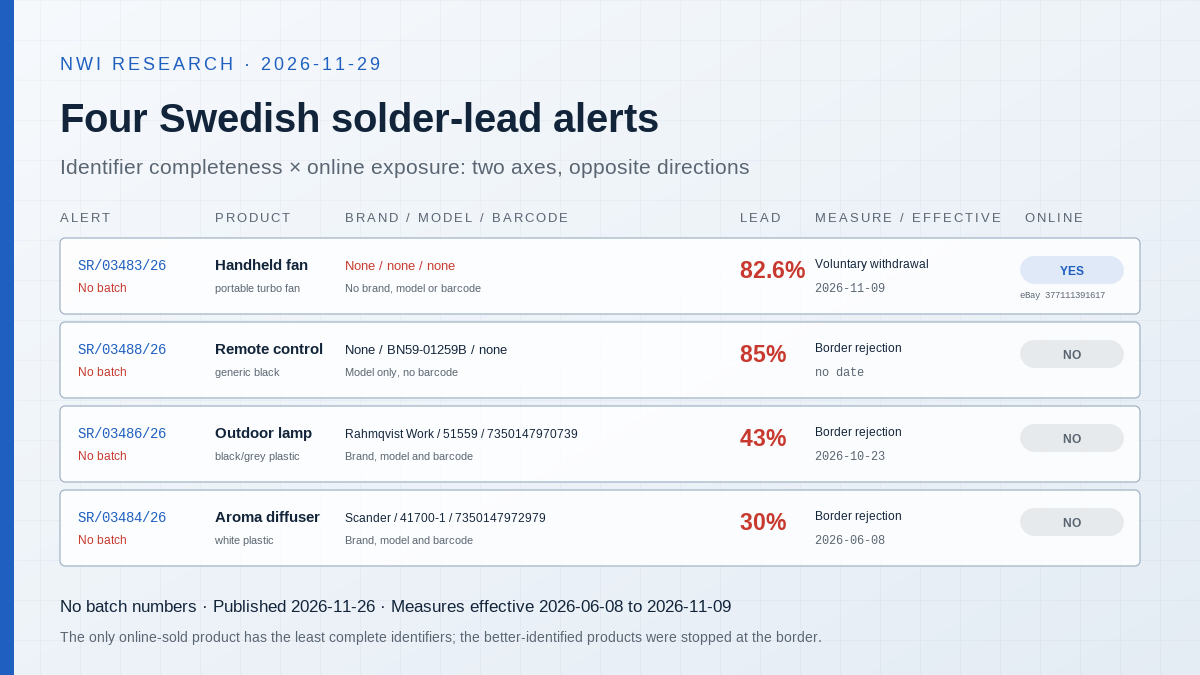
The real decision is: when four Swedish solder-lead alerts put “already sold online” and “least complete identifiers” on the same product, while three better-identified products were stopped at the border, should the seller isolate by PCBA/solder supplier, retest the known model/barcode, or work from the online listing identifier?
If you sell small electrical appliances, remote controls, lamps, aroma diffusers or PCBA-based consumer electronics in the EU or UK, these four records ask you to decide scope, not just severity: the only product marked sold online has no brand, model or barcode, while the three products with better identifiers were stopped at the border. All four alerts were published on 26 November 2026, but the measures entered into force on 8 June, 23 October and 9 November, or had no date at all; your response clock cannot start on the publication date.
This is not a repeat of the Swedish toy-batch article of 28 November 2026. That set covered five brands and six models sharing batch 260424:1, and its decision was batch versus brand. These four are adult small electrical appliances with no shared batch; identifier completeness and online exposure run in opposite directions, and the decision is supplier, model or listing. The two articles complement each other but do not substitute for each other.
1. Four alerts: the fuller the identifier, the less online the product
| Alert | Product | Brand / model / barcode | Lead in solder (up to) | Measure / entry into force | Sold online / online identifier | Origin |
|---|---|---|---|---|---|---|
| SR/03483/26 | Handheld portable fan | None / none / none | 82.6% | Voluntary withdrawal (importer) / 2026-11-09 | YES / eBay 377111391617 | China |
| SR/03488/26 | Remote control | None / BN59-01259B / none | 85% | Border rejection (compulsory, importer) / not given | NO / none | China |
| SR/03486/26 | Outdoor lamp | Rahmqvist Work / 51559 / 7350147970739 | 43% | Border rejection (compulsory, importer) / 2026-10-23 | NO / none | China |
| SR/03484/26 | Aroma diffuser | Scander / 41700-1 / 7350147972979 | 30% | Border rejection (compulsory, importer) / 2026-06-08 | NO / none | Unknown |
Put the four rows together and the sharpest fact is not the 30%–85% range but the inverse relationship between two axes. On online exposure, only the fan has isSoldOnline YES, with eBay as the online trader and 377111391617 as the product identifier; the other three are NO. On identifier completeness, the fan has no brand, model or barcode; the remote control has only model BN59-01259B; the outdoor lamp and aroma diffuser have brand, model and barcode. The two best-identified products were stopped at the border, while the least-identified product had already been sold online.
This does not mean fewer identifiers equal more danger. It means identifier completeness and market exposure are different variables. A product can be fully identified and already online, or poorly identified and stopped at the border. The four records happen to show four combinations: no identifier plus online, model only plus not online, and full identifier plus not online for two products. A seller who sorts on one axis will miss the risk on the other.
Separate publication from entry into force. All four were published on 26 November 2026, but the fan’s voluntary withdrawal took effect on 9 November 2026, the outdoor lamp on 23 October, the aroma diffuser on 8 June, and the remote control has no date. The diffuser’s measure took effect more than five months before publication; a review that starts on the publication date is looking at a measure that had already been in force for more than five months, not a new rule starting from zero. Publication is not inspection either: the records were created on 24–25 November, and the alerts do not say when the underlying checks began.
2. Mechanism: lead sits in the solder, but scope is set by the supply chain and identifiers
RoHS 2 (Directive 2011/65/EU), Article 4(1), requires EEE placed on the market not to contain the substances listed in Annex II. Article 4(2) sets the maximum concentration by weight in homogeneous materials at the Annex II values; Annex II lists lead at 0.1% and cadmium at 0.01%. This is the EU Official Journal text, not a paraphrase of UK guidance.
The four alerts report lead concentration in solder of up to 30%–85%. Against the 0.1% limit, the order-of-magnitude multiples are 30/0.1 = 300, 43/0.1 = 430, 82.6/0.1 = 826 and 85/0.1 = 850. Solder is a homogeneous material, so the comparison is valid; but the alerts do not publish sampling, sample preparation, test method, sample size or uncertainty. The multiples are not an independent retest and cannot rank products precisely.
Lead in solder is a materials problem at the PCBA and solder level, not a brand or category problem; a brand-level stop misses unbranded products, and a model-level stop misses products without a model.
Brands can change, models can be renamed, and listings can be reopened, but the same supplier, solder lot or PCBA process can remain across several SKUs. The reverse is also true: products under one brand may come from different suppliers. The alerts do not disclose the PCBA or solder supplier for these four products, so the public record cannot establish a shared supplier. Sellers can still map their own purchase data: which SKUs share a PCBA/solder source, and which are merely similar in name or category.
Border rejection and voluntary withdrawal are also different. A border rejection is compulsory and addresses the importer; it means the shipment was stopped at the border. A voluntary withdrawal is the importer removing the product from the market, possibly after it entered circulation. Neither is a consumer recall. The fan’s “published recall online” field is UNKNOWN, the other records have no company recalls, and none should be described as a recall.
3. Evidence boundary: four records, not four independent sources
All four records come from Sweden, were published on the same day, and are four product-level primary enforcement records; they are not four independent sources, and they do not disclose the supplier, batch, test method, sample size or uncertainty.
They show that the Swedish authority took measures on four products. They do not show that the four products share a supplier, that your SKU is involved, or that your SKU is safe. Because all four come from the same Safety Gate notifying country and publication process, adding them up as “four independent events” overstates the evidence.
- No seller identity, store, import volume, sales, inventory or current listing status; isSoldOnline is a notification field, not today’s listing status.
- No batch number; all four lack one, so a batch-level stop has no official basis here.
- No test report, sampling method, sample size or uncertainty; the percentages are the authority’s reported readings.
- No PCBA/solder supplier, factory or contractual relationship; a shared supply chain cannot be inferred.
- No published consumer recall is recorded; the fields are UNKNOWN or NO, and the measures are market withdrawal or border rejection.
- No injury count, incident report or follow-up action; actual harm cannot be inferred.
- The eBay identifier 377111391617 is an online product identifier, not a model, and does not prove the listing is still live or that your stock is the same product.
The Swedish Chemicals Agency’s Tillsyn 1/26 report provides background: the 2025 e-commerce inspection covered 188 products from 105 operators; 139 products were analysed in the toy, jewellery, electronics and soft-plastic categories; 72% of products from dropshipping shops, 64% from marketplaces and 26% from classic web shops contained illegal levels of chemicals; the most common deficiencies were lead in electrical goods, cadmium in jewellery, and short-chain chlorinated paraffins and phthalates in soft plastics. Of 49 textile products, only one exceeded a limit. The report explicitly says the selection was risk-based and is not representative of the whole market, and it is not a confirmation of these four alerts. The background supports supply-chain review for e-commerce small electricals; it is not a market failure rate and does not establish a relationship among these four products.
Four product-level enforcement records are not a court judgment, a test report or a recall notice. They can support a scope decision; they cannot certify your SKU.
4. Counter-cases: when not to stop the whole small-appliance category
The counter-case is not “do nothing”; it is “scope on a single axis”: model-only screening misses the fan and the remote control, listing-only screening misses the three border rejections, and stopping the whole small-appliance category harms unrelated suppliers.
- Model/barcode only: the fan has no model or barcode; the remote has a model but no barcode. Testing only the two fully identified products leaves the online-sold fan outside the review.
- Online listing only: the fan’s eBay identifier covers one online transaction identifier; the three border-rejected products have no online identifier. A listing-only sweep misses the border records.
- Stop the whole small-appliance category: the four products are a fan, a remote control, an outdoor lamp and an aroma diffuser, and their PCBA/solder sources may be entirely different. Without a supplier map, a category-wide stop locks up unrelated SKUs.
- Treat border rejection as proof the product never entered the EU: a border rejection means that shipment was stopped; the record does not say whether earlier shipments entered the market. isSoldOnline NO is a notification field, not proof of market-wide absence.
- Treat voluntary as low risk: voluntary or compulsory is the measure type, not the risk level. The fan was a voluntary withdrawal, but its 82.6% reading is the second highest of the four.
- Treat KemI’s 72%/64%/26% as a market failure rate: the report says the sample was risk-based, not representative; it does not prove these four products or your category’s failure rate.
- Treat the publication date as the entry-into-force date: the diffuser took effect on 8 June 2026, the lamp on 23 October, the fan on 9 November. Starting on the publication date misses measures that had already been in force.
The common point is that scope cannot be set by a product name or category; it can only be set by three checkable relationships: the same PCBA/solder source, the same model/barcode, or the same online listing. When none of the three is known, the correct action is not to declare “not us” but to finish the supplier questionnaire and listing check before deciding whether to expand.
5. Two scenarios: isolate by supplier or by identifier
Both scenarios use only variables the public records can establish (four alerts, four identifier states, two measure types); every other number is a labelled assumption. They are not estimates of the four products’ real sales, costs or losses, and they are not measurements by the Swedish authority, eBay, any seller or NWi.
Scenario A: isolate 12 SKUs by PCBA/solder supplier
Assumptions: 12 SKUs share one PCBA/solder supplier; combined monthly sales are 6,000 units at an average price of €18 and a 30% contribution margin; the stop lasts 30 days; testing costs €350 per SKU, or €4,200 for 12; supplier traceability review costs €1,500; platform fees, advertising, penalties, refunds and exchange rates are excluded.
Result: monthly revenue is 6,000 × €18 = €108,000 and monthly contribution is €108,000 × 30% = €32,400; the 30-day stop loses €32,400; adding €4,200 for testing and €1,500 for the review gives €38,100, or €3,175 per SKU.
Decision: if the supplier map confirms that all 12 SKUs share the same PCBA/solder source, this is the only scope that covers unbranded, model-less products; if that cannot be confirmed within seven days, do not treat “same supplier” as proven, isolate on the more conservative scope and keep gathering evidence.
Scenario B: isolate 3 SKUs by known model/barcode
Assumptions: 3 SKUs match a published model or barcode; combined monthly sales are 900 units at an average price of €22 and a 32% contribution margin; the stop lasts 30 days; testing costs €350 per SKU, or €1,050 for 3; no supplier review; platform fees, advertising, penalties, refunds and exchange rates are excluded.
Result: monthly revenue is 900 × €22 = €19,800 and monthly contribution is €19,800 × 32% = €6,336; the 30-day stop loses €6,336; adding €1,050 for testing gives €7,386; this covers only 3 of 12 SKUs (25%) and 900 of 6,000 units (15%).
Decision: B costs €30,714 less than A but leaves 9 SKUs and 5,100 units per month unscreened; only if those 9 SKUs are confirmed to use a different PCBA/solder source, or are outside RoHS scope, is B a complete plan; otherwise it converts testing cost into uncovered risk.
Scenario A’s cash exposure is €38,100 for 12 SKUs; Scenario B is €7,386 for 3 SKUs; A spends €30,714 more and buys coverage of 9 SKUs and 5,100 units per month, or about €3,412.67 per additional SKU and €6.02 per additional unit.
Whether that price is worth paying depends on the supplier map, not on the lead percentage. If all 12 SKUs share the PCBA/solder source, A is the only option that covers a product like the fan with no model; if the supplier confirms the other 9 use a different source, B’s gap has an evidential basis and B is more reasonable. The trigger for expanding scope is a confirmed shared source, not a high lead reading.
6. Action list and stop conditions
Day 0–1: freeze new inbound for any SKU matching one of the four identifiers or the online listing; Day 1–3: put the PCBA/solder supplier, model, barcode, online listing identifier and measure entry-into-force date on one SKU table; Day 3–7: decide the isolation scope from the supplier map.
- Day 0–1: copy the alert fields into one SKU table: alert number, product name, brand, model, barcode, batch (yes/no), measure category, measure type, entry-into-force date, isSoldOnline, online trader/product identifier, origin, risk type and legal basis. All four lack a batch number; write “none”, do not leave the field blank.
- Day 0–1: freeze new inbound for any match on model, barcode or online identifier; capture the listing, both sides of the label, barcode, packaging and supplier invoice. Do not relist the same product under a new ASIN or listing.
- Day 1–3: build the supplier map. Ask the PCBA/solder supplier for the solder grade, lead-free or leaded process, RoHS test report by homogeneous material, batch traceability and change history. Record “same supplier” separately from “same solder lot”; a supplier name is not a batch.
- Day 3–7: set the scope on the three relationships: same PCBA/solder source → supplier-level isolation; same model/barcode → model-level isolation; same online listing → listing-level isolation. If none is known → questionnaire and sampling first; do not declare “not us”.
- Day 7: resale conditions: a checkable RoHS test report or supplier declaration; model/barcode/batch can be matched; labels and warnings meet the target market; the platform accepts the change; no new official alert. If one is missing, keep the stop.
- Stop/exit conditions: the supplier refuses to disclose the solder source or test report; the same supplier/solder lot appears in another alert; the product cannot meet the RoHS limit and cannot change materials; the same product form is alerted in another market. On any one, exit the product form instead of repeatedly changing listings.
7. What this means for product selection and data
For product selection, the lesson is not that small electricals cannot be sold; it is that three questions must be answerable before launch: who is your PCBA/solder supplier, can you trace model/barcode/batch, and can you locate the online listing when needed? If all three are unanswerable, good sales and price bands only postpone the compliance cost.
For data work, platform data can locate family SKUs, price bands, markets on sale and listing distribution and rank the review; it cannot replace RoHS testing, supplier traceability, batch matching or legal advice. The eBay identifier 377111391617 is a useful online handle for one listing, not a product identity, and it does not prove your stock is the same.
Within activated modules, NWi CrossborderGo provides platform, site, category, brand, store and product data to locate family SKUs, price bands and markets on sale and to rank the review; it does not test products, read or issue RoHS reports, trace batches, confirm current listing status, execute recalls or provide legal conclusions, and available sites, history and fields depend on account access and the contract. To see how compliance records and product data can be reviewed together, start from the CrossborderGo product page or explain your market and data needs through the demo request.
The contribution is not another list of lead readings; it separates identifier completeness from online exposure and shows that publication and entry into force were up to more than five months apart, so the response clock cannot start on the publication date.
8. Method and limitations
Data basis: on 29 November 2026 this article reopened the four Swedish Safety Gate API records 10119910 (SR/03483/26, handheld fan), 10119929 (SR/03488/26, remote control), 10119954 (SR/03486/26, outdoor lamp) and 10119955 (SR/03484/26, aroma diffuser), checking product name, brand, model, barcode, batch, risk description, legal basis, measure category/type/entry-into-force date, origin, isSoldOnline and online trader/product identifier. On the same day it read the EUR-Lex text of Directive 2011/65/EU, checking Article 4(1), Article 4(2), the 0.1% lead limit in Annex II and the definition of homogeneous material, and the Swedish Chemicals Agency’s Tillsyn 1/26 report, checking 188 products from 105 operators, 139 analysed products, the 72%/64%/26% sample results and the statement that the selection was risk-based and not representative. The four alerts were published on 26 November 2026 and created on 24–25 November; their measures entered into force on 9 November 2026, no date, 23 October 2026 and 8 June 2026. Calculations: 30/0.1 = 300, 43/0.1 = 430, 82.6/0.1 = 826, 85/0.1 = 850; Scenario A, 108,000 = 6,000 × 18, 32,400 = 108,000 × 30%, 38,100 = 32,400 + 4,200 + 1,500, 3,175 = 38,100 ÷ 12; Scenario B, 19,800 = 900 × 22, 6,336 = 19,800 × 32%, 7,386 = 6,336 + 1,050, 30,714 = 38,100 − 7,386, 3,412.67 = 30,714 ÷ 9, 6.02 = 30,714 ÷ 5,100; 25% = 3 ÷ 12, 15% = 900 ÷ 6,000. All unit sales, prices, margins, stop days, test fees, review fees and SKU counts are labelled assumptions, not measurements by Safety Gate, the Swedish authority, KemI, eBay, any seller or NWi. Product boundary: within activated modules, NWi CrossborderGo provides platform, site, category, brand, store and product data to locate family SKUs, price bands and markets on sale and to rank the review; it does not test products, read or issue RoHS reports, trace batches, confirm listing status, execute recalls or provide legal conclusions, and available sites, history and fields depend on account access and the contract.
This article was prepared with the assistance of an automated research workflow from the public sources listed at the end and was not reviewed by a human; it does not invent customer data, expert review, test results, platform action or ranking effects. It is not legal, compliance, product-safety or platform-operations advice. Whether a product is involved, whether it should be stopped, retested or recalled, which market rules apply and how to engage an authority or platform should be based on the latest Safety Gate record, EU and target-market law, an accredited testing laboratory, a lawyer and the competent authority. Public-source analysis is not a market-wide test report.
The public records contain no seller inventory, orders, refunds, supplier contracts, test reports or platform action; the percentages in the four alerts are the authority’s reported readings, not this article’s retest, and they do not establish a market failure rate.
This article does not have the PCBA/solder supplier, batch, test method, sample size, uncertainty, injury count or follow-up action for the four products. The eBay identifier records an online product identifier at notification time; it does not prove the listing is live or that the stock is the same as yours. All four records come from Sweden and cannot serve as independent confirmation; the KemI report is a risk-based sample, not a market failure rate.
Sources
- European Commission Safety Gate, 26 November 2026, SR/03483/26 / 10119910: handheld portable fan; no brand/model/barcode; solder lead up to 82.6%; voluntary importer withdrawal effective 9 November 2026; sold online YES; online trader eBay, product identifier 377111391617; origin China.
- European Commission Safety Gate, 26 November 2026, SR/03488/26 / 10119929: remote control; no brand/barcode; model BN59-01259B only; solder lead up to 85%; compulsory importer border rejection, no entry-into-force date; sold online NO; origin China.
- European Commission Safety Gate, 26 November 2026, SR/03486/26 / 10119954: outdoor lamp; brand Rahmqvist Work, model 51559, barcode 7350147970739; solder lead up to 43%; compulsory importer border rejection effective 23 October 2026; sold online NO; origin China.
- European Commission Safety Gate, 26 November 2026, SR/03484/26 / 10119955: aroma diffuser; brand Scander, model 41700-1, barcode 7350147972979; solder lead up to 30%; compulsory importer border rejection effective 8 June 2026; sold online NO; origin Unknown.
- European Union, OJ L 174, 1 July 2011, Directive 2011/65/EU (RoHS 2): Article 4(1) and 4(2); Annex II lead at 0.1% by weight in homogeneous materials; homogeneous-material definition in Article 2(20).
- Swedish Chemicals Agency (KemI), Tillsyn 1/26: Tillsyn av e-handel varor 2025: 188 products from 105 operators; 139 analysed; 72% dropshipping, 64% marketplaces, 26% classic web shops contained illegal chemical levels; lead in electrical goods most common; risk-based sample, not representative; page updated 5 November 2026.