
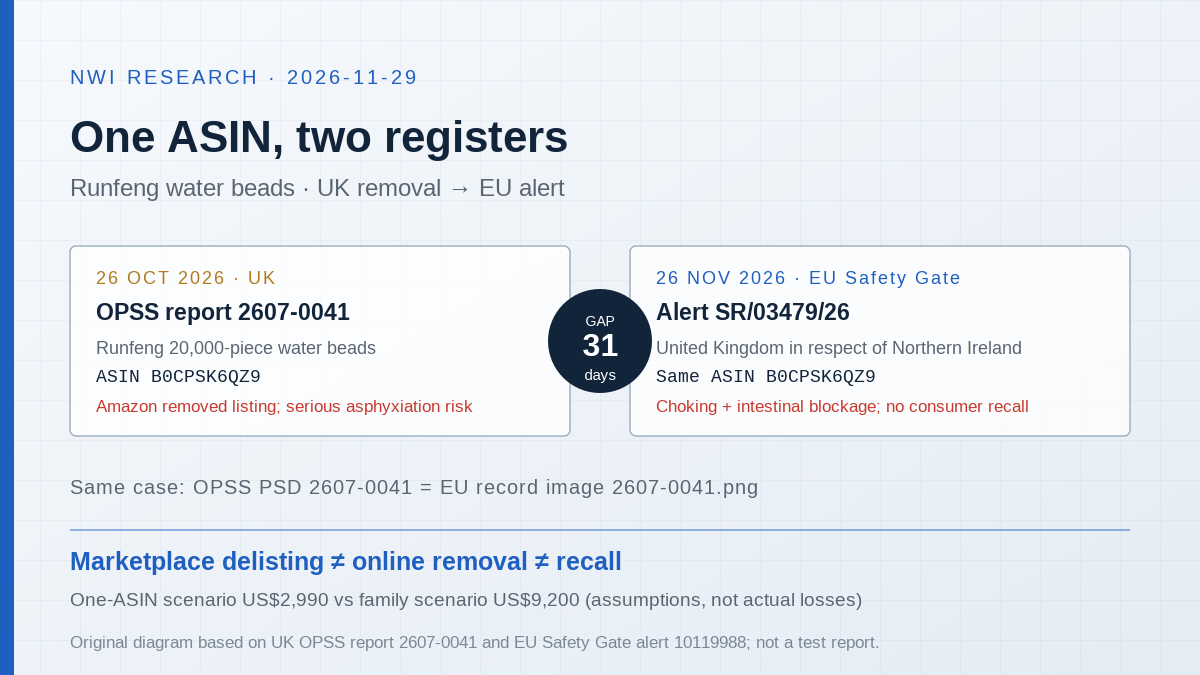
If you sell water beads, water babies, sensory kits or seasonal decor on Amazon UK or in the EU, these two records ask you to decide more than whether to take down one listing. The same ASIN that the UK handled by removing an Amazon listing appeared a month later in the EU Safety Gate. Should you stop that one ASIN, stop the whole water-bead SKU family, or change the age grading and warnings and keep selling? The UK OPSS report is dated 26 October 2026; the EU notification was published on 26 November 2026. Thirty-one days apart, both point to ASIN B0CPSK6QZ9 and the same case trail, 2607-0041. Treating a marketplace removal as a product recall, or a UK removal as an EU removal, produces the wrong scope.
This article is for three kinds of seller: a marketplace seller of water beads and water-bead kits on Amazon UK or in the EU, an importer that brings water beads in as decor or craft material, and a factory or trader supplying either. A seller with different products and evidence of a different product form and label template should not stop the whole store because the category is water beads. Continuing to sell the named ASIN, or relisting the same product under a new ASIN, does not resolve the risk.
1. Put both records on one timeline
| Date | Register / action | Authority | Product identifier | Measure / risk |
|---|---|---|---|---|
| 2024-09-19 | OPSS product safety alert PSA7 | UK OPSS | Water beads (category) | Warns of intestinal blockage or asphyxiation; keep away from children under 5 |
| 2026-10-26 | OPSS product safety report 2607-0041 | UK OPSS | Runfeng 20,000-piece water beads; ASIN B0CPSK6QZ9; barcode X00230H8WL | Amazon removed the listing; labeling improvements required; serious asphyxiation risk |
| 2026-11-25 13:52 UTC | EU Safety Gate record created | United Kingdom in respect of Northern Ireland | Same product name; same ASIN | Risk: choking and injuries; measure: voluntary removal from online marketplace |
| 2026-11-26 11:11 UTC | EU Safety Gate record published, SR/03479/26 | United Kingdom in respect of Northern Ireland | Same product name; same ASIN; image file 2607-0041.png | No consumer recall published; online-sales field is yes |
The records do not cross-reference each other in a data field, but the product name, ASIN and image filename point to the same case. The OPSS PSD notification number is 2607-0041; the EU record's image file is 2607-0041.png. Both name '20000 Pieces Water Beads Colorful, Biodegradable Balls', both name Runfeng, and both give ASIN B0CPSK6QZ9. That match is this article's starting point, but it proves the product identity, not that the two risk findings are independent.
The real decision is what to do when the same ASIN is removed by a marketplace in the UK and, a month later, enters the EU Safety Gate under the United Kingdom in respect of Northern Ireland: stop that ASIN, stop the whole water-bead SKU family, or change the label and keep selling.
2. Mechanism: why a UK removal does not become an EU removal
The UK OPSS report and the EU Safety Gate are two registers. The OPSS report applies the UK General Product Safety Regulations 2005; the EU notification cites the EU General Product Safety Regulation (GPSR). The authorities, fields and measure types differ. The UK report says the listing was removed by Amazon. That is a platform measure against one listing. The EU record says the product was voluntarily removed from the online marketplace by an 'other' economic operator and states that no consumer recall was published. A marketplace delisting, a removal from the online marketplace and a consumer recall are three different actions, not one.
The EU record's country field is 'United Kingdom in respect of Northern Ireland', not an EU27 member state. The field records the notifying country as the United Kingdom in respect of Northern Ireland, which appears as a separate territory in the EU product-safety register. It does not prove a new independent inspection in an EU27 market, nor that the same product is still on sale across the EU27. Reading 'entered the EU Safety Gate' as an EU27-wide recall overstates the scope; reading 'United Kingdom in respect of Northern Ireland' as unrelated to the EU understates the record's effect on an EU compliance file.
The product form carries the risk. OPSS's general water-bead alert PSA7 is explicit: water beads are superabsorbent polymers that can expand to more than 400 times their original size on contact with water or gastric fluids; if swallowed, they can block the intestine and require surgery, or be inhaled into the airway and cause choking. They should be kept away from children under five. The specific report classifies the Runfeng product as decorative articles/homeware/gardenware ornament accessories, yet still finds a serious asphyxiation risk, non-compliance with the 2005 regulations and a need to improve labeling. The decorative category did not exempt the product from a safety assessment. A category is a filing label, not a compliance conclusion.
Risk follows the product form, label and age grading, not the ASIN or the category name. That is the first mechanism-level conclusion. The second is that a marketplace removal handles one listing; it does not automatically create another market's recall or cover every ASIN with the same product form. The unit to manage is not 'the named ASIN' but the combination of product form, label template and supplier batch.
3. Evidence boundary: what the two records do not say
- There is no seller identity, sales volume, inventory, import volume or market share. Both records are product-safety records, not sales data, and cannot show how many units this product sold or what share of the category it holds.
- The EU record says online sales: yes, with Amazon as the online trader and B0CPSK6QZ9 as the identifier. That is a field at notification time, not proof that the listing is live today and not a platform delisting receipt.
- The UK report says Amazon removed the listing, but it does not say whether all inventory was removed, whether refunds were made, or whether a recall occurred. The EU record explicitly says no consumer recall was published. Merging the two into 'the UK and the EU both recalled it' is an overreach.
- Neither record has a batch number, model, test report, injury count or incident report. The EU record's model, batch and barcode fields are empty or unknown; the UK report gives only barcode X00230H8WL. Without a batch, traceability runs through the ASIN/barcode and the product form.
- The 31 days measure the gap between the report publication and the notification publication, not evidence that the product kept selling in the EU for 31 days. The EU record was created on 25 November and published on 26 November; when the underlying inspection began, or whether it began earlier, is not stated.
- The two records are not two independent events. The same ASIN, the same case number and the same product name make them closely related. The risk wording differs (the UK emphasizes a hydrated bead blocking the airway; the EU emphasizes expansion after contact with saliva or stomach liquids causing choking or intestinal blockage), which may reflect different assessors rather than two separate incidents.
- The general PSA7 alert is category background, not a test report for this ASIN. It supports the hazard mechanism and the under-five warning, not this product's measured values.
These limits mean this article cannot tell you how many units sold in the UK or the EU, whether the product is on sale today, or whether a platform has completed a recall. It can tell you what the two records match, what they do not match, and how to set a stop-sale scope at this strength of evidence.
4. Counter-case: when not to stop the whole water-bead family
- Counter-case one: stop every water bead, water baby, sensory kit and seasonal decor item in the store as soon as the word 'water beads' appears. The UK report names one ASIN and one product name. If other SKUs use different bead sizes, expansion ratios, packaging, warning text or suppliers, the current evidence does not automatically cover them. A family-wide stop turns inventory that can be shown to be different into a cash loss.
- Counter-case two: because the EU record says online sales: yes, assume the EU listing has also been removed. The field says the product was assessed as sold online at notification time; the measure is voluntary removal from the online marketplace; the record names Amazon as the online trader and gives the ASIN, but it does not name a seller or store and does not say that any listing has disappeared.
- Counter-case three: treat 'decorative articles' as an exemption. The specific report classifies the product as decorative articles and still finds a serious asphyxiation risk and requires labeling improvements. The general alert also says water beads can be sold as toys, craft, home decor or floristry, and that some water beads marketed as toys fail toy safety requirements. A category label cannot replace labeling, age grading and test evidence.
- Counter-case four: relist the same product under a new ASIN, a bundle or a new title. An ASIN is a marketplace identifier, not a product-safety boundary. If the product form, label and supplier are unchanged, a new shell does not change the risk or how a regulator identifies the product.
- Counter-case five: change only the English label and leave other languages unchanged. A product sold in a market must meet that market's language and warning requirements; one language does not cover multi-market listings. The applicable rules should be checked against target-market law, platform requirements and the competent authority's view.
A counter-case is not 'do nothing'. It is 'do not use the wrong scope to do the right thing'. If the shared-form review finds that the family uses the same product form, label template and supplier, a family-wide response has an evidence basis. If the review rules out a shared defect, a single-ASIN response is more accurate.
5. Two scenarios: one ASIN or the whole family
Both scenarios use only variables the public records can establish (one named ASIN, a possible four-ASIN family). Every other number is a labeled assumption. They are not estimates of this product's actual sales, costs or losses, and they are not measurements by NWi or any seller.
Scenario A: stop the one named ASIN
Assumptions: the affected ASIN accounts for 30% of the water-bead SKU family's monthly units; the family sells 1,000 units a month at an average price of US$12 with a 35% contribution margin; the processing period is 45 days; one SKU retest costs US$600, label redesign US$300 and platform compliance review US$200, for a one-off US$1,100; platform commissions, advertising, penalties, ranking loss and supplier compensation are excluded.
Result: the affected ASIN sells 300 units a month, for monthly revenue of 300 × 12 = US$3,600 and monthly contribution of 3,600 × 35% = US$1,260; 45 days is 1.5 months, so the contribution at risk is 1,260 × 1.5 = US$1,890; adding the one-off 1,100 gives US$2,990.
Decision: if only this ASIN has a unique packaging and label template, isolate the single ASIN first and complete the family inventory check within seven days; the single-ASIN cash exposure is US$2,990, but it does not cover other ASINs in the family, so a shared-form review must follow within seven days.
Scenario B: stop and retest the whole four-ASIN family
Assumptions: the family has four ASINs selling 1,000 units a month in total at an average price of US$12 with a 35% contribution margin; all are stopped and retested for 45 days; each retest costs US$600, or US$2,400 for four, plus US$300 for label redesign and US$200 for platform compliance review; platform commissions, advertising, penalties, ranking loss and supplier compensation are excluded.
Result: family monthly revenue is 1,000 × 12 = US$12,000 and monthly contribution is 12,000 × 35% = US$4,200; 45 days is 1.5 months, so the contribution at risk is 4,200 × 1.5 = US$6,300; adding the one-off 2,900 gives US$9,200. That is US$6,210 more than the single-ASIN US$2,990. The family option is cheaper only when four ASINs would be stopped one by one (4 × 2,990 = US$11,960), where it saves US$2,760.
Decision: a family-wide stop is not the default. Expand to the family only when the four ASINs share the same product form, label template or supplier batch and the review cannot rule out a shared defect within seven days; otherwise isolate the single ASIN first and avoid replacing an unproven risk with US$6,210 of certain cash cost.
The purpose of the two scenarios is not to pick the 'cheaper' option but to put a price on the scope decision: the single-ASIN option is cheaper but may miss the family; the family option covers more but is cheaper than sequential stops only if you would in fact stop all four. The trigger is the shared-form review, not the category name.
6. Action list and stop conditions
- Day 0–1: freeze new inbound to the named ASIN; capture the listing page, both sides of the label, barcode/batch and market-by-market sale status; do not relist the same product under a new ASIN or bundle in another market.
- Day 1–3: build the family map. List every ASIN/SKU that may share the product form (bead size, expansion ratio, color mix), packaging, label template, supplier and barcode prefix; mark its status in the UK, the EU, Northern Ireland and other markets.
- Day 3–7: run the shared-form review. Compare the OPSS specific report, the PSA7 general alert and the EU record against age grading, warning text, ingestion instructions, whether the product can be mistaken for a toy or food, and whether the label languages cover the target markets. If the product is for children or may be mouthed by young children, ask the laboratory and the authority about child/toy use instead of self-exempting with the 'decorative' category.
- Day 7: set the scope from the review. Shared-form hit: isolate and retest the family. Single-ASIN hit only: keep the single-ASIN isolation and record why the others are excluded. Cannot tell: isolate the family first until the evidence is complete.
- Relisting conditions: a checkable test/assessment file; a revised label covering the target-market languages; supplier confirmation that the corrective action applies to the same batch/label template; marketplace acceptance of the change; no new official alert. If any condition is missing, keep the stop.
- Stop/exit conditions: if the product form cannot meet the applicable expansion/age-grade requirement, or the supplier cannot provide batch traceability and test documents, exit the product form rather than repeatedly changing labels; if the same product form is flagged again in another market, expand to the worst case.
7. What this means for selection and data judgment
For selection, water beads are not a simple sell/no-sell binary but a category with a high compliance threshold: OPSS has had a general alert since September 2024, a specific ASIN report in October 2026, and an EU Safety Gate entry in November 2026. A selection process that looks only at sales, price bands and seasonality, without age grading, labels, test files and past platform actions, leaves the compliance cost until after listing. A more robust approach makes batch traceability, a label template and target-market language versions pre-listing filters, not post-delisting repairs.
For data judgment, the case makes two points. First, a marketplace removal is not sales data and cannot be used to infer that the product sold well and therefore attracted attention; neither record contains sales. Second, the status of the same product in different registers cannot simply be added up: a UK removal, an EU notification and a consumer recall are three different actions, and combining them overstates or understates the scope. When ranking exposure with product data, look at the number of SKUs sharing the product form, the number of markets on sale, inventory and the 45-day processing window together, not just the named ASIN.
Within activated modules, NWi CrossborderGo provides Amazon and other platform category, brand, store and product data to locate family SKUs, price bands and markets on sale and to rank the review. It does not test products, read or issue test reports, trace batches, confirm current marketplace listing status, execute recalls or provide legal/compliance conclusions; available sites, history and fields depend on account access and the contract. To look at compliance records alongside product data, see Amazon data analysis and the CrossborderGo product page, or explain your market and data needs through the demo request.
8. Method and limitations
Data basis: on 29 November 2026 this article reopened the UK OPSS product safety report 2607-0041 (published 26 October 2026) and EU Safety Gate notification 10119988 (SR/03479/26, created 25 November 2026, published 26 November 2026), checking the product name, Runfeng brand, ASIN B0CPSK6QZ9, barcode X00230H8WL, notifying country 'United Kingdom in respect of Northern Ireland', risk types, measure type and online-sales field. On the same day it read OPSS's general water-bead alert PSA7 of 19 September 2024, checking the advice to keep water beads away from children under five, expansion to more than 400 times, the intestinal-blockage and choking risks, and the reference to the EN 71 expansion limit. The two records are linked by the same product name, the same ASIN and the EU record's image filename 2607-0041.png matching the OPSS PSD notification number 2607-0041; they are different register entries for the same case, not two independent events. Calculations: Scenario A, 300 = 1,000 × 30%, 3,600 = 300 × 12, 1,260 = 3,600 × 35%, 1,890 = 1,260 × 1.5, 2,990 = 1,890 + 1,100; Scenario B, 12,000 = 1,000 × 12, 4,200 = 12,000 × 35%, 6,300 = 4,200 × 1.5, 2,900 = 4 × 600 + 300 + 200, 9,200 = 6,300 + 2,900, 6,210 = 9,200 - 2,990, 11,960 = 4 × 2,990, 2,760 = 11,960 - 9,200. All unit sales, prices, margins, processing days, test fees, label costs, platform review fees and ASIN counts are labeled assumptions, not measurements by OPSS, the European Commission, Runfeng, Amazon, any seller or NWi. Product boundary: within activated modules, NWi CrossborderGo provides platform, site, category, brand, store and product data to locate family SKUs, price bands and markets on sale and to rank the review; it does not test products, read or issue safety test reports, trace batches, confirm marketplace listing status, execute recalls or provide legal/compliance conclusions, and available sites, history and fields depend on account access and the contract.
This article was prepared with automated research assistance from the public sources listed at the end and has not been reviewed by a human. It does not invent customer data, expert review, test results, platform actions or ranking effects. It is not legal, compliance, product-safety or marketplace-operations advice. Whether a specific product is in scope, should be stopped, recalled or retested, which market applies, and how to communicate with an authority or marketplace should be checked against the latest OPSS and Safety Gate records, target-market law, an accredited test laboratory, a lawyer and the competent authority. Public-source analysis is not a market-wide test report.
This article has no seller inventory, orders, refunds, supplier contracts, test reports or platform delisting notices, and no follow-up action by the UK or EU authority. Both records are public product-safety records, not an investigation of this product's current sales status or market-wide prevalence. Public-source analysis is not a market-wide test report.
Sources
- UK OPSS, 26 October 2026, Product Safety Report: 20,000pcs Runfeng Water Beads (2607-0041): Runfeng 20,000-piece water beads, ASIN B0CPSK6QZ9, barcode X00230H8WL; serious asphyxiation risk; Amazon removed the listing; labeling improvements required; non-compliant with the General Product Safety Regulations 2005.
- European Commission Safety Gate, 26 November 2026 (created 25 November 2026), alert SR/03479/26 / 10119988: same product name, brand Runfeng, ASIN B0CPSK6QZ9, notifying country United Kingdom in respect of Northern Ireland; risks of choking and injuries; voluntary removal from the online marketplace; no consumer recall published; online-sales field is yes.
- UK OPSS, 19 September 2024, Product Safety Alert: Water Beads (PSA7): water beads can cause intestinal blockage or asphyxiation; keep away from children under five; expansion to more than 400 times; some toy-use water beads fail toy safety requirements; EN71 sets an expansion limit.