
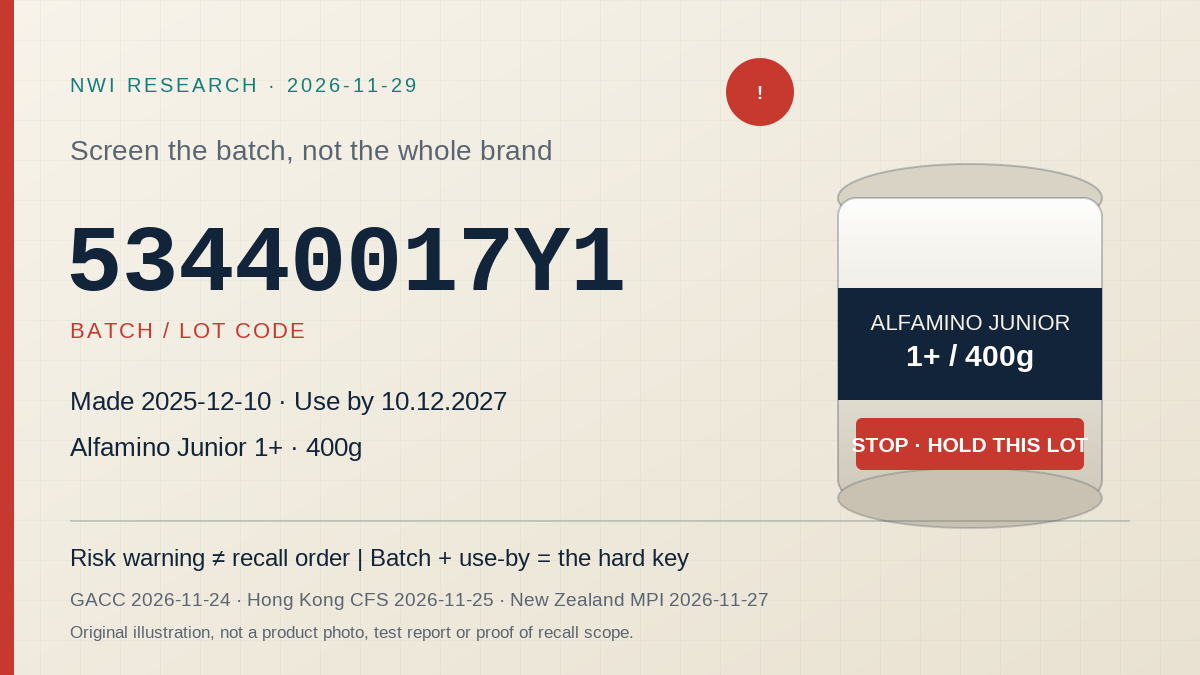
If you sell Nestlé Australian-version Alfamino stage 1+ through cross-border e-commerce, daigou or community channels, the GACC risk warning of 24 November 2026, the Hong Kong CFS notice of 25 November and New Zealand MPI’s recall of the same batch 53440017Y1 on 27 November have narrowed the question to the batch code and use-by date on the bottom of the tin, not the whole Alfamino brand. The real decision is whether to stop and refund the named batch first, or pause the whole line and wait for the supplier; the cash exposure and shortage risk differ.
This article is for three groups: sellers listing this version on cross-border platforms, daigou/community/personal-parcel sellers, and importers or distributors holding the batch. A seller who only carries other batches and can document batch and use-by dates should not delist the whole line because the headline says Nestlé; but continuing to sell the named batch after an official warning is hard to defend.
1. The three official documents in one table
| Item | GACC (24 Nov 2026) | Hong Kong CFS (25 Nov 2026) | New Zealand MPI (27 Nov 2026) |
|---|---|---|---|
| Document type | Risk warning notice | Reproduces GACC; local follow-up | Recall (recalled on 27 November 2026) |
| Product | Nestlé Australian-version Alfamino amino-acid fully hydrolysed infant formula, stage 1+ | Same | Alfamino Junior 1+ Years (400g) |
| Batch | 53440017Y1 | 53440017Y1 | 53440017Y1 |
| Production/use-by | Production date 2025-12-10 | Production date 2025-12-10 | Use by 10.12.2027 |
| Finding/reason | Bacillus cereus emetic toxin | Reproduces GACC | Cereulide |
| Channel | Cross-border retail; sold by Hangzhou Tmall Import and Export Co. | No local sale or import found so far | Mainly pharmacies; removed from shelves |
| Action | Consumers told to stop using | Consumers should discard | 103 cans recalled; no illness reports |
The row that is easiest to miss is document type. GACC issued a risk warning, not a recall order; it told consumers to check products obtained through cross-border e-commerce, personal carrying or daigou and to stop using them, and said no general-trade imports of the product had been found in China. Hong Kong CFS reproduced the same batch and said it had not found local sale or import. New Zealand MPI issued a recall: 103 cans, same batch, use-by 10.12.2027, mainly sold through pharmacies and removed from shelves. All three point to the same batch code, but the legal action and scope differ.
One boundary cannot be skipped: a batch code is a production lot, not proof that the same physical shipment moved through one logistics chain. China’s notice does not say the sample came from New Zealand’s 103 cans, and New Zealand does not say the product was re-exported to China. Writing “same batch” as “the same goods flowed from New Zealand to China” is overreach; using “China has no recall order” to prove the China channel is safe is equally wrong.
2. Mechanism: why hot water cannot clear this batch
Bacillus cereus can cause two kinds of illness: a heat-labile diarrhoeal toxin and a heat-stable emetic toxin, cereulide. New Zealand MPI’s recall page states that cereulide is extremely heat resistant and that preparing formula with hot water would not eliminate it; symptoms usually appear between 30 minutes and 6 hours after exposure and include severe or persistent vomiting, diarrhoea or unusual lethargy. GACC’s notice calls the finding “emetic toxin of Bacillus cereus”, the same class of substance.
That makes two actions meaningless: boiling the powder or raising the water temperature, and using a negative test on another tin or another batch to clear the named batch. The first does not destroy the toxin; the second is not a full test of the same batch. GACC’s notice does not publish the sampling plan, the detection level, the quantity imported in the batch or its distribution, so “someone else tested theirs and it was fine” cannot replace the fact that this batch was named.
For a seller, the mechanism-level conclusion is simple: batch code plus use-by date is the hard key; testing and heating are not release keys. Cereulide is heat-stable, so hot water cannot eliminate it, and a negative result on another tin or batch cannot release the named batch. What you need to prove is “I do not sell 53440017Y1, or the 53440017Y1 I had is segregated and handled”, not “it smells, looks or mixes fine”.
3. Evidence boundary: what the notices do not say
- GACC does not publish the detection level, sample size, quantity imported in the batch or distribution, and does not say whether the platform delisted the listing or opened an investigation. A risk warning is not a recall order.
- Hong Kong CFS says it has not found local sale or import, but explicitly says acquisition through online purchase or international travel cannot be excluded. “Not sold in Hong Kong” does not mean “not in Hong Kong consumers’ homes”.
- New Zealand MPI recalled 103 cans. That is the New Zealand market quantity, not a global failure rate and not the China-channel inventory. MPI says the product was not re-exported, but does not say no other market received the same batch.
- None of the three documents provides a complete distribution list, consumer case record or full test report. “No reports of illness” means no reports as of publication, not proof of no exposure.
- China’s notice says no general-trade imports of the product had been found. That covers general trade only, not cross-border e-commerce, personal carrying or daigou; it cannot be read as “the product is not in China”.
These boundaries mean this article cannot give you a failure rate for the batch, and cannot say the whole Alfamino line is unsafe. What it can give you is a screening order, a refund framework and stop conditions.
4. Counter-cases: how a batch stop becomes a wrong-line stop
- Counter-case 1: delisting every Alfamino stage 1+ or even stage 0–12 month product because one batch was named. MPI says the recall does not affect any other Nestlé brand products in New Zealand; GACC names one batch. A whole-line stop can leave infants who depend on a food for special medical purposes without stock and turn unaffected inventory into a cash loss.
- Counter-case 2: resuming the named batch because the supplier sends a general “all products comply” letter or a test report for another batch. A general letter is not a batch CoA, and another batch’s report is not a report for 53440017Y1; without a match on batch code and use-by date, the document cannot release the batch.
- Counter-case 3: continuing to sell the named batch because China has not issued a recall order. GACC has already told consumers to stop using it; after an official warning, complaints, platform penalties and regulatory questions from continuing to sell the named batch sit with the seller.
- Counter-case 4: assuming Hong Kong or mainland consumers do not have the product because Hong Kong found no local sale. CFS explicitly says online purchase and international travel cannot be excluded; daigou and personal parcels are not in local retail records.
- Counter-case 5: treating New Zealand’s 103 cans as the global total, or treating the China sample as those 103 cans. Both misread “same batch code” as “same logistics lot”.
These counter-cases are not reasons to keep selling; they decide which batch you stop first and which document you ask for. A supplier that can match batch, use-by date, channel and orders is the only one worth discussing resale with.
5. Scenario A: 200 tins in stock, 60 sold
Scenario A: 200 tins in stock, 60 sold
Assumptions: 200 tins in stock at CNY 180 cost and CNY 320 retail; 60 tins sold; refunds at retail; reverse logistics at CNY 25 per tin; all 140 unsold tins are unsellable; no platform commission, advertising, fines or supplier compensation.
Result: refunds = 60 × 320 = CNY 19,200; reverse logistics = 60 × 25 = CNY 1,500; unsold inventory cost = 140 × 180 = CNY 25,200; the three items total CNY 45,900. If the CNY 10,800 cost of the 60 sold tins is added, total economic cost = CNY 56,700. If the supplier credits the full unsold stock, the CNY 20,700 refund and logistics outlay is still fronted by the seller; the CNY 10,800 cost of the sold tins has already been incurred, and whether it is covered depends on the contract.
Decision: freeze and refund first; do not keep selling while waiting for a test. Calculate supplier compensation and reverse logistics separately; do not use “return the whole batch to the supplier” to hide refunds and complaint costs already incurred.
The CNY 45,900 is not a net profit loss. It is recall handling plus inventory write-down before deducting the CNY 19,200 already collected for the 60 sold tins, and before platform commissions, advertising, fines and supplier compensation. Treating it as net loss overstates the damage; treating it as the full cost understates the cash pressure from refunds and reverse logistics.
6. Scenario B: 1,000 tins, 3 batches, only 200 named
Scenario B: 1,000 tins, 3 batches, only 200 named
Assumptions: 1,000 tins across 3 batches at CNY 180 cost per tin; only 200 tins are the named batch; batch check 3 hours × CNY 150 = CNY 450; customer communication for 200 orders at CNY 3 = CNY 600; the 800 unaffected tins remain sellable; no traffic or markdown loss.
Result: a whole-brand stop freezes 1,000 × 180 = CNY 180,000 of inventory; a batch screen stops only 200 × 180 = CNY 36,000, plus CNY 450 for the check and CNY 600 for communication, or CNY 37,050; the difference, CNY 142,950, remains available for working capital. If batch records are missing and the other 800 tins cannot be shown to be outside the batch, all 1,000 tins must be treated as high risk.
Decision: screen by the batch code on the bottom of the tin and use-by 10.12.2027; do not use the Alfamino brand as a blunt cutoff. If batch records are missing, widen the freeze rather than accept a verbal assurance.
The difference between the scenarios is not whether to act but how wide the action should be. A is a full handling of one batch; B is a layered handling when batch records exist. If B’s batch records are incomplete, B collapses into A, or becomes larger than A, because you cannot even say which 200 tins are affected. Scenario A’s CNY 45,900 is the sum of CNY 19,200 refunds, CNY 1,500 reverse logistics and CNY 25,200 unsold inventory; Scenario B’s batch screen of CNY 37,050 is CNY 142,950 less than the CNY 180,000 whole-line freeze.
7. Action list and stop conditions
Five things to do now:
- Freeze: segregate batch 53440017Y1, use-by 10.12.2027, 400g tins, stage 1+; pause the listings; label the stock separately; do not mix it with other batches.
- Match orders: export sold orders and filter by batch, use-by date and channel; keep evidence for orders that can be shown to be outside the batch; treat the rest as high risk until proven otherwise.
- Refund/return: refund or replace sold units of the named batch under platform rules; keep reverse-logistics and complaint records; do not require a consumer to prove illness before refunding.
- Request documents: ask the supplier for the batch CoA, production/distribution list, recall notice and a written statement on whether the batch entered the China channel; the documents must match batch code, production date, use-by date and tin size.
- Notify the platform: submit the recall/stop-sale explanation as required and keep the timestamp and receipt; do not rely on a group-chat message, which is hard to prove later.
Resume unaffected batches only when all of these are true: batch code and use-by date can be matched tin by tin; the supplier provides batch distribution/CoA documents; no platform or regulator has widened the recall; and no new illness report or test result points to the same batch. If one is missing, keep the stop; do not substitute a supplier’s verbal assurance for documents. Freeze the named batch, refund order by order, ask the supplier for the batch CoA, distribution list and recall notice, and resume unaffected batches only when batch, use-by date and channel records all match.
Expand the freeze and escalate immediately if any of these happens: the supplier cannot provide batch documents; an official notice widens the batch; the platform delists the listing or a regulator asks questions; an illness report is linked to the batch; or the same batch is recalled in another market with a wider scope. At that point, stop calculating the cost of a batch-only stop and isolate on the worst-case basis.
If you never held this batch, the right action is to document: keep purchase invoices, batch photos, supplier statements and a dated check record, and keep watching official notices. Do not issue an “our products are absolutely safe” statement, and do not turn “we never stocked it” into “it passed testing”.
8. What this means for selection and data decisions
The selection impact is not “infant formula cannot be sold”; it is “formula whose batch and channel cannot be documented cannot be sold”. Compliance evidence belongs in SKU admission and replenishment, not in after-sales repair.
Within activated modules, NWi CrossborderGo provides platform, country/region, category, brand, store and product data, including sales, units, ASP, brand share and price bands; prior-month data is updated between the 10th and 15th of each month, and available sites, history and fields depend on the contract. It can help size the infant-formula category, price bands and brand concentration so a team can decide which SKUs and channels to audit first; it does not provide food testing, batch traceability, recall status, Tmall orders, customs declarations or legal/compliance conclusions.
To size the infant-formula category, its price bands and brand concentration in activated markets, see NWi CrossborderGo; to bring SKU, stock and stop-sale actions into operations, see NWi Operations; to break the data down by site, category and brand, book a demo. Product capabilities, site coverage and fields depend on the modules activated and the contract.
9. Method and disclosure
Data basis: on 29 November 2026 this article reopened the GACC Import and Export Food Safety Bureau risk warning of 24 November 2026 on Nestlé Australian-version Alfamino amino-acid fully hydrolysed infant formula. The article page returned HTTP 412 in this environment, so the text was read on GACC’s official search index and checked line by line against the Hong Kong Centre for Food Safety PDF of 25 November 2026 for batch 53440017Y1 and production date 2025-12-10. The New Zealand MPI recall page and media release returned an Incapsula shell in this environment; their text was read through the search channel’s full-text extraction and cross-checked with Pharmac’s page of 29 November 2026 and RNZ’s report of 27 November 2026 for the 103 cans, use-by 10.12.2027, pharmacy channel, removal from shelves and no illness reports. Calculation basis: Scenario A uses 19,200 = 60 × 320; 1,500 = 60 × 25; 25,200 = 140 × 180; 45,900 = 19,200 + 1,500 + 25,200; 10,800 = 60 × 180; 56,700 = 45,900 + 10,800; 20,700 = 19,200 + 1,500. Scenario B uses 180,000 = 1,000 × 180; 36,000 = 200 × 180; 450 = 3 × 150; 600 = 200 × 3; 37,050 = 36,000 + 450 + 600; 142,950 = 180,000 − 37,050. All inventory, retail, cost, hours, order and logistics figures are labeled assumptions, not measurements by GACC, MPI, CFS, Pharmac, NWi or any seller. Product boundary: within activated modules, NWi CrossborderGo provides platform, country/region, category, brand, store and product data to size the infant-formula category, price bands and brand concentration and to rank SKUs and channels for audit; it does not provide food testing, batch traceability, recall status, Tmall orders, customs declarations or legal/compliance conclusions, and available sites, history and fields depend on the contract.
This article was prepared with automated research assistance from the public sources listed at the end and has not been reviewed by a human. It does not invent customer data, expert review, sales, test results, platform actions or ranking outcomes. It is not medical, legal, compliance or platform-operations advice; whether a specific product is affected, whether to stop selling, refund or recall, which market applies, and how to communicate with a platform or supplier should be based on the latest GACC, Hong Kong CFS, New Zealand MPI/Pharmac notices, the batch and use-by date on the tin, the supplier’s batch documents and the competent authority’s advice. If a child has consumed the named batch and has persistent vomiting, diarrhoea or unusual lethargy, contact a medical provider or a local health/poison service.
This article does not have the seller’s inventory, orders, refunds, supplier contract or platform delisting notice, and does not have a China recall order, a Tmall listing-removal result or a full batch distribution list. The 103 cans are New Zealand’s recalled quantity, not a global failure rate, and cannot be used to estimate China-channel inventory or risk. It cannot decide whether a specific order is in scope.
10. Conclusion
Three sentences: first, on 24 November 2026 GACC issued a risk warning, not a recall order; New Zealand MPI recalled 103 cans of the same batch on 27 November, and Hong Kong CFS said it had not found local sale or import. Second, cereulide is heat-stable; hot water, a negative result on another tin and a general supplier letter cannot release 53440017Y1; the batch code plus use-by date is the hard key. Third, stop the named batch, refund sold units, request batch documents, and use batch records to decide whether unaffected batches can resume; do not use “stop the whole line” in place of scope analysis, and do not use “China has no recall” in place of action.
The contribution is threefold: separate the risk warning, the recall order and the local follow-up; separate “same batch code” from “same logistics lot”; and use two reproducible scenarios to show the cash exposure of a whole-line stop versus a batch stop. This article does not have the seller’s inventory, orders, refunds, supplier contract or platform delisting notice, and cannot decide whether a specific order is in scope.
Sources
- GACC Import and Export Food Safety Bureau, 24 November 2026, risk warning on Nestlé Australian-version Alfamino stage 1+: batch 53440017Y1, production date 2025-12-10; the article page returned HTTP 412 in this environment and the text was read on GACC’s official search index.
- Hong Kong Centre for Food Safety, 25 November 2026, CFS notice (PDF): reproduces the GACC batch and production date; no local sale or import found so far; consumers should discard.
- New Zealand MPI, 27 November 2026, Nestlé brand Alfamino Junior (1+ Years) recalled due to the presence of cereulide: batch 53440017Y1, use-by 10.12.2027, pharmacy channel, removed from shelves, no illness reports; cereulide is heat resistant.
- New Zealand MPI, 27 November 2026, Specialist toddler milk recalled due to the presence of cereulide: 103 cans, mainly pharmacies, removed from shelves, no illness reports.
- Pharmac, 29 November 2026, Alfamino Junior infant formula: Recall: one batch, Pharmacode 2634848, new batches airfreighted, alternative product Neocate Junior.
- RNZ, 27 November 2026, Nestlé recalls Alfamino Junior 1+ Years toddler milk due to cereulide toxin: 103 cans, pharmacies, removed from shelves, no illness reports.