
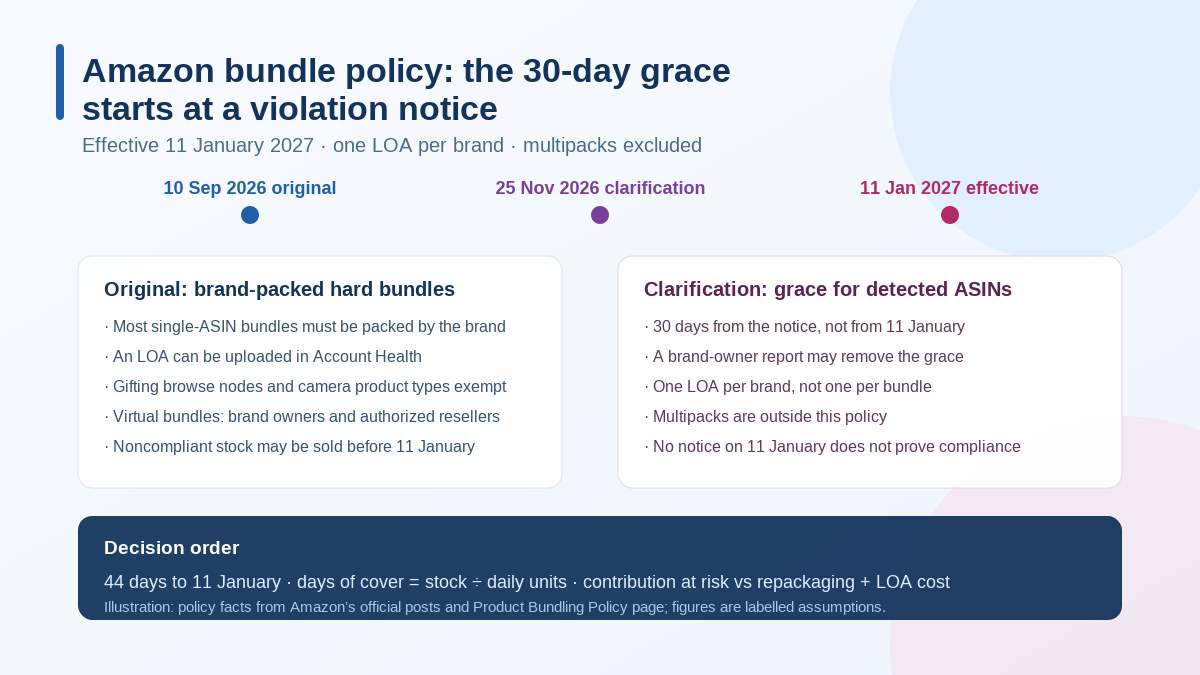
If you sell hard bundles on Amazon US—two or more different products physically packed as one ASIN—the decision after 25 November 2026 is which bundles can sell through before 11 January 2027, which need a letter of authorization (LOA) from every included brand, which can move to a virtual bundle, and which should be retired. The 30-day grace period is not an extra 30 days after 11 January; it starts when a violation notice arrives. The answer depends on four fields: who packed the bundle, the brands inside it, days of cover, and the scope of the LOA—not on the effective date alone.
1. Two official documents: what starts on 11 January and what the 25 November post adds
The first document is the 10 September 2026 announcement, “New requirements for product bundles starting January 11”. Amazon says that from 11 January 2027 most product bundles listed as a single ASIN must be packaged by the original manufacturer or brand, and that some previous bundle restrictions are being removed. Noncompliant bundles will be deactivated after 11 January and recorded as listing violations in Account Health, with an email notice; the 25 November clarification then places most affected bundles inside a 30-day window after a violation notice. Before 11 January, sellers may sell any noncompliant inventory.
The second is the 25 November 2026 (UTC) clarification, “Grace period and clarifications for the product bundling policy”. Amazon adds a 30-day grace period for most affected bundle listings so sellers can gather LOAs or submit appeals; the 30 days start at the violation notice, not on 11 January. The post also says the grace already applied to FBA bundles and high-volume consumables bundles and now extends to all bundle ASINs Amazon detects; a brand-owner report may remove the grace; multipacks of the same product are outside the policy; and one LOA per brand is enough.
Put together, the timeline is: rules published on 10 September 2026, grace and LOA clarifications on 25 November 2026, effective date on 11 January 2027, and a 30-day window that starts only when a violation notice arrives. Any one date on its own misleads: 11 January is not the start of the 30 days, and 25 November is not a new effective date.
| Date | Document | What it means for the seller |
|---|---|---|
| 10 Sep 2026 | Original announcement: new bundle requirements | From 11 January 2027 most single-ASIN hard bundles must be brand- or manufacturer-packed; noncompliance leads to deactivation and an Account Health violation |
| 25 Nov 2026 | Clarification: grace period and details | The 30-day grace starts at a violation notice; one LOA per brand; multipacks excluded; a brand-owner report may remove the grace |
| 11 Jan 2027 | Effective date | Amazon may issue a notice at any time; no notice on 11 January does not prove compliance |
2. The mechanism: two time windows, not one 30-day period
The first window is the run-up to the effective date. The original announcement lets sellers keep selling noncompliant inventory before 11 January; from 28 November 2026 to 11 January 2027 is 44 days, not 30. Whether that runway is enough depends on your stock and daily sales, not on a uniform Amazon grace period.
For a US seller of single-ASIN bundles made from multiple products, the decision before 11 January 2027 is which bundles can sell through on current stock, which need a letter of authorization from every included brand, which can move to a virtual bundle, and which should be retired; the 30-day grace is not an extra 30 days after 11 January but a response window that starts at a violation notice.
Mechanically, Amazon separates hard kit bundles from virtual bundles: a hard kit is physically packed as one ASIN and must be packed by the brand or manufacturer, or fit the LOA, gifting browse-node or camera product-type exception; a virtual bundle is not packed together, and the announcement describes that route for brand owners and authorized resellers.
Typical examples are multi-brand gift sets, starter kits or mixed consumable packs: they physically pack two or more different products into one ASIN, and whether the policy applies depends on the packer, browse node and product type, not on the word “kit” in the title.
The second window is the 30 days after a notice. The clarification says that if Amazon identifies a noncompliant bundle listing, the seller receives a violation notice and has 30 days from that notice to resolve the issue or sell all the inventory before the listing is deactivated; during those 30 days the pending violation appears as “Listing at risk of removal” in Account Health. A notice can arrive at any time after 11 January, and no notice on 11 January does not prove the listing is compliant.
The LOA count changes the workload: one LOA per brand, not one per bundle. A seller with 40 bundle ASINs across 6 brands needs 6 LOAs, not 40; but each LOA must allow that brand’s products to be reconfigured and repackaged with all other included brands, not merely allow the seller to sell the brand.
3. Evidence boundary: the rule is provable, your bundle’s compliance is not
The two official Amazon posts and the Product Bundling Policy page give the effective date, exceptions, LOA count and 30-day notice window, but they do not publish an enforcement rate, LOA approval time, repackaging cost, the number of affected sellers, or whether a specific ASIN will be found noncompliant; this article can therefore give a screening and calculation order, not a compliance ruling.
All three documents are Amazon’s: two Seller Forums posts and one Product Bundling Policy help page. They add detail to each other but are not three independent organisations, so this is not independent confirmation. The help page says “This article applies to selling in: United States” and defines bundles as excluding multipacks; the original announcement does not print a marketplace name, so confirm the store in Seller Central or the local help page before applying the rule elsewhere.
What cannot be proved includes how quickly Amazon will detect a given bundle, how long an LOA takes, the actual repackaging cost, the share of brand-owner reports, how the 30-day grace is applied in a specific category, and whether a specific ASIN will be deactivated. No public data shows the probability that a seller clears inventory within 30 days. Every calculation in this article uses labelled assumptions rather than presenting those unknowns as measurements.
4. Worked analysis: three scenarios
Start with days of cover: stock divided by recent daily units. Compare that with two windows: the 44 days to 11 January and the 30 days after a notice. Every number below is an assumption, not a measurement by Amazon, NWi or any seller.
| Scenario | Key assumption | Result | Decision |
|---|---|---|---|
| A | Notice on 11 January; 1,200 units; 40 or 30 units a day | 40 a day clears 1,200 exactly; 30 a day clears 900 and leaves 300 | If daily sales are below 40, start repackaging or the LOA first |
| B | 40 bundle ASINs; 6 brands; about 3 weeks per LOA | 6 LOAs; about 3 weeks in parallel; 6 x 3 = 18 weeks sequentially, beyond 30 days | Request the six LOAs in parallel now, not ASIN by ASIN after a notice |
| C | US$8 contribution; 1,200 units; US$1.20 repackaging; US$300 LOA per brand | Contribution at risk US$9,600; compliance cost US$3,240; protected US$6,360 | Comply if protected contribution exceeds cost; otherwise retire the bundle |
Scenario A: 1,200 units at 40 or 30 a day
Assume 1,200 bundle units, a notice on 11 January, a 30-day notice window, and daily sales of 40 or 30 units, with no replenishment or speed-up; illustrative only. 40 units a day x 30 days = 1,200 units, exactly clearing stock; 30 units a day x 30 days = 900 units, leaving 300 units unsold at the end of the window. If daily sales are below 40 units, start repackaging or the LOA before 11 January; do not rely on the 30-day notice window alone to clear stock.
Scenario B: 40 ASINs, 6 brands, three weeks per LOA
Assume 40 bundle ASINs across 6 brands, one LOA per brand, about three weeks per LOA, a notice on 11 January, run both in parallel and sequentially; illustrative only. The seller needs 6 LOAs, not 40; parallel work takes about 3 weeks, while sequential work takes 6 x 3 = 18 weeks, which exceeds the 30-day window from a notice. Map ASINs to brands now and request the six LOAs in parallel; do not wait for a notice and then process them ASIN by ASIN.
Scenario C: US$9,600 contribution against US$3,240 compliance cost
Assume US$8 contribution per unit, 1,200 units, US$1.20 per unit for repackaging, US$300 internal LOA cost per brand and 6 brands; illustrative only. Contribution at risk = 8 x 1,200 = US$9,600; repackaging = 1.20 x 1,200 = US$1,440; LOAs = 300 x 6 = US$1,800; total compliance cost US$3,240, protecting US$6,360 of contribution. If the bundle can sell through and the protected contribution exceeds compliance cost, comply; if it cannot sell through and compliance cost exceeds contribution, retire the bundle instead of repackaging.
In scenario A, 1,200 units at 40 units a day clear exactly 1,200 units in 30 days; at 30 units a day only 900 units clear and 300 remain. In scenario B, 40 bundle ASINs across 6 brands need 6 LOAs, not 40; if the six LOAs run sequentially at three weeks each, 18 weeks exceeds the 30-day notice window.
The common order is: first test whether the stock can clear inside a window, then how long the LOAs take, then whether the compliance cost is worth paying. Reversing the order—requesting LOAs before checking sell-through—can spend money on bundles that will be retired anyway; checking stock first without starting LOAs in parallel can miss the window.
5. Counter-cases and alternative explanations
Counter-cases matter: a multipack of the same product is outside this bundle policy and should not be repacked for the 30-day window; a bundle already packed by the brand needs no LOA; a bundle in a gifting browse node or camera product type can avoid brand packing; and the announcement describes a virtual bundle for brand owners and authorized resellers, not as a route for every seller.
Counter-case one: the bundle is a three-pack of the same product. The help page defines multipacks as two or more identical products and says bundles do not include multipacks; the clarification also says the policy does not apply to multipacks. That ASIN belongs under the ASIN creation policy, not the LOA process in this article. Counter-case two: the bundle is already packed by the brand. It needs no LOA and no repackaging; keep the brand-packaging evidence and purchase records instead of buying a redundant letter.
Counter-case three: the bundle sits in a gifting browse node or a camera product type. The announcement lists both as exceptions, but the help page also requires a gift basket to be in a gifting browse node and to “clearly specify gifting intent on detail page”, and the camera exception is limited to camera product types; looking like a gift box or containing a camera accessory is not enough. Counter-case four: using a virtual bundle to avoid packing. The announcement describes that route for brand owners and authorized resellers; if you are neither, confirm your eligibility before relying on the virtual route, rather than treating it as a general escape.
Counter-case five: no notice on 11 January, so keep selling. The clarification says a notice can happen at any time after 11 January and that no notice does not mean the listing is compliant. Counter-case six: the brand owner has already reported the listing. The clarification says the 30-day grace “might not apply”, so do not assume 30 days remain. Counter-case seven: one LOA per brand means one template covers every bundle. The count is per brand, but the letter must permit repackaging with all other included brands; whether a template works depends on its scope and signatory.
6. Action order and stop conditions
The action order is to build a bundle register grouped by packer, brand, stock, daily units and LOA status; compare days of cover with the time left before 11 January and the 30 days after a notice; sell through what can clear, request LOAs in parallel by brand for the rest, and only then choose a virtual bundle, repackaging or retirement.
- 1. Build the register: ASIN, component ASINs, brands, packer (brand / seller / third party), stock, trailing 30-day daily units, days of cover, LOA status, browse node or product type.
- 2. Classify: brand-packed; seller-repacked with an LOA; seller-repacked without an LOA; gifting or camera exception; virtual-bundle candidate; multipack (outside this policy).
- 3. Calculate: stock divided by daily units, compared with the 44 days to 11 January and the 30 days after a notice; handle first the ASINs that fail both windows.
- 4. Request LOAs: apply in parallel by brand and confirm that each letter permits repackaging and sale with all other included brands; do not apply once per ASIN.
- 5. Choose the action: sell through; repack with an LOA; move to a virtual bundle if eligible; otherwise retire or create an FBA removal order.
- 6. After the effective date, monitor: “Listing at risk of removal” in Account Health, the notice date, the 30-day deadline, brand-owner reports, LOA upload and appeal results, ASIN by ASIN.
Stop conditions: the packer or the brands cannot be confirmed; the LOA does not cover every included brand; the bundle is a multipack of the same product; the applicable store cannot be confirmed; compliance rests only on “no notice yet”; days of cover exceed both windows and there is no LOA; or a brand owner has already reported the listing. If any of these appears, stop repackaging or replenishment and return to the evidence and the LOA scope.
Observation fields: ASIN, components, brands, packer, LOA date and scope, browse node or product type, stock, daily units, days of cover, notice date, Account Health status, removal-order date, appeal result and supplier response.
This article has no seller’s bundle ASIN list, inventory, daily units, purchase invoices, LOA text, Account Health notices or enforcement records; every inventory, sales, LOA timing, repackaging cost and contribution figure is a labelled assumption, not a measurement by Amazon or any seller.
7. What this means for product selection and data decisions
The contribution is not a restatement that Amazon added a 30-day grace period: it separates the remaining time before 11 January from the 30 days after a notice, and turns the bundle decision into three reproducible tests—days of cover, LOAs per brand, and contribution against compliance cost.
The effect on product selection is not “bundles are banned” but “bundle market size has to be weighed with compliance cost”. NWi CrossborderGo can show category sales, units, ASP, brand share and price bands on Amazon US, which helps rank which bundle categories and price bands deserve attention first; it cannot tell whether a specific ASIN is compliant, and it does not see your inventory, LOAs or Account Health.
To put the bundle’s category, price band and brand concentration back into market data, see NWi CrossborderGo; to break data down by site, category and brand, contact us through the demo and inquiry page; for the Amazon platform coverage note, see Amazon data analysis. Product capability, site coverage and fields depend on the enabled modules and the contract.
8. Method and notes
Data basis: on 28 November 2026 this article re-read two official Amazon Seller Forums posts and the Seller Central Product Bundling Policy page. The 10 September 2026 post, “New requirements for product bundles starting January 11”, gives the 11 January 2027 effective date, the requirement that most single-ASIN bundles be packed by the original manufacturer or brand, the LOA / gifting browse-node / camera product-type / virtual-bundle exceptions, the ability to sell noncompliant inventory before 11 January, and deactivation plus an Account Health listing violation after 11 January. The 25 November 2026 (UTC) post, “Grace period and clarifications for the product bundling policy”, gives the additional 30-day grace period for most affected bundles, the notice-based start, the extension to all bundle ASINs Amazon detects, the possible exception when a brand owner reports the listing, the multipack exclusion and the one-LOA-per-brand rule. The policy page says it applies to selling in the United States, defines bundles as excluding multipacks, requires hard kit bundles to be packed by the brand or manufacturer, and says an LOA must grant permission to reconfigure and repackage the products with all other included brands for sale as bundles in Amazon stores. Calculations: from 28 November 2026 to 11 January 2027 is 44 days; scenario A days to clear = stock / daily units, 1,200 / 40 = 30 days, and at 30 units a day 30 x 30 = 900 units, leaving 300; scenario B counts LOAs by brand, 6 in parallel at about 3 weeks, or 6 x 3 = 18 weeks sequentially against a notice on 11 January; scenario C contribution at risk = 8 x 1,200 = US$9,600, repackaging = 1.20 x 1,200 = US$1,440, LOAs = 300 x 6 = US$1,800, total compliance cost US$3,240, protected contribution US$6,360. All inventory, sales, LOA timing, repackaging cost and contribution figures are labelled assumptions, not measurements by Amazon, NWi or any seller. Product scope: NWi CrossborderGo provides category, brand, store and product data for Amazon US, Europe, Japan and other enabled sites, including sales, units, ASP, brand share and price bands, updated monthly; it does not provide a seller’s bundle ASIN list, inventory, daily units, LOA status, Account Health notices, enforcement outcomes or compliance determinations; actual sites, history and fields depend on the contract.
This article was prepared with automated research assistance from the public sources listed at the end and has not been manually reviewed; it does not invent client data, expert review, a bundle compliance determination, inventory, LOA approvals, enforcement or ranking results. It is not legal, compliance, tax, accounting or marketplace-operations advice; the bundle scope, LOA requirements, repackaging, deactivation, appeals and consumer communication should be confirmed against Amazon’s official pages, Seller Central notices, the contract and professional advice.
The conclusions apply only to the bundle policy described in the Amazon documents cited here; later platform updates, store differences, category differences and individual enforcement can change the specific action. Every scenario number can be recalculated with the formulas shown, but it is not your actual inventory, cost or loss.
- 1. Amazon Seller Forums (News_Amazon), 25 November 2026, Grace period and clarifications for the product bundling policy: the 30-day grace starts at a violation notice; one LOA per brand; multipacks excluded; a brand-owner report may remove the grace; read on 28 November 2026.
- 2. Amazon Seller Forums (News_Amazon), 10 September 2026, New requirements for product bundles starting January 11: effective 11 January 2027; LOA, gifting browse-node, camera product-type and virtual-bundle exceptions; noncompliant inventory may be sold before 11 January; read on 28 November 2026.
- 3. Amazon Seller Central, Product Bundling Policy: applies to selling in the United States; bundles exclude multipacks; hard kit bundles must be brand- or manufacturer-packed; an LOA must permit repackaging with all other included brands; page undated; read on 28 November 2026.