
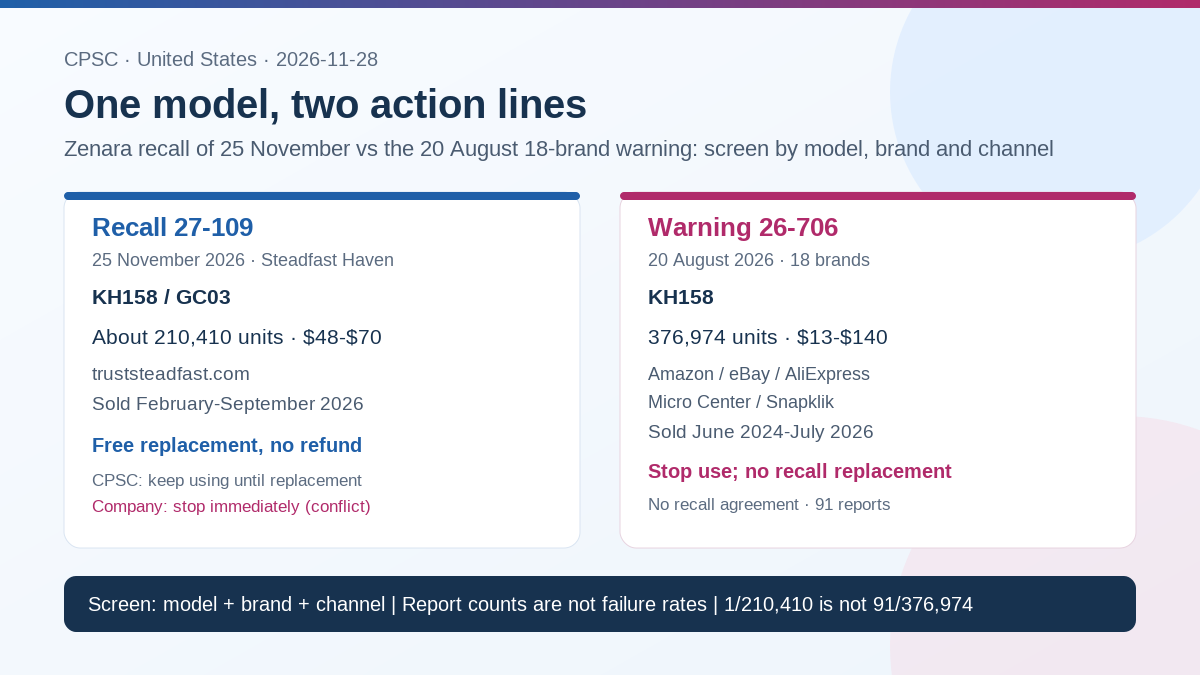
Three fields decide what to do with a plug-in carbon monoxide or natural gas detector in the US after 25 November 2026: model, brand and purchase channel. If you sell plug-in carbon monoxide or natural gas detectors in the US, the decision after 25 November 2026 is which group your KH158/GC03 units fall into: the Zenara recall, the 20 August 18-brand warning, or neither, because each group calls for a different action: stop sale and replacement, stop use and disposal, or no action beyond monitoring.
1. Two CPSC actions: recall 27-109 and warning 26-706
The first is recall 27-109 of 25 November 2026. The CPSC page states that Zenara Commerce LLC recalled the Steadfast Haven 4-in-1 plug-in CO and natural gas detectors, models KH158 and GC03, about 210,410 units; the products were sold on truststeadfast.com from February 2026 through September 2026 for $48-$70; the firm received one report of a detector failing to alarm in the presence of a CO leak, with no injuries; the remedy is a free replacement, not a refund.
The second is warning 26-706 of 20 August 2026. The CPSC warned consumers to stop using the 4-in-1 plug-in natural gas and CO detector model KH158 immediately, covering 18 brand names: ARIKON, ELECOIN, FLUNGSKY, HAOKESITE, Hembisen, JNHCD, KAKIMENT, KH Alert, KOABBIT, NICGOL, NORJAN, OUMEBIU, Sooguard, Vilfet, Vzmcov, WESHLGD, XLA Alert and YOJOCK; about 376,974 units; sold on Amazon.com, eBay.com, AliExpress, microcenter.com and snapklik.com from June 2024 through July 2026 for $13-$140; the CPSC is aware of 91 reports of failure to alarm; the manufacturer, Shenzhen Kanghua Shengshi Industrial Co., LTD dba KH Alert, has not agreed to recall the detectors.
| Item | Recall 27-109 | Warning 26-706 |
|---|---|---|
| Date | 25 November 2026 | 20 August 2026 |
| Legal nature | Recall (Fast Track Recall) | Warning, not a recall |
| Models | KH158, GC03 | KH158 |
| Brands | Steadfast Haven | 18 brand names |
| Units | About 210,410 | 376,974 |
| Channel | truststeadfast.com | Amazon, eBay, AliExpress, Micro Center, Snapklik |
| Sales period | February-September 2026 | June 2024-July 2026 |
| Price | $48-$70 | $13-$140 |
| Reports | One, no injuries reported | 91 |
| Remedy | Free replacement, no refund | No recall replacement; CPSC urges stop use and disposal |
| Party | Retailer Zenara Commerce LLC; made in China | Manufacturer Shenzhen Kanghua Shengshi Industrial Co., LTD dba KH Alert; no recall agreement |
The two rows most often missed are legal nature and remedy. The recall is a company action conducted with the CPSC, and the CPSC page states that the remedy is a free replacement. The warning is not a recall, the manufacturer has not agreed to a recall, and there is no recall replacement path. Calling both a recall gives consumers the wrong promise; calling both a warning understates the stop-sale duty on the recalled units.
2. Why one model name splits into two action lines
The mechanism is that a recall and a warning are different CPSC actions: the recall has a named retailer, channel, unit count and a replacement remedy, while the warning tells consumers to stop using and dispose of the product, but the manufacturer has not agreed to a recall and there is no recall replacement path.
The recall scope is defined by brand, model, channel and time together: Steadfast Haven KH158/GC03 sold on truststeadfast.com from February to September 2026. The warning scope is the KH158 model, but under 18 other brands and through Amazon, eBay, AliExpress, Micro Center and Snapklik. The overlap is the model name KH158; the brand and channel differ, which is exactly why a model-only or brand-only screen fails.
One gap cannot be filled by inference: the recall page does not name the manufacturer, only the retailer Zenara Commerce LLC and the manufacturing country China; the warning page names Shenzhen Kanghua Shengshi Industrial Co., LTD dba KH Alert as the manufacturer. Neither page says the two actions involve the same factory, batch or production period. Do not infer one batch from the shared model name, and do not infer unrelated products from the different brands.
The recall page and the company page give different instructions on continued use. The CPSC says consumers should contact Zenara for a free replacement and continue to use the recalled detector until the replacement is installed; the company page says not to use it and to register for a free replacement immediately. Both are readable primary documents, but they conflict. For a seller, the conflict does not change the recall scope; it changes consumer communication: do not merge the two sentences, and do not make a safety judgement for consumers without quoting the source.
3. Evidence boundary: scope is provable, your inventory is not
The readable evidence gives the model, brands, channels, counts, price ranges and report counts, but it does not give an ASIN list, a failure rate, a recall completion rate, or a determination that your specific inventory is in scope; this article can therefore give a screening order, not a compliance ruling for any seller.
The CPSC pages prove the recall date, models, brands, counts, channels, sales period, price range, report counts, injury status, remedy and recall number; the warning page also proves the 18 brand names, 91 reports, manufacturer name and refusal to recall. Those are the factual base of this article.
What they do not prove matters as much: there is no ASIN list, no sales split by brand, no failure rate, no recall completion rate, no statement that a specific inventory unit is in scope, and no statement of how Amazon will handle each listing. 1/210,410 and 91/376,974 are reports divided by units, not failure rates; the periods, reporting channels and denominators differ, so they are not directly comparable and cannot estimate the probability that your own units will fail.
For Amazon sellers there is one more channel boundary: the recall page names truststeadfast.com, not Amazon; the warning page names Amazon.com among its channels. NWi public coverage covers Amazon US and other enabled sites but does not provide CPSC recall status, an ASIN-level recall list, inventory or marketplace delisting notices. This article can therefore give a screening order and a communication boundary, not a compliance ruling for a specific ASIN.
4. Worked analysis: three scenarios
Start with a screening sheet: one row per SKU or batch, with three columns for model, brand and purchase channel, plus sales period and whether a purchase invoice exists. The three columns decide whether the row is recall, warning or unresolved; the period and invoice decide whether you can seek recourse from the supplier. Every figure below is an assumption, not a measurement by the CPSC, Zenara, Amazon or any seller.
In scenario A, 1,000 units split into 700 Steadfast Haven KH158/GC03 and 300 other-brand KH158; at $10 per recall unit, $2 per warning unit and $20 of unit contribution, handling costs $7,600, or 38% of the $20,000 contribution at risk.
| Scenario | Key assumptions | Result | Decision |
|---|---|---|---|
| A | 1,000 units: 700 recall, 300 warning; recall $10/unit, warning $2/unit; $20 contribution/unit | Handling $7,600; contribution at risk $20,000; 38% | Recall to replacement; warning stops sale and is disposed of; no merged message |
| B | 1,000 units all KH158/GC03; screen by model only or brand only | Model screen finds 1,000 but over-counts 300; brand screen finds 700 but misses 300 | Use model + brand + channel |
| C | Recall 1/210,410; warning 91/376,974; periods and denominators differ | 0.00048% and 0.0241%; about 50 times; not failure rates | Do not use the ratio to delay action |
Scenario A: 1,000 units split between recall and warning
The full assumptions and calculation are below. Assume 1,000 units: 400 Steadfast Haven KH158 plus 300 GC03 equals 700 recall units; 300 other-brand KH158 equals the August warning; recall handling $10 per unit, warning disposal $2 per unit, unit contribution $20; illustrative only. Recall handling = 700 x $10 = $7,000; warning disposal = 300 x $2 = $600; total $7,600; contribution at risk = 1,000 x $20 = $20,000; handling is 38% of contribution at risk. Split the groups before acting: the recall group goes to replacement registration, the warning group stops sale and is disposed of; do not merge 700 recall units and 300 warning units into one refund or replacement message.
Scenario B: model-only or brand-only screening
The full assumptions and calculation are below. Assume 1,000 units, all KH158/GC03: 700 Steadfast Haven and 300 other brands; screen once by model only or by brand only; no models beyond GC03 are involved. A model-only screen finds all 1,000 and counts the 300 warning units as recall units; a Steadfast Haven brand-only screen finds 700 and misses the 300 other-brand KH158 units; the three-column model + brand + channel screen yields 700 recall plus 300 warning. Keep three columns in the screening sheet and never use a single brand or model as the boundary; each result must trace to a purchase invoice, intake date and sales channel.
Scenario C: report counts are not failure rates
The full assumptions and calculation are below. One report for 210,410 recall units; 91 reports for 376,974 warning units; the periods, reporting channels and denominators differ; one report may cover multiple units. 1 / 210,410 = 0.00048%; 91 / 376,974 = 0.0241%; the ratio is about 50 times larger, but both are report-to-unit ratios, not failure rates, and they are not directly comparable. Do not use the small ratio to delay a stop-sale or replacement; set priority by action scope, channel and remedy, and treat report counts as background only.
Put the three scenarios together and the priority is not set by the report ratio; it is set by whether the action can be executed. The recall group has a defined replacement path, the warning group has no recall remedy, and the unresolved group needs replenishment frozen first. The report ratio only says that reports exist; it does not say how dangerous your units are.
5. Counter-cases and alternative explanations
The counter-case is that screening only by model KH158 would treat the other 17 brands in the August warning as part of the November recall, while screening only by the Steadfast Haven brand would miss the other-brand KH158 units; units made after September 2026 or bought outside truststeadfast.com also cannot be automatically fitted into the November recall.
Counter-case one: your unit is another brand of KH158 but not one of the 18 names. It is neither in the recall nor in the warning, so no remedy from either action applies; you should still check the model, UL 2034 compliance and marketplace policy. Counter-case two: your unit is a Steadfast Haven KH158 bought wholesale, as a return or through a transfer rather than from truststeadfast.com. The recall describes the product and its sales channel; the product is recalled, so confirm replacement eligibility with Zenara and the CPSC rather than assuming that a purchase outside the brand site is excluded.
Counter-case three: your unit is a GC03 with no reports. The company page says GC03 was included out of caution even though no report involved that model; no report does not mean outside the recall. Counter-case four: your unit was made or bought after September 2026. The recall page gives February-September 2026 as the sales period; it does not say whether units outside that period are covered, so do not expand or narrow the scope yourself. Counter-case five: the marketplace has already delisted the listing and refunded buyers. Your focus then shifts from refunding again to reconciliation, inventory disposal and supplier recourse, avoiding a double refund.
Keep the alternative explanation too: the CPSC warning says consumers should not purchase or sell the detectors, but a warning is not a recall order; a seller stop-sale is a risk and marketplace decision, not a legal finding that the model is unlawful. Conversely, the recall is a company action conducted with the CPSC, and federal law prohibits selling products subject to a recall; do not read no recall in the warning as permission to keep selling the recalled units.
6. Action order and stop conditions
The sequence is to sort inventory into recall, warning and unresolved groups using model, brand and purchase channel; route the recall group to Zenara replacement registration, stop sale and dispose of the warning group, and freeze replenishment for the unresolved group until the supplier and marketplace confirm the scope in writing.
- 1. Build the three-column sheet: SKU or batch, model, brand, purchase channel, sales period and purchase invoice; filter KH158/GC03 first, then group by brand and channel.
- 2. Recall group: Steadfast Haven KH158/GC03, stop sale, use the Zenara/CPSC recall path and register for replacement under the company page; quote the CPSC text and the company page to consumers, and do not rewrite keep using or stop using into a single instruction.
- 3. Warning group: KH158 under the 18 brands, stop sale and follow the CPSC stop-use and disposal guidance; there is no recall replacement, so do not promise Zenara replacement or a refund.
- 4. Unresolved group: model or channel does not match, no invoice, or the date is outside the stated period; freeze replenishment and ask the supplier, marketplace or CPSC for a written scope before making any refund promise.
- 5. Reconciliation: record marketplace delisting, refunds, FBA inventory, returns and supplier recourse separately; if the marketplace has already refunded, do not refund twice.
- 6. Monitoring fields: ASIN, model, brand, purchase channel, sales period, inventory count, listing status, delisting notice, refund record, recall registration number, replacement shipment date, supplier response and CPSC page update date.
Stop conditions: the model, brand or channel cannot be confirmed; there is no purchase invoice or supplier trace; the marketplace has delisted the listing but inventory remains; the consumer instruction conflicts between the CPSC and the company page and cannot be quoted; the supplier refuses batch or compliance documents; the recall registration has not been confirmed but the consumer is asked to discard the unit. If any of these appears, stop selling and stop making promises until the evidence is back.
Review triggers: the CPSC updates recall 27-109 or warning 26-706; Zenara updates the recall page or replacement stock; Amazon, eBay, AliExpress, Micro Center or Snapklik updates its delisting or refund policy; the supplier provides new batch or certification information; a marketplace notice differs from the CPSC scope. Re-run the three-column screen at each change.
7. What this means for product selection and data
The original contribution is not a retelling of the recall news: it separates one model name, KH158, into two non-substitutable CPSC action lines, gives a three-column model + brand + channel screen, and shows that 1/210,410 and 91/376,974 are report-to-unit ratios, not failure rates.
The product-selection lesson is not that carbon monoxide detectors cannot be sold; it is that under one model name, brand, channel and time split responsibility into different groups. NWi CrossborderGo can show Amazon US category sales, units, ASP, brand share and price bands for the home-safety and detector category, to size the price bands, brand concentration and substitution space; it cannot tell you whether a specific ASIN is recalled, and it does not replace the CPSC, a marketplace notice or supplier documents.
To put category, price-band and brand-concentration data back into market context, see NWi CrossborderGo; to break data down by site, category and brand, contact us through Request a demo; for the Amazon coverage note, see Amazon data analysis. Product capability, site coverage and fields depend on the enabled modules and the contract.
8. Method and disclosure
Data basis: on 28 November 2026 this article re-read CPSC recall 27-109, CPSC warning 26-706, the Steadfast Haven (Zenara Commerce LLC) recall registration page and the Medical Daily report. The recall page gives 25 November 2026, about 210,410 units, models KH158/GC03, sales on truststeadfast.com from February to September 2026 at $48-$70, one failure-to-alarm report, no injuries, a free replacement and recall number 27-109. The warning page gives 20 August 2026, 376,974 units, 18 brand names, 91 reports, sales on Amazon.com, eBay.com, AliExpress, microcenter.com and snapklik.com from June 2024 to July 2026 at $13-$140, the manufacturer refusal to recall and warning number 26-706. The company page adds that GC03 is included without a report, that the only remedy is a replacement rather than a refund, and that registration requires marking the unit and uploading a photo. Medical Daily records the CPSC instruction to keep using the recalled unit until the replacement is installed. Calculations: report-to-unit ratio = reports / units; scenario A handling cost = 700 x $10 + 300 x $2 = $7,600, contribution at risk = 1,000 x $20 = $20,000, share = $7,600 / $20,000 = 38%; scenario B is a set-screening example; scenario C computes 1 / 210,410 and 91 / 376,974 separately. All inventory splits, handling costs, contribution figures and ratios are labelled assumptions, not measurements by the CPSC, Zenara, Amazon or any seller. Product scope: NWi CrossborderGo provides category, brand, store and product data for Amazon US and other enabled sites, including sales, units, ASP, brand share and price bands, updated monthly; it does not provide CPSC recall status, an ASIN-level recall list, inventory, marketplace delisting notices or compliance determinations; actual sites, history and fields depend on the contract.
This article was prepared with automated research assistance from the public sources listed at the end and has not been manually reviewed; it does not invent client data, expert review, an actual recall list, inventory, refunds or ranking results. It is not legal, compliance, product-safety, tax or accounting advice; the recall scope, replacement eligibility, stop-sale duty, marketplace delisting, refunds and consumer communication should be confirmed against the CPSC text, the Zenara/Steadfast Haven page, the marketplace notice, the contract and professional advice.
This article has no seller ASIN list, purchase invoice, inventory count, marketplace delisting notice, refund record or recall completion rate, and no CPSC failure-rate denominator; every inventory split, handling cost and contribution figure is a labelled assumption, not your actual loss or a compliance conclusion.
- 1. U.S. Consumer Product Safety Commission, 25 November 2026, Zenara Recalls 4-in-1 Plug in Steadfast Haven Carbon Monoxide (CO) and Natural Gas Detectors: recall 27-109; about 210,410 units; KH158/GC03; sold on truststeadfast.com from February to September 2026 at $48-$70; one report, no injuries; free replacement; read on 28 November 2026.
- 2. U.S. Consumer Product Safety Commission, 20 August 2026, CPSC Warns Consumers to Stop Using 4 in 1 Plug In Natural Gas and Carbon Monoxide Detectors Immediately: warning 26-706; 376,974 units; 18 brands; 91 reports; sold on Amazon.com, eBay.com, AliExpress, microcenter.com and snapklik.com from June 2024 to July 2026 at $13-$140; manufacturer has not agreed to a recall; read on 28 November 2026.
- 3. Steadfast Haven / Zenara Commerce LLC, Steadfast Haven Recall: KH158/GC03; GC03 included without a report; replacement only, no refund; stop use and register; mark the unit and upload a photo; page undated; read on 28 November 2026.
- 4. Medical Daily, 27 November 2026, Carbon Monoxide Detector Recall: About 210,000 Steadfast Haven Plug-In Units May Fail to Alarm During a Leak: confirms about 210,410 units, one report and no injuries, and records the CPSC instruction to keep using the recalled unit until the replacement is installed; read on 28 November 2026.