
If you sell PC, small appliances, toys or watches on Amazon.ae, the decision after 1 December 2026 is not simply that the referral fee rose by one point: it is how much each SKU's unit contribution falls under the new rate, what price increase would hold the old contribution, and which SKUs should absorb the change or adjust the bundle; watch sellers must first check which side of the AED 5,000 band the price falls on. Four variables drive the answer: the category rate, the total sales price basis, the share of other variable costs, and the actual FBA per-size change. This article sets out the notice, the evidence boundary and three labelled scenarios that translate the rate change into per-unit amounts.
1. The notice: which rates change on 1 December
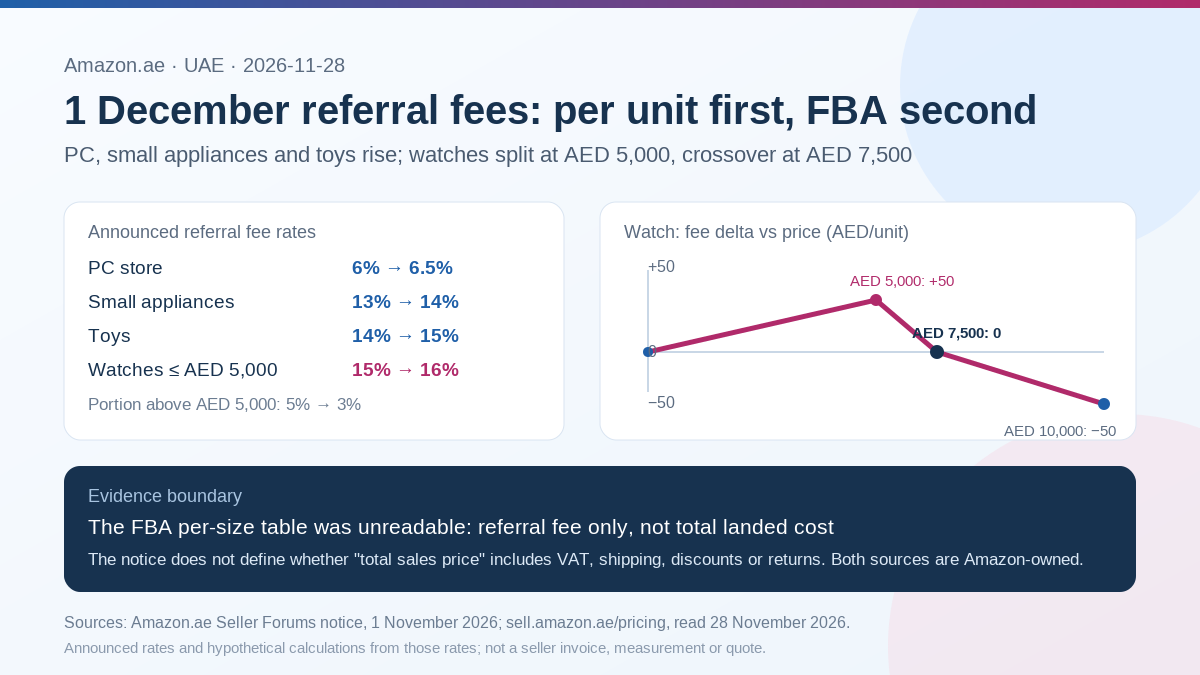
The Amazon.ae Seller Forums notice carries a page datePublished of 2026-11-01T20:07:28Z and the title "Updated fees take effect on Dec 1, 2026". It says that on 1 December 2026 Amazon is updating referral fees and Fulfillment by Amazon (FBA) fulfillment fees in the United Arab Emirates to optimize its cost structure and help offset higher shipping and operating costs in the UAE. The referral fee changes are in the table below.
| Category | Old rate | New rate | Change | Note |
|---|---|---|---|---|
| PC store | 6% | 6.5% | +0.5 percentage points | On total sales price |
| Small appliances | 13% | 14% | +1 percentage point | On total sales price |
| Toys | 14% | 15% | +1 percentage point | On total sales price |
| Watches (portion up to AED 5,000) | 15% | 16% | +1 percentage point | Band calculation |
| Watches (portion above AED 5,000) | 5% | 3% | -2 percentage points | Only the excess |
The notice does not publish the FBA per-size table. It says only that FBA fulfillment fees "will increase to align with operational costs across size tiers and weights" and links to "FBA fulfillment fees for Amazon.ae orders" and "Changes to Amazon fees". When we opened those links on 28 November 2026, they returned JavaScript shells: HTTP 200, but a body of about 1,460 characters with no referral, fee, Watch or rate-table content; the FBA link did not return within 60 seconds. The article therefore cannot give a specific FBA per-size number, and it cannot treat the referral fee delta as the total fee change.
The second source is sell.amazon.ae/pricing. On 28 November 2026 it still listed the old rates: PC store 6%, Small Appliances 13%, Toys 14%, Watches 15% up to AED 5,000 and 5% above; the page also says "Most referral fees are between 4.5% and 15%", the FBA fulfillment fee "starts at 7.5 AED per unit", the shipping fee "starts at 14 AED per shipment", and listed fees exclude VAT, which is added. The page confirms the old rates and the fee structure, but it does not confirm that the 1 December rates are live; it and the Seller Forums notice are both Amazon-owned, not two independent organisations.
2. Mechanism: referral fee on total sales price, FBA by size and weight
The mechanism is that the referral fee is charged as the category rate multiplied by what the notice calls the total sales price, so a one-percentage-point rate increase adds one percent of the price, not one percent of profit; the FBA fulfilment fee is a separate charge by size tier and weight, and it is a different fee pool from the referral fee.
Translating one percentage point into money: if the price is P, the old rate is r0 and the new rate is r1, the unit referral fee delta is (r1 - r0) x P. For PC at P = AED 3,000, it is 0.5% x 3,000 = AED 15; for a small appliance at P = AED 300, it is 1% x 300 = AED 3; for a toy at P = AED 200, it is 1% x 200 = AED 2. The smallest absolute delta is the toy, but the toy's price and unit contribution are also low, so AED 2 may be a larger share of contribution.
The price increase needed to hold contribution is not simply the fee delta added back. Because the price increase also raises the referral fee base, and assuming other costs do not change and demand is unaffected, the price increase = fee delta / (1 - new rate). For the small appliance, 3 / (1 - 14%) = AED 3.49; for PC, 15 / (1 - 6.5%) = AED 16.04; for the toy, 2 / (1 - 15%) = AED 2.35. This formula applies only to the non-watch categories; watches use a band rate and cannot use it directly.
Watches must be calculated in bands. If the price P is at or below AED 5,000, the old fee is 15% x P, the new fee is 16% x P, and the delta is 1% x P; at P = AED 5,000 the delta is AED 50. If P is above AED 5,000, the old fee is 15% x 5,000 + 5% x (P - 5,000), the new fee is 16% x 5,000 + 3% x (P - 5,000), and the delta is 50 - 2% x (P - 5,000). Setting the delta to zero gives P = AED 7,500: below AED 7,500 the new fee is higher; above AED 7,500 the new fee is lower; at exactly AED 7,500 they are equal. The crossover is not AED 5,000; it is AED 7,500.
3. Evidence boundary: rates yes, your invoice no
The readable evidence is limited to the Amazon.ae Seller Forums notice and the public fee page at sell.amazon.ae: the notice gives the new rates, while the public fee page still listed the old rates on 28 November 2026; both pages are Amazon-owned, not two independent organisations, and neither proves that your settlement will be charged at the new rate.
That boundary determines what the article can and cannot say. It can say that Amazon announced these rates and this effective date, and that the public fee page still listed the old rates on the same day. It cannot say how much the FBA per-size fee will rise, whether total sales price includes VAT, shipping, discounts or returns, what your SKU will actually be charged, or that every seller will be affected in the same way. Those points require a settlement report, Fee Preview, a contract or a later Amazon fee schedule.
The notice does not define total sales price. The public fee page uses the same phrase for Watches but also does not explain whether it includes VAT, customer-paid shipping, platform discounts or seller promotions. Every calculation here multiplies the announced rate by an assumed price and does not add assumptions about VAT, shipping, discounts or returns; if your fee base differs from the assumed price, the result must be recalculated with the same formula.
We also have no seller settlement report, Fee Preview, advertising cost, return rate or actual sales. The notice page has one seller reply, which complains about FBA service; it is not evidence of fee impact. In the channels available to us, we did not find an independent media outlet or a second-organisation confirmation of these rates; both sources are Amazon-owned, so the article is an analysis of an official notice, not two independently confirmed reports.
4. Worked examples: three scenarios and the AED 7,500 crossover
The formula: for non-watch categories, unit referral fee delta = (new rate - old rate) x price; price increase to hold contribution = fee delta / (1 - new rate). Watches use the band formula. The table puts the key numbers for the three scenarios together; every price, volume, cost and contribution is an assumption.
| Scenario | Price | Old fee | New fee | Delta/unit | Monthly delta | Price to hold |
|---|---|---|---|---|---|---|
| A Small appliance | AED 300 | AED 39 | AED 42 | +AED 3 | +AED 3,000 | About AED 303.49 |
| B PC | AED 3,000 | AED 180 | AED 195 | +AED 15 | +AED 1,500 | About AED 3,016.04 |
| C Watch | AED 8,000 | AED 900 | AED 890 | -AED 10 | -AED 1,000 | Not needed |
In scenario A, a small appliance priced at AED 300 with AED 207 of other variable cost has a unit contribution of AED 54 at the old 13% rate; at the new 14% rate the fee rises from AED 39 to AED 42 and contribution falls to AED 51; holding AED 54 requires a price of about AED 303.49, an increase of AED 3.49, or 1.16%.
Scenario A: small appliance at AED 300, 1,000 orders a month
The full assumptions and calculation for scenario A are as follows. Assume an AED 300 price, 1,000 orders a month, AED 207 of other variable cost, referral fee only, and no VAT, shipping, returns, advertising or FBA change; old rate 13%, new rate 14%. Old fee AED 39/unit and contribution AED 54/unit; new fee AED 42/unit and contribution AED 51/unit; contribution falls by AED 3/unit and AED 3,000/month; holding AED 54 requires a price of about AED 303.49. If competitor prices and demand allow, raise the price to about AED 303.49 to hold contribution; if the increase would clearly lose sales, absorb AED 3/unit, adjust the bundle or renegotiate cost rather than treating "price to hold contribution" as the only answer.
Scenario B: PC at AED 3,000, 100 orders a month
The full assumptions and calculation for scenario B are as follows. Assume an AED 3,000 price, 100 orders a month, AED 2,400 of other variable cost, referral fee only, and no VAT, shipping, returns, advertising or FBA change; old rate 6%, new rate 6.5%. Old fee AED 180/unit and contribution AED 420/unit; new fee AED 195/unit and contribution AED 405/unit; contribution falls by AED 15/unit and AED 1,500/month; holding AED 420 requires a price of about AED 3,016.04. The PC rate rises only 0.5 points, but the absolute delta is AED 15/unit; rank by contribution share first, then decide whether to raise the price by about AED 16.04, absorb the change, or adjust the gift and shipping policy together.
Scenario C: watch at AED 8,000, 100 orders a month
The full assumptions and calculation for scenario C are as follows. Assume an AED 8,000 price, 100 orders a month, AED 6,400 of other variable cost, referral fee only, and no VAT, shipping, returns, advertising or FBA change; old rate 15% up to AED 5,000 and 5% above, new rate 16% up to AED 5,000 and 3% above. Old fee AED 900/unit and contribution AED 700/unit; new fee AED 890/unit and contribution AED 710/unit; the fee falls by AED 10/unit and AED 1,000/month; contribution rises from AED 700 to AED 710; this price does not need an increase to hold contribution. At AED 8,000, do not raise the price because of the "watch fee increase"; first confirm whether the price is above AED 7,500, where the portion above that level pays less fee.
The toy can be estimated with the same formula: an AED 200 price and AED 150 of other variable cost give a fee of AED 28 and a contribution of AED 22 at the old 14% rate; at the new 15% rate the fee is AED 30 and contribution is AED 20; holding AED 22 requires a price of about AED 202.35, an increase of AED 2.35, or 1.18%. The absolute delta is only AED 2, but its share of contribution is about 9.1%, higher than the small appliance's AED 3 at about 5.6%; do not ignore it because the amount looks small.
| Watch price | Old fee | New fee | Delta/unit |
|---|---|---|---|
| AED 4,999 | AED 749.85 | AED 799.84 | +AED 49.99 |
| AED 5,000 | AED 750 | AED 800 | +AED 50 |
| AED 6,000 | AED 800 | AED 830 | +AED 30 |
| AED 7,500 | AED 875 | AED 875 | 0 |
| AED 8,000 | AED 900 | AED 890 | -AED 10 |
| AED 10,000 | AED 1,000 | AED 950 | -AED 50 |
The table shows that "watch fees decrease" is conditional: only a price above AED 7,500 pays the lower 3% rate on the excess; at or below AED 5,000 the new fee is higher. For a watch priced above AED 5,000 and below AED 7,500, the new fee is still higher, but the delta shrinks as the price rises; at AED 7,500 they are equal. Sellers cannot apply "watch fees decrease" to every watch.
5. Counter-cases and alternative explanations: price-to-hold may not hold
The counter-case is that if your price increase reduces volume or Buy Box share, or if the FBA fulfilment fee increase exceeds the referral fee delta, then a "price to hold contribution" calculation based on the referral fee alone may still leave total contribution lower.
Alternative one: price elasticity. A 1.16% increase looks small, but in a transparent, crowded category volume may fall by more than 1.16%, leaving total contribution lower. Alternative two: competitors do not follow. If a competitor absorbs the fee and keeps the old price, your increase may lose the Buy Box; absorbing AED 3/unit and keeping volume may be better. Alternative three: there is room on the cost side. A supplier discount, packaging change, logistics change or bundle adjustment may hold contribution more easily than a price increase. Alternative four: the contribution lens is wrong. If the SKU is a traffic driver, unit contribution is not the only goal; basket or repeat contribution matters. Alternative five: the fee base differs. If total sales price includes or excludes VAT, shipping or discounts differently from your assumption, the delta changes. Alternative six: the FBA increase may be larger. The notice says FBA fees rise across size tiers, but the numbers are unreadable; if the FBA increase exceeds the referral delta, optimizing only the referral fee misses the larger cost.
Watches have a particularly sharp counter-example: a watch priced at AED 4,999 pays an old fee of AED 749.85 and a new fee of AED 799.84, AED 49.99 more; a watch priced at AED 8,000 pays an old fee of AED 900 and a new fee of AED 890, AED 10 less. The two prices are about AED 3,000 apart, yet the fee change reverses direction. If a watch is heavy or bulky, the FBA per-size increase may exceed the referral fee saving, so total cost can still rise.
6. Action order and stop conditions
The sequence is to recompute the unit referral fee for the four categories under the announced rates, separate the referral fee delta from the actual FBA per-size fee, and then raise prices only for SKUs that still have demand after the increase and whose total contribution stays above the floor; absorb the change, adjust the bundle or exit the SKUs that cannot meet that test.
- 1. Pull the SKU list: identify the PC, small appliance, toy and watch SKUs and confirm the category rate each one actually uses; do not assume that a "PC accessory" uses the PC store rate, or that every "toy" uses the Toys rate.
- 2. Recompute the unit: multiply the old and new announced rates by the actual price to get the unit and monthly referral fee delta; split watches at AED 5,000 and flag the SKUs around the AED 7,500 crossover.
- 3. Separate FBA: read each SKU's actual FBA per-size fee from Fee Preview, the settlement report or Seller Central, and keep it separate from the referral fee delta; do not add the two into a single "commission increase".
- 4. Rank: sort by unit delta, delta as a share of contribution, monthly delta and the demand risk of a price increase; handle the SKUs with a high contribution share and little pricing room first.
- 5. Decide and record: for each SKU choose price increase, absorb, bundle change, cost renegotiation or exit, and write down the assumed price, cost, volume and effective date; backfill from the actual settlement after 1 December.
Observation fields should include at least: SKU/ASIN, category, price, total sales price basis, old rate, new rate, referral fee amount, FBA size tier, FBA fulfilment fee, VAT treatment, returns and refunds, promotions and coupons, Buy Box price, competitor price, unit contribution, monthly sales and settlement date. These are operating and finance fields, not fields in the notice; if the settlement does not break out the referral fee or the FBA tier, export the detail from Seller Central or finance rather than substituting the announced number for the invoice.
Stop conditions: the settlement does not charge the announced rate; the total sales price basis differs from the assumption; the FBA per-size increase exceeds the referral fee delta; a price increase reduces volume enough to push total contribution below the floor; a competitor price war makes the increase unworkable; unit contribution is negative after all fees; or cash flow or inventory does not allow the adjustment. If any of these occurs, stop the price increase or expansion and recalculate from cost and demand data.
Review triggers: Amazon updates "Changes to Amazon fees" or the FBA rate table; your category rate, size tier, VAT or returns policy changes; the actual settlement differs from the notice; the AED exchange rate or sourcing cost changes; competitor prices and Buy Box share change. Re-run the unit formula at each change rather than reusing the previous conclusion.
7. What this means for product selection and data judgement
The original contribution is not the headline that "Amazon raised fees again", but the conversion of a one-percentage-point fee change into a per-unit amount and a price-to-hold-contribution point, plus the finding that the watch band does not start cutting fees at AED 5,000; it only matches the old fee at AED 7,500.
The product-selection implication is not that "the UAE is unviable"; it is that the same one-point change affects SKUs differently depending on price and contribution. A low-price, low-contribution SKU has a small absolute delta but a potentially high share of contribution; a high-price, high-contribution SKU has a larger absolute delta but may have more room to raise the price. Watches also depend on which side of the band the price falls: at or below AED 5,000 the fee rises, while above AED 7,500 only the excess falls. The order should be: unit delta and share of contribution first, then demand and competitor prices, and only then the headline rate.
NWi CrossborderGo provides category, brand, store and product data for Amazon US, Europe, Japan and other activated marketplaces, including sales, units, ASP, brand share and price bands, updated monthly; the public coverage.json lists Amazon sites as US, EU and JP, so Amazon.ae is not in that public list and the product cannot be used to look up UAE-specific rates or sales directly. It can support a cross-market comparison of categories, price bands and brand concentration on activated sites, to judge which categories depend more on low prices and which price bands have more room to raise prices; exact sites, history and fields depend on the contract. It does not provide Amazon.ae seller referral fee invoices, FBA per-size fees, VAT, inventory or real-time rates.
If you need to see category, price band and brand concentration on activated sites first, see NWi CrossborderGo; to break data down by site, category and brand, contact us through the demo page; for the Amazon platform page and its coverage note, see Amazon data analysis. Product capability, site coverage and fields depend on the activated modules and the contract.
8. Method and disclosure
Data basis: on 28 November 2026 this article re-read the Amazon.ae Seller Forums notice "Updated fees take effect on Dec 1, 2026" (page structured data datePublished 2026-11-01T20:07:28Z) and the public fee page at sell.amazon.ae/pricing, and tried to open the notice's "Changes to Amazon fees" and "FBA fulfillment fees" links. The notice's PC store 6% to 6.5%, small appliances 13% to 14%, toys 14% to 15%, watches 15% to 16% up to AED 5,000, 5% to 3% on the portion above AED 5,000, and the 1 December 2026 effective date are recorded from the page, as are the old rates still listed on the public fee page on 28 November 2026 (PC 6%, small appliances 13%, toys 14%, watches 15%/5%), the FBA fee starting at AED 7.5 per unit, the shipping fee starting at AED 14 per shipment, and the note that listed fees exclude VAT. The linked fee pages returned JavaScript shells and the FBA per-size table could not be read. Calculation basis: for non-watch categories, referral fee delta = (new rate - old rate) x price; the price increase needed to hold contribution = fee delta / (1 - new rate); watches use the AED 5,000 band, with delta = 50 - 2% x (price - 5,000) above AED 5,000, and a crossover at AED 7,500. Scenario A uses an AED 300 price, 1,000 orders per month and AED 207 of other variable cost; scenario B uses AED 3,000, 100 orders and AED 2,400; scenario C uses AED 8,000, 100 orders and AED 6,400; the toy paragraph uses AED 200 and AED 150. All prices, volumes, costs, contributions and price outcomes are labelled assumptions, not measurements by Amazon, NWi or any seller. Product basis: NWi CrossborderGo provides category, brand, store and product data for Amazon US, Europe, Japan and other activated marketplaces, including sales, units, ASP, brand share and price bands, updated monthly; the public coverage.json lists Amazon sites as US, EU and JP, so Amazon.ae is not in that public list; exact sites, history and fields depend on the contract; it does not provide Amazon.ae seller referral fee invoices, FBA per-size fees, VAT, inventory or real-time rates.
This article was prepared with automated research assistance from the public sources listed at the end and has not been manually reviewed; it does not invent client data, expert review, actual referral fee invoices, FBA per-size fees, sales, profit or ranking results. It is not pricing, financial, tax, accounting or legal advice; the actual referral fee, FBA fulfilment fee, VAT, total sales price basis, promotions and returns should be confirmed in Amazon Seller Central, Fee Preview, the settlement report, the contract and the actual invoice.
This article has no seller settlement report, FBA per-size fee, VAT treatment, return rate, advertising cost or actual sales, and it could not read the complete fee schedule linked from Amazon.ae; all prices, volumes, costs and contributions are labelled assumptions, not measurements by the platform or any seller.
- 1. Amazon.ae Seller Forums (News_Amazon), 1 November 2026, Updated fees take effect on Dec 1, 2026: from 1 December 2026, Amazon.ae updates referral fees and FBA fulfilment fees; PC store 6% to 6.5%; small appliances 13% to 14%; toys 14% to 15%; watches 15% to 16% up to AED 5,000 and 5% to 3% above; FBA fees rise but no table is published; read 28 November 2026.
- 2. Amazon, Amazon FBA Fees Calculator - Amazon Seller UAE: on 28 November 2026 it still listed PC store 6%, Small Appliances 13%, Toys 14% and Watches 15%/5%; the FBA fulfilment fee starts at AED 7.5 per unit; shipping starts at AED 14 per shipment; listed fees exclude VAT, which is added; no publication date is stated.
- 3. Amazon.ae Seller Central Help, Changes to Amazon fees and FBA fulfillment fees: on 28 November 2026 both returned JavaScript shells with about 1,460 characters and no rate table; used as an evidence boundary, not as a source for any rate.