
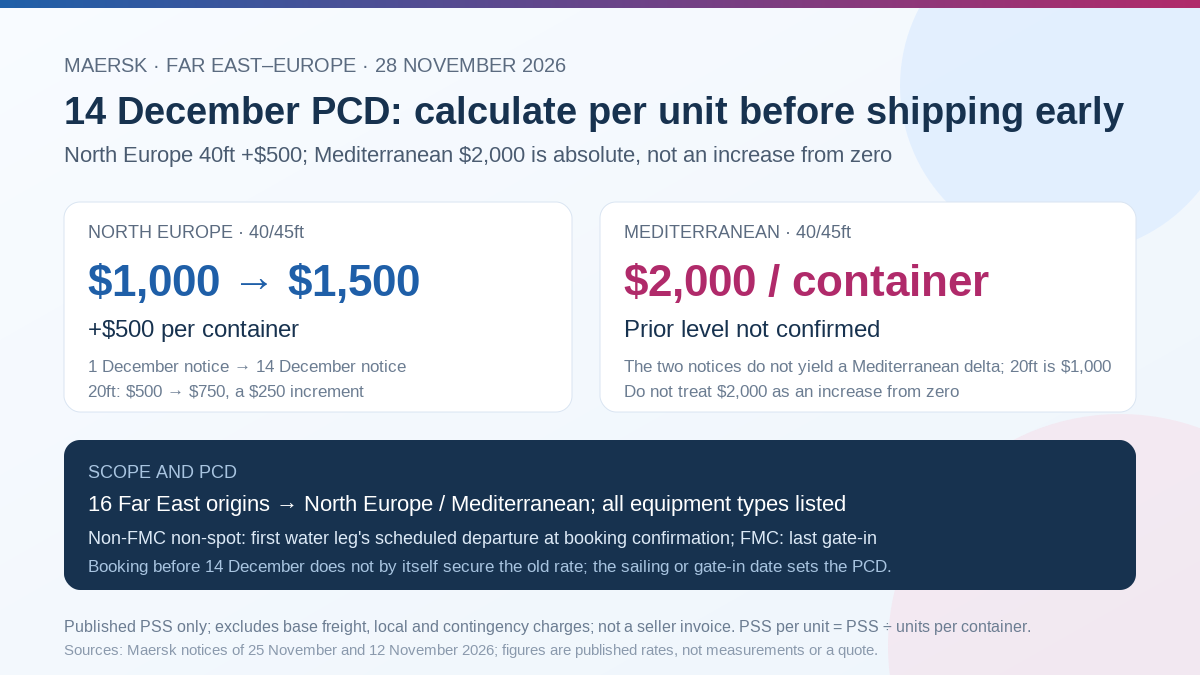
If you replenish Europe from China, Vietnam or another Far East origin, the decision after 25 November 2026 is not simply 'how much did Maersk raise rates'. It is which SKUs in this shipment justify sailing or gate-in before the 14 December price calculation date (PCD), which can wait, and whether the Mediterranean's $2,000 absolute PSS makes a low-contribution SKU uneconomic. The answer depends on three variables: which PSS version applies, where the PCD falls, and how many units and how much contribution each container carries. This article separates the published facts from the evidence boundary, then translates $500 and $2,000 into per-unit cost under two labelled scenarios.
Align three dates first. On 12 November 2026, Maersk announced a Far East–North Europe PSS with a 1 December 2026 PCD: $500 per 20ft and $1,000 per 40/45ft. On 25 November 2026, Maersk announced a revision for Far East–North Europe and the Mediterranean with a 14 December 2026 PCD: North Europe $750 per 20ft and $1,500 per 40/45ft; the Mediterranean $1,000 per 20ft and $2,000 per 40/45ft; Syria is listed at EUR 925/1,850. On 19 November 2026, Maersk published a separate Far East–North Europe/Mediterranean rate-increase announcement, also effective 14 December 2026, but the public page read does not give an amount.
The 25 November notice is titled a 'revision' but its body does not give the previous level. The North Europe baseline in this article comes from the 12 November notice's 1 December level, not from a number stated in the 25 November notice. There is a timing nuance: the 25 November notice was published before 1 December and may have replaced the 1 December version; the notices do not say whether the 1 December level ever applied. The $1,000 to $1,500 comparison is therefore a difference between two announced levels, not proof of an increase that already appeared on a seller's invoice.
Morelink's 26 November 2026 carrier update repeats the same 25 November notice and explicitly says the notice does not give previous levels and that it will not infer them. That matches our reading, but it cites the same Maersk notice, so it is not a second independent confirmation.
| Destination | Container size | 1 December announced PSS | 14 December announced PSS | Increment confirmed here |
|---|---|---|---|---|
| North Europe | 20ft | $500 | $750 | +$250 |
| North Europe | 40/45ft | $1,000 | $1,500 | +$500 |
| Mediterranean | 20ft | Not confirmed on the two pages | $1,000 | Not calculable |
| Mediterranean | 40/45ft | Not confirmed on the two pages | $2,000 | Not calculable |
Scope matters too. The notice lists 16 Far East origins: Brunei, China, Hong Kong China, Indonesia, Japan, Cambodia, Mongolia, South Korea, Laos, Myanmar, Malaysia, the Philippines, Singapore, Taiwan China, Thailand and Vietnam. The PSS applies to all equipment types listed, including dry, high dry, reefer, high cube reefer, bulk, collapsible flat rack, flat rack, hive, pallet wide, open top, tank and twin deck. The notice also says other local and contingency charges apply; none of those are included in the per-unit calculations below.
2. Mechanism: the PSS is charged per container, and the PCD is not the booking date
The real decision is which SKUs in a Far East–Europe shipment justify sailing or gate-in before the 14 December 2026 PCD to avoid the $500 North Europe 40ft increment, which can wait, and whether the Mediterranean's $2,000 absolute PSS makes a low-contribution SKU uneconomic.
The mechanism is that the PSS is charged per container and the PCD is set by the scheduled departure date of the first water leg at booking confirmation for non-FMC non-spot bookings, or by the last container gate-in date for FMC bookings, so the booking date itself does not fix the rate; the sailing or gate-in date does.
Translated into operations: for non-FMC, non-spot bookings, the PCD is the scheduled departure date of the first water leg at booking confirmation. If you book on 10 December but the confirmed sailing departs on 16 December, the PCD can still fall after 14 December and the new PSS can apply; if the confirmed sailing departs on 13 December, the PCD falls before 14 December even if you booked earlier. The booking date is not the switch; the sailing date is. For FMC trades, the PCD is the last container gate-in date; a container gated in on or after 14 December can attract the new PSS. Confirm the exact treatment in the carrier's or forwarder's booking confirmation and contract.
Spot and contract bookings also need separating. The PCD definitions in the notice are for non-spot bookings; the notice does not spell out whether or how spot quotes carry the PSS, so this article does not infer it. The PSS is also not the base freight: a separate 19 November rate-increase announcement for the same trade is effective 14 December and gives no public amount, which means the base freight may move at the same time. Treating the PSS increment as the whole cost change would miss that part, as well as local charges, contingency charges, trucking, storage and cash flow.
The PSS is charged per container, not per unit. The same $500 increment is $0.025 per unit in a 20,000-unit container and $0.10 per unit in a 5,000-unit container; whether contribution is $2 or $3 per unit then determines what share of contribution that $0.025 or $0.10 represents. Do not decide whether to ship early from the $500 alone; use the units and contribution inside the container.
3. Evidence boundary: one carrier notice is not a freight index
The readable record is Maersk's PSS notice, the 1 December baseline notice and a separate rate-increase notice, plus one independent logistics media summary; these pages do not give the previous Mediterranean PSS, the base freight, a space guarantee, the spot rate or a seller invoice, so $1,500 must not be treated as an increase from zero.
This boundary defines what the article can and cannot say. It can say that Maersk published these PSS amounts for the named dates, trade and equipment types; that the 12 November notice gives the 1 December announced North Europe level; that the 25 November notice does not give a previous Mediterranean level; and that a separate 19 November notice flags a rate increase with no public amount. It cannot say that other carriers will follow, that the market rate will move by the same amount, that every seller's invoice will rise by $500 or $2,000, or that space will be available.
The Mediterranean needs particular restraint. The 25 November notice gives absolute values only: $1,000 per 20ft and $2,000 per 40/45ft. The 12 November notice we read covers North Europe only. Do not subtract $2,000 from zero, and do not subtract the North Europe $1,500 from the Mediterranean $2,000 to invent a Mediterranean increase. If a forwarder quote shows a Mediterranean PSS, check its PCD, container size, currency and previous level before using the absolute figure here for a per-unit estimate.
The two scenarios, container types, unit counts, contributions, daily sales, stockout days and storage costs in this article are assumptions, not measurements by Maersk, Morelink, NWi or any seller. Their purpose is to turn 'ship early or wait' into a formula you can populate with your own numbers, not to issue a market-wide conclusion.
4. Worked analysis: translate $500 and $2,000 into per-unit cost
The formula is: PSS per unit = PSS / units per container; PSS as a share of unit contribution = PSS / (units per container x contribution per unit). For North Europe 40/45ft use the $500 increment ($250 for 20ft); for the Mediterranean 40/45ft use the $2,000 absolute value ($1,000 for 20ft). The table below plugs in different unit counts and contributions so you can size the effect first.
| Lane / container | Units per container | Contribution per unit | PSS per unit | Share of contribution |
|---|---|---|---|---|
| North Europe 40/45ft (+$500) | 5,000 | $2 | $0.10 | 5.00% |
| North Europe 40/45ft (+$500) | 10,000 | $3 | $0.05 | 1.67% |
| North Europe 40/45ft (+$500) | 20,000 | $5 | $0.025 | 0.50% |
| Mediterranean 40/45ft ($2,000) | 5,000 | $2 | $0.40 | 20.00% |
| Mediterranean 40/45ft ($2,000) | 10,000 | $3 | $0.20 | 6.67% |
| Mediterranean 40/45ft ($2,000) | 20,000 | $5 | $0.10 | 2.00% |
In scenario A, a $500 North Europe 40ft increment over 20,000 units at a $3 contribution is $0.025 per unit, or 0.83% of contribution; avoiding even one day of about 222 units and $666 of lost contribution is worth more than $500.
Scenario A: a fast-moving, high-contribution SKU on a 40ft North Europe container, shipped before the PCD
The complete assumptions and calculation for scenario A are below. Assumptions: one 40ft container holds 20,000 units with a $3 contribution per unit; the North Europe 40ft PSS moves from the 12 November notice's $1,000 for 1 December to $1,500 for 14 December, a $500 increment; waiting until after 14 December would cause a three-day stockout, with 222 units sold per day and stockout loss valued at the $3 contribution; early shipment adds no storage or air freight.Result: the $500 increment is $500 / 20,000 = $0.025 per unit, or 0.83% of the $3 contribution; a three-day stockout costs about 222 x 3 x $3 = $1,998, above $500; even a one-day stockout costs about $666, still above $500.Decision: if a sailing confirmed to depart before 14 December is available and the expected stockout loss exceeds $500 plus any early-shipment cost, ship early; otherwise do not change the sailing for $500.
Scenario B: a slower-moving, lower-contribution SKU on a 40ft North Europe container, left to the later PCD
The complete assumptions and calculation for scenario B are below. Assumptions: one 40ft container holds 5,000 units with a $2 contribution per unit; the same $500 North Europe increment applies; waiting until after 14 December would cause a three-day stockout, with 56 units sold per day and stockout loss valued at the $2 contribution; early shipment adds no storage or air freight.Result: the $500 increment is $500 / 5,000 = $0.10 per unit, or 5% of the $2 contribution; a three-day stockout costs about 56 x 3 x $2 = $336, below $500; paying $500 to avoid $336 of lost contribution destroys $164 before any early-shipment cost.Decision: do not pay $500 to pull this container forward; let it take the later PCD, unless the SKU has a hard seasonal window or a stockout cost not captured by the $2 contribution.
The Mediterranean: $2,000 is absolute, so the decision is whether to ship this batch at all
The Mediterranean cannot use the 'save $500 by shipping early' frame. The 25 November notice gives an absolute $2,000 per 40/45ft. Assume one 40ft container holds 5,000 units with a $2 contribution per unit: the PSS is $2,000 / 5,000 = $0.40 per unit, or 20% of contribution; with $300 of extra storage, the storage is $300 / 5,000 = $0.06 per unit, so the combined cost is $0.46 per unit, or 23%, or $2,300 in total. If the SKU has 60 days of stock and no seasonal window, shipping early creates no incremental sales and costs an extra $2,300. Only keep the Mediterranean booking if the stockout or seasonal-window value exceeds $2,300 and contribution after the PSS is still positive; otherwise defer the non-urgent SKUs, re-quote or compare another route.
Recalculation check: A: $500 / 20,000 = $0.025; $0.025 / $3 = 0.83%; 222 x 3 x $3 = $1,998; 222 x $3 = $666. B: $500 / 5,000 = $0.10; $0.10 / $2 = 5%; 56 x 3 x $2 = $336; $500 - $336 = $164. Mediterranean: $2,000 / 5,000 = $0.40; $0.40 / $2 = 20%; ($2,000 + $300) / 5,000 = $0.46; $0.46 / $2 = 23%. These results match the table and the scenario paragraphs.
One more variable is easy to miss: container fill. The per-unit figures above assume a full container. If the container is only half full, the same PSS is spread over half the units and the per-unit PSS doubles; if the shipment is consolidated, the allocation of the PSS depends on the forwarder's or carrier's quote and cannot simply be averaged by unit count. Confirm the actual units and the consolidation allocation before deciding to ship early.
5. Action order and stop conditions
The action order is to work back from the PCD to the sailing and gate-in cut-offs and list space that can depart or gate in before 14 December, then rank SKUs by contribution per unit, units per container and stockout loss, and finally pull forward only the SKUs where stockout loss plus seasonal-window value exceeds the incremental PSS plus early-shipment cost.
Step 1: work back from the sailing. Pull the first water leg's scheduled departure, vessel and voyage, the documentation/cut-off and gate-in times, and the last gate-in date from the booking confirmation; list the sailings that can depart before 14 December (non-FMC) or gate in before 14 December (FMC). Do not substitute 'booked today' for 'departed or gated in before 14 December': for non-FMC, a confirmed sailing after 14 December can still attract the new PSS; for FMC, the gate-in date is the relevant event, and booking early does not help if the container misses the gate-in cut-off.
Step 2: build the SKU list. For each container, list the SKU, units per container, contribution per unit, current stock cover, daily sales, stockout loss, seasonal window, whether it is heavy or low-value, and any alternative transport. Do not use a store-wide average contribution: a container that mixes high- and low-contribution SKUs can hide the low-contribution exposure.
Step 3: calculate three things per container: PSS per unit, PSS as a share of unit contribution, and the stockout or seasonal loss from waiting. Add the extra storage, trucking, cash-flow cost and markdown risk of shipping early; if early shipment only moves inventory forward and does not create extra sales, it buys avoidance of a stockout, not demand.
Step 4: decide and document: pull forward, split the container, wait or change route. Record the assumed PCD, sailing, units, contribution, stockout days and extra costs. After the invoice and arrival, replace the assumptions with the actual PSS, base freight, local charges and sales, and rerun the same table. Do not turn one successful pull-forward into a permanent rule.
Observation fields should include at least: the PCD and first water-leg departure on the booking confirmation, the last gate-in/cut-off, the PSS line on the invoice, base freight, local and contingency charges, actual units per container, contribution per unit, stock cover, daily sales, stockout or markdown loss, and actual versus planned arrival. These are operations and finance fields, not a platform back-end field; if the invoice does not show the PSS separately, ask the forwarder for the breakdown rather than substituting the published number for the invoice.
Stop conditions: no confirmed sailing or gate-in before 14 December; the quote or invoice does not show the PSS separately, so it cannot be checked; a base-freight increase or other surcharge already exceeds the PSS saving; stock cover already covers arrival, listing and the review period, so early shipment creates no extra sales; contribution after the PSS is negative; demand is uncertain and markdown or overstock risk exceeds the PSS; cash flow or warehouse capacity does not support early arrival. If any of these applies, do not pull the shipment forward just to 'save the PSS'.
Review triggers: the carrier or forwarder publishes a new PSS or rate announcement; the PCD, scope, equipment type or origins change; your contract, spot quote or space arrangement changes; the invoice's PSS differs from the quote. Rerun the per-unit PSS and stockout calculation at each change rather than carrying the previous conclusion forward.
6. Counter-case and alternative explanations
The counter-case is that if the base freight falls in mid-December, or the PSS proves short-lived, shipping before 14 December may lock in a higher total cost; for low-contribution, heavy or uncertain-demand SKUs, waiting and paying the increment may be cheaper.
Alternative 1: the base freight may fall in the same period and offset the PSS increment; this article has no base-freight data and cannot judge that. Alternative 2: the PSS may be short-lived and may not persist after 14 December; pulling forward into a more expensive sailing or longer inventory may not pay. Alternative 3: other carriers may not follow, so a seller could switch carrier or route; but switching also has space, transit-time and contract constraints and cannot be assumed. Alternative 4: the 1 December version may never have applied because the 25 November notice replaced it; in that case the '+$500' is a difference between announced levels, not a realised invoice increase.
A common misread is to treat the PSS as a per-unit price increase. It is charged per container; only when you know the units per container can you translate it into per-unit cost. Adding $500 to every SKU's unit price overstates the effect on low-volume, high-value SKUs; spreading $2,000 across every SKU in the container hides the pressure on the low-contribution SKUs. Split by container, then by SKU.
If the invoice has no PSS line, or the forwarder gives only a total price, do not turn the published number into a firm conclusion. Ask for the PSS, base freight, local charges and contingency charges separately; if they are not available, use the published PSS as an upper-bound scenario in a sensitivity analysis and mark it as a published rate, not an invoice.
This article has no seller booking contract, base freight, space, inventory, sales data or actual invoice, and it did not read a complete Maersk or forwarder quotation; the container types, unit counts, contributions and stockout days in both scenarios are labelled assumptions.
7. What this means for product selection and data
The product-selection implication is not 'stop replenishing Europe'. It is that the same PSS produces different per-unit costs and contribution shares across SKUs. A high-volume, low-price SKU may have a low per-unit PSS but also a low contribution, so the share may not be small; a low-volume, high-price SKU may have a high per-unit PSS but enough contribution to absorb it. The order should be: units per container and contribution per unit first, then stock cover, stockout and seasonal window, and only then the absolute PSS.
NWi CrossborderGo provides category, brand, store and product data for Amazon US, Europe, Japan and other activated marketplaces, including sales, units, ASP, brand share and price bands, updated monthly. It can help you see which categories and price bands have larger sales and more concentrated competition, and therefore which SKUs to put into the replenishment calculation first. It does not provide ocean freight rates, PSS, space, schedules, booking, inventory or seller order data; exact sites, history and fields depend on the contract. In other words, the data can rank which SKUs to calculate first, but it cannot replace a forwarder quote or invoice.
To size European category, price-band and brand concentration first, see NWi CrossborderGo; to break the data down by site, category and brand, use the demo and inquiry page; to read the Amazon platform coverage note, see Amazon data analysis. Product capability, site coverage and fields depend on the modules actually opened and the contract.
The contribution is not another 'Maersk raised rates again' summary: it compares the 14 December PSS with the 1 December level, translates the PCD rule into a sailing-date countdown, and uses PSS as a share of contribution to answer which SKUs justify early shipment.
8. Method and notes
Data basis: on 28 November 2026 this article re-read three Maersk notices through Maersk's website: the 25 November 2026 'Revise Peak Season Surcharge (PSS) from Far East Asia to North Europe and Mediterranean (E1W/E2W)', the 12 November 2026 'Implementation of Peak Season Surcharge (PSS) from Far East Asia to North Europe (E1W)', and the 19 November 2026 'Rate Increase Announcement – Far East to North Europe & Mediterranean', and cross-checked the wording against Morelink's 26 November 2026 carrier update. The PCD dates and rates in the 25 and 12 November notices, the 16 Far East origins and equipment scope in the 25 November notice, the non-FMC/FMC PCD definitions in the PSS notices, the rate-increase flag in the 19 November notice and the other-surcharge wording are recorded from those pages. The 1 December North Europe level comes from the 12 November notice; the 25 November notice does not state the previous level, so the article compares two announced levels and does not treat the difference as a realised invoice increase. Calculation basis: scenario A uses one 40ft North Europe container, 20,000 units, $3 contribution per unit, a $500 incremental PSS, a three-day stockout and 222 units sold per day; scenario B uses one 40ft North Europe container, 5,000 units, $2 contribution per unit, a $500 incremental PSS, a three-day stockout and 56 units sold per day; the Mediterranean paragraph uses one 40ft container, 5,000 units, $2 contribution per unit, the $2,000 absolute PSS and $300 of extra storage. All container types, unit counts, contributions, sales rates, stockout days and stock-cover days are labelled assumptions, not measurements by Maersk, Morelink, NWi or any seller. Product basis: NWi CrossborderGo provides category, brand, store and product data for Amazon US, Europe, Japan and other activated marketplaces, including sales, units, ASP, brand share and price bands, updated monthly; exact sites, history and fields depend on the contract; it does not provide ocean freight rates, PSS, space, schedules, booking, inventory or seller order data.
This article was prepared with automated research assistance from the public sources listed at the end and has not been manually reviewed; it does not invent client data, expert review, actual freight rates, space, sales, profit or ranking results. It is not freight, booking, trade, financial or legal advice; the actual PSS amount, applicability, PCD, space, base freight and other surcharges should be confirmed in Maersk's or the forwarder's written quote, booking confirmation, contract and invoice.
- 1. Maersk, 25 November 2026, Revise Peak Season Surcharge (PSS) from Far East Asia to North Europe and Mediterranean (E1W/E2W): 14 December 2026 PCD; North Europe $750/20ft and $1,500/40-45ft; Mediterranean $1,000/20ft and $2,000/40-45ft; 16 Far East origins; all equipment types; non-FMC/FMC PCD definitions; local and contingency charges also apply; read 28 November 2026.
- 2. Maersk, 12 November 2026, Implementation of Peak Season Surcharge (PSS) from Far East Asia to North Europe (E1W): 1 December 2026 PCD; North Europe $500/20ft and $1,000/40-45ft; covers North Europe only and does not establish a Mediterranean baseline; read 28 November 2026.
- 3. Maersk, 19 November 2026, Rate Increase Announcement – Far East to North Europe & Mediterranean: a separate rate-increase announcement for the same trade, effective 14 December 2026; the public page read gives no amount; read 28 November 2026.
- 4. Morelink, 26 November 2026, Carrier Updates | 26 November: Maersk revises Far East–North Europe and Mediterranean PSS from 14 December: repeats the 25 November notice's $1,500/40ft North Europe and $2,000/40ft Mediterranean; explicitly says the notice does not give previous levels and does not infer them; because it cites the same notice, it is not independent confirmation; read 28 November 2026.