
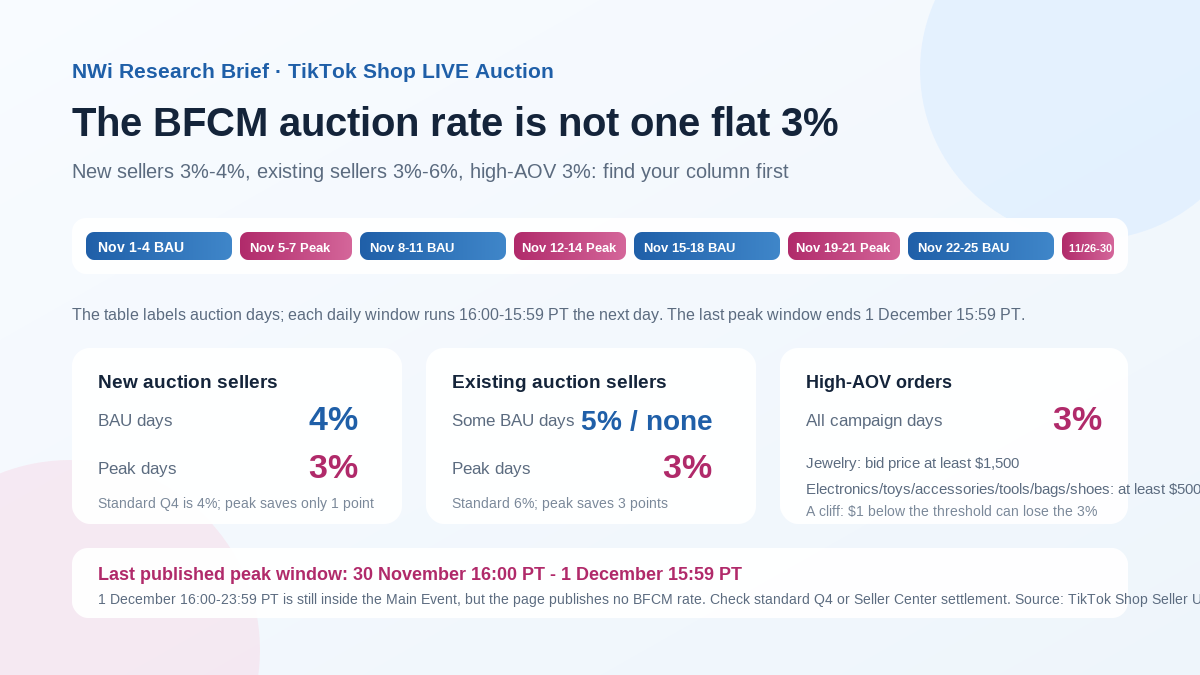
The decision is where to place high-AOV auctions under the BFCM fee table updated on 27 November 2026: a peak day, a BAU day, or after 1 December 3:59 PM PT, and what evidence shows the fee saving is not given back through the clearing price. TikTok Shop Seller University updated its Q4 Seller LIVE Auction fee page on 27 November and added a BFCM table: new auction sellers pay 4% on BAU days and 3% on peak days; existing auction sellers pay 5% or no reduction on some BAU days and 3% on peak days; high-AOV orders pay 3% throughout. But "3%" is not one uniform cut; it is a table split by seller type and date window. The last peak window starts at 16:00 PT on 30 November and ends at 15:59 PT on 1 December. The Main Event runs to 23:59 PT on 1 December, but the page publishes no BFCM rate for the last eight hours. The number to calculate is not "how many points were cut" but "will my clearing price give the cut back".
The article splits "3%" into a seller-type by date-window table, shows that new sellers save only one point while existing sellers save three, and turns the eight-hour gap after 1 December 3:59 PM PT and the high-AOV threshold cliff into scheduling rules.
1. What changed on 27 November: a BFCM table on top of the standard Q4 rates
The page is titled "26Q4 Seller LIVE Auction Referral Fee Reduction Policy" and is marked Updated at 11/27/2026. It now has two fee layers. The first is the standard Q4 policy for 1 October 2026 00:00 through 31 December 2026 23:59 PT: new auction sellers pay 4%, and existing auction sellers pay 3% only on high-AOV orders. The second is the BFCM table for 1 November through 1 December PT, which adds a 5% row and "No reduction" BAU rows for existing sellers, plus a 3% peak-day row for all qualifying orders.
The BFCM table, as published (referral-fee rate, PT dates):
| Type | Period (PT) | New Auction Sellers | Existing Auction Sellers | High-AOV Orders |
|---|---|---|---|---|
| BAU | Nov 1–4 | 4% | No reduction | 3% |
| Peak Days | Nov 5–7 | 3% | 3% | 3% |
| BAU | Nov 8–11 | 4% | 5% | 3% |
| Peak Days | Nov 12–14 | 3% | 3% | 3% |
| BAU | Nov 15–18 | 4% | No reduction | 3% |
| Peak Days | Nov 19–21 | 3% | 3% | 3% |
| BAU | Nov 22–25 | 4% | No reduction | 3% |
| Peak Days | Nov 26–30 | 3% | 3% | 3% |
The AI Summary at the top of the page still gives only the standard Q4 rates: new auction sellers 4%, existing auction sellers 3% on high-AOV orders. It does not mention the BFCM 5%, "No reduction" or peak-day 3% rows. A seller who reads only the summary will assume every qualifying order is at 3% for the whole season; scheduling has to use the table, not the summary.
Separate what is new in BFCM from what already existed in the standard Q4 policy: the 3% high-AOV rate for existing auction sellers is not a 27 November cut; the standard Q4 policy already gives 3% on high-value orders, and the BFCM table repeats that rate on the listed dates; it does not add a second cut. For a new seller, the standard Q4 rate is 4%, so high-AOV 3% is a one-point difference; for an existing seller, the incremental BFCM benefit on a high-AOV order is zero, and the real risk is falling below the threshold and paying 6%.
The page also says that only qualifying $1-start Seller LIVE Auction orders receive the reduction. Regular LIVE orders, non-auction orders, restricted shops and orders that fail platform review pay the standard rate. The discount is applied automatically with no registration, but configuration and system processing can delay it, and the actual effective time shown in the platform prevails. The discount applies only to orders placed after it takes effect and does not support retroactive application or reimbursement; if it fails to take effect because of a configuration delay or system issue, the platform does not cover the difference.
2. Mechanism: the referral fee is charged on the transaction base, not on the list price
TikTok charges the referral fee as the rate times customer payment plus platform discount minus tax; the BFCM table applies only to qualifying $1-start Seller LIVE Auction orders, while non-auction orders keep the standard rate.
TikTok calculates the referral fee as rate x (customer payment + platform discount - tax). Customer-paid shipping is included in the base; a platform-funded discount is added back; a seller-funded discount lowers customer payment and therefore lowers the base. The standard US referral fee is 6%. A cut from 6% to 3% saves three percentage points of the transaction base, not three percent of the list price.
Turning a lower rate into higher contribution requires at least four more numbers: the clearing-price discount against the normal selling price, creator commission, fulfillment and return cost, and whether the auction order is incremental. If the auction merely moves an order that would have sold at the normal price to a peak day, a three-point fee saving with a five-point lower clearing price still leaves contribution negative.
Eligibility has two layers: the shop must be able to run LIVE Auction, and it must fit the fee policy's seller type. The feature guide requires AHR above 150, an account in good standing and no recent serious violations; the fee page adds the last-30-day LIVE GMV thresholds and SPS conditions for new and existing auction sellers. Both layers have to be satisfied, and final order eligibility is still subject to platform review.
High-AOV orders are a separate column. For jewelry, the Bid Price must be at least USD 1,500; for electronics, toys and hobbies, accessories, tools, bags and shoes, it must be at least USD 500. The page says high-AOV orders pay 3% throughout the campaign, including non-peak days. The key word is "Bid Price": the page does not say whether it includes shipping, platform discounts or tax, while the referral-fee base explicitly includes customer-paid shipping. A seller cannot treat "USD 1,500" as the all-in order value without checking.
3. The date window: the table says 26-30 November and the notes say 26 November-1 December, and both can be right
The Key Notes say the daily window is 16:00-15:59 PT, ending at 15:59 the next day, and "Nov 30 extended to Dec 1, 3:59 PM". Put that next to the table labels: "Nov 12–14" covers through 15 November 15:59 PT, which matches the notes' "12-15"; "Nov 19–21" covers through 22 November 15:59 PT, matching "19-22"; "Nov 26–30" covers through 1 December 15:59 PT, matching "26-1 December". The table labels the start date of each 24-hour window; the notes list every calendar date the window touches.
Under that reading, the last published BFCM peak 3% window is 30 November 16:00 PT through 1 December 15:59 PT. The Main Event runs to 1 December 23:59 PT, but the table has no BFCM row for the segment after 15:59 PT. The page publishes no BFCM rate for those eight hours. The only published fallback is the standard Q4 policy: new auction sellers 4%, existing auction sellers 3% on high-AOV orders only, and no reduction for other existing sellers. A seller should not automatically extend "3%" into the evening of 1 December.
The evening uncertainty therefore matters less for high-AOV orders: an existing seller still gets 3% under the standard Q4 policy, and a new seller gets 4%. It matters most for ordinary orders, which can fall from the peak 3% back to the 6% standard. Schedule high-AOV and ordinary orders separately; a single 6% stress case is wrong for every SKU.
This is the easiest part of the update to misread. The headline says "3%-5%", but the table gives existing sellers "No reduction" on some BAU days. The notes say "through 1 December", but the last table row starts on 30 November. Only seller type, window start date and the 16:00-15:59 PT window together produce the correct auction schedule.
4. Who is affected: new sellers save one point, existing sellers save three, high-AOV depends on a threshold
New auction sellers: the standard Q4 rate is 4%, and the BFCM BAU rate is also 4%; the peak rate is 3%. The peak day therefore saves only one percentage point against the standard Q4 rate, not three. The cross-border new-seller category scope is broader than the local list: the page says "Crossborder: All categories", including the local list plus Collectibles, Luxury Resale & Nature. The exact categories and eligibility still need confirmation in Seller Center.
Existing auction sellers: the standard Q4 policy gives 3% only on high-AOV orders and 6% on ordinary orders. The BFCM table gives 5% on 8–11 November, "No reduction" on the other BAU days and 3% on peak days. An ordinary existing-seller order therefore saves three points against the 6% standard on a peak day, one point on 8–11 November, and nothing on the other BAU days. The difference is larger than for new sellers because the existing-seller baseline is 6%, not 4%.
High-AOV orders: jewelry at a Bid Price of at least USD 1,500, and electronics, toys and hobbies, accessories, tools, bags and shoes at a Bid Price of at least USD 500, pay 3% throughout. The threshold is a cliff, not a phase-out: a USD 1,499 jewelry order does not qualify, and an existing seller on a BAU day may pay 6%; at USD 1,500 the rate is 3%. One dollar lower can mean a three-point difference.
For an existing seller this is not a new BFCM three-point cut; it is the standard Q4 high-AOV rate, and the real difference is the jump back to 6% below the threshold. For a new seller, the standard Q4 rate is 4%, so high-AOV 3% is one point.
Outside the scope: regular LIVE orders, non-auction orders, orders that do not start at USD 1, restricted shops and orders that fail platform review. A new seller with at least USD 65,000 of last-30-day LIVE GMV and existing auction GMV is no longer a "New Auction Seller"; an existing seller below USD 65,000 of last-30-day LIVE GMV does not meet the T3-T5 threshold. A seller with an SPS below 3.5 that is not 0 or null does not meet the page's conditions.
5. The arithmetic: four scenarios, starting with whether the fee saving covers the clearing-price give-back
For an existing seller with a USD 200 non-high-AOV item and 100 orders, 6% is USD 12 per order and 3% is USD 6, a USD 600 saving; a clearing price 3% lower (USD 6 per order) gives the entire saving back.
All four scenarios are assumptions, not TikTok, NWi or seller measurements. Amounts are in USD; only the items listed are counted, with no returns, creator commission, ads, payment fees, storage or capital cost. Every clearing price, order count and rate is a labelled assumption.
Scenario A: existing seller, USD 200 non-high-AOV item, 100 orders
Assume a USD 200 clearing price, no platform discount or tax, and customer-paid shipping included in the base; the standard rate is 6% and the peak rate is 3%; returns, creator commission and ads are excluded.
6% x 200 = USD 12 per order; 3% x 200 = USD 6 per order; 100 orders save USD 600; a clearing price 3% lower, or USD 6 per order, gives the entire USD 600 back and leaves net saving at zero.
Run the peak day only if the clearing-price give-back stays below 3%; above 3%, stop or run only when the auction brings incremental new buyers.
Scenario B: new auction seller, USD 500 item, 50 orders
Assume a USD 500 clearing price, no platform discount or tax, and shipping included in the base; the BAU rate is 4% and the peak rate is 3%; returns, creator commission and ads are excluded.
4% x 500 = USD 20 per order; 3% x 500 = USD 15 per order; 50 orders save USD 250; a clearing price 1% lower, or USD 5 per order, gives the USD 250 back and leaves net saving at zero.
For a new seller the peak day is worth only one point; do not cut the clearing price by more than 1% just to wait for a peak day.
Scenario C: high-AOV jewelry, USD 1,500, 10 orders
Assume a clearing price of exactly USD 1,500, no platform discount or tax, and shipping included in the base; high-AOV orders pay 3% and a sub-threshold order from an existing seller pays 6% on a BAU day; returns and commission are excluded.
3% x 1,500 = USD 45 per order, or USD 450 for 10 orders; at USD 1,499 and 6%, 6% x 1,499 = USD 89.94 per order, or USD 899.40 for 10 orders, a difference of USD 449.40.
If the jewelry falls into one of the five fine-jewelry sub-categories taxed at 5%, the 6% case overstates the difference and is a conservative stress test; check the category-level rate table.
This difference is the threshold cliff, not a new BFCM discount; an existing seller's high-AOV order was already at 3%.
Set the reserve at USD 1,500 or above, or stress-test at 6%; do not assume a USD 1,499 clearing price still earns 3%.
Scenario D: 1 December 16:00-23:59 PT, USD 1,500 non-high-AOV, 20 orders
Assume an existing seller's ordinary, non-high-AOV order at a USD 1,500 clearing price, no platform discount or tax, and shipping included in the base; compare a 3% rate with the standard 6% rate; returns and commission are excluded.
3% x 1,500 x 20 = USD 900; 6% x 1,500 x 20 = USD 1,800; the difference between the two bases is USD 900.
Stop ordinary-order scheduling at 1 December 3:59 PM PT; if you must go live in the evening, confirm the rate in Seller Center first, otherwise budget at 6%. Stress-test high-AOV orders separately at the standard Q4 3% for existing sellers or 4% for new sellers.
Read together, the rule is simple: existing sellers save three points on ordinary orders on a peak day, so the clearing-price give-back ceiling is 3%; new sellers save one point, so the ceiling is 1%; the high-AOV 3% is the standard Q4 rate for existing sellers, not a new BFCM cut, and its value is avoiding the 6% rate below the threshold, while for a new seller it is one point below the standard 4%. The evening of 1 December has no published rate, so stress-test ordinary orders at 6% and high-AOV orders at the standard Q4 3% for existing sellers or 4% for new sellers. The fee saving is the numerator and the clearing-price give-back is the denominator; both belong in the same table.
6. Counter-cases: when not to schedule the peak day
Counter-case: an existing seller saves three points on a peak day, but the auction clears 5% below the normal price, so the price give-back is larger than the fee saving and contribution is negative.
Counter-case 1: the auction moves an order that would have sold on a BAU day. Assume a normal price of USD 200 and USD 40 of contribution; the auction clears at USD 194 with USD 34 of contribution; the peak fee saves USD 6 but the price gives back USD 6, so contribution is unchanged. If the auction also adds creator commission or a return, contribution turns negative.
Counter-case 2: the high-AOV order does not cross the threshold. A USD 1,499 jewelry order from an existing seller on a BAU day pays 6%, not 3%; the seller thinks it is running "high-AOV at 3%" while the rate is 6%. Setting the reserve at USD 1,500 may reduce the chance of a sale. The seller has to choose between "possibly unsold" and "sold but three points higher", not assume both.
Counter-case 3: reading only the "3%-5%" headline and missing the "No reduction" BAU days. Existing sellers have no reduction on 1–4, 15–18 and 22–25 November for ordinary orders and still pay 6%; pricing at 3% gives away three points.
Counter-case 4: auction fulfillment and returns cost more than the fee saving. The auction requires shipping the exact won item within two days, charging shipping that reflects actual cost, and handling non-receipt, damage, defect or mismatch claims within 14 days of delivery; auction orders also count toward the Invalid Seller Rejection Rate. Using auctions to clear slow stock can let returns and rejections eat the entire fee saving.
Counter-case 5: system delay or an order that fails review. The page explicitly does not support retroactive compensation; if the discount does not take effect, the platform does not cover the difference. A seller cannot treat "should be 3%" as "already 3%" without checking the settlement statement.
7. Action list and fields to watch
Classify the shop as a new auction seller, an existing auction seller or a high-AOV case, schedule ordinary orders inside the peak window before 1 December 3:59 PM PT, stress-test high-AOV orders at the standard Q4 rate, then check the settlement statement; stop when the clearing-price give-back exceeds the fee saving in points.
Step 1: confirm the shop type, new auction seller or existing auction seller. Check last-30-day Seller LIVE GMV, last-30-day auction GMV, SPS and AHR; do not rely on whether the back office shows a LIVE Auction entry. An entry point does not prove an order will receive the reduction.
Step 2: split the SKUs into ordinary orders, high-AOV candidates and non-auction orders. Check the high-AOV candidate against the category threshold: USD 1,500 for jewelry, USD 500 for electronics, toys and hobbies, accessories, tools, bags and shoes. Confirm whether Bid Price includes shipping and platform discounts; the page does not say.
Step 3: schedule ordinary orders inside the peak window before 1 December 3:59 PM PT. If you plan to go live from 16:00 to 23:59 PT on 1 December, budget ordinary orders at 6% and stress-test high-AOV orders at the standard Q4 3% for existing sellers or 4% for new sellers, then confirm the current rate in Seller Center. Do not infer from "Main Event runs to 23:59" that 3% continues to the last minute.
Step 4: calculate the clearing-price ceiling for each SKU. An existing seller's ordinary order saves three points, so the give-back ceiling is 3%; a new seller saves one point, so the ceiling is 1%; high-AOV is already at 3% under the standard Q4 policy for existing sellers, so its risk is the jump to 6% below the threshold, while a new seller saves one point. Convert the fee saving into dollars per order and compare it with the normal price minus the auction clearing price.
Step 5: after the first orders, check the settlement: how much referral fee was actually deducted, whether the base included shipping, whether the platform discount was added back, and whether 3% applied. Fields to watch: shop type, last-30-day LIVE GMV, last-30-day auction GMV, SPS, AHR, SKU category, Bid Price, whether shipping is included, clearing price, normal price, referral-fee rate, referral-fee amount, creator commission, fulfillment cost, return rate, settlement date and system effective time.
Stop conditions: the clearing-price give-back exceeds the fee saving in points; auction contribution is negative after commission, fulfillment and returns; the settlement statement does not show the expected rate; the account or shop is restricted; the page changes the rate or dates again; or the 1 December evening rate cannot be confirmed in Seller Center. When a trigger fires, pause high-AOV auctions, keep regular LIVE or BAU pricing, and wait for the settlement data before scheduling again.
8. Limitations and unknowns
The official page proves the rate table, date labels and eligibility conditions, but not your clearing price, return rate, creator commission or whether the settlement statement will apply the table exactly.
There is no independent third-party confirmation of the table, the page does not define whether Bid Price includes shipping or platform discounts, no BFCM rate is published for 1 December 16:00-23:59 PT, and actual settlement can be affected by configuration delays.
The core evidence is one official TikTok Shop Seller University page (updated 27 November 2026) plus three supporting official pages. There is no independent third-party confirmation of the BFCM table. The page's AI Summary also omits the 5% and "No reduction" BAU rows, which shows the summary cannot replace the table.
The page does not define whether "Bid Price" includes shipping, platform discount or tax, while the referral-fee base explicitly includes customer-paid shipping; the two definitions can differ near the threshold. The page also does not give the standard rate for every category; this article uses 6% as the US standard rate, and the category-level table remains the authority.
This article has no seller clearing prices, order counts, return rates, creator commission, fulfillment cost or settlement statements; the four scenarios are assumptions, not platform or seller measured results. It also does not verify the actual rate for 1 December 16:00-23:59 PT; that gap can only be confirmed in Seller Center or the settlement statement.
The platform reserves the right to adjust the rate, policy period, eligibility and other terms, and may pause or modify the campaign. Final order eligibility is subject to platform review; restricted shops may not receive the reduction. This article is not financial, tax, legal or operational advice.
Three sentences capture the update: the BFCM 3% is a peak-day rate, not a season-wide rate; an existing seller's ordinary order saves three points on a peak day while a new seller saves one; and the high-AOV 3% is already the standard Q4 rate, so the real risk is falling below the threshold and paying 6%.
9. Method and disclosure
Data basis: on 28 November 2026 this article reopened and read TikTok Shop Seller University's "26Q4 Seller LIVE Auction Referral Fee Reduction Policy" (page marked Updated at 11/27/2026), "TikTok Shop Referral Fee Updates - 2024" (page marked 05/08/2025) and the "LIVE Auction" feature guide (page marked 11/18/2026). The fee table, date labels, eligibility conditions, referral-fee formula and high-AOV thresholds come from those official pages; the page text was retrieved through the current search/reader channel because a direct browser request returned a closed connection, and no login was used. Calculation basis: referral fee = rate x (customer payment + platform discount - tax); the standard US referral fee is 6%. Scenario A: 12 = 6% x 200; 6 = 3% x 200; 600 = (12 - 6) x 100; 6 = 600 / 100 = 200 x 3%. Scenario B: 20 = 4% x 500; 15 = 3% x 500; 250 = (20 - 15) x 50; 5 = 250 / 50 = 500 x 1%. Scenario C: 45 = 3% x 1,500; 450 = 45 x 10; 89.94 = 6% x 1,499; 899.40 = 89.94 x 10; 449.40 = 899.40 - 450. Scenario D: 900 = 3% x 1,500 x 20; 1,800 = 6% x 1,500 x 20; 900 = 1,800 - 900. Every clearing price, order count, return rate, creator commission, ad cost and shipping charge is a labelled assumption, not a TikTok, NWi or seller measurement. Product basis: NWi CrossborderGo covers TikTok Shop US, Southeast Asia and UK sales, units, ASP, creator GMV and price bands on a monthly basis; attribution and refunds need first-party data, and it does not read the seller's auction settlement, referral-fee invoice, real-time stock or LIVE back office. The fee comparison in this article does not depend on NWi product data.
This article was prepared with automated research assistance from the public sources listed at the end and has not been manually reviewed; it does not invent client data, expert review, sales lift, ranking results or platform endorsement. It is not financial, tax, legal or operational advice; questions about auction eligibility, fee application, settlement disputes and account restrictions should be checked against TikTok Shop Seller Center, the current Seller University page and the actual settlement statement.
The article splits "3%" into a seller-type by date-window table, shows that new sellers save only one point while existing sellers save three, and turns the eight-hour gap after 1 December 3:59 PM PT and the high-AOV threshold cliff into scheduling rules.
If you want to put TikTok Shop US category, price-band, brand/store and creator performance into one research workflow, see the TikTok Shop data analysis page and the global overview, industry, brand/store and product research modules in NWi CrossborderGo. For product selection and daily operations, see NWi Operations; for category-specific expert research, see the NWi Cross-border Agent; to connect marketplace data to your own workflow, see MCP data access; and to review your own sites and data scope, book a demo. Available sites, history and fields depend on the account authorization and contract; these products do not read the seller's auction settlement, referral-fee invoice or real-time stock.
Sources: the following pages were reopened and read on 28 November 2026; rates and dates follow the current page text.
- TikTok Shop Seller University, "26Q4 Seller LIVE Auction Referral Fee Reduction Policy", updated 27 November 2026, including the BFCM table, eligibility, the 16:00-15:59 PT daily window and the no-retroactive-compensation note: View source
- TikTok Shop Seller University, "TikTok Shop Referral Fee Updates - 2024", updated 8 May 2025, including the 6% standard referral fee and the rate x (customer payment + platform discount - tax) formula: View source
- TikTok Shop Seller University, "LIVE Auction" feature guide, updated 18 November 2026, including AHR above 150, account standing and seller responsibilities: View source
- TikTok Shop Seller University, "LIVE Auction: Requirements & Guidelines", updated 19 November 2026, including two-day shipping, actual shipping cost, 14-day after-sales claims and the Invalid Seller Rejection Rate: View source