
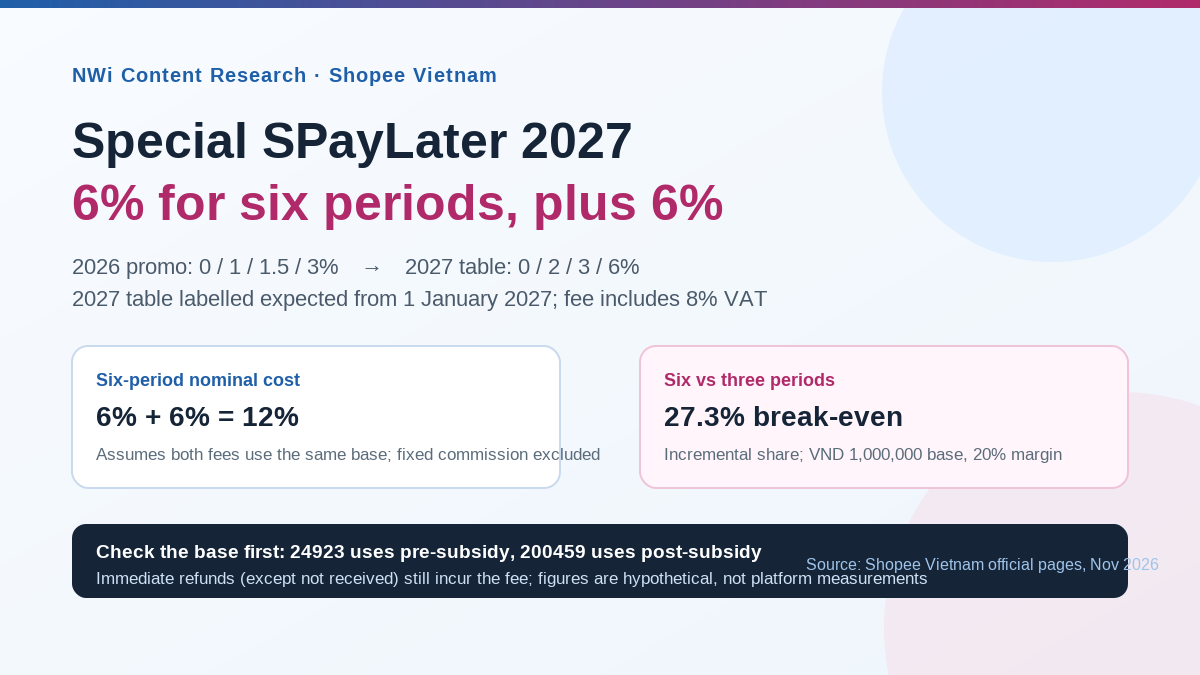
If you run a Shopee Vietnam shop with Special SPayLater (SSPL) enabled, the decision on 1 January 2027 is not whether the fee rose. It is which SKUs still deserve six-period instalments after the six-period SSPL fee rises from 3% to 6% and stacks on top of the 6% transaction processing fee. Shopee Vietnam's Seller University page dated 27 November 2026 lists the 2027 table at 0% for one period, 2% for two, 3% for three and 6% for six, labelled expected from 1 January 2027; the 1 July–31 December 2026 promotional table is still 0/1/1.5/3%. The terms page states that the 2027 table applies from 1 January 2027 and that the fee includes 8% VAT, but the two pages disagree on whether the base is before or after Shopee's subsidy and on the invoice line. This article separates the rate, the additive fee, the base and the refund scope, recalculates the break-even point for six periods in three hypothetical scenarios, and sets out the order for disabling, repricing, testing incrementality and checking the first invoice; it is not marketplace, financial or tax advice.
1. What the 2027 table changes: align the object, date, tax and base first
The real decision is: for a seller already enrolled in SSPL on Shopee Vietnam, which instalment tenors should stay enabled after 1 January 2027, and at what order value and contribution margin does a six-period order stop paying once the 6% SSPL fee is stacked on the 6% transaction processing fee?
The mechanism is that SSPL is charged per order paid with SPayLater according to the buyer's chosen tenor: the fee includes 8% VAT, is deducted per order, and is added to the platform transaction processing fee rather than replacing it; the 2026 promotional table is 0/1/1.5/3% and the 2027 table is 0/2/3/6%.
Start with the object. SSPL is a shop-level, seller opt-in package. Once enabled, eligible products in the shop are covered automatically, and the current page says sellers cannot select participation product by product. Buyers get a 0% instalment conversion fee; sellers pay SSPL by the buyer's chosen tenor. One period is always 0%, and the seller is not charged SSPL when the buyer chooses only one month. That shop-level switch is the key constraint for the action plan: you cannot disable six periods for one low-margin SKU only; you can disable six periods for the whole shop, leave SSPL, or offset the fee through price and bundles.
| Tenor | 1 Jul–31 Dec 2026 promo | 2027 table (24923 labels it expected) | VAT | Nominal total with the 6% transaction fee |
|---|---|---|---|---|
| 1 period | 0% | 0% | 8% included | 6% |
| 2 periods | 1% | 2% | 8% included | 8% |
| 3 periods | 1.5% | 3% | 8% included | 9% |
| 6 periods | 3% | 6% | 8% included | 12% |
The nominal total is the 6% transaction processing fee plus the SSPL rate, assuming both are charged on the same base. The actual invoice base may differ, so 12% is not a fixed deduction rate for every order.
Next, the date. Article 24923 labels 1 January 2027 with “Dự kiến” (expected), while article 200459 says “Áp dụng từ” (applies from) the same day. Both point to 1 January 2027, but one reads as a preview and the other as an operative term. The careful wording is “Shopee has published the 2027 table and the terms say it applies from 1 January 2027”, not “the charge is confirmed to start on 1 January”; the first invoice is the final evidence.
Align tax and triggers as well. The SSPL fee already includes 8% VAT, so do not add VAT again. The fee applies to successfully delivered orders (“Đã giao”) and to return orders where the seller or Shopee accepts an “immediate refund”, except refunds for “goods not received”. The higher the immediate-refund rate, the higher the effective fee on every kept order.
2. The 6% transaction fee and SSPL stack; they are not alternatives
Shopee Vietnam's fee classification page dated 14 May 2026 lists a 6% “Phí Xử Lý Giao Dịch” (transaction processing fee, VAT included). The 6% sits in one merged cell spanning 11 payment methods, and SPayLater is one of them. It is not an SPayLater-only 6%; it is the platform transaction processing fee charged on every listed payment method.
Article 24923 states the addition directly: for an order paid with Special SPayLater, total transaction processing fee = the most recently effective platform transaction processing fee + the SSPL fee for the buyer's tenor. So the nominal six-period cost is 6% + 6% = 12%, not 6%. Treating the 6% SSPL fee and the 6% transaction fee as substitutes understates the cost by half.
The two official pages disagree on the base. Article 24923 uses “product price before Shopee's subsidy + buyer-paid shipping − seller promotions − bank promotions”; article 200459 uses “order value paid with SPL after Shopee's subsidy + buyer-paid shipping − seller promotions − bank promotions”. The pre-subsidy base is higher and therefore more conservative; the scenarios below use it and check the actual base on the first invoice. The pages also disagree on the display line: 24923 says the fee is merged into “Phí xử lý giao dịch”, while 200459 says it appears under “Special SPayLater”.
One credit is easy to misread. Sellers in SSPL can receive Display Service ad credit equal to the SSPL fee on eligible two- or three-period orders placed on Shopee campaign days, capped at 50% of the month's total SSPL fee, valid for 30 days. It is ad credit, not a cash rebate; six-period orders do not qualify, and the 50% cap is not a net fee reduction for six periods.
3. Three scenarios: when six periods stop paying
Scenario A: VND 1,000,000 base, 20% contribution margin, six periods vs three. Assumptions: base VND 1,000,000; contribution margin VND 200,000 (20%); 6% transaction fee = VND 60,000; 2027 SSPL six periods 6% = VND 60,000 and three periods 3% = VND 30,000; both fees use the same base; fixed commission, ads, returns and shipping are excluded. Result: six-period total fees VND 120,000, contribution after fees VND 80,000; three-period total fees VND 90,000, contribution after fees VND 110,000; six periods cost VND 30,000 more, the incremental order contributes VND 80,000 after fees, and the break-even incremental share is 30,000/(80,000+30,000)=27.3%. Decision: keep six periods only if at least 27.3% of six-period orders are incremental, meaning they would not have been placed without the six-period option; otherwise keep three periods and disable six.
| Tenor | SSPL rate | SSPL fee | 6% transaction fee | Total fees | Contribution after fees |
|---|---|---|---|---|---|
| 1 period | 0% | 0 | 60,000 | 60,000 | 140,000 |
| 2 periods | 2% | 20,000 | 60,000 | 80,000 | 120,000 |
| 3 periods | 3% | 30,000 | 60,000 | 90,000 | 110,000 |
| 6 periods | 6% | 60,000 | 60,000 | 120,000 | 80,000 |
Under the same assumptions, the six-period break-even against one period is 60,000/(80,000+60,000)=42.9%. Six periods must generate 42.9% more incremental orders than one period to justify the extra VND 60,000 of SSPL, a much higher bar than the three-point rate difference suggests.
Scenario B: VND 500,000 base, 10% contribution margin, six periods vs one. Assumptions: base VND 500,000; contribution margin VND 50,000 (10%); 6% transaction fee = VND 30,000; 2027 SSPL six periods 6% = VND 30,000 and one period 0%; both fees use the same base; fixed commission, ads, returns and shipping are excluded. Result: six-period total fees VND 60,000 already exceed the VND 50,000 contribution margin, leaving a contribution of -VND 10,000; even if every six-period order is incremental, the unit contribution is negative; one-period total fees are VND 30,000, leaving VND 20,000. Decision: a low-margin SKU should not keep six periods; disable six first, keep one period or leave SSPL, unless price can be raised or the fee passed to buyers without hurting conversion.
| Tenor | Total fees | Contribution after fees |
|---|---|---|
| 1 period | 30,000 | 20,000 |
| 3 periods | 45,000 | 5,000 |
| 6 periods | 60,000 | -10,000 |
Scenario C: VND 1,000,000 base, 20% margin, 10% immediate-refund rate. Assumptions: base VND 1,000,000; six-period SSPL 6% = VND 60,000; 6% transaction fee = VND 60,000; 10% of six-period orders receive an “immediate refund” accepted by the seller or Shopee and not for “goods not received”, so both fees are still charged; the other 90% are kept orders. Result: 100 six-period orders incur 100 x (60,000 + 60,000) = VND 12,000,000 in fees; 90 orders are kept; the fee per kept order is 12,000,000/90 = VND 133,333, or 13.33% of the base; the SSPL share is 6,000,000/90 = VND 66,667 (6.67%). Decision: high-immediate-refund categories should budget with the effective fee per kept order, not the headline 6% or 12%; if the effective rate turns contribution negative, disable six periods and fix the refund reason first.
4. Counter-cases and alternative explanations: six periods can still pay
Counter-case one: a high-margin, low-return category where six periods materially lift conversion can still justify 6%. If the incremental share exceeds 27.3% and the return rate is below 10%, the extra VND 30,000 of SSPL can be covered by incremental contribution; do not disable six periods just because the rate rose.
Counter-case two: if six periods merely move orders that would have used three periods, the seller pays three extra points without incremental volume. The 27.3% break-even line separates “shifted” from “incremental”; without incrementality evidence, do not treat six-period order counts as incremental.
Counter-case three: if the seller adds the fee to the price and competitors do not follow, conversion may fall and the volume loss can exceed the fee saved. Conversely, in a price-insensitive category where six periods clearly lower the buyer's decision barrier, a partial price increase may beat disabling six.
Alternative explanation: a sales drop after the fee change may come from seasonality, ads, price or assortment rather than SSPL. Compare cohorts by tenor, campaign day, order value and refund reason instead of attributing all of the change to the fee.
5. Action order and stop conditions
The action order is: pull 90 days of SPayLater orders, split by tenor, order value, category margin, refund reason and campaign day; recalculate each tenor's contribution with the 6% transaction fee plus the matching SSPL rate; estimate the share of six-period orders that would not exist without the option, using a four-week small-traffic test or a historical switch; then decide whether to disable six, keep it with a price increase, or leave SSPL.
- Data: order ID, order date, tenor, product price, buyer shipping, seller promotion, bank promotion, actual fee, refund reason and whether the refund was immediate.
- Calculation: contribution per tenor = product price + buyer shipping − seller promotion − bank promotion − 6% transaction fee − SSPL for that tenor − fixed commission/other fees; stop at contribution and do not mix in ads or returns yet.
- Incrementality: the six-vs-three break-even share is 30,000/(80,000+30,000)=27.3% under the VND 1,000,000 base and 20% margin assumption; below that, disable six.
- Shop-level constraint: SSPL cannot be exited SKU by SKU; if low-margin SKUs dominate, prefer disabling six or leaving SSPL rather than promising SKU-level exclusion.
- Invoice: on the first invoice after 1 January 2027, check whether the base is pre- or post-subsidy, which line holds the SSPL fee, and whether the 8% VAT is included; if any differs from the assumptions, rerun the scenarios.
- Stop: two consecutive settlement cycles of negative contribution, a rising immediate-refund rate, a first-invoice base above the assumption, or a platform change to the rate/base means stop keeping six and fix returns and pricing first.
If six-period contribution is positive but the incremental share is below 27.3%, the right action is to disable six, not to keep observing. If it is above 27.3%, keep six and review monthly, because the incremental share moves with category, campaign day and competitor pricing.
6. Limitations and unknowns
This article has no seller-level GMV, margin, conversion elasticity, return rate or campaign-day data; the base, margin and refund rate in all three scenarios are labelled assumptions, not Shopee, NWi or any seller's measurement.
The readable primary material is Shopee Vietnam Seller University article 24923, Help Center article 200459 and fee classification article 251; they prove that Shopee published the rates, formula and scope, not that a seller's actual invoice, conversion elasticity or return rate behaves as assumed. The pages disagree on the base (pre- or post-subsidy) and the display line, and their effective-date wording is not identical, so the first invoice must be checked.
Fixed commission, category commission, ads, shipping, tax and other fees are excluded. The 6% transaction fee is the value on the 14 May 2026 page and may change; different categories, seller plans and campaigns may use different rates. The Display Service credit applies only to two- and three-period campaign orders and is ad credit, not cash, so it cannot offset six-period fees. There is no independent third-party audit or seller-invoice sample; an official page's self-description cannot prove the actual deduction.
The original contribution is not repeating that six periods rise to 6%. It puts the 2027 table, the additive 6% transaction fee, the pre-/post-subsidy base conflict, the effective fee after immediate refunds and the 27.3% incremental break-even into one reproducible framework, so a seller can decide whether to disable six, raise price, or first collect incrementality evidence.
To judge which Vietnam categories and price bands are worth keeping six periods for, see Shopee data analysis; to bring site-level data into your team workflow, see NWi CrossborderGo; to check your own shop's fee, refund and margin assumptions, use the demo and contact page. Product capabilities, site coverage and fields depend on the modules and contract actually activated.
7. Method and disclosure
Data basis: on 28 November 2026 this article read Shopee Vietnam Seller University article 24923 (published 27 November 2026), Help Center article 200459 (published 10 September 2026, effective 1 December 2026) and Seller University article 251 (published 14 May 2026). The 2027 table, 2026 promotional table, 8% VAT statement, fee formula, additive transaction-fee formula, refund scope and shop-level limit come from those official pages. Article 24923 rendered in full only with a Googlebot user agent; article 200459 rendered with a browser user agent. Calculation basis: transaction fee = base x 6%; SSPL fee = base x tenor rate; total = transaction fee + SSPL; contribution after fees = assumed contribution margin - total fees; all amounts are VND and use the pre-subsidy base unless stated; scenario A: 60,000 = 1,000,000 x 6%; 20,000 = 1,000,000 x 2%; 30,000 = 1,000,000 x 3%; 60,000 = 1,000,000 x 6%; total 60,000/80,000/90,000/120,000; contribution 140,000/120,000/110,000/80,000; 6-vs-3 break-even 30,000/(80,000+30,000)=27.3%; 6-vs-1 break-even 60,000/(80,000+60,000)=42.9%; scenario B: 30,000 = 500,000 x 6%; 30,000 = 500,000 x 6%; total 60,000; contribution 50,000 - 60,000 = -10,000; one-period total 30,000 and contribution 20,000; scenario C: 100 x 120,000 = 12,000,000; 12,000,000/90 = 133,333; 133,333/1,000,000 = 13.33%; 6,000,000/90 = 66,667 = 6.67%. All bases, margins, order counts and refund rates are labelled assumptions, not Shopee, NWi or seller measurements. Product basis: NWi CrossborderGo covers the Shopee Vietnam site with site-level sales, units, ASP, brand share and price bands, monthly, prior month published on the 10th-15th; it does not provide seller-level SSPL fees, tenor mix, installment conversion uplift or refund reasons, and cannot verify an individual invoice.
This article was prepared with automated research assistance from the public sources listed at the end and has not been manually reviewed; it does not invent client data, expert review, sales lift, ranking results or platform endorsement. It is not marketplace, financial, tax or legal advice; questions about eligibility, fee application, settlement disputes and account restrictions should be checked against Shopee Vietnam Seller Center, the current official pages and the actual invoice.
- Shopee Vietnam Seller University, 27 November 2026, Tổng quan về Gói Dịch vụ Special SPayLater Shopee: 2027 table 0/2/3/6%, 2026 promo 0/1/1.5/3%, 8% VAT, fee formula, additive formula, refund scope, shop-level limit and Display Service credit; read on 28 November 2026.
- Shopee Vietnam Help Center, published 10 September 2026 and effective 1 December 2026, ĐIỀU KHOẢN VÀ ĐIỀU KIỆN GÓI DỊCH VỤ SPECIAL SPAYLATER: 2027 table applies from 1 January 2027, 8% VAT, post-subsidy base, immediate-refund scope, per-order deduction and opt-out; read on 28 November 2026.
- Shopee Vietnam Seller University, 14 May 2026, Một số phí bán hàng trên Shopee Người bán cần nắm rõ: the 6% transaction processing fee (VAT included) covers 11 payment methods including SPayLater and is the baseline added to SSPL; read on 28 November 2026.