
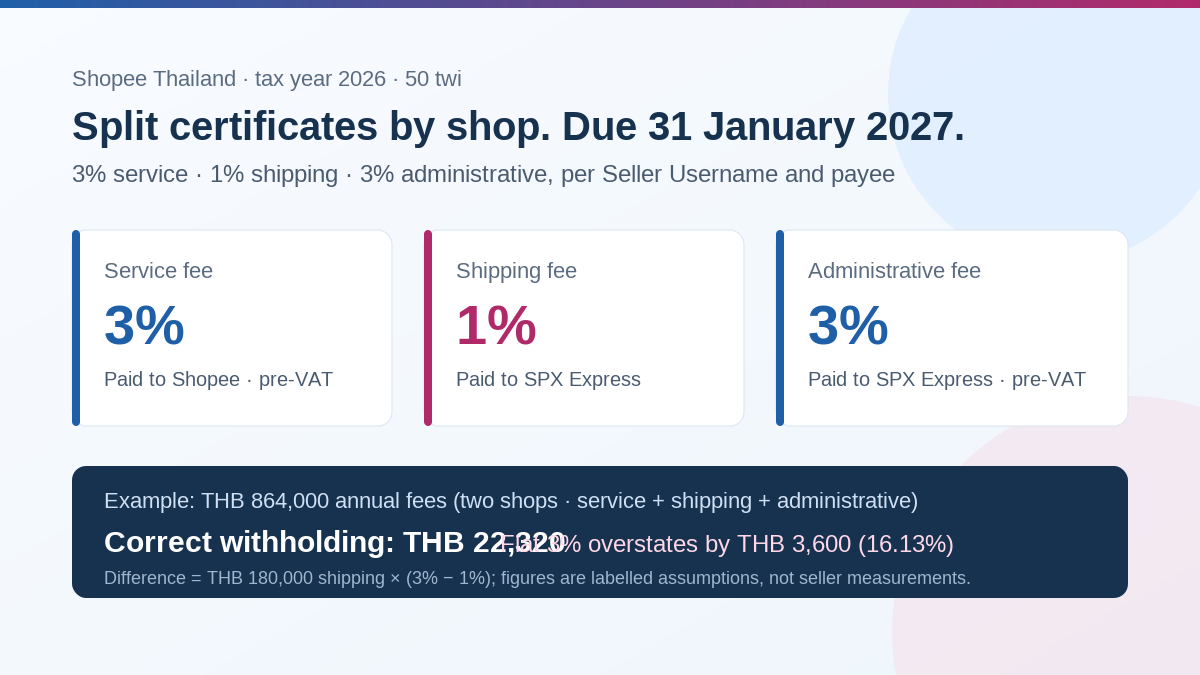
If you sell on Shopee Thailand through a Thai juristic entity, the 2026 50 twi withholding certificates are not paperwork to leave until the platform reminds you; the originals must reach Shopee and SPX Express by 31 January 2027. Shopee Thailand Seller Education Hub's 27 November 2026 page addresses juristic sellers; a separate platform tax guide says individual sellers do not have this withholding duty. Certificates are split by Seller Username and payee, with 3% on the pre-VAT service fee, 1% on shipping and 3% on the pre-VAT administrative fee. This article aligns the scope, dates and edition, then recalculates three hypothetical scenarios and sets out the reconciliation, mailing, Seller Balance check and correction sequence; it is not tax, legal or marketplace-operations advice.
1. Align the scope, dates and edition first: who sends what, and when it must arrive
The real decision is which 2026 50 twi certificates must reach Shopee and SPX Express by 31 January 2027, how to split them by fee type and shop, and which cases do not need a resend.
Start with the person. The page addresses juristic sellers or juristic shops; the platform's 25 October 2024 tax guide draws the line further: a juristic seller that pays service fees and shipping to Shopee/SPX earns Section 40(8) income and has a withholding duty, while an individual seller does not have this withholding duty. The page does not discuss foreign companies or cross-border shops without a Thai juristic entity, so this article does not decide that question for the platform or the Revenue Department; those sellers should have a Thai accountant confirm their actual status.
Then the content. The 2026 notice asks for the originals of all 2026 tax-year certificates (1 January to 31 December 2026, BE 2569), not only the December certificate; the service fee is 3% of the pre-VAT amount, shipping 1% and the administrative fee 3% of the pre-VAT amount. Certificates are split by Seller Username; a certificate that references one receipt must attach the receipt/invoice, and one that references several receipts must attach all receipt numbers. The page also says that a seller who has already sent the originals does not need to resend them.
Then the date. The 2026 edition sets 31 January 2027 (31 January BE 2570) and refers to the date the company receives the documents from the logistics company; after that date the platform reserves the right not to refund. This is not a task that starts on 31 January; it is a deadline by which the documents must arrive.
The edition is the easiest trap in this notice. On 28 November 2026, the bare URL without a language parameter showed the 2025 edition (published 25 November 2025, tax year 2568, deadline 31 January 2026), while the URL with ?lang=th showed the 2026 edition (published 27 November 2026, tax year 2569, deadline 31 January 2027). The two titles are almost identical; only the publication date, tax year and deadline year differ. Reading only '31 January' without the tax year can easily turn 2027 into 2026.
| Edition | Published | Tax year | Deadline | Applies to |
|---|---|---|---|---|
| 2025 edition (bare URL) | 2025-11-25 | 2568 (2025) | 2026-01-31 | 2025 tax-year juristic sellers |
| 2026 edition (?lang=th) | 2026-11-27 | 2569 (2026) | 2027-01-31 | 2026 tax-year juristic sellers |
This table only settles which edition to read; it does not settle whether you must send. That depends on the entity, the fee type and whether the originals have already been sent, which the next section separates.
2. 3%/1%/3% is not one flat rate: split by fee type, shop and payee
The mechanism is that a juristic seller withholds 3% of the pre-VAT service fee paid to Shopee, 1% of the shipping fee and 3% of the pre-VAT administrative fee paid to SPX Express, remits the tax, sends the original 50 twi certificates to the payee, and receives the withheld amount back after the platform checks the documents.
The three rates match three fee types and cannot be replaced by one 3% rate: the service fee paid to Shopee uses 3% of the pre-VAT amount; the shipping fee paid to SPX Express uses 1%; the administrative fee paid to SPX Express uses 3% of the pre-VAT amount. The platform's example images use the same basis: a THB 100 service fee including VAT splits into THB 93.46 before VAT plus THB 6.54 VAT, so the withholding is 93.46 x 3% = THB 2.80; THB 100 of shipping gives 100 x 1% = THB 1.00; a THB 100 administrative fee including VAT also gives THB 2.80.
| Fee type | Payee | Rate | Base | THB 100 example |
|---|---|---|---|---|
| Service fee | Shopee | 3% | Pre-VAT amount | 93.46 x 3% = 2.80 |
| Shipping fee | SPX Express | 1% | Shipping amount | 100 x 1% = 1.00 |
| Administrative fee | SPX Express | 3% | Pre-VAT amount | 93.46 x 3% = 2.80 |
Certificates are also split by shop and payee. The page asks for a separate 50 twi certificate for each Seller Username when a seller has more than one shop or username; the service fee is payable to Shopee while shipping and the administrative fee are payable to SPX Express, so the payees differ and cannot be merged into one certificate. In practice, two shops and two payees can produce four certificates, not one annual total.
The refund is not automatic. After the certificates are complete, correct and received, the platform returns the amount through Seller Balance; shipping and service-fee refunds appear separately, and the platform pays twice a month. If a document is incorrect, the platform sends an email and the seller must resend a new certificate within 30 days after the email date; after the resubmission is approved, the amount is paid in the next payment cycle.
One more date is easy to confuse: the Revenue Department guide requires a 50 twi certificate to be issued each time tax is withheld on Section 40(3)-(8) income, while the platform sets a 30-day or annual deadline for sending the certificate to the platform. Issuing and sending are two actions; do not postpone issuance to the end of the year just because the platform allows a year-end batch.
3. Three scenarios: one shop, two shops with mixed fees, and the wrong edition
Scenario A: one shop, service fees only. Assumptions: Shop A pays a pre-VAT Shopee service fee of THB 30,000 a month, or THB 360,000 for 12 months; there are no shipping or administrative fees; refunds, advertising and exchange rates are excluded. Result: the 3% service-fee withholding is THB 10,800; a single annual certificate states THB 10,800, while 12 monthly certificates state THB 900 each and still total THB 10,800. Decision: prepare this certificate first, because the THB 10,800 recovery is likely to exceed the finance team's preparation cost; reconcile all 12 monthly receipts so no month is missed.
| Item | Amount/calculation | Result |
|---|---|---|
| Annual service fee (pre-VAT) | 30,000 x 12 | THB 360,000 |
| 3% withholding | 360,000 x 3% | THB 10,800 |
| One monthly certificate | 10,800 / 12 | THB 900/month |
Scenario B: two shops with service, shipping and administrative fees. Assumptions: Shop A pays a pre-VAT service fee of THB 30,000, shipping of THB 10,000 and a pre-VAT administrative fee of THB 5,000 a month; Shop B pays THB 20,000, THB 5,000 and THB 2,000 respectively; both are measured over 12 months; refunds, advertising and exchange rates are excluded. Result: Shop A's service fee is 360,000 x 3% = THB 10,800, shipping 120,000 x 1% = THB 1,200 and administrative fee 60,000 x 3% = THB 1,800, for THB 13,800; Shop B's service fee is 240,000 x 3% = THB 7,200, shipping 60,000 x 1% = THB 600 and administrative fee 24,000 x 3% = THB 720, for THB 8,520; the two shops total THB 22,320. Merging both shops into one certificate breaks the per-Seller-Username rule; applying 3% to all THB 864,000 of fees gives THB 25,920, which is THB 3,600 or 16.13% above the correct amount, and the THB 3,600 is exactly the THB 180,000 shipping fee multiplied by (3% - 1%). Decision: split the certificates by shop, payee and fee type: Shop A to Shopee for THB 10,800 and to SPX for THB 3,000; Shop B to Shopee for THB 7,200 and to SPX for THB 1,320; do not merge shops or use a blended 3%.
| Certificate | Fee | Calculation | Amount |
|---|---|---|---|
| Shop A to Shopee | Service fee | 360,000 x 3% | 10,800 |
| Shop A to SPX | Shipping + administrative | 120,000 x 1% + 60,000 x 3% | 3,000 |
| Shop B to Shopee | Service fee | 240,000 x 3% | 7,200 |
| Shop B to SPX | Shipping + administrative | 60,000 x 1% + 24,000 x 3% | 1,320 |
| Total | 22,320 |
In Scenario B the correct amount is 10,800 + 1,200 + 1,800 + 7,200 + 600 + 720 = THB 22,320; a flat 3% gives 864,000 x 3% = THB 25,920, and the THB 3,600 difference is exactly the THB 180,000 shipping fee multiplied by (3% - 1%). Isolating the blended rate: total fees of THB 864,000 at 3% give THB 25,920; the correct amount is THB 22,320; the difference is THB 3,600, and 3,600 / 22,320 = 16.13%. The error is easy to miss in the total because it comes entirely from applying 3% instead of 1% to shipping.
Scenario C: reading the old edition and mistaking 2027 for 2026. Assumptions: on 1 December 2026 the seller opens the bare URL without a language parameter and sees the 2025 edition (published 25 November 2025, tax year 2568, deadline 31 January 2026); the seller does not notice the tax year, assumes the 2026 deadline has passed, or records the deadline as 31 January 2026, and therefore does not prepare the 2026 certificates; the THB 22,320 recoverable amount from Scenario B is the exposure. Result: the 2026 edition (published 27 November 2026, tax year 2569) sets the deadline at 31 January 2027; if the originals arrive after 31 January 2027, the platform reserves the right not to refund, so the THB 22,320 may be lost, equal to 2.58% of the THB 864,000 annual fee base. Decision: always open the current ?lang=th edition, check the publication date and tax year (2569) before the deadline, put 31 January 2027 in the finance calendar and set an internal mailing cutoff of 15 January 2027 to leave time for courier delays and corrections.
4. Counter-cases and evidence boundaries: when not to resend, and what not to assume
The counter-case is that a seller who has already sent the originals does not need to resend, an individual seller has no withholding duty under the platform's tax guide, and a seller who applies 3% to shipping will overstate the recoverable amount.
The first boundary is the 30-day rule. The platform's 2024 tax guide says the certificates must reach Shopee/SPX within 30 days after the month in which they were issued; the 2026 notice says all 2026 certificates must arrive by 31 January 2027. For certificates issued earlier in 2026, the 30-day rule may be earlier than the annual deadline; the page does not say clearly whether the annual notice covers those earlier certificates. The safe approach is: if you have been sending monthly, keep sending monthly; if you want to switch to an annual batch, ask Shopee/SPX in writing to confirm that 31 January 2027 applies to all 2026 certificates, and do not treat the annual deadline as a reason to stop sending during the year.
The second boundary is the mailing information. The 2026 notice gives the deadline, rates, certificate split and receipt requirements but does not put a mailing address in the body, and article 12017's 'here' link points back to article 1143 without an address. Take the address, recipient and courier method from the current Seller Centre, a platform notice, or a mailing instruction confirmed by platform support, not from an old blog or screenshot.
The third boundary is that a refund is not automatic. The platform says it returns the amount through Seller Balance after the certificates are complete, correct and received; an incorrect document triggers an email and must be resubmitted within 30 days after the email; refunds are paid twice a month. Sending is only the first step; the seller must also watch Seller Balance's Adjustment by Shopee and the mailbox.
The readable primary material proves only that Shopee published the 2026 deadline, fee types and certificate requirements, and that the Revenue Department sets the 50 twi form and issuance rules; it does not prove a seller's actual tax position, refund eligibility or that the platform will refund. The platform page is not a Revenue Department ruling, and the Revenue Department guide does not contain the platform's 31 January 2027 deadline; cite them separately.
Another counter-case is 'the amount is too small to bother'. If a shop's annual recoverable amount is only THB 1,000 and the finance and courier cost is higher, it can be deprioritised from a refund perspective; but withholding and issuing the certificate are legal duties, so a small refund does not remove the obligation to issue. Rank by recoverable amount, but do not use 'small' to skip the certificate.
This article has no seller-level fee, certificate, refund or tax data; the monthly fees, shop counts and fee structures in all three scenarios are labelled assumptions, not Shopee, SPX, NWi or seller measurements.
5. Action sequence and stop conditions
The sequence is to confirm the juristic entity and every Seller Username, pull the January-December 2026 service, shipping and administrative fee receipts, classify them by shop and payee, check which certificates have already been sent, and mail the originals by 15 January 2027 while keeping the courier record.
- Now to December: confirm the entity, the shop list and the certificates already sent; classify the January-November receipts by fee type and add December after the month closes.
- First week of January: draft the certificates by Seller Username and payee; attach the receipt for a one-receipt certificate, or all receipt numbers for a multi-receipt certificate.
- By 15 January: mail the originals and keep the tracking number and delivery record; do not wait until 31 January.
- After mailing: check Seller Balance's Adjustment by Shopee twice a month; after an invalid-document email, resend within 30 days.
The stop conditions are equally explicit: do not resend originals that have already been sent; an individual seller does not have this withholding duty; if the platform confirms a different deadline or address in writing, follow that confirmation; if a certificate is rejected, correct the issue named in the email and resend, not the same incorrect document; if the entity, rate or address cannot be confirmed, stop and ask the platform or a Thai accountant instead of guessing.
6. What this means for category and product decisions
The notice is not a demand signal, but it affects cash flow and margin: the recoverable amount is proportional to the fee base, and the fee base is related to a shop's sales, category and price band. For multi-shop, multi-category sellers, first compare which Shopee Thailand categories and price bands have the largest sales on one basis, then prioritise those shops for the fee and certificate review; do not use market data to infer an individual seller's refund, because market data can only help rank the work.
To judge which Thailand categories and price bands are worth reviewing first, see Shopee data analysis; to bring site-level data into your team workflow, see NWi CrossborderGo; for operations tools, see NWi Operations; to check your own shop's fee, certificate and refund assumptions, use the demo and contact page. Product capabilities, site coverage and fields depend on the modules and contract actually activated.
The product boundary also needs to be explicit: NWi CrossborderGo covers the Shopee Thailand site with site-level sales, units, ASP, brand share and price bands, updated monthly with the prior month published on the 10th-15th; it does not provide seller-level withholding tax, certificates, refunds or tax filing, and cannot verify an individual seller's invoice. NWi Operations is an operations tool, not a tax tool; MCP is data access, not a tax-filing channel; the Cross-border Agent performs research and does not replace an accountant.
The contribution is not a repeat of the 31 January deadline but a reproducible reconciliation that combines the 3%/1%/3% fee split, per-shop and per-payee certificates, the THB 3,600 blended-rate error, the 2025/2026 bare-URL version conflict and the 30-day monthly rule in one framework.
7. Method and disclosure
Data basis: on 28 November 2026 this article read Shopee Thailand Seller Education Hub article 1143 (the 2026 edition published 27 November 2026, accessed with ?lang=th), the same article without the language parameter (which showed the 2025 edition published 25 November 2025 on the same day), Seller Education Hub article 12017 (published 25 October 2024), and the Revenue Department's 50 twi guide and form. The 2026 edition gives the 31 January 2027 deadline for all 2026 (BE 2569) certificates, 3% pre-VAT service fee, 1% shipping, 3% pre-VAT administrative fee, per-Seller-Username certificates and receipt attachments. Article 12017 sets out the juristic/individual distinction, the 30-day rule after the month of issuance, twice-monthly refunds through Seller Balance and the 30-day resubmission window after an invalid-document email. The Revenue Department documents set out the 50 twi form, two copies and the Thai/English requirement. Article 1143 rendered in full only with a Googlebot user agent; article 12017 and the 2025 edition were read the same way. Calculation basis: withholding = pre-VAT fee x rate; recoverable amount = certificate amount; scenario A: 30,000 x 12 = 360,000, 360,000 x 3% = 10,800, 10,800 / 12 = 900; scenario B: 360,000 x 3% = 10,800, 120,000 x 1% = 1,200, 60,000 x 3% = 1,800, 240,000 x 3% = 7,200, 60,000 x 1% = 600, 24,000 x 3% = 720, total 22,320; blended 3%: 864,000 x 3% = 25,920, difference 3,600, 3,600 / 22,320 = 16.13%, 3,600 = 180,000 x (3% - 1%); scenario C: 22,320 / 864,000 = 2.58%. All monthly fees, shop counts and fee structures are labelled assumptions, not Shopee, SPX, NWi or seller measurements. Product basis: NWi CrossborderGo covers the Shopee Thailand site with site-level sales, units, ASP, brand share and price bands, monthly, prior month published on the 10th-15th; it does not provide seller-level withholding tax, certificates, refunds or tax filing, and cannot verify an individual seller's invoice.
This article was prepared with automated research assistance from the public sources listed at the end and has not been manually reviewed; it does not invent client data, expert review, refund amounts, ranking results or platform endorsement. It is not tax, legal, financial or marketplace-operations advice; questions about juristic status, withholding rates, certificate format, mailing address, refund eligibility and late submission should be checked against Shopee Thailand Seller Centre, the Revenue Department, a qualified accountant and the actual invoices.
- Shopee Thailand Seller Education Hub, 27 November 2026, การออกหนังสือรับรองการหักภาษี ณ ที่จ่ายให้ Shopee และ SPX Express: all 2026 (BE 2569) 50 twi certificates must reach Shopee/SPX by 31 January 2027; 3% pre-VAT service fee, 1% shipping, 3% pre-VAT administrative fee; certificates per Seller Username; no resend if the originals were already sent; read on 28 November 2026.
- Shopee Thailand Seller Education Hub, 25 October 2024, ภาษีหัก ณ ที่จ่ายสำหรับผู้ขายบนช้อปปี้: juristic sellers have the withholding duty, individual sellers do not; certificates within 30 days after the month of issuance; refunds through Seller Balance twice a month; invalid documents must be resubmitted within 30 days after the email; read on 28 November 2026.
- Revenue Department, Thailand, undated PDF, คำแนะนำในการออกหนังสือรับรองการหักภาษี ณ ที่จ่ายตามมาตรา 50 ทวิ: the 50 twi form, two matching copies, Thai or English, and issuance at the time of withholding for other income; read on 28 November 2026.
- Revenue Department, Thailand, undated PDF, หนังสือรับรองการหักภาษี ณ ที่จ่าย (form): official 50 twi form template; read on 28 November 2026.