
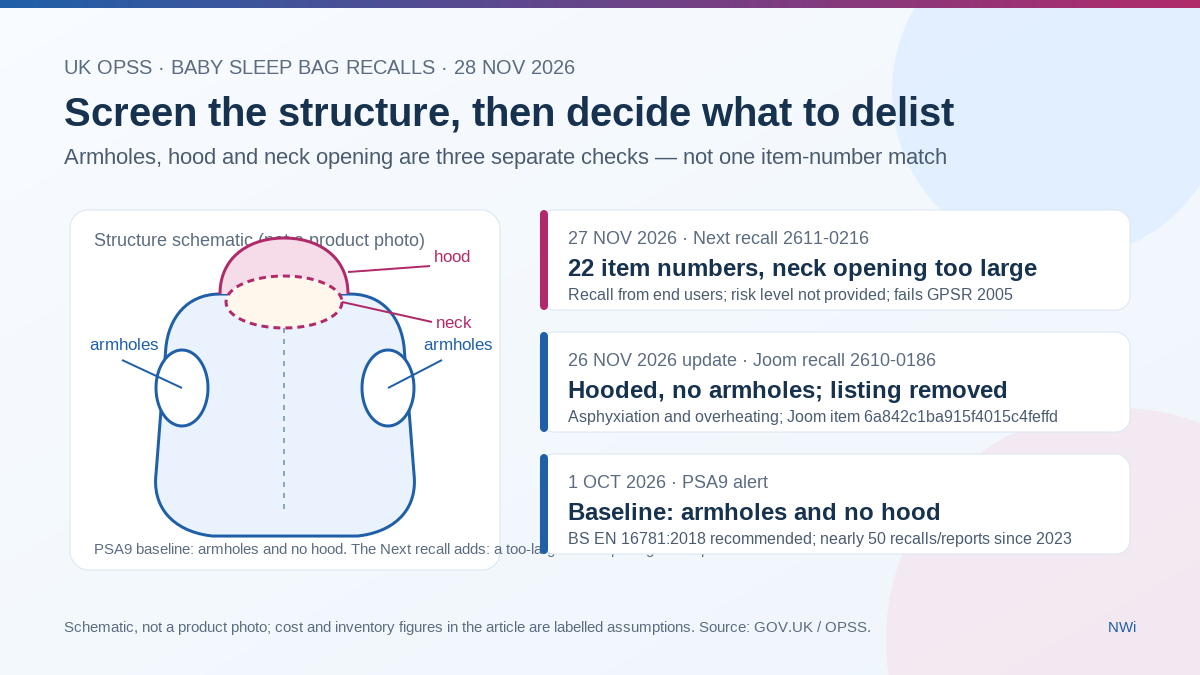
If you sell baby sleep bags in the UK, the decision after 27 November 2026 is not only whether the 22 Next item numbers are in your catalogue. It is whether any SKU in your sleep bag range has a hood, lacks armholes or has a neck opening large enough to let an infant slip inside, and whether you should stop selling it and gather evidence before the platform acts. OPSS published the Next recall that day; PSA9 set the armhole-and-no-hood baseline on 1 October; and the Joom notice shows a marketplace removing a listing. The three notices together form a screening table.
1. Three dates, two risk types and one marketplace action
Start with the facts. On 27 November 2026, OPSS published the Next Baby Sleep Bags recall (PSD 2611-0216), covering 22 item numbers of 2.5 TOG removable-sleeve sleep bags. The hazard is that the neck opening is too large and the infant's head could pass through and slip completely inside the bag, posing a suffocation risk. The risk level is 'not provided'. The corrective action is a recall from end users by Next; OPSS recommends that consumers stop using the product immediately and visit the Next website for returns, refunds or replacements. The notice says the product does not meet the General Product Safety Regulations 2005 (GPSR 2005) and was notified by Local Authority Trading Standards.
The second date is 26 October 2026, when OPSS first published the Joom blue starfish sleeping bag notice (PSD 2610-0186); it was updated to a recall on 26 November 2026. The hazard is asphyxiation and overheating: the product does not incorporate arm openings and/or incorporates a hood, so an infant may slip down inside and excess fabric may cover the nose and mouth. The corrective action is a recall from end users by Joom, and 'the listing has been removed by the online marketplace (Joom)'. The Joom item number is 6a842c1ba915f4015c4feffd, and the notifying body is OPSS.
The third date is 1 October 2026, when OPSS published the Baby Sleeping Bags Product Safety Alert (PSA9). It defines baby sleeping bags as products marketed or intended for unsupervised sleep in a crib or cot, and excludes pram suits, pram muffs and products designed specifically to swaddle. The key safety message is to buy or use only a bag that has armholes and no hood. The background says OPSS has published nearly 50 recalls or product safety reports for dangerous baby sleeping bag products since 2023, and that bags meeting the voluntary standard BS EN 16781:2018 fall outside the alert. For businesses, PSA9 requires compliance with GPSR 2005: products marketed or intended for unsupervised sleep must include armholes and must not contain a hood, and non-compliant products must be removed from sale with corrective action taken. OPSS recommends that retailers and importers consider supplying only bags that meet BS EN 16781:2018.
| Date | Notice | Product | Hazard | Corrective action | What it means for a seller |
|---|---|---|---|---|---|
| 27 Nov 2026 | Next recall 2611-0216 | 22 item numbers of 2.5 TOG removable-sleeve sleep bags | Neck opening too large; head could pass through | Recall from end users by Next | Match the 22 item numbers; the neck opening is a separate risk |
| 26 Nov 2026 update (first published 26 Oct 2026) | Joom recall 2610-0186 | Blue starfish sleeping bag with a hood and no arm openings | Asphyxiation and overheating | Recall by Joom and removal of the listing | A marketplace can remove a listing; do not wait for the notice |
| 1 Oct 2026 | PSA9 alert | Sleep bags for unsupervised sleep | Missing armholes or a hood | Businesses must remove non-compliant products | Baseline: armholes and no hood; test the neck opening separately |
All three notices come from OPSS/GOV.UK, not three independent organisations. They supplement one another on product, hazard and action, but three notices from the same regulator are not three independent verifications. That boundary matters when reading the 'nearly 50 recalls' background.
2. The mechanism: why delisting only the named lines misses similar SKUs
The real decision for a UK seller of baby sleep bags is whether to screen the whole range on three separate checks — armholes, hood and neck opening — before a platform notice, or to delist only the 22 Next item numbers and the Joom listing.
The mechanism is that OPSS treats missing armholes, a hood and a too-large neck opening as structural risks that can let an infant slide inside and have the nose and mouth covered; a marketplace can remove a listing and a retailer can recall, but neither makes every other similar SKU safe.
The three risks are not the same thing. The PSA9 baseline is 'armholes and no hood', aimed at an infant sliding into the bag and a hood covering the nose and mouth. The Next recall is about a neck opening that is too large: even with armholes and no hood, the head could still pass through. Screening only on the PSA9 two points would miss the neck-opening risk; delisting only the 22 Next item numbers would miss the same structural risk in other brands and other item numbers. The Joom case also shows that a marketplace removal can happen, but the notice does not say the marketplace swept the whole category or that other listings were removed with it.
One more reading trap: the Joom listing name includes 'Baby Sleeping Bag', 'Knitted Swaddle Sleep Sack', 'Wearable Blanket' and 'Newborn Photography'. PSA9 says it does not apply to products designed specifically to swaddle, yet OPSS still recalled this hooded, armhole-less product as a baby sleeping bag. The confirmable fact is that OPSS classified it as a baby sleeping bag and recalled it; the notice does not support a rule that writing 'swaddle' or 'photography prop' creates an automatic exemption. For a seller, the judgment turns on the actual structure, the marketed use and the platform category, not one word in the title.
The GPSR 2005 duty is to place only safe products on the market. PSA9 adds that products for unsupervised sleep must have armholes and no hood, and that non-compliant products must be removed from sale with corrective action. That duty does not disappear because a platform has not yet removed a listing. A marketplace removal, a retailer recall and a regulator alert are three different actions; 'the platform has not contacted me' is not evidence of compliance.
3. The evidence boundary: no neck measurement, sales or injury data
The readable notices prove the dates, product descriptions, hazard types and corrective actions, but they do not publish a numeric neck-opening threshold, test method, sales volume, injury data or the full scope of marketplace removals, so 'not named' is not a certificate of compliance.
The Next notice does not say how many centimetres make a neck opening too large, does not publish a test method, the number of units affected or whether anyone was injured, and the risk-level field says 'not provided'. The Joom notice does not say how many listings were removed, whether similar products were swept or how many returns occurred. PSA9 gives no neck measurement; it gives the armhole/no-hood baseline and names BS EN 16781:2018 as a voluntary standard. This article did not read the full text of BS EN 16781:2018, so it cannot supply a 'pass below X cm' number. Sellers should have an accredited laboratory measure the actual SKU under the standard, not reverse-engineer a threshold from this article or the notices.
The 'nearly 50 recalls or product safety reports' line is PSA9's background statement. It shows this is not a single event. It does not prove that your SKU is unsafe, and it does not prove that your SKU is safe. It shows that OPSS treats this product type as a continuing concern, which is a reason to make the structural screen routine rather than waiting for the next recall.
There is also a geographic and channel boundary. PSA9 is a UK OPSS alert for the UK market; it does not automatically create obligations in the EU, the US or other markets. The Next and Joom recalls cover their own products and item numbers. A seller also active in the EU or the US should check the local rules and platform policies separately; this article does not decide those markets.
4. Reproducible test: screen the structure first, then decide which SKUs to test
In scenario A, the structural screen cuts 40 SKUs to 34; of the 10 SKUs without reports, seven can obtain supplier reports and three need testing at £250 each, or £750; avoiding one recall of 300 units at a 35% response rate already costs more than that in refunds, returns handling and unsold stock.
Scenario A: screen the structure first, then test the 10 SKUs without reports
The full assumptions and arithmetic for scenario A are as follows. Assumptions: 40 SKUs; six have a hood or no armholes; 10 have armholes and no hood but lack a per-SKU test report; 24 have reports; each SKU holds 300 units at £9 landed cost; the recall response rate is 35%; each refund is £9 plus £8 returns handling; seven of the 10 can obtain supplier reports within seven days and three need testing at £250 each. Result: the structural screen stops six SKUs; seven wait for reports; three tests cost £750. If one of the three fails and is recalled after sale: of 300 units, assume 180 sold and a 35% response, or 63 returns; refunds and handling are 63 x £17 = £1,071; 120 unsold units at £9 = £1,080; total £2,151. The £750 test bill is below the £2,151 loss from one recall; if all three pass, £750 buys per-SKU evidence for 900 units. Decision: stop the six failing SKUs immediately; test the three; hold the seven as unsellable until reports arrive; do not substitute a sister-colour report.
Scenario B: delist only the 22 Next item numbers and keep selling other similar SKUs
The full assumptions and arithmetic for scenario B are as follows. Assumptions: only two SKUs resemble the named Next lines but sit outside the 22 item numbers; each holds 500 units at £9 landed cost; one has a hood and no armholes, the other has armholes but a large neck opening; each sells 300 units; the recall response rate is 35%; each refund is £9 plus £8 returns handling. Result: the two SKUs total 1,000 units; 400 unsold units at £9 = £3,600; of 600 sold, a 35% response is 210 returns; refunds and handling are 210 x £17 = £3,570; total £7,170, before advertising and ranking losses from a marketplace removal. Decision: an item-number delisting is not enough; treat 'hood or no armholes' and 'large neck opening' as two separate triggers and screen every similar SKU, not only the 22 Next item numbers.
The numbers in both scenarios are assumptions, not Next, Joom, OPSS, NWi or seller measurements. Their purpose is to turn 'screen the structure or wait for the platform' into a comparable cost question: a structural screen is almost free, per-SKU testing costs money, and a recall or removal usually costs more; whether the test bill is worth it depends on stock, price, response rate and how fast reports arrive, so a seller should substitute its own numbers and recalculate.
5. Action order and stop conditions
The action order is to search the catalogue for 'sleep bag', 'sleep sack' and 'wearable blanket', check each SKU for armholes, a hood and the neck opening, match the 22 Next item numbers and the Joom item number, and then request a per-SKU EN 16781 report for every unresolved SKU.
Step one: pull the whole catalogue. Search at least sleep bag, sleep sack, sleeping bag, wearable blanket and swaddle sleep sack, and also screen the platform category 'Baby Sleeping Bags / Childcare articles' so a title-only search does not miss a product. Step two: inspect each SKU's structure: does it have armholes; does it have a hood; does the neck opening look large when laid flat and gently stretched; do removable sleeves, buttons or zips change the opening. Step three: match the item numbers: put the 22 Next item numbers (F25357, F24717, F24440, F75940, Y88412, G24073, V62655, G96530, V73061, G96579, V62659, Y51659, F23852, F24715, F25348, Y39999, V62707, Q53671, Y53637, Y51763, Y51767, Y39990) and the Joom item number 6a842c1ba915f4015c4feffd into a table and check each one; stop any match immediately and follow the Next or Joom return, refund or replacement path. Step four: for SKUs that do not match but remain structurally doubtful, request a per-SKU BS EN 16781:2018 test report and a neck-opening measurement record; if the supplier can only provide a 'same style, different colour' or 'similar model' report, treat it as no report.
Stop conditions: the product is for unsupervised sleep and has no armholes, or has a hood; it matches a Next item number or the Joom item number; the neck measurement or test fails; the supplier cannot provide a per-SKU report within seven days; the report covers a different SKU, colour, size or batch from the one on sale. Any one condition should move the SKU to unsellable; 'wait for the platform notice' is not a reason to keep selling.
Resume conditions: a per-SKU test report with a passing neck-opening test; a structural correction (remove the hood, add armholes, fix the neck opening) with post-correction test evidence; for an affected batch already sold, a completed recall, refund or replacement with a record. Before resuming, keep the report, measurements, supplier declaration, platform communications and recall record in one file so the evidence can be shown to a platform or regulator.
Monitoring: add the OPSS Product Safety Alerts, Reports and Recalls page to a weekly check; watch recalls and PSA updates for similar products; if a platform issues a category screening notice, rerun the check against the item numbers and fields in that notice. Do not watch only Next or Joom: PSA9 already treats this product type as a continuing concern.
6. Counter-cases, alternative explanations and limits
The counter-case is that swaddles, pram suits and pram muffs fall outside PSA9; if a sleep bag has a complete per-SKU BS EN 16781:2018 test report and passes the neck-opening test, it should not be delisted merely because another product in the category was recalled.
Alternative explanation one: the Next recall is a single retailer's product problem and does not mean every 2.5 TOG sleep bag has a neck-opening risk. Alternative explanation two: the Joom removal is a marketplace action on one listing and does not mean the marketplace swept the category. Alternative explanation three: PSA9 is a safety alert, not a ban on all sleep bags, and a compliant bag can still be sold. All three explanations can be true, but they do not change one action: a seller needs its own SKU evidence, not a judgment based on who was or was not named.
This article has no seller SKU list, sales data, test reports or marketplace back-end data, and it did not read the full text of BS EN 16781:2018; the SKU counts, stock, prices, recall response rate and test fees in both scenarios are labelled assumptions. It is not legal, compliance, product-safety or marketplace-operations advice; whether a specific product is compliant should be judged by an accredited laboratory and a legal or compliance adviser against the actual product, market and date.
7. What this means for product selection and data
The lesson for product selection is not that baby sleep bags cannot be sold. It is that a structurally non-compliant sleep bag cannot be sold while a compliant product still can. A seller looking at the UK baby sleep bag category should first size demand, price bands and brand concentration, then use the structural screen to remove high-risk SKUs; do not reject the whole category because of one recall, and do not use category growth to prove that a particular SKU is safe.
NWi CrossborderGo provides Amazon US, Europe and Japan category, brand, store and product data, including sales, units, ASP, brand share and price bands, updated monthly. The UK site sits in the European site group; exact site, history and field access depend on the contract. It can help size the baby sleep bag category, price bands and brand concentration, but it does not provide product-safety testing, recall status, GPSR compliance conclusions or marketplace penalty data. In other words, the data can rank which SKUs to check first; it cannot certify that a SKU is safe.
The contribution is not another 'another sleep bag was recalled' summary: it puts the Next neck-opening risk, the Joom listing removal and the PSA9 armhole/no-hood rule into one screening table, then compares test cost with recall loss to answer whether to screen the structure first or wait for a delisting.
To size the UK baby sleep bag category and price bands first, see NWi CrossborderGo; to break the data down by site, category and brand, use the demo and inquiry page; to read the Amazon platform coverage note, see Amazon data analysis. Product capability, site coverage and fields depend on the modules actually opened and the contract.
8. Method and disclosure
Data basis: on 28 November 2026 this article re-read three OPSS primary notices through GOV.UK: the Next Baby Sleep Bags recall (PSD 2611-0216) published 27 November 2026; the Blue Starfish Shaped Baby Sleeping Bag sold via Joom notice (PSD 2610-0186), first published 26 October 2026 and updated to a recall and marketplace removal on 26 November 2026; and the Baby Sleeping Bags Product Safety Alert (PSA9) published 1 October 2026. Dates, product descriptions, hazard types, corrective actions, the 22 Next item numbers, the Joom item number, the GPSR 2005 reference and the BS EN 16781:2018 reference are recorded from those pages. Calculation basis: scenario A uses 40 SKUs, six structural failures, 10 SKUs without per-SKU reports, seven supplier reports obtainable within seven days, three tests at £250 each, 300 units per SKU at £9 landed cost, 60% sold, a 35% recall response rate and £9 refund plus £8 returns handling per unit; scenario B uses two unnamed but structurally similar SKUs, 500 units each at £9 landed cost, 300 sold each, a 35% response rate and the same £9 refund plus £8 handling. All SKU counts, stock, prices, response rates and test fees are labelled assumptions, not Next, Joom, OPSS, NWi or seller measurements. Product basis: NWi CrossborderGo provides Amazon US, Europe and Japan category, brand, store and product data, including sales, units, ASP, brand share and price bands, updated monthly; the UK site sits in the European site group, with exact site, history and field access by contract; it does not provide product-safety testing, recall status, GPSR compliance conclusions or marketplace penalty data.
This article was prepared with automated research assistance from the public sources listed at the end and has not been manually reviewed; it does not invent client data, expert review, recall volumes, test results, ranking results or platform endorsement. It is not legal, compliance, product-safety or marketplace-operations advice; whether a specific product is compliant, whether its neck opening passes, which test method applies and how far a recall reaches should be checked against the latest OPSS notice, the full BS EN 16781:2018 standard, an accredited test laboratory, the platform rules and the actual product.
- Office for Product Safety and Standards, 27 November 2026, Product Recall: Next Baby Sleep Bags (2611-0216): 22 item numbers of 2.5 TOG removable-sleeve sleep bags; neck opening too large and the infant's head could pass through and slip completely inside; recall from end users by Next; risk level not provided; fails GPSR 2005; read on 28 November 2026.
- Office for Product Safety and Standards, first published 26 October 2026 and updated 26 November 2026, Product Recall: Blue Starfish Shaped Baby Sleeping Bag sold via Joom (2610-0186): hood and/or no arm openings; asphyxiation and overheating risks; Joom recalled from end users and removed the listing; Joom item number 6a842c1ba915f4015c4feffd; fails GPSR 2005; read on 28 November 2026.
- Office for Product Safety and Standards, 1 October 2026, Product Safety Alert: Baby Sleeping Bags (PSA9): sleep bags for unsupervised sleep must have armholes and no hood; excludes pram suits, pram muffs and products designed specifically to swaddle; nearly 50 recalls or product safety reports since 2023; bags meeting BS EN 16781:2018 fall outside the alert; businesses must comply with GPSR 2005; read on 28 November 2026.