
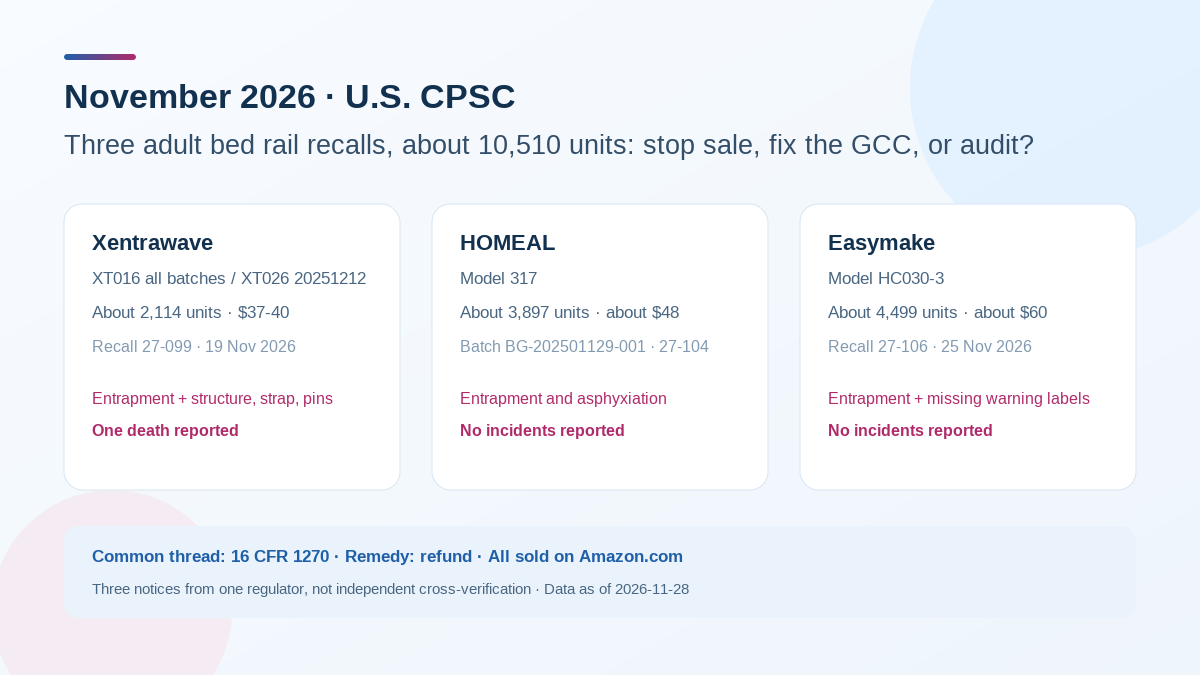
If you sell adult portable bed rails on Amazon US, the decision after 25 November 2026 is not whether CPSC issued another recall. It is whether to stop specific models and batches first, fix the GCC next, or run a full-chain audit. CPSC announced three recalls of Amazon-sold adult bed rails on 19 and 25 November 2026, covering Xentrawave, HOMEAL and Easymake and about 10,510 units. The two 25 November recalls violate 16 CFR 1270; Easymake also lacks the required hazard warning labels, and Xentrawave involves one death. The answer depends on whether the product is in scope of 1270, whether the model and batch match, whether the GCC and test reports are complete, and whether labels and assembly are traceable.
The contribution is to place the three recalls in one model/batch/document/label screen and use reproducible refund-ceiling, response-range and testing-cost arithmetic to show when to stop sale, fix documents or test, rather than repeating a recall headline.
1. What happened on 19 and 25 November: three recalls, four models, about 10,510 units
All three notices were published on CPSC's website, all name Amazon.com as the sales channel, and all offer a refund. Xentrawave recalled the XT016 (all batches) and XT026 (batch 20251212) on 19 November, about 2,114 units sold from May 2025 through August 2026 at $37-40, recall 27-099. CPSC records one death: in 2026, an 89-year-old woman died from asphyxiation after she became entrapped between the bed rail and mattress.
HOMEAL recalled Model 317, batch BG-202501129-001, on 25 November, about 3,897 units sold from December 2025 through October 2026 at about $48, recall 27-104, with no incidents reported. Easymake recalled Model HC030-3 on 25 November, about 4,499 units sold from March through July 2026 at about $60, recall 27-106, with no incidents reported, but the notice states that the rails do not bear the required hazard warning labels.
| Recall date | Brand and model | Batch and identifier | Units | Price | Amazon sales window | Recall number | Hazard and incidents |
|---|---|---|---|---|---|---|---|
| 19 November 2026 | Xentrawave XT016 / XT026 | XT016 all batches; XT026 batch 20251212 | About 2,114 | $37-40 | May 2025-August 2026 | 27-099 | Entrapment and asphyxiation; XT016 also fails structural stability and retention strap requirements, and incorrectly sized push pins pose a laceration hazard; one death |
| 25 November 2026 | HOMEAL Model 317 | Batch BG-202501129-001 | About 3,897 | About $48 | December 2025-October 2026 | 27-104 | Entrapment and asphyxiation; no incidents reported |
| 25 November 2026 | Easymake HC030-3 | Model HC030-3 | About 4,499 | About $60 | March-July 2026 | 27-106 | Entrapment and asphyxiation; missing required hazard warning labels; no incidents reported |
The total is about 10,510 units. That figure adds the 'about' unit counts in the three notices; it is not market sales, a defect rate or the number of units still in use. The notices also give no return rate, seller cost or Amazon handling time. All three require consumers to stop using the product, destroy it and send a photo before a refund, and the destruction steps differ, so one buyer script will not fit all three.
2. Why these are not three isolated events: 16 CFR 1270 splits compliance into several tests
The common thread is 16 CFR 1270: it splits compliance into retention systems, structural integrity, four entrapment zones, openings, misassembly, sharp edges and label warnings, not a single metric. The standard applies to adult portable bed rails manufactured after 21 August 2023, incorporates ASTM F3186-17 with modifications, and CPSC's business guidance describes the four zones as within the rail, between the rail support and mattress, between the rail and mattress, and under the end of the rail and mattress.
The three recalls show three different failure combinations. HOMEAL cites entrapment and asphyxiation only. Easymake adds missing hazard warning labels. Xentrawave's XT016 adds structural stability and retention strap failures, while incorrectly sized push pins and holes create a laceration hazard. For a seller, mechanical testing and label compliance are two separate checks: a test report does not prove the labels are right, and complete labels do not prove the structure is right.
The rule appendix also records CPSC's market testing: one round in 2018-2019 and one in 2021, with no adult portable bed rail meeting all ASTM F3186-17 requirements in either round; every product failed at least one critical mechanical requirement, and every product failed the labeling, warning and instructional requirements. That evidence is from 2018-2021, not a 2026 recall rate, and it does not prove that this year's three recalls represent an industry-wide defect rate. It does show that incomplete compliance in the market is not a new problem.
3. Which sellers are affected: a three-layer model/batch, document and physical-label screen
The affected group is not only the three brands' own stores. If you sell or import adult portable bed rails in the US and the product is in scope of 1270, you may need to check whether your model is the same as, or sourced from the same line as, a recalled model; whether your batch falls in a recalled batch; whether your supplier is the manufacturer or importer named in a notice; whether your GCC and test reports cover 1270; and whether your retail package, instructions and rail carry the required warnings. Children's bed rails fall under 16 CFR 1224, and FDA-regulated hospital bed rails are outside 1270, so do not apply the wrong standard.
Layer 1: model and batch
The identifiers sit in different places, so a warehouse check cannot stop at the outer carton. HOMEAL prints Model 317 and batch BG-202501129-001 on a label on the rail's fabric pouch. Easymake prints 'Brand: easymake' and 'Model: HC030-3' on the packaging and on a white label on the bottom rail. Xentrawave covers all XT016 batches and only XT026 batch 20251212; the brand is on a green label on the grey fabric pouch, the model is on the front of the outer packaging and the first page of the instruction manual, and the batch is on the product label on the back of the pouch and in the manual. Map on-hand, in-transit and live units to the model by ASIN/SKU first, then inspect the physical label location, and only then decide whether to stop sale.
Layer 2: GCC and test file
Adult portable bed rails are subject to a mandatory CPSC safety standard, so the importer must issue a GCC under section 14(a) of the CPSA, and section 2 of the GCC should cite '16 CFR part 1270 - Adult portable bed rails'. Under 16 CFR 1110, the importer is the certifier for imported finished products; the certificate must identify the product, list each applicable rule, name the certifier and records contact, give the manufacture date and place and the test date and place, and carry the certifier's attestation. Imported finished products must also have the certificate data eFiled in ACE at entry, and the records must be kept for at least five years. Check that the model, batch, factory and test report on the GCC match the physical product, not just that a PDF exists.
Layer 3: physical labels and assembly
1270 is not only a mechanical test. The retail package and instructions must include the required warning statements, and at least one installation component must be labeled with the entrapment warning. Retention system components must not be removable without a tool after initial assembly; a misassembled product must look non-functional; and openings, sharp edges and structural integrity are also tested. During inspection, photograph the label, instruction version, retention strap, push pins and openings, and mattress thickness range, and file them with the GCC, test report and purchase batch.
| Observation field | Why it matters | Where to look |
|---|---|---|
| Model, batch, UPC or GTIN | Confirm whether the unit is in a recalled range | Pouch label, bottom rail, outer carton, instructions |
| ASIN and SKU mapping | Connect on-hand, in-transit and live units to the model | Seller central, FBA inventory, purchase orders |
| GCC rule citation | Confirm coverage of 16 CFR 1270 | Section 2 of the GCC |
| Test date and place | Confirm the test covers the current model and batch | GCC item 6, test report |
| Warnings and installation-component label | Confirm the package, instructions and rail are complete | Package, instructions, installation component |
| Retention system and assembly | Confirm tool-required removal and visible misassembly | Physical unit, inspection photos |
| On-hand, in-transit and returns | Estimate refund and stop-sale exposure | Inventory sheet, return records |
4. Three reproducible scenarios: refund ceiling, partial response, testing two models
The numbers below use only the unit counts and prices in the recall notices and the testing-cost estimate in the CPSC rule appendix. Every ratio and quantity not labelled as official is an assumption, not a seller measurement.
Scenario A: refund ceiling if every recalled unit is refunded
Assume every unit in the three recalls is refunded at the stated retail price, with no tax, freight, return handling, destruction or marketplace fees. Xentrawave at 2,114 units and $37-40 each gives a ceiling of $78,218-$84,560; HOMEAL at 3,897 units and $48 gives $187,056; Easymake at 4,499 units and $60 gives $269,940. The three recalls total $535,214 to $541,556; the two 25 November recalls alone total $456,996. Use this only as a gross order-of-magnitude ceiling, not as the seller's actual loss or as a CPSC or Amazon compensation promise.
Scenario B: partial buyer response
Assume a 40% buyer response rate for HOMEAL and 60% for Easymake, refunded at the stated retail price, with no other costs. HOMEAL is 3,897 x 40% x $48 = $74,822.40; Easymake is 4,499 x 60% x $60 = $161,964. The total is $236,786.40, about 51.8% of the $456,996 ceiling for the two recalls. The response rates are assumptions, not notice data; track claims weekly and reserve against a range rather than accruing the full ceiling at the start.
Scenario C: testing two models before the next inbound shipment
Assume both models need full 1270 testing, CPSC's 2023 rule appendix estimate is $42,239 per model in the first year, no retest is needed, and the figure is in 2021 dollars, not inflated to 2026. The two models total $84,478, equal to 18.5% of the $456,996 ceiling for the two 25 November recalls. Allocated over 500 units, that is about $168.96 per unit; over 2,000 units, about $42.24 per unit. Use this only as a budget order of magnitude, not a laboratory quote; actual cost depends on the lab, sample count and any redesign.
5. Actions and stop conditions: today, this week, before the next inbound shipment
Today: send the recalled model, batch and label identifiers to operations, the warehouse and purchasing, and match them to on-hand, in-transit, live and sold orders by ASIN/SKU; stop sale of matched units immediately, follow the recall refund and destruction remedy, and keep buyer messages, photos and refund records. Do not downgrade the task because a notice says no incidents were reported: both 25 November recalls are preventive, and the stated hazard is entrapment and asphyxiation, not a count of incidents that have already happened.
This week: run the three-layer check on every adult portable bed rail SKU. Layer one, model, batch and label location; layer two, GCC, test report, importer and ACE eFile records; layer three, retail package, instructions, installation-component warning, retention system and misassembly. If any layer is missing, mark the SKU as pending documents; do not replace a record with a supplier's verbal assurance.
Before the next inbound shipment: confirm that section 2 of the GCC cites 16 CFR 1270, that the certifier is the correct importer, and that the model, factory, manufacture date and test date on the certificate match the product; confirm the test report covers ASTM F3186-17 and the 1270 modifications; confirm the retail package and instructions carry the required warnings and at least one installation component carries the entrapment warning; confirm the retention system cannot be removed by hand; and confirm records are kept for at least five years. If any of these fails, stop the inbound shipment and test, change supplier or change model first.
Trigger points and stop conditions: re-check when a new CPSC recall appears, when a recalled model or batch matches your inventory, when a supplier changes factory or changes the retention strap or push-pin design, when buyers report entrapment, loosening or cuts, when the GCC or test report is missing, or when the label version does not match the product. Conversely, if a specific batch has a traceable different structure, a different supplier and a complete test report, and the labels and GCC are complete, it can be treated as lower risk and checked further rather than delisted as a whole; if a regulator has already recalled, delisted or otherwise acted on the product, follow the regulatory action rather than treating it as an ordinary batch.
Product scope: NWi CrossborderGo provides global overview, industry analysis, brand and store research, product research and custom-market analysis to help map affected ASINs, brands, stores and live markets; if you need to map affected SKUs to sites and categories, request a demo to discuss the data scope. Available sites, history and fields depend on account authorisation and the contract; it does not read CPSC notices or provide compliance certification, defect rates, recall status or legal advice.
6. Evidence boundary, counter-cases and unknowns
All three recalls come from CPSC, one regulator publishing three notices, not independent cross-verification by three separate bodies. The notices prove the named models, batches, hazard wording and refund remedy, but they do not prove that every unit of the same model is non-compliant, or that all adult bed rails share the same defect rate. The notices give no total sales, defect rate, seller cost, Amazon removal timing or buyer response rate, and this article did not verify the current Amazon US listing status of the three brands.
Counter-case 1: children's bed rails fall under 16 CFR 1224, not 1270, and FDA-regulated hospital bed rails may fall outside 1270. Counter-case 2: a product with a GCC and complete labels can still be recalled for a batch-specific structural or retention failure; a certificate is not immunity. Counter-case 3: if a supplier can provide the test report for the specific batch, a different structural version and traceable label records, the entire consignment need not be delisted. Counter-case 4: 'no incidents reported' does not mean zero risk; it means CPSC had received no incident report at the time of the notice, and one death cannot be used to infer a death rate for all bed rails. Counter-case 5: even a full refund at the stated price is only what the consumer receives; the seller also bears first-leg freight, FBA fees, return handling, destruction and stop-sale losses, so the stated price is not the seller's actual loss.
7. Method and disclosure
Data basis: this article reopened and read the three CPSC recall notices on 28 November 2026 for Xentrawave XT016 and XT026 (recall 27-099, 19 November 2026), HOMEAL Model 317 (27-104, 25 November 2026) and Easymake HC030-3 (27-106, 25 November 2026), together with the CPSC Adult Portable Bed Rails business guidance and 16 CFR part 1270 and part 1110 on eCFR. Models, batches, unit counts, prices, sales windows, hazard wording, incidents and recall numbers come from those pages. The 10,510 units are 2,114 + 3,897 + 4,499. The refund ceilings are 2,114 x $37-40, 3,897 x $48 and 4,499 x $60, totalling $535,214-$541,556; the two 25 November recalls alone total $456,996. Scenario B: $74,822.40 = 3,897 x 40% x $48; $161,964 = 4,499 x 60% x $60; $236,786.40 in total, or 51.8% of $456,996. Scenario C: $84,478 = 2 x $42,239, or 18.5% of $456,996; allocated over 500 and 2,000 units, that is $168.96 and $42.24 per unit. CPSC's $42,239 is a 2021 first-year compliance cost estimate in the 2023 rule appendix, not a laboratory quote; the 40% and 60% response rates and the 500 and 2,000 unit allocations are labelled assumptions, not CPSC, Amazon, NWi or seller measurements.
This article was prepared with automated research assistance and analysed from the public sources listed at the end; it was not manually reviewed. It does not invent customer data, expert review, sales lift, ranking results or platform endorsement. It is not legal, compliance, tax or investment advice; questions about importer duties, product liability, test standards, GCCs or recall status should be referred to a qualified professional.
Sources:
- CPSC recall: HOMEAL adult portable bed rails (27-104)
- CPSC recall: Easymake adult portable bed rails (27-106)
- CPSC recall: Xentrawave adult portable bed rails (27-099)
- CPSC business guidance: Adult Portable Bed Rails
- 16 CFR Part 1270: Safety Standard for Adult Portable Bed Rails
- 16 CFR Part 1110: Certificates of Compliance