
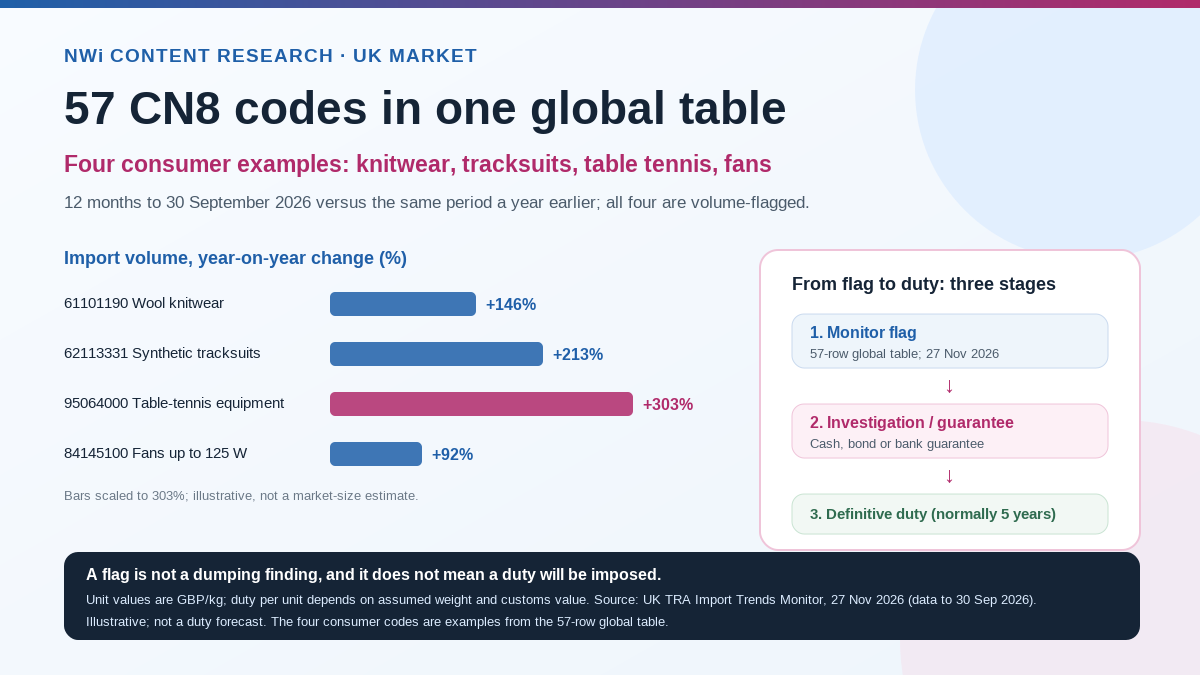
If you import or sell wool knitwear, synthetic tracksuits, table-tennis equipment or electric fans in the UK, the question after 27 November 2026 is not whether the TRA has “flagged” you. It is whether the next purchase order should build a 10–30% assumed duty into landed cost, or wait until the TRA actually opens an investigation or issues a provisional guarantee notice. The TRA’s latest import monitor, published on 27 November 2026 and covering the 12 months to 30 September 2026, places 57 CN8 codes in its global table; the four consumer codes are examples closest to marketplace sellers, not the whole list, and they have not been found to be dumped. The answer is not “raise prices now” or “switch suppliers now”. It is a CN8 map, three duty sensitivities and three action triggers.
1. What was published on 27 November: 57 CN8 codes, four consumer examples
The TRA published UK Import Trends Monitor: Imports up to 30 September 2026 on 27 November 2026. The data cover the 12 months to 30 September 2026 and compare them with the same 12-month period a year earlier. The global table lists 57 CN8 codes flagged for an anomalous increase in import volume, an anomalous decrease in import unit price, or both. The method does not rely on a single year-on-year change: it requires at least a 20% change, a Z-score of at least 2 on the percentage change and a Z-score of at least 2 on the absolute change. All three conditions must be met. That makes the table a screen, not a ruling.
Most of the 57 codes are agricultural, chemical, metal, machinery or other intermediate goods. Four consumer-adjacent examples are useful for marketplace sellers: 61101190, women’s or girls’ jerseys, pullovers, cardigans, waistcoats and similar articles of wool, knitted or crocheted (with exclusions for jerseys and pullovers containing at least 50% wool and weighing at least 600 g, and for wadded waistcoats); 62113331, men’s or boys’ lined tracksuits of manmade fibres with an outer shell of a single identical fabric, not knitted; 95064000, articles and equipment for table tennis; and 84145100, table, floor, wall, window, ceiling or roof fans with a self-contained electric motor of up to 125 W. All four are flagged for an increase in import volume, not for a decrease in unit price. The unit-value falls in the table are context, not the trigger.
The numbers: 61101190 imported 4,761 t, up 146% year on year, at GBP 20.44/kg, down 59%; 62113331 imported 219 t, up 213%, at GBP 28.95/kg, down 22%; 95064000 imported 8,457 t, up 303%, at GBP 1.33/kg, down 64%; 84145100 imported 27,905 t, up 92%, at GBP 5.88/kg, down 17%. These are HMRC customs aggregates, not a seller, an ASIN or a retail price.
Why single out these four codes? They cover products sold by many cross-border sellers on Amazon UK, eBay UK and TikTok Shop UK, and their unit weight, customs value and contribution structures differ sharply. A 20% ad valorem duty on a GBP 8.18 customs-value jumper is not the same burden as the same 20% on a GBP 1.33 table-tennis set. The three scenarios below use them as examples, not as a prediction that the TRA will investigate these four codes.
2. Mechanism: from a monitor flag to a provisional guarantee and a definitive duty
The monitor flags changes in import volume and unit value at CN8 level; UK industry, or a trade association acting on its behalf, can use that signal to apply for a TRA investigation, which then tests dumping, subsidy or a surge, and injury to UK industry.
The TRA guidance says an investigation normally starts on an application from UK industry, or in exceptional circumstances at the request of the Secretary of State. The TRA process may include questionnaires, sampling, verification, hearings, injury assessment and an economic interest test. If it makes a provisional affirmative determination and recommends a provisional measure, importers may be asked for a guarantee in the form of cash, a bond or a bank guarantee.
Provisional anti-dumping measures can run for up to six months, extendable to nine; provisional countervailing measures for up to four months; provisional safeguard measures for up to 200 days. Definitive anti-dumping or countervailing measures normally last five years, and may be shorter. A definitive measure starts the day after the Secretary of State publishes the decision, and duties are also collected for the provisional period.
The form of duty is not limited to an ad valorem rate. The TRA may recommend an ad valorem duty, a specific duty per unit or per kilogram, a minimum import price, a compound duty or a mixed duty. Anti-dumping and countervailing cases also apply the Lesser Duty Rule: the recommended level will not exceed the dumping margin or subsidy amount, or the injury margin, whichever is lower. Do not apply a 20% formula without checking the form, the duty base and the scope.
Several gates sit between a monitor flag and a duty: the TRA must assess the application, injury, causation and economic interest; it will propose terminating a case if the dumping margin is below 2%, if imports are negligible or if injury is negligible; and the Secretary of State may reject a recommendation. The monitor itself says it is not a definitive assessment or conclusive evidence of grounds for an investigation. The robot lawn mower case is a live process example: the TRA began a dumping investigation into robot lawn mowers from China on 18 November 2026, and affected businesses were asked to register by 3 December 2026. That does not mean the four codes in this article will be investigated.
3. Evidence boundary: why a flag is not a dumping finding
The monitor is a screening tool, not a dumping finding; the TRA itself says it does not provide a definitive assessment or conclusive evidence of grounds for a trade-remedy investigation.
The monitor uses HMRC aggregate customs data, not seller invoices, costs, origin or UK industry injury data. It can see volume and value at code level; it cannot see why a particular SKU is cheap. The unit value is GBP/kg, not a per-unit FOB price or a retail price. A single CN8 code can contain high-end and low-end products, and a change in product mix can move the average sharply; the report itself lists product heterogeneity as a limitation. The wool knitwear code, for example, mixes different weights, wool content and processes, so GBP 20.44/kg cannot be treated as the purchase price of one product.
There are three more data limits. First, values are in current prices and are not inflation-adjusted. Second, HMRC data are treated as provisional for 18 months and may be revised. Third, the report uses country of dispatch rather than country of origin because origin data have not been collected consistently far enough back; active investigations look at both origin and dispatch. Transhipment, third-country assembly or a change of container can change the dispatch country without changing the origin analysis.
This article uses only the global table, not the report’s heatmaps by partner country or region, and it did not re-run the underlying HMRC data. The four consumer codes are examples selected from the 57 rows, not a TRA priority list. The robot lawn mower case is a different product, code and date, used only to show the process and timing. All of this means the article can support “build a CN8 map and a duty sensitivity now”; it cannot support “these four codes will be taxed”.
4. Which sellers are exposed: four codes, three kinds of exposure
The real decision is which SKUs and purchase batches should build a 10–30% assumed duty into landed cost now, and which can wait until the TRA opens an investigation or issues a provisional measure.
The first group is UK importers and brand owners. You clear customs in the name of a UK company, or your UK subsidiary or distributor is the importer of record. The duty sits on the customs entry; even if the contract passes the cost to an overseas supplier, cash flow and clearance timing may land on the UK entity first. Confirm who the importer is, who bears the duty and who holds the customs valuation file.
The second group is marketplace sellers and own-brand operators. You sell on Amazon UK, eBay UK or TikTok Shop UK, but the goods enter a UK third-party warehouse or FBA. If duty was paid at import, it may already be in the inbound cost; if you ship direct, duty may be charged on each entry. You need more than a duty rate: you need customs value, contribution and inventory turns for each SKU.
The third group is multi-market sellers. The same jumper may sell in the UK, the EU and the US. A UK measure affects UK imports, but the supplier may reallocate capacity, materials or prices across markets, which can feed back into other markets. EU or US measures can also change supplier quotes. Do not treat the UK monitor as a global duty forecast.
The four codes differ in exposure. Wool knitwear and tracksuits have a higher customs-value-to-contribution ratio, so a 20% ad valorem duty bites harder. Table-tennis sets have a low customs value and a relatively high contribution, so an ad valorem duty is smaller but a specific duty is more painful. Fans sit in between: a 15% duty takes roughly a fifth of contribution, while 20% takes more than a quarter. That ranking is this article’s assumption, not a TRA or HMRC conclusion.
5. The arithmetic: from GBP/kg to per-unit duty sensitivity
The three scenarios below are assumptions, not TRA, HMRC, NWi or seller measurements. The currency is GBP; only the duty line is modelled, not import VAT, freight, warehousing, returns, exchange rates, compliance costs or demand effects. Customs value per unit = GBP/kg unit value × assumed weight per unit; duty per unit = duty rate × customs value per unit; duty as a share of contribution = duty per unit ÷ contribution per unit; absorbed contribution = original contribution minus duty per unit; break-even volume loss for pass-through = duty per unit ÷ contribution per unit. The table adds a fan row as a cross-check; the text expands only Scenarios A, B and C.
Scenario A: wool knitwear, 12,000 units, 20% ad valorem duty
Assume 0.4 kg per unit, GBP 20.44/kg, GBP 8.176 customs value per unit, GBP 6 contribution per unit, 12,000 units a year and a 20% ad valorem duty.
The duty is GBP 1.6352 per unit, or GBP 19,622.40 a year, equal to 27.3% of contribution; absorbed contribution falls to GBP 4.3648, and the break-even volume loss for passing the duty through is 27.3%.
If a GBP 1.64 price increase is expected to cost less than 27.3% of volume, pass-through preserves more contribution than absorbing; if the loss is higher, absorb, press FOB or change supplier.
Scenario B: synthetic tracksuits, 6,000 sets, 20% ad valorem duty
Assume 0.6 kg per set, GBP 28.95/kg, GBP 17.37 customs value per set, GBP 9 contribution per set, 6,000 sets a year and a 20% ad valorem duty.
The duty is GBP 3.474 per set, or GBP 20,844 a year, equal to 38.6% of contribution; absorbed contribution falls to GBP 5.526, and the break-even volume loss is 38.6%.
Tracksuits carry a higher duty-to-contribution ratio, so negotiate FOB and packaging weight before raising price; if the expected volume loss exceeds 38.6%, do not try to pass the whole duty through.
Scenario C: table-tennis sets, 30,000 sets, 20% ad valorem versus GBP 0.50 specific duty
Assume 1 kg per set, GBP 1.33/kg, GBP 1.33 customs value per set, GBP 3 contribution per set, 30,000 sets a year; test a 20% ad valorem duty and a GBP 0.50 specific duty per set.
The 20% ad valorem duty is GBP 0.266 per set, or GBP 7,980 a year, equal to 8.9% of contribution; the GBP 0.50 specific duty is GBP 15,000 a year, equal to 16.7%, so the specific form is heavier at this price point.
Low-customs-value, high-contribution sets are less sensitive to an ad valorem duty but more sensitive to a specific duty; do not apply a 20% formula without checking the form of the measure.
| Scenario | CN8 | Assumed weight | Customs value/unit | Assumed contribution | Assumed duty | Duty/unit | Share of contribution | Break-even volume loss |
|---|---|---|---|---|---|---|---|---|
| A Wool knitwear | 61101190 | 0.4 kg | GBP 8.176 | GBP 6.00 | 20% ad valorem | GBP 1.6352 | 27.3% | 27.3% |
| B Synthetic tracksuits | 62113331 | 0.6 kg | GBP 17.37 | GBP 9.00 | 20% ad valorem | GBP 3.474 | 38.6% | 38.6% |
| C Table-tennis sets | 95064000 | 1 kg | GBP 1.33 | GBP 3.00 | 20% ad valorem | GBP 0.266 | 8.9% | 8.9% |
| C Table-tennis sets | 95064000 | 1 kg | GBP 1.33 | GBP 3.00 | GBP 0.50 specific | GBP 0.50 | 16.7% | 16.7% |
| D Fans | 84145100 | 2 kg | GBP 11.76 | GBP 9.00 | 15% ad valorem | GBP 1.764 | 19.6% | 19.6% |
Scenario A's customs value is 0.4 × 20.44 = GBP 8.176 per unit, the 20% duty is GBP 1.6352 and equals 27.3% of the GBP 6 contribution; Scenario C's customs value is 1 × 1.33 = GBP 1.33, the 20% duty is GBP 0.266 and equals 8.9% of the GBP 3 contribution.
Sensitivity: if the wool duty falls from 20% to 10%, the duty falls from GBP 1.6352 to GBP 0.8176 per unit and from 27.3% to 13.6% of contribution; if the tracksuit duty rises from 20% to 30%, the duty rises from GBP 3.474 to GBP 5.211 and from 38.6% to 57.9% of contribution; if the table-tennis specific duty rises from GBP 0.50 to GBP 1.00, its share rises from 16.7% to 33.3%. The form and the rate matter equally; a single percentage is not enough.
Decision order: first check whether absorbed contribution stays above your internal minimum; if it does not, check whether the volume loss from pass-through is below the break-even point; if neither works, negotiate FOB, reduce packaging weight, change supplier or exit the SKU. Do not set a retail price first and back out the duty, because marketplace commission is charged as a percentage of price, while FBA and advertising costs per unit also move with volume.
6. Counter-cases and alternative explanations: when not to change price
The counter-case is that a flagged code may reflect a one-off shipment, a classification change, a low base or a change in product mix; it is not proof of dumping, and it does not mean a UK industry will apply for an investigation.
A second counter-case is that UK industry may not apply, or the TRA may reject the application. The monitor informs the TRA case pipeline and is shared with other government bodies in a watch-list; it is not an automatic case. Without an application, injury evidence and a positive economic interest test, there may be no measure. A seller should not cancel every order because a code appears in the table.
A third counter-case is that the product may be outside the measure. The TRA can exclude product types and set different rates for exporters, and the final rate may be lower than the headline because of the Lesser Duty Rule. The same code is not enough; read the product description, exclusions and exporter coverage in the measure notice.
A fourth counter-case is that you may not bear the duty in the end. If a UK importer is your customer, the duty may land on the customer first and come back through contract, price or return terms; if the supplier sells DDP, the duty may already be in the quote. Check the Incoterms, the importer of record and the duty clause before deciding who changes price.
A fifth counter-case is that demand elasticity may matter more than the duty. If a price increase loses more volume than the break-even point, absorbing the duty preserves more contribution; if the product is differentiated and repeat-purchase heavy, pass-through may be easier. This article has no elasticity data, so it cannot conclude that either pass-through or absorption is always better.
7. Action list and three triggers
Map every SKU to its CN8 code, calculate the per-unit duty at 10%, 20% and 30% ad valorem and under a specific duty, and set three triggers: TRA initiation, a provisional measure or guarantee notice, and a definitive measure.
Step one: build a CN8 map. Split the SKUs cleared in the UK over the past 12 months by code, product description, unit weight, customs value, country of dispatch, importer and duty paid or unpaid. If a code is missing, ask the customs broker or supplier for a classification view; do not guess from the product name.
Step two: calculate three sensitivities. For each SKU, calculate the per-unit duty at 10%, 20% and 30% ad valorem and at GBP 0.25, GBP 0.50 and GBP 1.00 specific duty, the share of contribution, the absorbed contribution and the break-even volume loss. Put the result in the sourcing decision sheet, not only in a finance spreadsheet.
Step three: set three triggers. TRA initiation: check the product scope, registration deadline and whether to participate. A provisional affirmative determination or guarantee notice: prepare cash, a bond or a bank guarantee, and adjust goods in transit and pricing. A definitive measure: put the rate into landed cost, and assess alternative suppliers, repayment or refund options and inventory treatment. The robot lawn mower registration deadline is 3 December 2026, which shows that the initiation-to-participation window can be about two weeks; that is not the timetable for these four codes, only a reminder to assign an owner for TRA notices.
Step four: prepare alternatives before the trigger. Have at least one alternative supplier, one alternative material or specification and one alternative market; the alternative must pass compliance, quality and lead-time checks, not just be cheaper on a quote. Do not wait for a guarantee notice to look for a second supplier.
Stop conditions: the TRA terminates the case or makes a negative determination; the product is explicitly excluded from the measure; the final rate is below your contribution buffer; an alternative supplier has completed compliance and quality validation; or you decide to exit the SKU or market. If any of these occurs, stop buying for the worst case and return to a normal replenishment rhythm.
Review frequency: with goods in transit or a new SKU, check the TRA public file and HMRC tariff notices monthly; with no new goods, check quarterly. Do not refresh the news every day, and do not treat one monitor flag as a long-term trend.
8. Limitations and unknowns
This article has no seller-level import volume, customs value, origin, UK industry application or case-specific duty rate; the four consumer codes are examples selected from the 57-row table, not a TRA investigation list.
The report is aggregate data; it cannot prove that a particular SKU, brand or store is dumping. This article did not re-run the underlying HMRC OTS data and did not use the report’s country heatmaps; every conversion from GBP/kg to customs value per unit depends on an assumed unit weight. Actual weight, material, packaging, classification and valuation can differ, and the result will change.
The article does not predict the TRA’s conclusion, rate, form of measure or timetable. It does not model import VAT, combined anti-dumping and countervailing duties, quotas, origin rules, repayment or exchange rates. The robot lawn mower case is a different product and is used only to illustrate the process.
The report’s method section contains one wording slip in the unit-price threshold, saying the unit value “has increased by at least 20%” where the heading, results and purpose concern a decrease. This article uses the decrease reading, consistent with the table; the code list and numbers are unaffected. The detail is a reminder to read official reports against their tables and definitions, not a single sentence.
Product boundary: NWi CrossborderGo provides global overview, industry analysis, brand and store analysis, product research and custom market analysis, which can map platform, category, brand and product-level market data; available sites, history and fields depend on account authorization and the contract. It does not read the TRA monitor or provide trade-remedy case status, duty rates, customs classification or legal advice.
9. Method and disclosure
The original contribution is to convert the TRA's GBP/kg unit values into per-unit duty sensitivity and to separate volume flags from price flags, so sellers calculate their contribution buffer before changing prices or suppliers.
Data basis: on 27 November 2026 this research reopened and read the TRA's HTML release, UK Import Trends Monitor: Imports up to 30 September 2026 (published 27 November 2026; data to 30 September 2026), and its GOV.UK publication page. It also read The TRA's investigation process (last updated 21 August 2026), the TRA's 18 November 2026 notice TRA investigates imported robot lawn mowers, and the HMRC UK Trade Info data portal named by the report. The 57 CN8 rows, import volumes, unit values and year-on-year changes come from the HTML table. The four consumer codes 61101190, 62113331, 95064000 and 84145100 are examples, not the full affected list or a TRA priority list. Calculation basis: customs value per unit = GBP/kg unit value × assumed weight per unit; duty per unit = duty rate × customs value per unit; duty as a share of contribution = duty per unit ÷ contribution per unit; absorbed contribution = original contribution − duty per unit; break-even volume loss for pass-through = duty per unit ÷ contribution per unit. Scenario A: 0.4 × 20.44 = GBP 8.176 customs value; 20% duty = GBP 1.6352; 1.6352 ÷ 6 = 27.3%. Scenario B: 0.6 × 28.95 = GBP 17.37; 20% duty = GBP 3.474; 3.474 ÷ 9 = 38.6%. Scenario C: 1 × 1.33 = GBP 1.33; 20% duty = GBP 0.266; 0.266 ÷ 3 = 8.9%; a GBP 0.50 specific duty = 16.7%. Every weight, contribution, duty rate, volume and specific-duty amount is a labelled assumption, not a TRA, HMRC, NWi or seller measurement. Product basis: NWi CrossborderGo provides global overview, industry analysis, brand and store analysis, product research and custom market analysis; available sites, history and fields depend on account authorization and the contract. It does not read the TRA monitor or provide trade-remedy case status, duty rates, customs classification or legal advice.
This article was prepared with automated research assistance from the public sources listed at the end and has not been manually reviewed; it does not invent customer data, expert review, sales lift, ranking results or platform endorsement. It is not legal, trade-remedy, tax or investment advice; consult a customs broker, trade lawyer or other qualified professional on CN8 classification, origin, customs valuation, the form of duty and case participation.
If you need to map UK SKUs, categories, brands and price bands before deciding which products need a duty sensitivity, see NWi CrossborderGo for global overview, industry, brand and store, and product research; available sites, history and fields depend on account authorization and the contract. For a walkthrough against your own sites and data scope, book a demo. If your team wants to put public monitors, platform data and an internal SKU ledger into one research workflow, see the Cross-border AI Agent; its output still needs human review and does not replace a customs broker, trade lawyer or compliance advice.
Sources: all pages below were reopened and checked on 27 November 2026.
- 1. UK Trade Remedies Authority, UK Import Trends Monitor: Imports up to 30 September 2026, published 27 November 2026, data to 30 September 2026; 57-row global table, four consumer rows, method, disclaimer and data limits: read the source
- 2. UK Trade Remedies Authority, The TRA's investigation process, last updated 21 August 2026; initiation, provisional measures, guarantees, duty forms, Lesser Duty Rule, duration and termination thresholds: read the source
- 3. UK Trade Remedies Authority, TRA investigates imported robot lawn mowers, 18 November 2026; process and timing example only, different product, code and date: read the source
- 4. HM Revenue & Customs, UK Trade Info, the Overseas Trade in Goods Statistics portal named by the report; the underlying dataset was not re-run: read the source
- 5. UK Trade Remedies Authority, UK Import Trends Monitor publication page, updated 27 November 2026; monthly update, case pipeline and cross-government watch-list purpose: read the source