
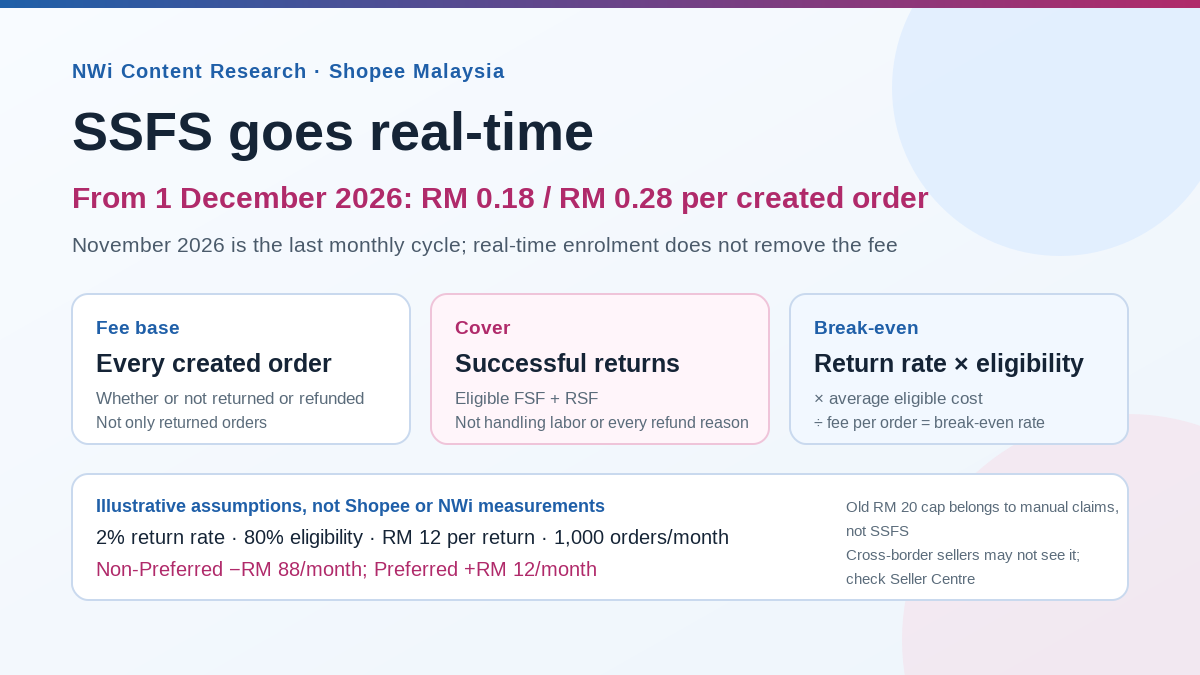
If you run a local Shopee Malaysia shop, the 1 December 2026 switch to real-time SSFS enrolment is not mainly a convenience question. The decision is whether paying RM 0.18 (Preferred) or RM 0.28 (Non-Preferred) on every created order, in exchange for cover limited to eligible FSF and RSF on successful returns and refunds, beats self-insuring the return shipping cost. This article recalculates the break-even in two hypothetical scenarios at 2% and 8% return rates, and flags the page's own conflict between real-time enrolment and next-month effective dates. It is not platform-operations, financial, tax, or legal advice.
1. The December change is enrolment, not the per-order fee
The Shopee Malaysia Seller Education Hub SSFS page (page date 28 July 2026) carries a top announcement: from 1 December 2026, the Seller Shipping Fee Saver Programme moves from monthly enrolment to real-time enrolment. Eligible sellers can opt in or out at any time instead of following a monthly sign-up cycle; November 2026 is the last month under the monthly process. The announcement does not say the fee structure changed or the cover expanded. What changes is when a seller can enter and leave.
The same page's fee table still shows RM 0.18 per order for Preferred sellers and RM 0.28 per order for Non-Preferred sellers. The Preferred Seller page confirms that from 1 April 2026, Preferred sellers pay RM 0.18 per order while regular sellers without Preferred status pay RM 0.28. The rates themselves do not change on 1 December; the time granularity of joining and leaving does.
There is a page conflict to resolve before acting. The top announcement says sellers can opt in or out at any time from 1 December, but the “How do I opt in / out” steps and the FAQ still say the action takes effect on the 1st of the next calendar month, that each run lasts one full calendar month, and that an opt-out must be submitted two days before the next run. Both statements sit on the same page and the page does not say which one governs after 1 December. This is not a wording nit: it determines when December fees and cover start. This article treats it as a field to confirm in Seller Centre or with support, not something to guess.
2. Who is affected: local shops, cross-border sellers, and three return costs
The page describes the audience as “eligible sellers” and lists four reasons a seller may not see the programme: mainly selling digital or non-returnable products, an ongoing shop issue, an account with limited access, and being a cross-border seller. Cross-border sellers should not assume they can join. First confirm whether you have an eligible local shop and whether the Campaign page in Seller Centre shows SSFS. Not seeing the entry does not prove the shop is permanently ineligible, but it also does not mean you can bypass the eligibility check.
For an eligible local seller, SSFS covers the Forward Shipping Fee (FSF, the actual shipping fee) and the Return Shipping Fee (RSF) that the seller bears on successful return/refund orders. The same hub's Return/Refund page states that under the “I want to return item in original/sealed condition” reason, sellers bear FSF and RSF, and that sellers can subscribe to SSFS to save that cost. The page also states that from 1 October 2026, manual reverse-shipping-fee claims for RIOC and ITRR reasons are discontinued; orders created up to 30 September 2026 remain claimable, and the manual claim webform closes on 31 December 2026.
For orders created after 1 October 2026, a seller outside SSFS no longer has the old manual RIOC/ITRR claim route. For these two return reasons, SSFS takes over the old manual-claim route; a seller can still choose not to join and bear the shipping cost. A seller with a low return rate and a low eligibility rate may find the choice uneconomic, while a seller whose returns concentrate in RIOC/ITRR may find it clearly worthwhile. The question is not whether returns exist, but how many of every 100 orders can be claimed and how much each claim is worth.
Separate three return costs. First, the forward shipping fee on a successful return, meaning the actual shipping cost already incurred on the original order. Second, the return shipping fee. Third, returns handling, inspection, restocking, and customer-service time. The SSFS page explicitly covers the first two through FSF and RSF; it does not cover handling labor, every refund reason, or orders using non-Shopee Supported Logistics. The Return/Refund page is explicit that non-SSL orders cannot be claimed. Treating SSFS as full return-cost insurance overstates the cover.
3. The mechanism: the fee covers every created order, the cover follows successful returns
The fee base is the easiest layer to miss. The FAQ says the programme fee applies to all orders created for all sellers enrolled in the programme, regardless of whether an order was returned or refunded. In other words, once an order is created, the fee applies whether or not it is returned and whether or not a claim succeeds. It is not a fee on returned orders and not a fee on approved claims.
The cover runs the other way: it follows only eligible successful returns and refunds. The page says eligible shipping fees are handled automatically, including RIOC and ITRR; the Key Service Benefits section adds that seller-borne FSF and RSF apply to all successful buyer returns or refunds. Two qualifiers matter. “Eligible” means not every return is automatically covered. “Successful” means an unfinished return or refund is outside the cover.
Put the two sides together and the decision formula is straightforward: monthly fee = created orders × fee per order; expected recovery = created orders × return rate × eligibility rate × average eligible shipping cost per return; net = expected recovery − monthly fee; break-even return rate = fee per order ÷ (eligibility rate × average eligible shipping cost per return). Order volume and fee are known. The return rate, eligibility rate, and average eligible cost must come from the seller's own 90-day statement.
The mechanism is asymmetric: the fee is charged on every created order whether or not it is returned, while cover follows only eligible successful returns and refunds, so the decision hinges on the return rate, the eligibility rate, and the average eligible shipping cost per return.
| Variable | Definition | Where to get it | Common error |
|---|---|---|---|
| Created orders | All orders created in the billing period, whether or not returned or refunded | Seller Centre order export by creation date | Counting only shipped or completed orders, understating the fee base |
| Return rate | Successful return/refund orders ÷ created orders | Return/refund records, deduplicated by order | Using return requests instead of successful returns |
| Eligibility rate | Returns meeting SSFS conditions ÷ successful returns | Tag each return by reason, logistics method, and order status | Counting non-SSL and excluded reasons as eligible |
| Average eligible cost | FSF + RSF borne on eligible orders ÷ eligible orders | Shipping statements, return invoices, order details | Counting only RSF and missing the original FSF |
One number is often mixed up. The Return/Refund page has a table showing monthly quotas of 1,000 / 750 / 500 orders for Mall / Preferred / Marketplace sellers and a RM 20 cap limit. That table belongs to the legacy manual-claim route for orders created up to 30 September 2026. It is not the SSFS fee cap and not the SSFS per-order reimbursement cap. The SSFS FAQ says there is currently no fixed cap on the number of savings, while Shopee retains discretion to set limits case by case. Applying the old RM 20 cap to SSFS gets both the fee and the cover wrong.
4. Two scenarios: 2% and 8% return rates
The real decision is whether paying RM 0.18 or RM 0.28 on every created order, in exchange for cover limited to eligible FSF and RSF on successful returns, beats self-insuring the return shipping cost around the 1 December 2026 switch.
The two scenarios below are illustrations. Every number is an assumption, not a Shopee, NWi, or seller measurement. Common assumptions: 1,000 created orders a month; the Non-Preferred fee is RM 0.28 per order and the Preferred fee is RM 0.18 per order; SST, exchange rates, promotion stacking, refund-size differences, and manual handling time are excluded. The per-return eligible cost is FSF + RSF and applies only to eligible successful returns/refunds.
Scenario A: 2% return rate, 80% eligibility, RM 12 average eligible cost
Assumptions: 1,000 created orders a month, a 2% return rate, an 80% eligibility rate, and RM 12 average eligible shipping cost per return; the Non-Preferred fee is RM 0.28 per order and the Preferred fee is RM 0.18 per order.
Result: 20 returns, 16 eligible, RM 192 recovered (16 × 12); the Non-Preferred fee is RM 280 (1,000 × 0.28), a net loss of RM 88; the Preferred fee is RM 180, a net gain of RM 12.
Decision: a Non-Preferred seller should not join on these assumptions; a Preferred seller gains only RM 12 a month, so unless the automated handling saves that much time, verify the eligibility rate and average cost before joining.
Scenario B: 8% return rate, 70% eligibility, RM 15 average eligible cost
Assumptions: 1,000 created orders a month, an 8% return rate, a 70% eligibility rate, and RM 15 average eligible shipping cost per return; the Non-Preferred fee is RM 0.28 per order and the Preferred fee is RM 0.18 per order.
Result: 80 returns, 56 eligible, RM 840 recovered (56 × 15); the Non-Preferred net gain is RM 560 (840 − 280); the Preferred net gain is RM 660 (840 − 180).
Decision: join at either rate; if the seller qualifies for Preferred, join at the Preferred rate, because at 1,000 orders it saves another RM 100 a month and lowers the break-even return rate from 2.67% to 1.71%.
On the stated assumptions, Scenario A nets minus RM 88 at the Non-Preferred rate and plus RM 12 at the Preferred rate; Scenario B nets plus RM 560 at the Non-Preferred rate and plus RM 660 at the Preferred rate.
| Scenario | Return rate | Eligibility | Average eligible cost | Non-Preferred net | Preferred net | Non-Preferred break-even return rate | Preferred break-even return rate |
|---|---|---|---|---|---|---|---|
| A | 2% | 80% | RM 12 | −RM 88 | +RM 12 | 2.92% | 1.88% |
| B | 8% | 70% | RM 15 | +RM 560 | +RM 660 | 2.67% | 1.71% |
| C high volume, low returns | 1.5% | 60% | RM 10 | −RM 950 | −RM 450 | 4.67% | 3.00% |
Scenario C challenges the intuition that volume always justifies joining. At 5,000 orders a month, a 1.5% return rate, a 60% eligibility rate, and RM 10 average eligible cost, recovery is 5,000 × 1.5% × 60% × 10 = RM 450; the Non-Preferred fee is 5,000 × 0.28 = RM 1,400, a net loss of RM 950; the Preferred fee is RM 900, a net loss of RM 450. A larger order base also enlarges the fee base; when the return and eligibility rates are low, joining amplifies the loss.
Sensitivity: in Scenario A, if the average eligible cost is RM 8 rather than RM 12, recovery falls to 16 × 8 = RM 128, the Non-Preferred net loss is RM 152, and the Preferred net loss is RM 52; at RM 16, recovery rises to RM 256, the Non-Preferred net loss narrows to RM 24, and the Preferred net gain is RM 76. In Scenario B, at RM 8 the Non-Preferred net gain is still RM 168 and the Preferred net gain is RM 268; at RM 20 they are RM 840 and RM 940. The lower the average eligible cost, the less attractive the programme; the higher it is, the more attractive.
| Average eligible cost | Scenario A Non-Preferred net | Scenario A Preferred net | Scenario B Non-Preferred net | Scenario B Preferred net |
|---|---|---|---|---|
| RM 8 | −RM 152 | −RM 52 | +RM 168 | +RM 268 |
| RM 12 / RM 15 | −RM 88 | +RM 12 | +RM 560 | +RM 660 |
| RM 16 / RM 20 | −RM 24 | +RM 76 | +RM 840 | +RM 940 |
Read the table in two steps: locate your average eligible cost, then compare your return rate with the break-even line. Do not stop at “RM 0.28 is cheap” and do not assume an 8% return rate automatically justifies joining. The fee uses all created orders; the cover uses eligible returns. The denominators are different.
5. Counter-cases: the free first month, the old RM 20 cap, low returns, and high AOV
The counter-case is a seller with a 2% return rate, an 80% eligibility rate, and RM 12 average eligible cost: at RM 0.28 the seller pays RM 280 a month but recovers only RM 192, a net loss of RM 88, so real-time enrolment does not mean joining is rational.
Counter-case one: treating the free first month as a permanent benefit. The SSFS page still advertises a one-month no-cost period before deciding whether to continue, but this round found no explanation of how that period interacts with the December real-time switch. This article calculates the ongoing fee from month two and does not count the free period as a long-term gain. If the free period does apply, the first-month decision is easier, but month two returns to the same formula. Confirm the start date and eligibility in Seller Centre before joining.
Counter-case two: treating the old RM 20 limit as the SSFS limit. The RM 20 cap and the 500/750/1,000-order quotas on the Return/Refund page belong to the manual-claim route for orders created up to 30 September 2026. The SSFS FAQ says there is currently no fixed cap on the number of savings, while Shopee retains discretion. Mixing the two mechanisms produces false conclusions such as “SSFS pays at most RM 20 per order” or “SSFS covers at most 500 orders a month.”
Counter-case three: assuming a low return rate always means do not join. A low return rate does reduce recovery, but if the average eligible cost is high (high AOV, expensive cross-border leg, a required logistics channel), a small number of returns can still cover the fee. Conversely, a high return rate with a low eligibility rate (many non-SSL orders, excluded reasons, unfinished returns) may not pay. Judge the product of return rate × eligibility rate × average eligible cost, not the return rate alone.
Counter-case four: assuming a high AOV always justifies joining. A higher AOV usually means higher FSF and RSF, which increases the claim value, but it can also bring higher handling cost and a longer cash cycle. SSFS covers FSF and RSF only; it does not cover inspection, restocking, customer service, or the sales lost to a return. Treating the SSFS net gain as the saving on total return cost overstates it.
Counter-case five: assuming every cross-border seller can join. The page lists cross-border sellers among the groups that may not see SSFS. A seller with only a cross-border shop should not put SSFS into the December cost budget unless it has confirmed an eligible local shop and the Seller Centre entry. The audience for this article is local shops, not every seller shipping to Malaysia.
Counter-case six: ignoring the value of automated handling. One real benefit is avoiding manual claim administration. If the cash net is near zero (for example, the Preferred case in Scenario A at plus RM 12), saved administrative time may be the main reason to join. But time value must not be double-counted as cash savings, and it must not hide a negative cash net. Calculate the cash account first, then decide whether time savings make a near-zero case worthwhile.
6. Evidence boundary: what the official pages do and do not say
The official pages prove the 1 December 2026 real-time switch, the RM 0.18 and RM 0.28 rates, the all-orders charging base, and the FSF/RSF scope, but they do not prove the exact hour of the switch, whether the free first month applies, any per-order cap, or seller-level savings.
Here is the confirmed list: the real-time switch from 1 December 2026; that November 2026 is the last monthly cycle; the RM 0.18 Preferred and RM 0.28 Non-Preferred rates; that the fee applies to all created orders regardless of return or refund; that cover includes eligible FSF and RSF, including RIOC and ITRR; that cross-border sellers may not see the programme; and that manual RIOC/ITRR claims stopped from 1 October 2026, with orders created up to 30 September 2026 still claimable and the manual webform closing on 31 December 2026.
The official pages do not prove the exact hour of the 1 December switch; whether a 1 December opt-in or opt-out immediately affects December fees and cover; whether the free first month applies to December real-time joiners; whether there is a per-order reimbursement cap; whether canceled or unshipped orders are charged; whether the programme fee carries SST; seller-level return rates, eligibility rates, or actual savings; or claim-review times and rejection reasons. This article does not fill those gaps with numbers.
The page's own conflict between “real-time” and “next-month effective” needs separate treatment. The top announcement describes real-time enrolment from 1 December; the steps and FAQ still describe next-month effectiveness and one-month runs. The two may apply to the old and new processes respectively, but the page does not say so. A seller joining or leaving around 1 December should save a screenshot of the Seller Centre confirmation, the effective date, and the fee start date. If support gives a different answer, follow the actual Seller Centre status and record the difference.
All three sources are official Shopee Malaysia seller-education pages, not three independent organizations. They corroborate the rates, fee base, and FSF/RSF scope, but they do not provide third-party verification independent of Shopee. This article uses no competitor data, third-party estimates, or anonymous seller sample; every scenario number is an assumption and should be replaced with the reader's own statement.
7. Action list: fields to pull, the 30-day check, and stop conditions
Before 1 December, confirm the shop's eligibility, pull 90 days of created orders, successful returns/refunds, RIOC/ITRR reasons, FSF/RSF charges, and non-SSL orders, calculate the return rate, eligibility rate, and average eligible cost, then decide with the formula and verify against the first 30-day statement.
Step one: confirm eligibility. Log in to Seller Centre and check Campaign or Seller Programmes for SSFS. Confirm whether the shop is local or cross-border, whether the account has full access, and whether the shop has an open issue. If the entry is missing, ask support whether it is an eligibility issue; do not use another seller's invitation link or screenshot as a substitute for your own eligibility.
Step two: pull 90 days of data. Export at least: orders by creation date; successful return/refund orders and reasons; RIOC, ITRR, and other return reasons separately; FSF and RSF on each return; orders using non-SSL; returns that were not completed; and the actual shipping cost on each eligible order. From these, calculate four numbers: return rate, eligibility rate, average eligible cost, and monthly created orders.
Step three: apply the formula. Non-Preferred: monthly fee = orders × 0.28; Preferred: monthly fee = orders × 0.18; expected recovery = orders × return rate × eligibility rate × average eligible cost; net = recovery − fee. Compare the actual return rate with the break-even rate. Join if the actual rate is above the line; hold if it is below. If the net is near zero, list the administrative time saved separately and do not mix it into the cash account.
Step four: handle the December timing. To leave for December under the old monthly rule, submit the opt-out two days before the next run, which means by 29 November; do not wait until 1 December unless Seller Centre explicitly says real-time opt-out takes effect immediately. To join for December, confirm in Seller Centre whether fees and cover start that day or on 1 January; if they start on 1 January, treat December as self-insured. Keep a screenshot of every action.
Step five: verify with the first 30-day statement. After joining, check four fields: whether the programme fee is charged on every created order; whether eligible FSF/RSF are automatically offset; whether non-SSL, excluded reasons, and unfinished returns are excluded; and whether the net is close to the pre-join calculation. If the net is negative for two consecutive months or the eligibility rate is well below the assumption, reassess and leave if necessary.
Stop conditions: the actual net is negative for two consecutive months; the eligibility rate is below the break-even level; the average eligible cost is materially below the estimate; the programme fee or cover changes; Seller Centre cannot confirm the December effective time; or the shop's eligibility changes (for example, it becomes a cross-border shop or is removed from the programme). If any applies, stop and recheck rather than paying because you already joined.
If you need to put Shopee Malaysia category, price-band, and brand/store/product structure into one table, see [Shopee data analysis](/platforms/shopee/) and [NWi CrossborderGo](/product/). If you are reviewing product selection and operations, see [NWi Operations](/products/zhiying/). For a custom category study, talk to us through the [Cross-border Agent](/page/agent.html) or [book a demo](/demo/). Product capabilities depend on the contract and the access actually granted.
8. Limitations and original contribution
This article has no seller-level return rate, eligibility rate, FSF/RSF statement, per-order cap, SST treatment, or exact switch time; every scenario number is an assumption and cannot replace the seller's own statement and Seller Centre confirmation.
Additional caveats: the three pages are all official Shopee documents rather than independent third-party verification; the free-first-month interaction with December real-time enrolment is not explained; and the page's internal conflict between real-time and next-month effectiveness remains unresolved. Readers cannot treat the modeled net as their actual result.
The original contribution is to separate the all-created-orders fee from the return-only cover, give a reproducible break-even formula, show that the old RM 20 cap belongs to the legacy manual-claim route rather than SSFS, and flag the page's real-time-versus-next-month timing conflict.
In practice, the article gives four reproducible formulas for monthly fee, expected recovery, net, and break-even return rate; uses 2%, 8%, and 1.5% return scenarios to show how volume, return rate, eligibility, and average cost interact; distinguishes the old RM 20 manual-claim cap from SSFS; and turns the timing conflict into an action item to verify before 1 December.
If you remember one sentence: the SSFS fee is charged on every created order, while cover follows only eligible successful returns; calculate return rate × eligibility rate × average eligible cost from 90 days of your own statement before deciding whether to join or self-insure on 1 December. Real-time enrolment gives the choice back to you; it does not make the choice for you.
Data basis: the Shopee Malaysia Seller Education Hub SSFS page dated 28 July 2026 was read in full; it states that real-time enrolment starts on 1 December 2026, that November 2026 is the last monthly cycle, that Preferred sellers pay RM 0.18 per order and Non-Preferred sellers pay RM 0.28, and that the fee applies to all orders created for enrolled sellers. The same hub's Return/Refund page dated 25 December 2025 states that sellers bear FSF and RSF, that manual RIOC/ITRR claims stopped from 1 October 2026, and that orders created up to 30 September 2026 remain claimable; the Preferred Seller page confirms the RM 0.18 and RM 0.28 relationship. Calculation basis: monthly fee = created orders × fee per order; expected recovery = created orders × return rate × eligibility rate × average eligible shipping cost per return; net = expected recovery − monthly fee; break-even return rate = fee per order ÷ (eligibility rate × average eligible shipping cost per return). Every order volume, return rate, eligibility rate, average shipping cost, and fee scenario is a labeled assumption, not a Shopee, NWi, or seller measurement. Product basis: NWi CrossborderGo covers Shopee Malaysia market, category, brand/store, product, and price-band data; sites, history, and fields depend on the contract, and it does not provide order-level return rates, SSFS billing, return-shipping invoices, or Seller Centre eligibility status.
This article was prepared with automated research assistance from the public sources listed at the end and has not been manually reviewed; it does not invent customer data, expert review, platform penalties, search rankings, or official endorsement. It is not platform-operations, financial, tax, or legal advice.